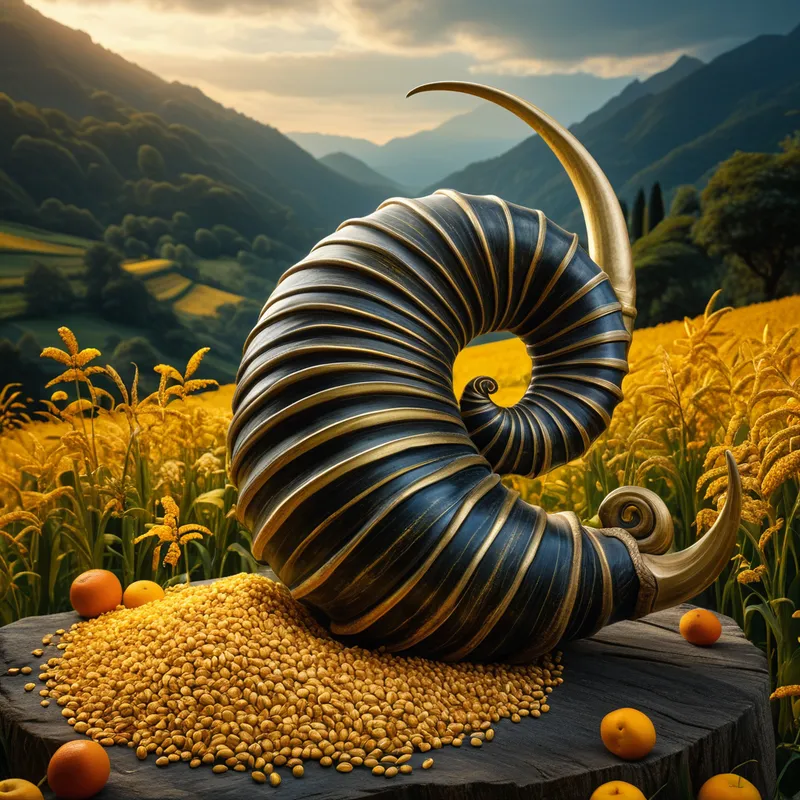
The Cornucopia Myth Meaning & Symbolism
A magical horn, born from a god's broken tusk, overflows with endless bounty, symbolizing the divine source of all nourishment and prosperity.
The Tale of The Cornucopia
Listen, and hear the story of the first fullness, the origin of the unending stream.
In the time before time, when [the world](/myths/the-world “Myth from Tarot culture.”/) was young and raw with chaos, a great and terrible titan ruled the heavens. His name was [Kronos](/myths/kronos “Myth from Greek culture.”/), and he devoured his own children, fearing the prophecy that one would overthrow him. His wife, the goddess Rhea, heavy with grief and another child, could bear the loss no more. When her son was born in the dead of night, she wrapped a stone in swaddling clothes and gave it to the ravenous titan. The infant, she hid.
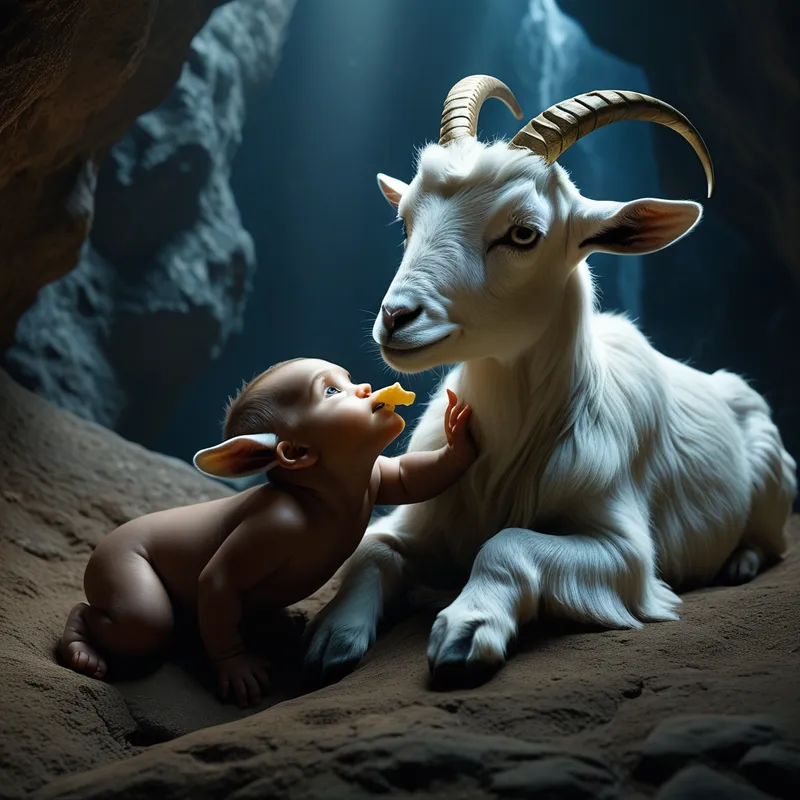
She fled to the wild, secret heart of Mount Ida, to a cave echoing with the drip of [water](/myths/water “Myth from Chinese culture.”/) and the scent of earth. There, she entrusted her child to the care of gentle spirits. The [nymphs](/myths/nymphs “Myth from Greek culture.”/) Adrasteia and Ida rocked him in a cradle of gold, and their brother, a youth named Pan, played soft, distracting melodies on his pipes to mask the infant’s cries. But the most vital guardian was a being of pure, primal nurture: the divine goat Amalthea.
Her coat was the color of storm clouds and sunlight, and her eyes held the patience of the mountains. She offered her milk, rich and warm, to the hungry child. [The cave](/myths/the-cave “Myth from Platonic culture.”/) was not silent; it hummed with the sound of the baby suckling, with the clatter of the Curetes beating their spears against their shields to drown out his wails, and with the low, comforting bleat of Amalthea. [The child](/myths/the-child “Myth from Alchemy culture.”/), named Zeus, grew strong on this sacred sustenance.
Yet, even divine play has its perils. One day, as the young god tugged and played at Amalthea’s horn, his godly strength, still unmeasured, flared. With a sound like a cracking mountain root, one of her magnificent horns broke off in his hand. For a moment, there was a horrified silence. The nymphs gasped. Amalthea merely bowed her head, not in pain, but in a strange, knowing acceptance.
Then, the miracle. From the hollow of the broken horn, a gentle glow emanated. It began to weep—not blood, but a trickle of clear, sweet nectar. Then came a fat, perfect fig, tumbling into the nymph’s lap. Then a cluster of deep purple grapes, a spray of golden wheat, a cascade of [pomegranate seeds](/myths/pomegranate-seeds “Myth from Greek culture.”/) like rubies. The horn filled and overflowed, spilling forth every good [thing](/myths/thing “Myth from Norse culture.”/) [the earth](/myths/the-earth “Myth from Hindu culture.”/) could yield: fruits never before seen, herbs of potent fragrance, coins of shining metal. It did not empty. It poured and poured, a river of bounty onto the cave floor, filling the air with the scent of harvest and honey. The infant Zeus laughed, clutching the horn, the very source of his nourishment now transformed into an eternal promise. The [Horn of Plenty](/myths/horn-of-plenty “Myth from Norse culture.”/) was born, not from conquest, but from an accident of care, a brokenness that became a blessing.
Cultural Origins & Context
The Cornucopia, or Horn of Plenty, is a mythic symbol with roots most famously traced to the Greco-Roman world, yet its essence is truly universal. Its primary literary sources are the fragmented hymns and genealogies of early Greek poets like Hesiod and the later compilations of mythographers. It was not a single, rigid story but a fluid narrative cluster, often attached to other deities of abundance like Demeter, Dionysus, and especially Gaia and Copia.
Its societal function was profound. In agrarian societies, the threat of famine was a constant shadow. The Cornucopia was a psychic and religious technology against that dread. It was depicted in art, carried in rituals, and invoked in prayers as a tangible symbol of divine favor and the earth’s endless capacity to regenerate. It served as a mythological anchor for the concepts of sovereignty (the rightful ruler provides plenty) and [xenia](/myths/xenia “Myth from Greek culture.”/) (the host’s duty to offer abundance). By telling the story of its origin in the nurturing of the future king of gods, culture encoded a deep truth: legitimate power and societal order are founded not on brute force, but on the ability to provide, to nourish, and to transform loss into generative gain.
Symbolic Architecture
At its core, the Cornucopia is an archetypal [symbol](/symbols/symbol “Symbol: A symbol can represent an idea, concept, or belief, serving as a powerful tool for communication and understanding.”/) of the [Source](/symbols/source “Symbol: The origin point of something, often representing beginnings, nourishment, or the fundamental cause behind phenomena.”/). It is not the bounty itself, but the [vessel](/symbols/vessel “Symbol: A container or structure that holds, transports, or protects something essential, representing the self, emotions, or life journey.”/), the [conduit](/symbols/conduit “Symbol: A passage or channel that transfers energy, information, or substance from one place to another, often hidden or structural.”/), the magical point of [origin](/symbols/origin “Symbol: The starting point of a journey, often representing one’s roots, source, or initial state before transformation.”/) from which bounty flows without depletion.
The broken horn teaches that the wound and the gift are often the same aperture; what is fractured in service of life becomes the channel for inexhaustible nourishment.
Psychologically, the [horn](/symbols/horn “Symbol: A horn symbolizes primal power, warning signals, and spiritual connection, often representing strength, alertness, or divine communication in dreams.”/) represents the nourishing, feminine principle—not exclusively female, but the receptive, containing, and endlessly giving [aspect](/symbols/aspect “Symbol: A distinct feature, quality, or perspective of something, often representing a partial view of a larger whole.”/) of the [psyche](/myths/psyche “Myth from Greek culture.”/). Amalthea is the archetypal Great [Mother](/symbols/mother “Symbol: The symbol of ‘Mother’ represents nurturing, protection, and the foundational aspect of one’s emotional being, often associated with comfort and unconditional love.”/), and her broken [horn](/symbols/horn “Symbol: A horn symbolizes primal power, warning signals, and spiritual connection, often representing strength, alertness, or divine communication in dreams.”/) signifies a sacrifice that does not diminish but amplifies her essence. The [infant](/symbols/infant “Symbol: The infant symbolizes new beginnings, innocence, and the potential for growth and development.”/) Zeus represents the nascent Self, the developing ego and [consciousness](/symbols/consciousness “Symbol: Consciousness represents the state of awareness and perception, encompassing thoughts, feelings, and experiences.”/), which is utterly dependent on this primal nourishment for its survival and eventual supremacy. The myth dramatizes the [moment](/symbols/moment “Symbol: The symbol of a ‘moment’ embodies the significance of transient experiences that encapsulate emotional depth or pivotal transformations in life.”/) when the source of our most basic sustenance is seemingly damaged by our own unconscious growth, only to reveal that this very “damage” unlocks a higher, more symbolic form of sustenance—spiritual, cultural, and creative [abundance](/symbols/abundance “Symbol: A state of plentifulness or overflowing resources, often representing fulfillment, prosperity, or spiritual richness beyond material needs.”/).

The Dreamer’s Resonance
When the Cornucopia appears in modern dreams, it rarely manifests as a classical horn. Instead, one might dream of a kitchen faucet that flows with wine, a wallet that never empties, a bookshelf where read books are instantly replaced by new ones, or a mentor whose wisdom seems infinite. Conversely, its shadow appears as the blocked horn: a clogged pipe, a locked granary, a mentor who falls silent.
Such dreams signal a critical engagement with the psyche’s inner resource economy. A dream of overflowing abundance often arises during periods of creative fertility, emotional openness, or the integration of a nurturing influence. It is the somatic feeling of “enough,” of being held and provided for by life itself. The dream of the blocked or empty horn, however, points to a perceived scarcity—not necessarily material, but often emotional, creative, or spiritual. It asks the dreamer: Where have I believed the source has dried up? What part of my inner Amalthea have I neglected or failed to honor? The dream work involves identifying the nature of the desired “nourishment” and examining [the self](/myths/the-self “Myth from Jungian culture.”/)-imposed or internalized breaks in its flow.

Alchemical Translation
The alchemical process modeled by the Cornucopia myth is that of Multiplicatio—the multiplication and infinite increase of value. It is the final stage of the individuation process where what has been earned and integrated begins to generate its own surplus.
The initial state is dependency (the infant Zeus). The [nigredo](/myths/nigredo “Myth from Alchemical culture.”/), or first darkness, is the breaking of the horn—the inevitable crisis, the felt loss of a primal source of security (a relationship, a belief, a talent used in an old way). This feels like a catastrophe, a maiming of what nourishes us. The albedo, or whitening, is the moment of realization—the shock that the broken vessel is not leaking life but emanating a new kind of life. The [rubedo](/myths/rubedo “Myth from Alchemical culture.”/), or reddening, is the full, conscious acceptance and stewardship of this new, magical flow.
Individuation is not about hoarding the gold of the Self, but about becoming the horn through which it is endlessly shared. Your deepest wound, transformed, becomes your most generous offering.
For the modern individual, this translates to a profound inner shift: from a mindset of scarcity and competition for limited resources to an identification with the source itself. It means discovering that one’s core vulnerability, one’s “broken” history, when held with consciousness and compassion, can become the very wellspring of one’s unique creativity, empathy, and capacity to nurture others. You are not just the child drinking the milk; you are, through the alchemy of your own experiences, also the goat whose horn breaks and becomes the Cornucopia. Your task is to tend the break, to point the open end of your experience outward, and to trust that what flows through you is meant to overflow.
Associated Symbols
Explore related symbols from the CaleaDream lexicon: