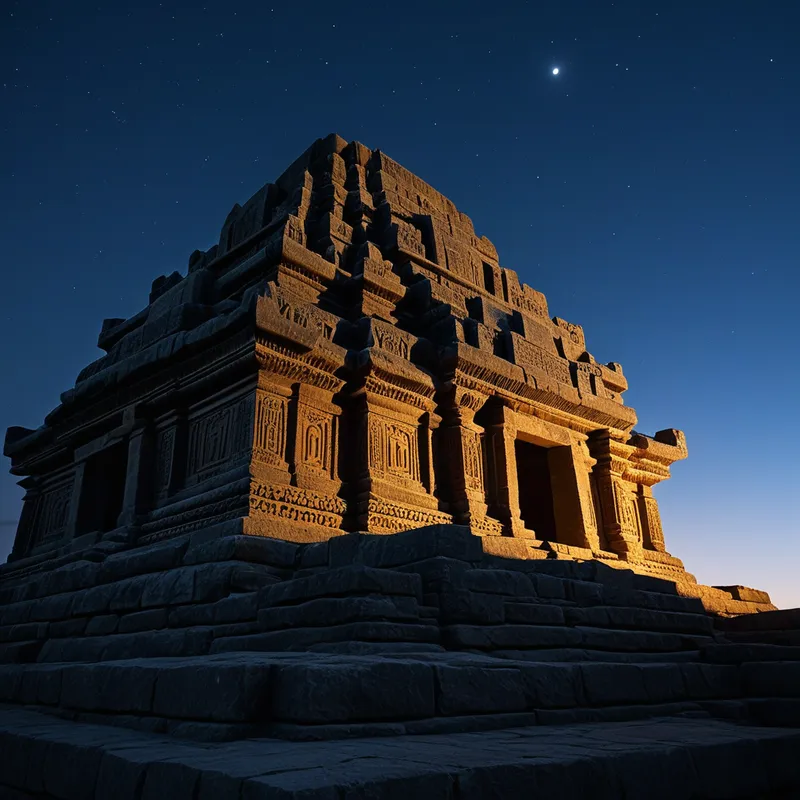
The Cornerstone Myth Meaning & Symbolism
A tale of a stone, rejected by builders, that becomes the essential foundation, revealing the paradoxical power of what is overlooked and despised.
The Tale of The Cornerstone
Listen. The air is thick with the dust of ambition and the sweat of labor. On a hill called Zion, the sound of chisel on stone is a symphony of human will. The King, a man after the heart of the Divine, dreams of a House—not for himself, but for the Name that whispers on [the wind](/myths/the-wind “Myth from Various culture.”/). The architects have drawn their lines; the masons have sorted their quarries. Great blocks of gleaming limestone are hauled, measured, and fitted with grunts of satisfaction.
But there is one stone.
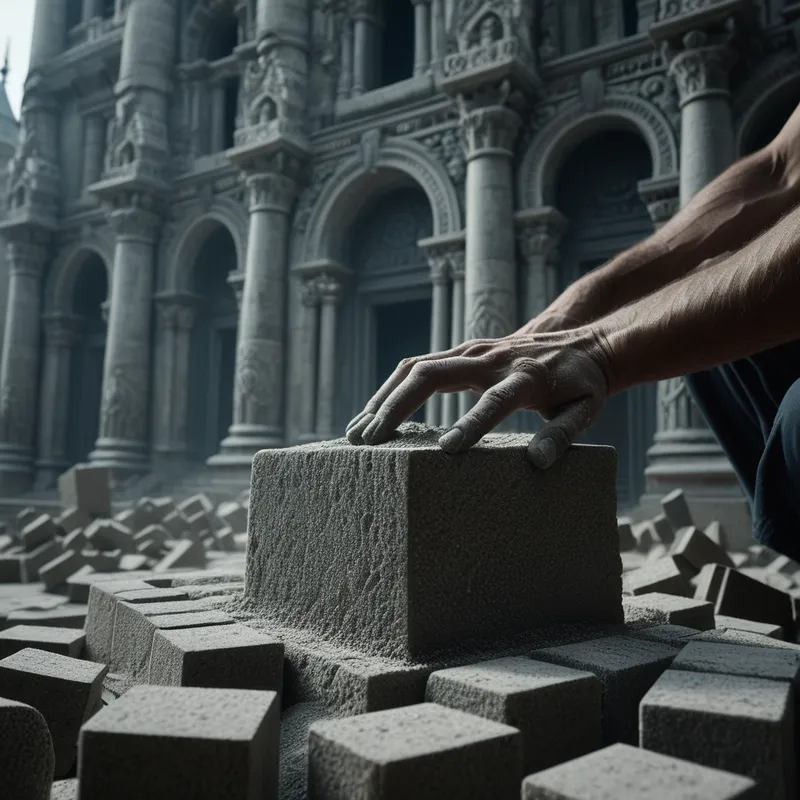
It arrives not with fanfare, but obscurity. It is not from the royal quarry. It is rough-hewn, its angles strange to the eye, its surface bearing the marks of a different, older hand. The builders, experts in symmetry and load, pass it by. It does not fit their templates. It is an anomaly, a disruption to the clean logic of their rising walls. With a dismissive shrug, it is cast aside. It rolls down the embankment, coming to rest in the Kidron Valley, a place of shadows and refuse, deemed worthless.
The House rises, course upon perfect course. Yet, as the final, crowning moment approaches—the placing of the keystone—a silence falls. The precisely cut stones wait, but none can bear the ultimate weight. The arch trembles, incomplete. The foundation, for all its perfection, lacks its heart.
Then, a voice, not from the architects but from [the prophets](/myths/the-prophets “Myth from Biblical culture.”/), a whisper that becomes a thunder: Look to the rejected one.
Eyes turn to the valley. The discarded stone, kissed by rain and scorn, now seems to hold a quiet gravity. It is hauled up, not with ease, but with a sense of destined struggle. As it is lifted to the pinnacle of need, a miracle of alignment occurs. Its strange angles meet the waiting spaces perfectly. It slides into place with a sound like a mountain sighing. In that moment, the rejected becomes the essential. The cast-off stone becomes the cornerstone, the absolute [reference](/myths/reference “Myth from Global/Universal culture.”/) point from which every other line in the sacred House derives its truth. The builders gasp, for they realize their error was not of measurement, but of perception.
Cultural Origins & Context
This narrative is not a single story bound to one page, but a resonant motif woven through the tapestry of Biblical literature. It appears first in the Psalms (118:22), a song of thanksgiving likely used in temple liturgy, celebrating divine deliverance that defies human logic. It is then prophetically amplified in [Isaiah](/myths/isaiah “Myth from Abrahamic culture.”/) (28:16), where the cornerstone is described as a “sure foundation,” a promise of stability in a time of national crisis and moral failing.
By the first century, within the [ferment](/myths/ferment “Myth from Alchemical culture.”/) of Second Temple Judaism and the early [Jesus](/myths/jesus “Myth from Christian culture.”/) movement, the myth was reactivated with explosive force. Early followers of [Jesus](/myths/jesus “Myth from Christian culture.”/) saw in his execution—the ultimate rejection by religious and political builders—and his subsequent elevation, the perfect enactment of this pattern. The authors of the Gospels and Epistles explicitly cite the psalm and the prophecy, framing the entire Christ event as the cosmic fulfillment of the cornerstone mystery. Thus, the myth functioned as a hermeneutic key, explaining paradox, justifying suffering, and establishing a new paradigm for understanding authority and value that was radically inverted from worldly standards.
Symbolic Architecture
At its [heart](/symbols/heart “Symbol: The heart symbolizes love, emotion, and the core of one’s existence, representing deep connections with others and self.”/), the Cornerstone myth is a master [symbol](/symbols/symbol “Symbol: A symbol can represent an idea, concept, or belief, serving as a powerful tool for communication and understanding.”/) of paradoxical inversion and foundational [identity](/symbols/identity “Symbol: Identity represents the sense of self, encompassing personal beliefs, cultural background, and social roles.”/).
The ego builds with the stones of convention, but the Self provides the stone of destiny, which the ego always first rejects.
The builders represent the conscious, rational mind—the part of us that seeks order, accepts prevailing standards, and builds our [personality](/symbols/personality “Symbol: Personality in dreams often symbolizes the traits and characteristics of the dreamer, reflecting how they perceive themselves and how they believe they are perceived by others.”/) according to approved societal blueprints. They are competent, but their [vision](/symbols/vision “Symbol: Vision reflects perception, insight, and clarity — often signifying the ability to foresee or understand deeper truths.”/) is limited to the known quarry. The rejected [stone](/symbols/stone “Symbol: In dreams, a stone often symbolizes strength, stability, and permanence, but it may also represent emotional burdens or obstacles that need to be acknowledged and processed.”/) symbolizes the Self—our deepest, most authentic, and often most unconventional potential. It does not come from [the ego](/myths/the-ego “Myth from Jungian culture.”/)‘s controlled quarry; it emerges from the unconscious, raw and seemingly incompatible with our carefully constructed identity.
The act of [rejection](/symbols/rejection “Symbol: The experience of being refused, excluded, or dismissed by others, often representing fears of inadequacy or social belonging.”/) is universal. It is the [psyche](/myths/psyche “Myth from Greek culture.”/)‘s initial [resistance](/symbols/resistance “Symbol: An object or tool representing opposition, struggle, or the act of pushing back against external forces or internal changes.”/) to what is unfamiliar, challenging, or disruptive to its current [structure](/symbols/structure “Symbol: Structure in dreams often symbolizes stability, organization, and the framework of one’s life, reflecting how one perceives their environment and personal life.”/)—a creative [impulse](/symbols/impulse “Symbol: A sudden, powerful urge or drive that arises without conscious deliberation, often linked to primal instincts or emotional surges.”/) stifled, a true feeling denied, a calling ignored because it [doesn](/symbols/doesn “Symbol: The word ‘doesn’ typically points to a lack or feeling of uncertainty regarding action or inactivity in one’s life.”/)‘t “fit” our [life](/symbols/life “Symbol: The symbol of ‘Life’ represents a journey of growth, interconnectedness, and existential meaning, encompassing both the joys and challenges that define human experience.”/) plan. The [valley](/symbols/valley “Symbol: A valley often symbolizes a period of transition or a place of respite between two extremes.”/) of refuse is the [shadow](/symbols/shadow “Symbol: The ‘shadow’ embodies the unconscious, repressed aspects of the self and often represents fears or hidden emotions.”/) [realm](/symbols/realm “Symbol: The symbol of ‘Realm’ often signifies the boundaries of one’s consciousness, experiences, or emotional states, suggesting aspects of reality that are either explored or ignored.”/), where we relegate these rejected parts of ourselves.
The myth’s [resolution](/symbols/resolution “Symbol: In arts and music, resolution refers to the movement from dissonance to consonance, creating a sense of completion, release, or finality in a composition.”/) reveals the fatal flaw in the ego’s project: a structure built without the central, unifying principle of [the Self](/myths/the-self “Myth from Jungian culture.”/) is inherently unstable. It may look complete, but it cannot hold ultimate meaning or [weight](/symbols/weight “Symbol: Weight symbolizes burdens, responsibilities, and emotional loads one carries in life.”/). The elevation of the stone is the [moment](/symbols/moment “Symbol: The symbol of a ‘moment’ embodies the significance of transient experiences that encapsulate emotional depth or pivotal transformations in life.”/) of psychological [integration](/symbols/integration “Symbol: The process of unifying disparate parts of the self or experience into a cohesive whole, often representing psychological wholeness or resolution of internal conflict.”/), where the ego, faced with its own incompletion, must turn to what it despised and acknowledge it as essential. The cornerstone, once set, is no longer just a stone; it becomes the [axis](/symbols/axis “Symbol: A central line or principle around which things revolve, representing stability, orientation, and the fundamental structure of reality or consciousness.”/) mundi of the personal psyche, the fixed point from which true orientation becomes possible.
The Dreamer’s Resonance
When this myth stirs in the modern unconscious, it often manifests in dreams of construction, rejection, and hidden value. You may dream of building a house that perpetually collapses, searching frantically for a missing piece to a puzzle, or holding an object others mock but that feels profoundly important to you. Somaticly, this can feel like a weight in the hands or chest—the burden of carrying something you don’t yet understand the value of.
Psychologically, these dreams signal a critical juncture in the process of individuation. The dream ego (the builders) is being confronted with the limitations of its current life-construction. The “rejected stone” in the dream is a direct representation of a complex, a talent, a memory, or a facet of your personality that your waking consciousness has deemed unusable or shameful. The dream is not merely replaying the rejection; it is presenting the possibility of re-evaluation. The anxiety in the dream is the friction between the old, failing structure and the emerging, integrative pattern. To resonate with this dream is to begin the difficult work of retrieving that discarded part from the shadowy valley of your neglect and considering it anew.
Alchemical Translation
The alchemical journey mirrored in the Cornerstone myth is the opus contra naturam—the work against one’s own habitual nature. The base material is the entirety of the personality, including its flaws and rejected elements.
The prima materia is not gold, but the very thing the builders threw away.
[The first stage](/myths/the-first-stage “Myth from Alchemical culture.”/), [nigredo](/myths/nigredo “Myth from Alchemical culture.”/), is embodied in the stone’s rejection and descent into the valley. This is a necessary humiliation, a dark night where the prized values of the ego are revealed as insufficient. The stone lies in the massa confusa of the unconscious.
The turning point is the albedo, the prophetic voice that calls for a re-examination. This is the moment of insight, often precipitated by crisis (the unstable arch), where consciousness realizes it must look to its own depths for the solution. The retrieval and lifting of the stone is an act of conscious effort (citrinitas), struggling to integrate what was once despised.
Finally, the setting of the stone is the [rubedo](/myths/rubedo “Myth from Alchemical culture.”/). This is the culmination of the psychic transmutation. The rejected element is not just added back; it is placed in the central, foundational position. It becomes the principle of order. The ego is not destroyed but is re-founded upon the authority of the Self. The new structure—the individuated personality—is stable not because it is perfect, but because it is whole. Its cornerstone is the paradoxical truth that our greatest weakness, once fully integrated, becomes our unshakable foundation. The myth, therefore, is an eternal blueprint for the soul’s architecture, reminding us that the key to our completion is often the very piece we were most determined to throw away.
Associated Symbols
Explore related symbols from the CaleaDream lexicon: