
The Cook Myth Meaning & Symbolism
A myth of a divine artisan who sacrifices their own substance to transmute the raw, chaotic world into a nourishing, ordered, and sacred reality.
The Tale of The Cook
In the time before time, when the Prima Materia swirled in a deafening, formless soup, there was a silence at the center of the roar. And in that silence, worked the First Artisan, known to the later ages as The Cook.
They did not command from a throne, but labored at a hearth forged from the heart of a dying star. Their kitchen was the Vas Hermeticum of all creation, and their tools were patience, heat, and a love so fierce it was indistinguishable from agony. The world-stuff—screaming with potential, bitter with salt, sharp with metallic shards—heaved and pulsed around them, a banquet of chaos that could not be eaten, only endured.
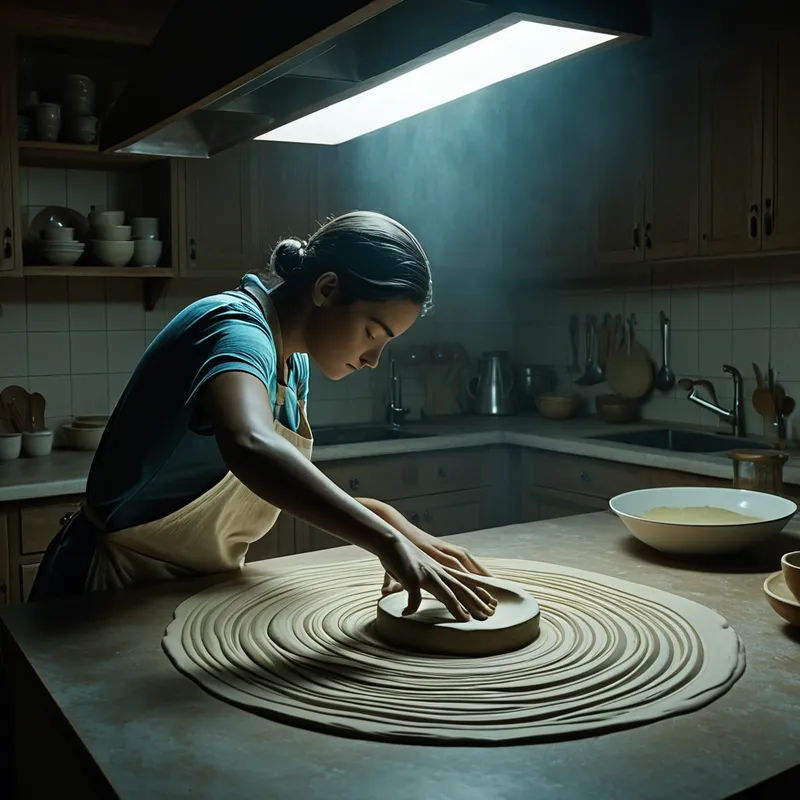
The Cook looked upon this raw feast and did not see disorder, but ingredients. With hands that were neither male nor female, but simply making, they reached into the seething mass. They gathered the shrieking winds and pounded them upon an anvil of midnight until they lay still as a silver sheet. They captured the frantic, skittering fires and folded them, again and again, like a luminous dough, until they glowed with a steady, inner warmth. They took the weeping waters, heavy with memory, and distilled them drop by precious drop in a crucible of their own rib.
But the work was incomplete. The substances were separate, beautiful in their purity, yet lifeless in their isolation. The cosmic meal was prepared, but it had no soul, no unifying principle to make it nourish. The chaos, though subdued, whispered of a hunger that would never be sated.
And so, The Cook made the choice that defines all true creation. They did not reach for an external spice. Instead, they placed their own heart—a pulsing orb of concentrated attention and conscious love—upon the central chopping block of reality. Without a sound, they divided it. Not in half, but into infinite, fractal portions. Each shimmering fragment was a seed of consciousness, a grain of salt, a flake of pepper, a drop of sacred oil.
With a final, merciful gesture, they scattered this essence of Self into the waiting, ordered ingredients. The silver sheet of wind inhaled. The folded dough of fire sighed. The distilled waters trembled. And in that moment, the separate became whole. The chaotic banquet was transmuted. The first true meal was served—a universe that was not just arranged, but alive, capable of sustaining life, of complexity, of meaning. The Cook, now a subtle presence woven into the very fabric of flavor, looked upon their work. The hearth-fire dimmed, not to darkness, but to the gentle, sustaining glow of a hidden sun, and the great kitchen became the world itself.

Cultural Origins & Context
This myth is not a story of a distant, omnipotent god, but of a philosophical artisan. It emerged from the workshops and scriptoria of medieval and Renaissance alchemists, not as a religious dogma, but as an operative metaphor for their entire worldview. It was passed down in encrypted manuscripts, whispered in laboratory corridors, and encoded in emblematic drawings. The tellers were not bards for the masses, but masters for apprentices, using the narrative to illustrate the terrifying and sacred responsibility of the transformative work.
Its societal function was deeply subversive and profoundly personal. In a world of rigid hierarchies and dogmatic truths, the myth of The Cook placed ultimate value on the individual’s labor of inner transformation. It said that order is not imposed from above by a king, but cultivated from within by a craftsman. It served as a psychological map, assuring the adept that the feeling of being broken down, of sacrificing one’s familiar self, was not a path to damnation, but the essential recipe for creating something of true, enduring value.
Symbolic Architecture
The myth is a perfect symbolic diagram of the psyche’s journey from unconsciousness to consciousness. The Prima Materia represents the raw, unprocessed contents of the personal and collective unconscious—our chaotic emotions, instincts, and unlived potentials. The kitchen laboratory is the vessel of the conscious ego, the place where this chaos is brought to be worked upon.
The true sacrifice is not of something you have, but of something you are. The Cook does not give up a possession; they give up the very structure of their isolated being to become the nutrient of a greater whole.
The pounding, folding, and distilling are the painful but necessary processes of analysis, reflection, and emotional discipline—the separatio and purificatio of alchemy. The separated ingredients symbolize the differentiated psychic functions (thought, feeling, sensation, intuition) which, while refined, remain sterile without integration. The critical moment—the sacrifice of the heart—is the symbol of the ego’s relinquishment of its central, controlling position. It is the act of love that transcends the personal, allowing the conscious mind to become a seasoning for the larger, Self-directed process of individuation. The resulting “meal” is the coherent, nourishing, and sustainable personality, a Self that can feed its own world.

The Dreamer’s Resonance
When this myth stirs in the modern unconscious, it often manifests in dreams of urgent, surreal culinary tasks. You may dream of being in a vast, unfamiliar kitchen, tasked with feeding a multitude, but finding only bizarre, uncooperative ingredients—stones that need to be softened, emotions that have physical form, clocks that must be minced. The overwhelming feeling is one of sacred responsibility coupled with utter inadequacy.
Somatically, this can mirror periods of intense stress or life transition where one feels “in the fire” or “being put through the wringer.” The psychological process is the nigredo, the alchemical blackening, where the old, naive identity is broken down. The dreamer is The Cook at the beginning of the tale, confronted with their own inner Prima Materia. The anxiety stems from the dawning realization that to create order and meaning in one’s life, one must willingly engage with the chaos within, and that the process will demand a piece of one’s current self-concept.
Alchemical Translation
For the modern individual, the myth of The Cook models the path of individuation not as a quest for glory, but as a humble, daily practice of sacred craft. Our lives are the kitchen. Our relationships, our work, our crises are the ingredients—often raw, unappealing, or difficult to handle. The first step is to cease seeing them as meaningless burdens and to begin viewing them with the curiosity of an artisan: What potential lies hidden here?
The labor of pounding, folding, and distilling translates to the inner work of therapy, journaling, meditation, or any disciplined practice that helps us process experience. We learn to separate our reactions from our core, to purify our intentions, to distill wisdom from pain.
The final transmutation occurs only when we stop trying to create a masterpiece called “My Perfect Life” and instead offer our refined awareness back to life itself as a gift, becoming a conscious participant rather than a desperate controller.
The ultimate “sacrifice of the heart” is the release of the ego’s demand to be the sole author and center of the universe. It is realizing that our deepest purpose may be to contribute our unique, hard-won quality of consciousness—our “flavor”—to the collective human story. In doing so, we cease to be merely consumers of experience and become, like The Cook, nourishers of reality. Our personal hearth-fire dims from a blaze of selfish desire to the steady, warm glow of meaningful contribution, and we find ourselves, at last, at home in the world we have helped to make digestible.
Associated Symbols
Explore related symbols from the CaleaDream lexicon: