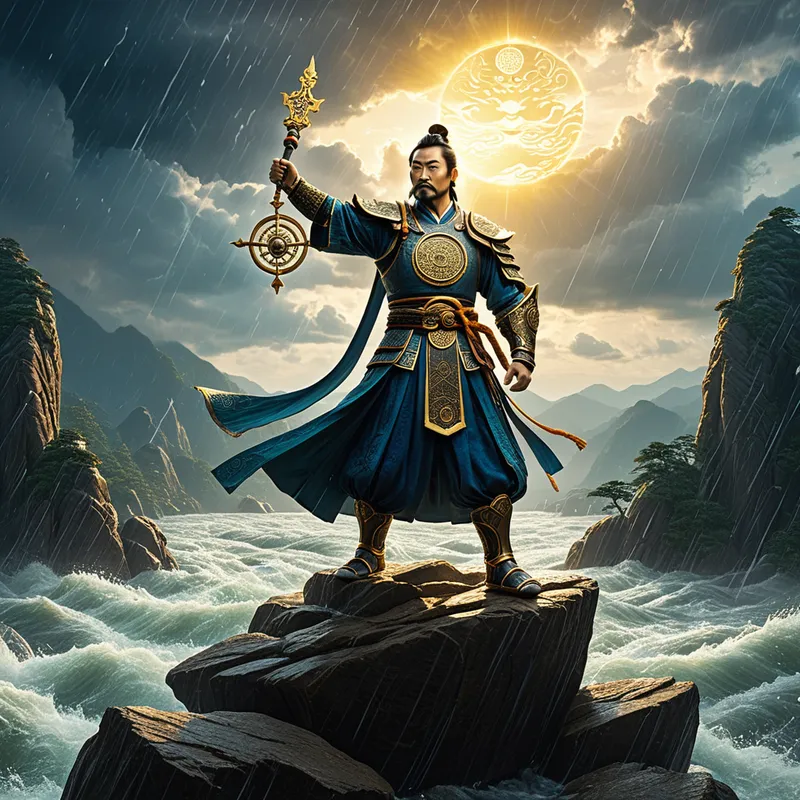
The Compass of Yu the Great Myth Meaning & Symbolism
The legendary hero Yu harnesses a divine compass to channel chaotic floods, forging the world's rivers and the order of the human psyche.
The Tale of The Compass of Yu the Great
Hear now the tale of a world undone. The heavens wept without cease, and the earth was a drowning beast. Rivers forgot their banks, lakes swelled into inland seas, and the Nine Provinces were swallowed by a churning, silt-thick soup. This was the Great Flood, a chaos not of water alone, but of a cosmos out of joint. The people clung to mountaintops, their voices lost to the roar, their Qi sinking into despair.
The Shangdi, gazing upon the ruin, saw that force alone would not answer chaos. A different power was needed—not to oppose, but to guide. And so the mandate fell not to a god, but to a man of relentless heart: Yu.
Yu was the son of Gun, who had tried to dam the waters with stolen heavenly soil and failed. Where his father fought, Yu would flow. He received a divine instrument: The Compass. It was no mere tool for direction. Cast from celestial bronze, its face was a mandala of the world, its central needle a sliver of polar star, humming with the intent of order.
For thirteen years, Yu walked. He did not ride. His feet measured the drowned earth, his hands calloused against rock and root. He consulted the Compass not as a master, but as a partner in dialogue with the land. In the howling gales of the north, he would hold it aloft, and its light would cut through the rain, revealing the hidden bones of mountains, the ghost of ancient riverbeds beneath the tumult. He listened to the water’s desire—not to destroy, but to move, to find its way home to the sea.
He led the people, a vast, weary chain of humanity following the man with the glowing dial. Where the Compass pointed, they dug. They channeled. They worked until their bodies broke and were mended by purpose. Yu passed the door of his own home three times, hearing the wail of his newborn son, but he did not enter. The Compass in his hand pulled him forward, its light a tether to a future not yet born.
The climax came at Dragon Gate. Here, the waters raged against an unyielding cliff, a bottleneck of pure fury. Yu stood before the torrent, the Compass glowing like a captured sun. He did not command the mountain to part. Instead, he read the chaos. He saw the spiral of the current, the pressure points in the stone. Following the Compass’s silent wisdom, he directed the digging not through, but with the grain of the rock. With a sound like the earth sighing, the cliff channeled the rage into a mighty, directed flow. The floodwaters found their voice, not as a roar of destruction, but as the song of the Huang He, the Yangtze, and all the arteries of the world.
The waters receded, revealing a land sculpted by sacred geometry. Yu had not conquered the flood. He had conversed with it, and with the Compass as his translator, he had written the water’s chaotic poetry into the enduring text of the land.
Cultural Origins & Context
The myth of Yu the Great is foundational, embedded in texts like the Shujing and the Shiji. It transcends mere legend to become political cosmology. Yu is the paradigmatic Sage-King, the model ruler whose virtue (De) and tireless labor bring order (Zhi) from chaos (Luan). The story was propagated by scholars and statesmen to illustrate the Mandate of Heaven: legitimate rule is not about birthright, but about the tangible, self-sacrificing work of creating a habitable world for the people.
The Compass (Liang or guiding instrument) is central to this. In a culture deeply concerned with harmonizing human activity with the patterns of the cosmos (Dao), Yu’s tool symbolizes the application of celestial principle to terrestrial problem. It represents the idea that true leadership—and by extension, true culture—is a act of alignment, not domination. The myth was a societal compass itself, orienting values towards communal effort, perseverance, and symbiotic relationship with nature.
Symbolic Architecture
At its heart, the myth is a blueprint for the conscious structuring of the psyche. The Great Flood represents the undifferentiated, overwhelming power of the unconscious—a tide of emotion, instinct, and psychic material that threatens to engulf the conscious ego.
The flood is not the enemy; it is the unharnessed potential of the Self.
Yu is the archetype of the disciplined ego-consciousness that undertakes the monumental task of individuation. He does not repress the flood (like his father Gun, whose dams burst). He engages with it. His thirteen-year journey is the long, arduous process of self-analysis and integration. The Compass is the symbol of a transcendent function—a psychic organ that emerges from the tension between chaos and order. It is intuition guided by wisdom, the inner principle that can discern pattern within turmoil.
His refusal to enter his home is a profound symbol of the necessary sacrifice in this work. Personal desires, immediate gratifications, must be temporarily set aside to serve the larger, slow-blooming purpose of psychic wholeness. The rivers he creates are the newly formed channels of the personality—the directed flows of libido, talent, and emotion that now nourish the inner landscape instead of drowning it.
The Dreamer’s Resonance
When this myth stirs in the modern dreamer, it often signals a profound encounter with inner chaos. One may dream of overwhelming floods in the basement of a childhood home, of rising waters in a city street, or of being tasked with managing a broken, gushing pipe with inadequate tools. The somatic feeling is one of pressure, helplessness, and urgent, exhausting labor.
This is the psyche’s depiction of a life crisis—a career upheaval, a relational breakdown, a surge of grief or anxiety that feels unmanageable. The dreamer is in the position of the pre-Yu world: overwhelmed. The appearance of a guiding object—a strange tool, a map, a glowing device—in the dream may signal the nascent emergence of the “Compass” function. The dreamwork is the beginning of the psyche’s own attempt to not just survive the flood, but to consult with it, to ask what new channels need to be dug. The exhaustion felt upon waking is the honest toll of this unconscious labor.

Alchemical Translation
The alchemical process modeled here is the solve et coagula—dissolve and coagulate—applied to the soul. First, the flood (solve): the old structures of the personality are dissolved, often painfully. Then, the labor of Yu (coagula): the slow, mindful re-formation of a new, more capacious structure.
For the modern individual, “taming the flood” is not about achieving perfect control. It is about developing an inner Compass. This is the cultivated capacity for discernment in emotional storms. It is the practice of pausing in the face of chaos (the raging waters at Dragon Gate) to seek the inherent pattern, the potential course, rather than reacting in panic.
Individuation is the work of becoming the cartographer of your own inner wilderness, using the compass of consciousness to trace rivers where there was only swamp.
Yu’s ultimate triumph is that the land he reveals is more fertile, more defined, and more resilient than before the flood. Psychically, this translates to a self that has integrated its own depths. The chaotic energies—the passions, the rages, the sorrows—are not gone. They are now channeled. They have become the rivers that give life, depth, and direction to one’s character. The individual moves from being a victim of inner weather to a respectful steward of an entire, flowing landscape. They have, like Yu, earned the right to rule their own inner kingdom.
Associated Symbols
Explore related symbols from the CaleaDream lexicon: