The Colossus of Rhodes Myth Meaning & Symbolism
A city builds a titanic bronze god to honor its patron, only to see its pride shattered by the earth, leaving a legacy of awe and warning.
The Tale of The Colossus of Rhodes
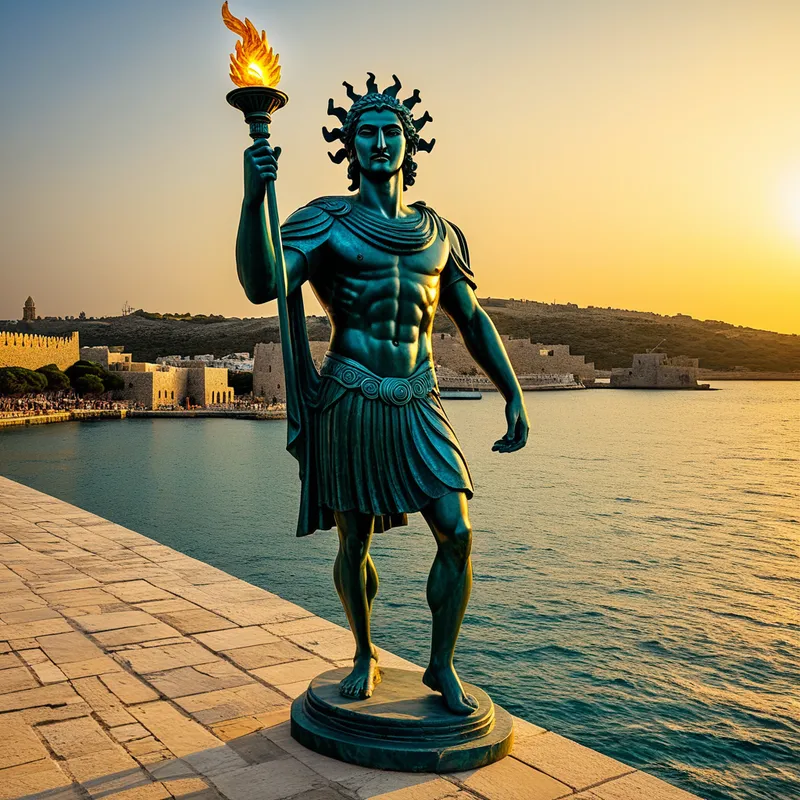
Hear now of Rhodes, the island rose, and [the shadow](/myths/the-shadow “Myth from Jungian culture.”/) it cast upon the wine-dark sea. It was an age when gods walked with men in whispers of wind and the flash of sunlight on bronze. The people of Rhodes, blessed by [Helios](/myths/helios “Myth from Greek culture.”/) himself, had weathered a storm not of [water](/myths/water “Myth from Chinese culture.”/), but of war. Demetrius Poliorcetes, the Besieger of Cities, had come with his towers and his engines, his hunger for conquest a dark cloud on [the horizon](/myths/the-horizon “Myth from Various culture.”/). For a full year, the Rhodians held their walls, their prayers rising like incense to their patron, the Sun God.
And Helios heard. He filled their hearts with a stubborn fire, and he turned the siege engines of Demetrius to folly. When the Macedonians finally withdrew, abandoning a fortune in bronze weaponry and war machines upon the shore, the people saw not scrap, but a divine offering. [The earth](/myths/the-earth “Myth from Hindu culture.”/) itself had provided the metal; the failed siege, the catalyst. A vision was born, audacious, terrifying in its scale: to build a thank-offering unlike any [the world](/myths/the-world “Myth from Tarot culture.”/) had seen. Not a simple stele or a modest temple, but a god in their own image, or rather, their image of the divine.
They summoned Chares of Lindos, a man whose soul must have been part Titan. For twelve long years, the harbor became a forge of the gods. The air rang with the hammer’s song, thick with the scent of hot metal and clay. Towering scaffolds of wood grew like a skeletal forest against [the sky](/myths/the-sky “Myth from Persian culture.”/). They built the Colossus limb by limb, shell by shell, filling the hollow bronze form with stones and iron braces. The people watched as a foot, then an ankle, then a mighty calf rose from the earth. They saw the god’s torso take shape, a mountain of burnished metal catching the first and last light of each day.
Finally, the day came. The head was raised, crowned with radiating spikes like the sun’s own rays. The eyes, perhaps of polished stone or glass, looked out across [the sea](/myths/the-sea “Myth from Greek culture.”/) he was said to have drawn from the deep. In his hand, a torch held high, a beacon to all who sailed the Aegean. The Colossus stood astride the harbor mouth, not straddling it as later tales would boast, but beside it, a silent, shining guardian. For decades, he was the wonder of the world. Ships passed in his shadow, sailors felt the weight of his gaze. He was the pride of Rhodes made manifest, a declaration that this island, this people, stood under the direct favor of heaven.
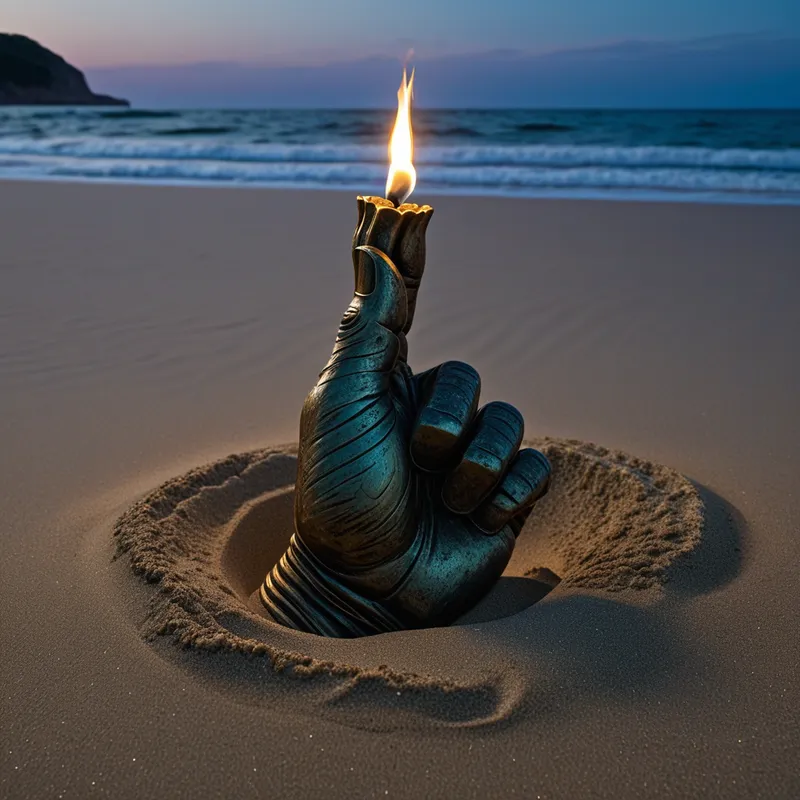
But [the Fates](/myths/the-fates “Myth from Greek culture.”/) weave a tighter thread. Fifty-six years after the Colossus first caught the sun, the earth shook. It was not a gentle tremor, but a convulsion from the depths, as if [Poseidon](/myths/poseidon “Myth from Greek culture.”/), perhaps slighted, had stirred. The great bronze knees, the pride of engineering, buckled. With a groan that was said to echo for miles, the giant fell. He did not shatter, but lay broken at the knee, a fallen king on his own shore. The crash was felt in every heart on Rhodes. The god they had built to touch the sky now slept upon the earth, his form a new, tragic geography.
Cultural Origins & Context
The Colossus is a unique figure in the Greek world, a myth born not in the misty age of heroes, but in the clear, historical light of the Hellenistic era (c. 323–31 BCE). Its story is recorded by historians like Strabo and Pliny the Elder, placing it at the intersection of documented fact and legendary amplification. This was an age of city-states vying for prestige, where cultural capital was as crucial as military might. Erecting a wonder was a political and religious statement: Rhodes was announcing its resilience, its wealth, and its special relationship with Helios to the entire Mediterranean.
The myth functioned on multiple levels. For the Rhodians, it was a foundational narrative of identity—a story of divine salvation followed by monumental gratitude. For the wider Greek world, it became a paradeigma, a teaching story, about the limits of human achievement. The tale was passed down not by bards singing of [the Trojan War](/myths/the-trojan-war “Myth from Greek culture.”/), but by historians, engineers, and travelers who saw the ruins and recounted the “what” and the “why.” Its societal function evolved from a symbol of [triumph](/myths/triumph “Myth from Roman culture.”/) to a profound meditation on hubris and [nemesis](/myths/nemesis “Myth from Greek culture.”/), a warning etched in broken bronze.
Symbolic Architecture
At its core, the [Colossus](/symbols/colossus “Symbol: A monumental statue or figure representing overwhelming power, legacy, and the tension between human achievement and hubris.”/) is a [symbol](/symbols/symbol “Symbol: A symbol can represent an idea, concept, or belief, serving as a powerful tool for communication and understanding.”/) of the creative act pushed to its absolute limit. It represents the [human](/symbols/human “Symbol: The symbol of a human represents individuality, complexity of emotions, and social relationships.”/) [impulse](/symbols/impulse “Symbol: A sudden, powerful urge or drive that arises without conscious deliberation, often linked to primal instincts or emotional surges.”/) to materialize our gratitude, our ambition, and our understanding of the divine into a tangible, overwhelming form.
The Colossus is the Ego idealized—a monumental structure built to withstand time, meant to forever catch the light of admiration and ward off the shadows of obscurity.
The materials are deeply symbolic. The bronze, forged from the weapons of a defeated [enemy](/symbols/enemy “Symbol: An enemy in dreams often symbolizes an internal conflict, self-doubt, or an aspect of oneself that one struggles to accept.”/), speaks of [alchemy](/symbols/alchemy “Symbol: A transformative process of purification and creation, often symbolizing personal or spiritual evolution through difficult stages.”/)—transforming the instruments of [death](/symbols/death “Symbol: Symbolizes transformation, endings, and new beginnings; often associated with fear of the unknown.”/) and conflict into an object of [peace](/symbols/peace “Symbol: Peace represents a state of tranquility and harmony, both internally and externally, often reflecting a desire for resolution and serenity in one’s life.”/), commemoration, and awe. The [statue](/symbols/statue “Symbol: A statue typically represents permanence, ideals, or entities that are revered.”/) is not just of a god, but a channel for the god; it was an attempt to anchor the celestial power of [Helios](/symbols/helios “Symbol: Helios symbolizes the sun, embodying light, life, and divine energy in various mythological traditions.”/) ([illumination](/symbols/illumination “Symbol: A sudden clarity or revelation, often representing spiritual awakening, intellectual breakthrough, or the dispelling of ignorance.”/), [clarity](/symbols/clarity “Symbol: A state of mental transparency and sharp focus, often representing resolution of confusion or attainment of insight.”/), [life](/symbols/life “Symbol: The symbol of ‘Life’ represents a journey of growth, interconnectedness, and existential meaning, encompassing both the joys and challenges that define human experience.”/)-giving force) permanently to their homeland.
Its fall is the essential counterpoint. The [earthquake](/symbols/earthquake “Symbol: An earthquake in a dream often symbolizes a sudden disruption or transformation that shakes the foundation of one’s life.”/) represents the intervention of a [reality](/symbols/reality “Symbol: Reality signifies the state of existence and perception, often reflecting one’s understanding of truth and life experiences.”/) greater than any human [construction](/symbols/construction “Symbol: Construction symbolizes creation, building, and the process of change, often reflecting personal growth and the need to build a solid foundation.”/)—the unpredictable, chthonic forces of [nature](/symbols/nature “Symbol: Nature symbolizes growth, connectivity, and the primal forces of existence.”/) and [psyche](/myths/psyche “Myth from Greek culture.”/) that no amount of planning can fully anticipate or control. The broken knees are particularly potent; they symbolize the failure at the point of support, the weakness in the [foundation](/symbols/foundation “Symbol: A foundation symbolizes the underlying support systems, values, and beliefs that shape one’s life, serving as the bedrock for growth and development.”/) of our grandest ambitions, often hidden until the [moment](/symbols/moment “Symbol: The symbol of a ‘moment’ embodies the significance of transient experiences that encapsulate emotional depth or pivotal transformations in life.”/) of [crisis](/symbols/crisis “Symbol: A crisis symbolizes turmoil, urgent challenges, and the need for immediate resolution or change.”/).
The Dreamer’s Resonance
To dream of a colossus—whether building one, seeing one stand, or witnessing its fall—is to engage with the psyche’s own scale of ambition. The somatic feeling is often one of awe mixed with dread, a tightening in the chest at the sheer scale of the image.
If one dreams of constructing such a figure, it may point to a conscious or unconscious life project of immense proportions: building a career, a reputation, a legacy, or a perfect self-image. The dream asks: What are you building, and with what materials? Is it with the integrated lessons of past struggles (the melted-down weapons), or with untested arrogance?
Dreaming of the fallen Colossus often accompanies a psychological event of “collapse”—a failure, a humiliation, the crumbling of a long-held belief or identity structure. The dream presents not just the ruin, but the posture of the ruin. The giant lies prostrate, but it is not gone. It becomes a new landscape to navigate. This dream phase is a painful but necessary dissolution, the psyche’s earthquake that topples an edifice that had become, despite its beauty, untenably rigid.
Alchemical Translation
The myth of the Colossus models the full cycle of psychic transmutation, the journey of individuation. The initial siege represents a period of intense pressure and confrontation with the outer world (the Other, challenges, crises). The victory and decision to build symbolize the inflation of the conscious ego, rightly proud of its resilience but risking identification with the divine itself (“We are so favored, we can build a god”).
The twelve-year construction is the laborious concretization of a complex, a worldview, or a [persona](/myths/persona “Myth from Greek culture.”/). It is a conscious, willed act of creation. The earthquake is the critical intervention of [the Self](/myths/the-self “Myth from Jungian culture.”/)—the total psychic totality—correcting [the ego](/myths/the-ego “Myth from Jungian culture.”/)’s inflation. This is not a punishment, but a rebalancing.
The true alchemy begins not in the raising, but in the ruin. The shattered bronze is the prima materia for a new consciousness.
Here lies the alchemical gold. The Colossus stood for decades as a “wonder,” an external object of awe. After its fall, for nearly 900 years, it lay where it fell, becoming known as “The Ruin.” This is the crucial phase. The psyche must learn to live with the ruin, to visit it, to see its grandeur and its brokenness together. It is in this state—where the creation is no longer perfect but is imbued with history, pathos, and a new, grounded form—that it becomes an internal symbol. The integrated individual does not identify with the perfect, standing Colossus (the inflated ego), nor with the shame of the fallen one (the defeated ego). Instead, they carry within them the memory of both states—the ambition, the creativity, the fragility, and the resilience that survives even collapse. The legacy is no longer the intact statue, but the story of its rise and fall, a story that contains both triumph and humility, a truly human myth.
Associated Symbols
Explore related symbols from the CaleaDream lexicon: