The Code of Hammurabi Myth Meaning & Symbolism
A king receives divine laws from the sun god, etching a cosmic contract into stone to bind chaos with order and establish justice for all.
The Tale of The Code of Hammurabi
Hear now, and let the dust of ages settle upon your mind. In the land between the two rivers, where the sun’s gaze is a hammer upon the clay, there was a city of baked brick and ambition: Babylon. Its king was Hammurabi, a man whose brow was heavy with the weight of a thousand disputes. In his streets, the strong preyed upon the weak; in his courts, the wealthy man’s word drowned out the poor man’s truth. Chaos, like the silt of the Twin Rivers, threatened to choke the order of the kingdom.
The king climbed [the ziggurat](/myths/the-ziggurat “Myth from Mesopotamian culture.”/), the stairway to heaven, his soul aching for a clarity as sharp as a scribe’s stylus. He offered libations of fine oil and barley, his prayers rising with the incense smoke into the bronze dome of [the sky](/myths/the-sky “Myth from Persian culture.”/). He called not for conquest, but for counsel. He called for the one who sees all, from the highest palace to the lowest reed hut: Shamash, the Lord of [Justice](/myths/justice “Myth from Tarot culture.”/).
And the god answered.
The air in [the temple](/myths/the-temple “Myth from Jewish culture.”/) grew still and potent, thick as molten glass. The light did not fade, but concentrated, pulling itself from every corner of the room into a single, unbearable point before the king. From this forge of divine radiance, the form of Shamash emerged. Not as a man, but as the essence of judgment itself—seated upon a throne of mountain stone, rays of terrible light fanning from his shoulders, in one hand the measuring rod of truth, in the other the ring of heaven’s eternal cycle. His face was the sun at its zenith, impossible to behold directly, yet his presence was not of heat, but of an absolute, chilling clarity.
A voice spoke, not in the king’s ear, but directly into the substance of his spirit. It was the sound of a balance weighing stars, of a plumb line finding the core of [the earth](/myths/the-earth “Myth from Hindu culture.”/). It spoke of mīšarum—justice, equity, the setting right of all things. It spoke not in grand philosophies, but in stark, undeniable equations: If a man destroys the eye of another man, they shall destroy his eye. If a builder’s house collapses and kills the owner, that builder shall be put to death. If a son strikes his father, they shall cut off his hand.
Each pronouncement was a wedge of cosmic truth driven into the king’s consciousness. This was not a request. It was a revelation of the hidden architecture of a civilized world, the divine mathematics that could bind the chaos of human passion. Hammurabi received them not as a petitioner, but as a vessel, his mind a clay tablet pressed by a godly stylus.
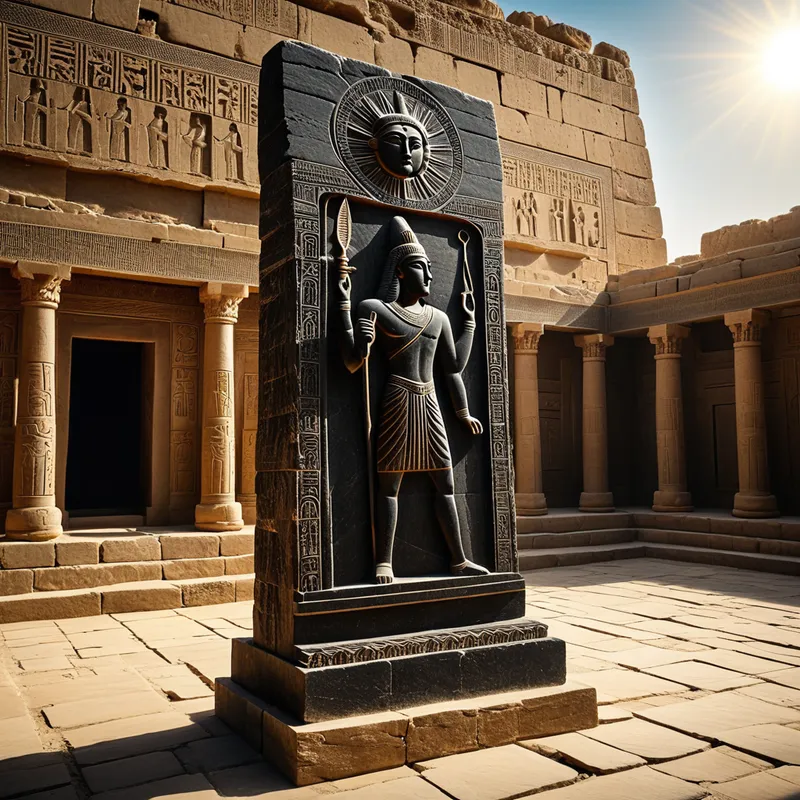
When the vision faded, leaving only the scent of ozone and sanctified stone, the king descended. He summoned his master scribes. “Bring the black stone of the mountain,” he commanded, “the diorite that endures forever.” And there, under the same sun that was Shamash’s eye, they carved. They carved the god in his majesty, handing the symbols of authority to his chosen king. And below, they etched the 282 pronouncements, the divine logic made manifest. The stele was raised in the temple of [Marduk](/myths/marduk “Myth from Mesopotamian culture.”/), so that any man, from the poorest mushkenum to the highest official, could stand before it and know [the law](/myths/the-law “Myth from Biblical culture.”/). It was a covenant in stone: a promise that the universe itself had rules, and the king was but their humble, steadfast servant.
Cultural Origins & Context
The Law Code of Hammurabi is not merely a legal document; it is a foundational myth of civilization enacted as statecraft. Erected around 1754 BCE, the basalt stele was a public monument, a physical anchor for a revolutionary idea: that justice should be standardized, written, and accessible (at least in principle). While earlier Sumerian law collections existed, Hammurabi’s Code was unparalleled in its scope and its explicit claim of divine origin.
Its societal function was multifaceted. Practically, it sought to harmonize the laws across the diverse city-states Hammurabi had conquered, creating a unified Babylonian identity. Politically, it brilliantly legitimized the king’s authority, framing him not as a tyrant, but as the divinely-appointed “shepherd” and “favorite of the gods” tasked with protecting the weak from the strong. The prologue and epilogue are pure mythic rhetoric, casting Hammurabi’s reign as the fulfillment of a celestial mandate to establish order (kittum) and justice (mīšarum) in the land. The code was likely not a statute book used in daily courts—those relied on customary law—but a grand, symbolic representation of the king’s ideal of righteous rule, meant to be seen, revered, and copied by scribes for generations.
Symbolic Architecture
At its core, the myth of [the Code](/symbols/the-code “Symbol: A system of rules or hidden structure governing behavior, communication, or reality. Often represents order, secrets, or unspoken social agreements.”/) symbolizes the [human](/symbols/human “Symbol: The symbol of a human represents individuality, complexity of emotions, and social relationships.”/) [psyche](/myths/psyche “Myth from Greek culture.”/)’s desperate, noble struggle to impose conscious order on the unconscious [chaos](/symbols/chaos “Symbol: In Arts & Music, chaos represents raw creative potential, uncontrolled expression, and the breakdown of order to forge new artistic forms.”/) of instinct, desire, and conflict. Shamash represents the transcendent function, the luminous, impersonal principle of objective [truth](/symbols/truth “Symbol: Truth represents authenticity, honesty, and the quest for knowledge beyond mere appearances.”/) and balance that exists beyond personal bias. Hammurabi is [the ego](/myths/the-ego “Myth from Jungian culture.”/), the ruling [consciousness](/symbols/consciousness “Symbol: Consciousness represents the state of awareness and perception, encompassing thoughts, feelings, and experiences.”/) that must humble itself to receive and implement this higher law.
The [stone](/symbols/stone “Symbol: In dreams, a stone often symbolizes strength, stability, and permanence, but it may also represent emotional burdens or obstacles that need to be acknowledged and processed.”/) stele itself is a profound [symbol](/symbols/symbol “Symbol: A symbol can represent an idea, concept, or belief, serving as a powerful tool for communication and understanding.”/). It is the [axis](/symbols/axis “Symbol: A central line or principle around which things revolve, representing stability, orientation, and the fundamental structure of reality or consciousness.”/) mundi, [the world](/myths/the-world “Myth from Tarot culture.”/)-pillar connecting the divine [realm](/symbols/realm “Symbol: The symbol of ‘Realm’ often signifies the boundaries of one’s consciousness, experiences, or emotional states, suggesting aspects of reality that are either explored or ignored.”/) of perfect law (Shamash) with the human realm of flawed [action](/symbols/action “Symbol: Action in dreams represents the drive for agency, motivation, and the ability to take control of situations in waking life.”/) (Babylon). The act of inscribing transforms ephemeral divine utterance into permanent, earthly form—a [metaphor](/symbols/metaphor “Symbol: A figure of speech where one thing represents another, often revealing hidden connections and deeper truths through symbolic comparison.”/) for the incarnation of [spirit](/symbols/spirit “Symbol: Spirit symbolizes the essence of life, vitality, and the spiritual journey of the individual.”/) into matter, of ideal into [reality](/symbols/reality “Symbol: Reality signifies the state of existence and perception, often reflecting one’s understanding of truth and life experiences.”/).
The law is not born from consensus, but received from the cosmos. It is the recognition that for a community—or a self—to exist, there must be a sacred, non-negotiable boundary, a “thou shalt not” etched not in fear, but in the light of a higher truth.
The famous principle of “an eye for an eye” (lex talionis) is often misunderstood as brutality. Symbolically, it is the ultimate [expression](/symbols/expression “Symbol: Expression represents the act of conveying thoughts, emotions, and individuality, emphasizing personal communication and creativity.”/) of balance and limitation. It says: Your vengeance, your rage, your retribution shall go THIS far, and no further. The [response](/symbols/response “Symbol: Response in dreams symbolizes how one reacts to situations, often reflecting the subconscious mind’s processing of events.”/) must be proportionate to the offense. It is a dam against [the flood](/myths/the-flood “Myth from Biblical culture.”/) of limitless vendetta, a container for the [shadow](/symbols/shadow “Symbol: The ‘shadow’ embodies the unconscious, repressed aspects of the self and often represents fears or hidden emotions.”/)’s rage.
The Dreamer’s Resonance
When this myth stirs in the modern dreamer, it signals a profound interior process of legislation. To dream of receiving a stone tablet, of deciphering ancient, authoritative script, or of standing judgment before a radiant, imposing figure speaks to a psyche in the throes of establishing—or confronting—an inner code.
Somatically, this may manifest as a tightening in the chest or a stiffening of the spine—the body preparing to bear the weight of responsibility. Psychologically, the dreamer is negotiating their own inner kittum and mīšarum. Which parts of [the self](/myths/the-self “Myth from Jungian culture.”/) have been running lawlessly? Which outdated, internalized “laws” (from parents, society) need to be challenged and rewritten? The dream often arises during life transitions that demand new personal ethics: a promotion requiring authority, a relationship requiring clear boundaries, or a moral dilemma demanding a firm stand. The conflict is between the chaotic, impulsive, “anything goes” shadow and the emerging, disciplined inner ruler who must set limits to create a viable, integrated self.
Alchemical Translation
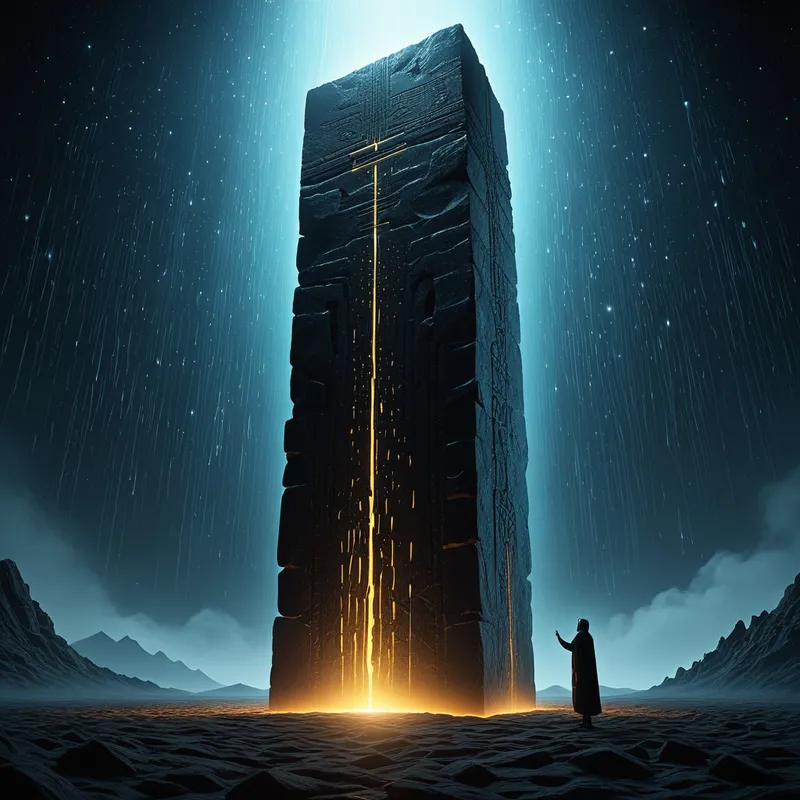
The alchemical journey modeled here is the transmutation of chaotic [prima materia](/myths/prima-materia “Myth from Alchemical culture.”/)—the raw, conflicting drives of the psyche—into the [lapis philosophorum](/myths/lapis-philosophorum “Myth from Alchemical culture.”/), the ordered and enduring “philosopher’s stone” of the mature personality. It is the stage of individuation where one moves from being ruled by complexes to becoming the ruler of one’s own inner kingdom.
The first operation is Submission to the Solar Father. The ego (Hammurabi) must ascend from its throne of willful control and submit to a higher, objective principle (Shamash). This is the death of pure subjectivity and the birth of conscience. In therapy or self-work, this is the moment of brutal, sun-lit honesty, of seeing one’s patterns and their consequences without excuse.
The second is Inscription. The received insights must be made concrete. This is the hard, patient work of writing one’s own code—defining values, setting boundaries, making promises to oneself and others. It is the “stele” we erect in our consciousness: “This I stand for. This I will not tolerate.”
The final alchemy is realizing the king and the law are not the same. The ego is the steward of the inner code, not its author. True authority comes from serving a justice greater than one’s own desire.
The [triumph](/myths/triumph “Myth from Roman culture.”/) is not in perfection, but in the very act of establishing the code. It creates an inner container strong enough to hold life’s contradictions, allowing the individual to move from a state of reactive chaos to one of responsive order, capable of wielding the rod and ring of personal sovereignty with both strength and mercy.
Associated Symbols
Explore related symbols from the CaleaDream lexicon: