The Cloud of Unknowing Myth Meaning & Symbolism
A seeker abandons all thought and image, entering a dark cloud of forgetting to touch the divine through a single, piercing dart of longing love.
The Tale of The Cloud of Unknowing
Listen, child of longing, to a tale not of light, but of a blessed and fruitful darkness.
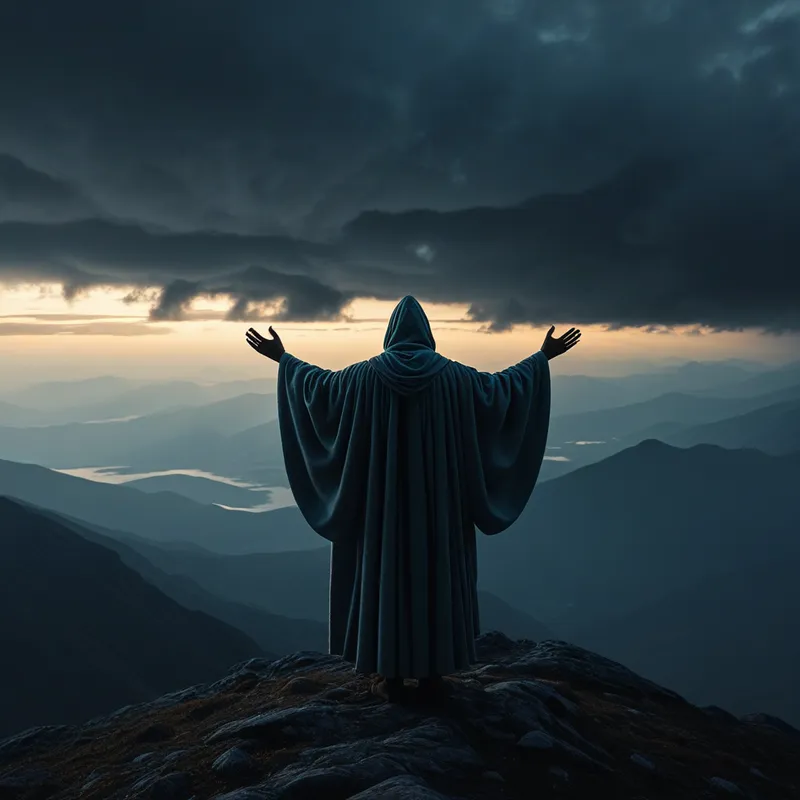
There was once a soul, weary of the marketplace of ideas, tired of the polished mirrors of reason that showed only reflections of itself. This seeker had climbed the mountain of knowledge, only to find [the summit](/myths/the-summit “Myth from Taoist culture.”/) shrouded in a mist that no logic could dispel. They had named every star, categorized every feeling, dissected every sacred text, yet the Beloved remained a rumor, a whisper heard only in the spaces between words.
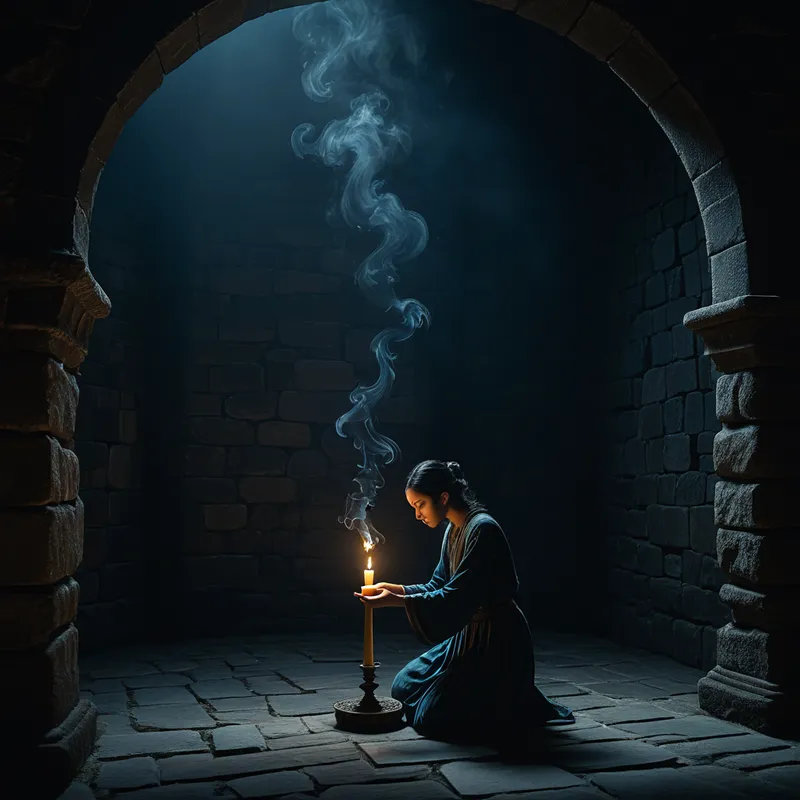
Driven by a hunger that food could not satisfy and a thirst that no well could quench, the seeker entered the hermitage of the heart. They extinguished the lanterns of the senses, one by one. Sight was let go, then sound, then the very taste and texture of thought. The cherished memories, the holy concepts, the sweetest theological consolations—all were placed gently, yet firmly, outside the door. This was not an act of destruction, but of supreme courtesy. A great <abbr title="A spiritual act of setting aside all created things, thoughts, and images to make space for the divine.">Cloud of Forgetting</abbr> descended, mercifully veiling the entire world of the known.
And in that silent, emptied chamber, the seeker beheld It: not a light, but a <abbr title="The direct, unmediated experience of the divine reality, which to the human intellect appears as a profound and impenetrable darkness.">Cloud of Unknowing</abbr>. It was a living darkness, thick and sweet, pressing upon the mind not with absence, but with a palpable, loving presence. It was a wall against all understanding, a door that could not be picked by the intellect’s clever keys. The soul trembled. Every instinct cried out to flee back to the familiar land of ideas, to light a candle of doctrine against this terrible, intimate night.
But the seeker had a single weapon, forged in the furnace of their deepest ache: a <abbr title="The focused, burning impulse of love and desire directed solely toward God, beyond all thought or image.">sharp dart of longing love</abbr>. Not a thought of love, but love itself—a naked, urgent, yearning will. And so, in the dark, they did the only work left to do. They gathered their entire being, every shred of attention and desire, and with a mighty heave of the heart, they cast this dart upward, into the heart of the Cloud.
They did not know if it struck. They received no vision, no answer, no confirming sign. Only the Cloud remained, dark and still. Yet, they cast the dart again. And again. Through seasons of dryness where the dart felt like a straw, and through moments of fiery urgency where it felt like lightning. The work was not to see, not to know, but to love the unknown. To rest in the mystery. To be present to the Presence that conceals itself.
And in time, a strange peace, deeper than any understanding, began to seep into the soul’s foundations. The Cloud did not part. It did not become light. But within its darkness, the seeker began to know by unknowing. They found that the Cloud was not a barrier, but the very substance of the Beloved’s nearness. The dart was not a weapon of assault, but a thread of connection, a lifeline of desire that bound the lover to the Loved in the only union possible: a union not of minds, but of wills, in the dark, silent country of love.
Cultural Origins & Context
This is not a myth of [the agora](/myths/the-agora “Myth from Greek culture.”/) or the epic poem, but of the cloister and [the anchor](/myths/the-anchor “Myth from Christian culture.”/)-hold. Its birthplace is the 14th century in England, a time of social upheaval, plague, and institutional corruption. In response, a flowering of vernacular, experiential spirituality emerged, seeking God not solely through the Church’s external sacraments but through an internal, direct encounter.
The Cloud of Unknowing is the title of an anonymous instructional text written for a young spiritual disciple. The author, likely a Carthusian or Augustinian monk, wrote in Middle English, making profound mystical theology accessible outside clerical Latin. The “myth” is the experiential map described within—a guide for the <abbr title="The journey of the soul into God, as described by medieval mystics like Bonaventure.">itinerarium mentis in Deum</abbr>. It was passed hand to hand, copied meticulously in scriptoria, a secret wisdom for those called to the “perfect life” of contemplation. Its function was utterly practical: to provide a psychological and spiritual technique (<abbr title="A method of prayer that focuses on a single word or short phrase to quiet the mind and open the heart to God.">the prayer of a single word</abbr>, the dart of love) for navigating the ultimate human crisis—the confrontation with the infinite mystery of God, which shatters all finite understanding.
Symbolic Architecture
The myth’s power lies in its stark, almost brutal, symbolic [architecture](/symbols/architecture “Symbol: Architecture in dreams often signifies structure, stability, and the framing of personal identity or life’s journey.”/). It presents a radical model of [consciousness](/symbols/consciousness “Symbol: Consciousness represents the state of awareness and perception, encompassing thoughts, feelings, and experiences.”/) and its transformation.
The <abbr title="The accumulated mass of memory, identity, concept, and sensory experience that constitutes the familiar self and world.">Cloud of Forgetting</abbr> represents the necessary [death](/symbols/death “Symbol: Symbolizes transformation, endings, and new beginnings; often associated with fear of the unknown.”/) of the psychological complex—the letting go of [the ego](/myths/the-ego “Myth from Jungian culture.”/)’s curated [museum](/symbols/museum “Symbol: A museum symbolizes the preservation of memories, culture, and knowledge; a place for reflection and learning.”/) of self. It is the active forgetting of what we think we are and what we think God is, to make [space](/symbols/space “Symbol: Dreaming of ‘Space’ often symbolizes the vastness of potential, personal freedom, or feelings of isolation and exploration in one’s life.”/) for what actually is.
The Cloud of Unknowing is not the absence of God, but the overwhelming presence of God that the instrument of the intellect cannot register. It is the divine reality itself, perceived as darkness by the mind that is made for created light.
The <abbr title="The focused, burning impulse of love and desire directed solely toward God, beyond all thought or image.">sharp dart of longing love</abbr> is the purified will, the essential core of the [human](/symbols/human “Symbol: The symbol of a human represents individuality, complexity of emotions, and social relationships.”/) being stripped of all imagery and agenda. It is eros—not in a sentimental sense, but as the fundamental magnetic pull of the [soul](/symbols/soul “Symbol: The soul represents the essence of a person, encompassing their spirit, identity, and connection to the universe.”/) toward its [source](/symbols/source “Symbol: The origin point of something, often representing beginnings, nourishment, or the fundamental cause behind phenomena.”/). In psychological terms, it is the libido, the psychic [energy](/symbols/energy “Symbol: Energy symbolizes vitality, motivation, and the drive that fuels actions and ambitions.”/), withdrawn from attachment to complexes and objects, and directed wholly toward the <abbr title="The central, organizing principle of the psyche that strives for wholeness and connection with the deep unconscious, analogous to the God-image.">Self</abbr>.
The entire [drama](/symbols/drama “Symbol: Drama signifies narratives, emotional expression, and the exploration of human experiences.”/) models the shift from a <abbr title="A mode of consciousness oriented toward thinking, categorization, and logical discrimination.">kataphatic</abbr> way (knowing God through affirmations and images) to an <abbr title="A mode of consciousness oriented toward negation, unknowing, and the transcendence of all concepts.">apophatic</abbr> way. It is the [journey](/symbols/journey “Symbol: A journey in dreams typically signifies adventure, growth, or a significant life transition.”/) from the God of theology to the God of experience, a journey that must pass through the [dissolution](/symbols/dissolution “Symbol: The process of breaking down, dispersing, or losing form, often representing transformation, release, or the end of a state of being.”/) of the former.
The Dreamer’s Resonance
When this myth stirs in the modern dreamer, it rarely appears as a medieval monk in a cloud. Its manifestations are more symbolic of the psychological process it describes.
You may dream of being in a familiar house that suddenly loses all its furniture and color, becoming an empty, echoing shell. You may dream of a computer or phone whose screen goes permanently black, despite your frantic tapping. You may dream of searching for a vital text in an archive, only to watch the ink fade from every page as you touch it. These are dreams of the <abbr title="The accumulated mass of memory, identity, concept, and sensory experience that constitutes the familiar self and world.">Cloud of Forgetting</abbr> at work—the [psyche](/myths/psyche “Myth from Greek culture.”/) initiating a necessary clearing of outdated identity structures.
The somatic experience is often a feeling of profound disorientation, groundlessness, or a “dark night” where former passions, beliefs, and self-concepts lose their meaning and motivational power. It can feel like depression, but its core is not absence of feeling, but a redirecting of feeling toward an object not yet known. The dreamer is in the Cloud, undergoing the painful but sacred dissolution of the known self to make room for a more authentic, but as yet unformed, totality.

Alchemical Translation
The alchemical opus of the psyche finds a perfect mirror in this myth. The process is one of <abbr title="The alchemical stage of breaking down matter into its base components, analogous to the deconstruction of the ego.">[nigredo](/myths/nigredo "Myth from Alchemical culture."/)</abbr>—the blackening, the descent into the primal darkness.
The Cloud is the alchemical crucible. The heat is not fire, but the acute, painful tension of loving what you cannot see or comprehend. In that heat, the lead of the ego-self is dissolved.
The seeker’s cell is [the alchemist](/myths/the-alchemist “Myth from Various culture.”/)’s sealed vessel. The deliberate forgetting (<abbr title="The alchemical stage of breaking down matter into its base components, analogous to the deconstruction of the ego.">[solutio](/myths/solutio "Myth from Alchemical culture."/)</abbr>, dissolution) of all mental and emotional contents is the stripping away of impurities. The <abbr title="The focused, burning impulse of love and desire directed solely toward God, beyond all thought or image.">dart of longing</abbr> is the focused, relentless application of the flame—the conscious attention and desire that drives the process forward, preventing it from stalling in mere emptiness or despair.
The goal is psychic transmutation: the shift from being led by the <abbr title="The center of conscious identity, which must be relativized for deeper wholeness.">ego</abbr> (with its need to know, control, and define) to being centered in the <abbr title="The central, organizing principle of the psyche that strives for wholeness and connection with the deep unconscious, analogous to the God-image.">Self</abbr>. This is the <abbr title="The alchemical and Jungian process of integrating the conscious and unconscious to become a psychologically whole individual.">individuation</abbr> achieved not through brilliant insight, but through humble, loving submission to the greater mystery at one’s core. The “union” achieved is the integration of the conscious mind with the guiding, archetypal depths of the unconscious. One does not become the Cloud; one learns to dwell within it, to let it be the ground of one’s being, and to know that in the deepest sense, one is of it. The final stone is not a philosopher’s stone of perfect knowledge, but a heart of perfect love, forged in the fruitful darkness of the unknown.
Associated Symbols
Explore related symbols from the CaleaDream lexicon: