The Cloak of Invisibility in G Myth Meaning & Symbolism
A myth of a cloak woven from absence, granting invisibility to the wearer but revealing the hidden cost of becoming unseen to the world.
The Tale of The Cloak of Invisibility in G
Listen, and hear the tale that is whispered not on [the wind](/myths/the-wind “Myth from Various culture.”/), but in the spaces between breaths. In the time before time was measured, when [the world](/myths/the-world “Myth from Tarot culture.”/) was raw potential, there existed a realm known only as G. It was not a place of land or sky, but of essence—a tapestry of becoming, where every thought, every fear, every unspoken dream hummed with latent form.
In this realm lived the Loom-Tenders. They were not gods of thunder or love, but sovereigns of substance. With fingers that plucked the threads of possibility, they wove the visible world from the chaos of G. Yet, for all their power, they knew a secret dread: the Unseen. For what they could not weave, they could not know, and what they could not know held a power over them.
Among them was one called An-Sera, whose curiosity was a quiet, persistent flame. While others wove mountains and rivers, An-Sera pondered the spaces between. She watched how a [thing](/myths/thing “Myth from Norse culture.”/) known became fixed, limited by the gaze that held it. “What of the essence that refuses form?” she whispered to [the void](/myths/the-void “Myth from Buddhist culture.”/). “What power lies in not being perceived?”
Her quest was not for glory, but for understanding. She journeyed to the Fringe of G, where the songs of the Loom-Tenders faded into silence. There, she did not seek to weave, but to unweave. For seven cycles of creation, she sat in perfect stillness, not adding a single thread, but paying profound attention to the absence. She listened to the silence until it spoke. She gazed into the emptiness until it revealed its texture.
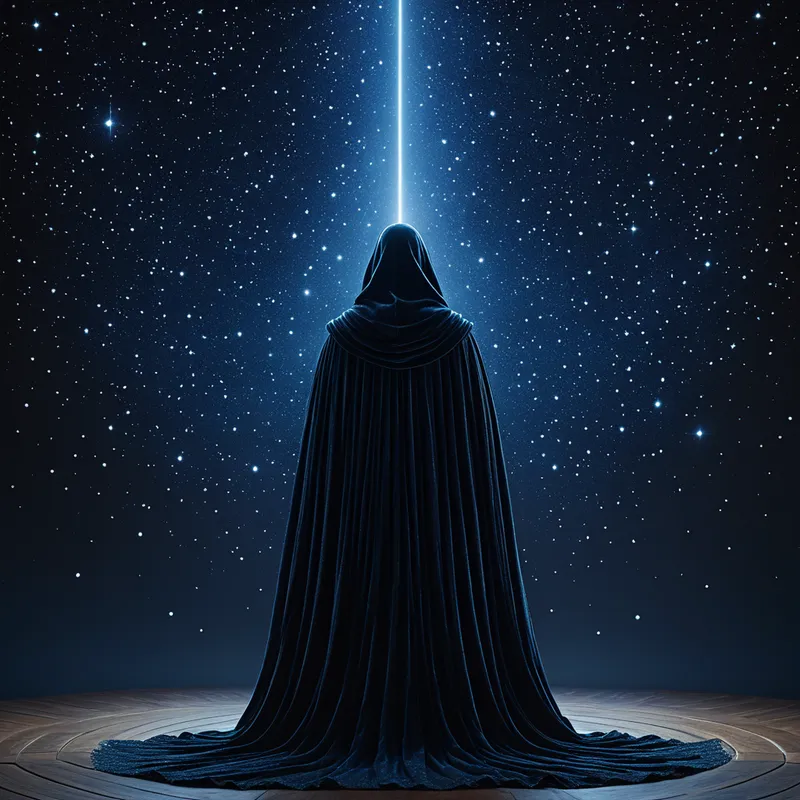
From this vigil, she gathered not thread, but the echo of thread—the memory of form where form had been refused. From the silence, she spun a yarn of quietude. From the unseen glance, she drew a filament of omission. With infinite patience, she wove these non-materials into a fabric. It did not glitter or shine; it drank the light. It did not rustle; it absorbed sound. It was the Cloak of Invisibility, a garment crafted not from something, but from the potential of something’s retreat.
When An-Sera donned the Cloak, she did not vanish in a puff of smoke. To the other Loom-Tenders, she simply… ceased to be a subject of perception. She was the stone they never noticed, the background hum they learned to ignore. She walked among them, a walking blind spot, and heard their secret fears—fears of the very unseen realms she now embodied. The power was absolute, but it carried a chill. To be unseen was to be untethered from the shared dream of reality. She was free, but she was also profoundly alone, a sovereign in a kingdom of one.
The myth ends not with a battle, but with a choice. An-Sera stands again at the Fringe, the Cloak heavy on her shoulders. Before her is the vibrant, noisy, limiting tapestry of the known world. Behind her is the boundless, silent freedom of the unseen. The tale does not record her decision. It only holds her there, at [the threshold](/myths/the-threshold “Myth from Folklore culture.”/), the weight of both visibility and invisibility balanced in her soul.
Cultural Origins & Context
The myth of the Cloak finds no single homeland; its roots are in the universal human experience of the margin. It is the story told by nomadic cultures about the spirit that walks just outside the firelight’s glow. It is the parable whispered in philosophical schools debating perception and reality. It is the cautionary tale embedded in the training of spies and mystics alike.
It was passed down not as a sacred text, but as a “threshold narrative,” recited during rites of passage—when an individual left the tribe to seek a vision, when an apprentice stepped into the master’s role, or when a community faced the terror of the unknown. Its function was dual: to name the terrifying allure of withdrawing from the collective gaze, and to map the existential cost of such an act. It served as both a warning and a guide, acknowledging the power of the unseen while tethering it to the human need for connection.
Symbolic Architecture
The [Cloak](/symbols/cloak “Symbol: A garment that conceals identity, protects from elements, or signifies authority and transformation in dreams.”/) is the ultimate [symbol](/symbols/symbol “Symbol: A symbol can represent an idea, concept, or belief, serving as a powerful tool for communication and understanding.”/) of the [Shadow](/symbols/shadow “Symbol: The ‘shadow’ embodies the unconscious, repressed aspects of the self and often represents fears or hidden emotions.”/), not as a dark [monster](/symbols/monster “Symbol: Monsters in dreams often symbolize fears, anxieties, or challenges that feel overwhelming.”/), but as that which is consciously or unconsciously edited out of our self-[presentation](/symbols/presentation “Symbol: A presentation in a dream can symbolize the act of revealing or showcasing one’s ideas, emotions, or status, reflecting the dreamer’s current life circumstances or relationships.”/). It represents all we hide to belong, to be safe, to be loved. The power it grants is the power of the unobserved—the freedom from judgment, from expectation, from the exhausting labor of maintaining a [persona](/symbols/persona “Symbol: The social mask or outward identity one presents to the world, often concealing the true self.”/).
To wear the Cloak is to hold the paradox: one gains the freedom of the unseen, but loses the reality that is co-created by being seen.
An-Sera’s [journey](/symbols/journey “Symbol: A journey in dreams typically signifies adventure, growth, or a significant life transition.”/) to the Fringe of G symbolizes the necessary withdrawal from collective [consciousness](/symbols/consciousness “Symbol: Consciousness represents the state of awareness and perception, encompassing thoughts, feelings, and experiences.”/) required for deep introspection. The act of weaving from “non-materials” is the psychological process of giving form to the formless contents of the unconscious—naming the anxieties, the repressed talents, the silent griefs that we have refused to “weave” into our [identity](/symbols/identity “Symbol: Identity represents the sense of self, encompassing personal beliefs, cultural background, and social roles.”/). The Cloak itself, therefore, is the integrated shadow. It is not the repressed [material](/symbols/material “Symbol: Material signifies the tangible aspects of life, often representing physical resources, desires, and the physical world’s influence on our existence.”/), but the [capacity](/symbols/capacity “Symbol: A measure of one’s potential, limits, or ability to contain, process, or achieve something, often reflecting self-assessment or external demands.”/) to hold it, to consciously choose when and how it enters the visible world.
The Loom-Tenders represent the collective, societal norms that weave a consensus [reality](/symbols/reality “Symbol: Reality signifies the state of existence and perception, often reflecting one’s understanding of truth and life experiences.”/). Their [dread](/symbols/dread “Symbol: A profound, anticipatory fear of impending doom or catastrophe, often without a clear external threat. It manifests as a heavy, paralyzing emotional state.”/) of the Unseen is civilization’s fear of the irrational, the individual, the uncontrollable. An-Sera’s final, unresolved stance at the threshold is the eternal [human](/symbols/human “Symbol: The symbol of a human represents individuality, complexity of emotions, and social relationships.”/) [condition](/symbols/condition “Symbol: Condition reflects the state of being, often focusing on physical, emotional, or situational aspects of life.”/): the [tension](/symbols/tension “Symbol: A state of mental or emotional strain, often manifesting physically as tightness, pressure, or unease, signaling unresolved conflict or anticipation.”/) between individuation and belonging, between absolute authenticity and social necessity.
The Dreamer’s Resonance
When this myth stirs in the modern dreamscape, it often manifests as dreams of being transparent, of shouting in a soundproof room, or of wearing a garment that makes one a ghost among the living. The somatic experience is one of profound chill and silence—a visceral sense of existential isolation.
This dream pattern signals a critical phase in individuation. The dreamer is grappling with a part of [the self](/myths/the-self “Myth from Jungian culture.”/) that feels it must hide to survive, or conversely, with a newfound awareness that is too fragile for the harsh light of day. The Cloak appears when the [psyche](/myths/psyche “Myth from Greek culture.”/) is negotiating a massive withdrawal—perhaps from a toxic social role, a stifling career, or a false self—in order to reclaim an authentic identity. The dream is the psyche’s way of experiencing the terrifying power and the profound loneliness of that withdrawal, forcing the dreamer to feel the cost of becoming “unseen” before they can consciously choose how to be seen anew.
Alchemical Translation
The myth models the alchemical [Nigredo](/myths/nigredo “Myth from Alchemical culture.”/), the descent into darkness and dissolution. An-Sera’s vigil at the Fringe is the retreat necessary for this stage. She does not fight the formless void of G; she learns its language. This is the psychological equivalent of turning toward one’s depression, anxiety, or sense of meaninglessness—not to battle it, but to understand its substance.
The weaving of the Cloak is the Albedo—the extraction of a new principle from the black mass. From the chaos of the unconscious (the Fringe), a new capacity is formed: the ability to consciously hold one’s hidden aspects (the Cloak). This is not yet integration, but the creation of [the vessel](/myths/the-vessel “Myth from Alchemical culture.”/) that makes integration possible.
The ultimate alchemical gold is not the permanent donning of the Cloak, but the mastery of its clasp. It is the achieved ability to move between visibility and invisibility with conscious choice, to be seen without being consumed, and to retreat without being lost.
The myth’s unresolved ending is its most profound teaching. Individuation is not a final state of perfected visibility or permanent withdrawal. It is the attainment of that threshold stance. The integrated individual is like An-Sera at the Fringe, capable of engaging fully in the woven world while knowing its threads are not the whole of reality, and able to retreat into the sanctuary of the self without dissolving into oblivion. They wear the Cloak not to hide, but to remember that they are always more than what meets the eye.
Associated Symbols
Explore related symbols from the CaleaDream lexicon: