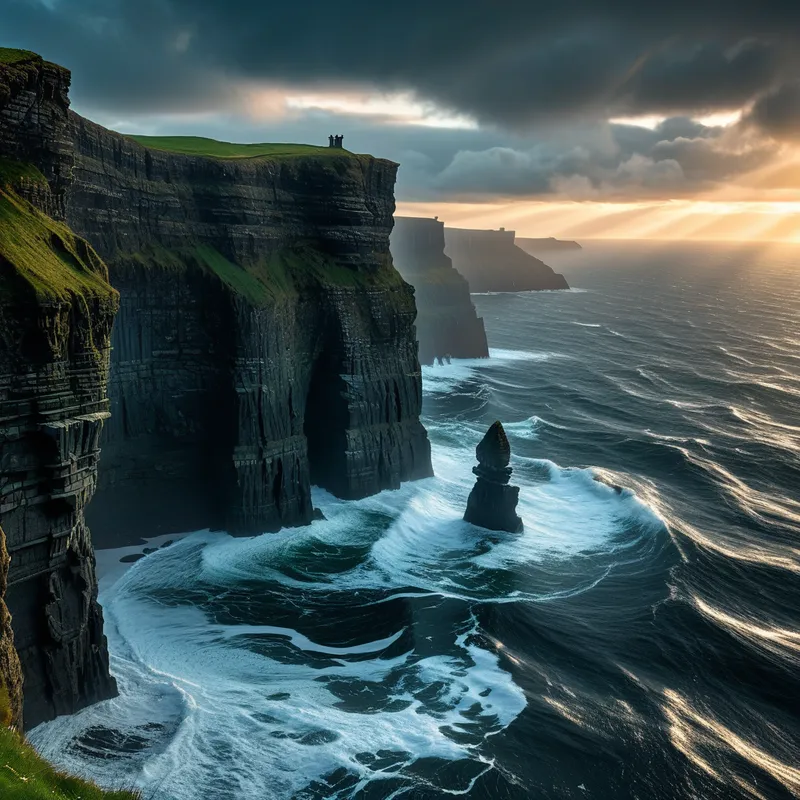
The Cliffs of Moher Myth Meaning & Symbolism
A giantess, grieving her lost love, weeps into the sea. Her tears become the Cliffs of Moher, a monument to love's enduring and formidable power.
The Tale of The Cliffs of Moher
Listen now, and let [the wind](/myths/the-wind “Myth from Various culture.”/) from the western sea carry you back. Before the stone forts of the Tuatha Dé Danann, before the coming of [the Milesians](/myths/the-milesians “Myth from Celtic culture.”/), the land was shaped by beings of a grander scale. Their hearts were as deep as the ocean trenches, their sorrows as vast as [the sky](/myths/the-sky “Myth from Persian culture.”/).
There was a giantess, Cailleach an Mhóthair. She was not a creature of malice, but of profound feeling, a spirit of the very earth and sea. Her love was a warrior of the [Fomorians](/myths/fomorians “Myth from Irish culture.”/), a being of storm and chaos, named Gránna Farraige. Their courtship shook the foundations of [the world](/myths/the-world “Myth from Tarot culture.”/); their laughter was the crash of waves against headlands, their whispers the hiss of retreating foam on sand.
But the Tuatha Dé Danann, the new gods of skill and light, waged their great war. In a battle that churned [the sea](/myths/the-sea “Myth from Greek culture.”/) to mist, Gránna Farraige was cast down, his essence scattered to the four winds. Cailleach an Mhóthair searched the shattered coasts, her cries a gale that stripped the trees bare. For seven years she wandered the edge of the world, where the land gives way to the endless grey Atlantic.
Finding no trace, her grief became a solid, silent [thing](/myths/thing “Myth from Norse culture.”/). It settled in her bones, heavy as bedrock. She went to the very westernmost point, where the land finally ended. There, she turned her face to the empty horizon where her love had vanished. She did not scream. She did not rage. She simply wept.
Her tears were not [water](/myths/water “Myth from Chinese culture.”/), but the very substance of her soul—a mixture of memory, love, and loss. They fell, one by one, into the seething ocean below. Where each tear struck the water, the sea recoiled. Where it touched the submerged rock, [the earth](/myths/the-earth “Myth from Hindu culture.”/) itself responded to her sorrow. Stone surged upward, not in a violent eruption, but in a slow, aching crescendo of defiance against [the void](/myths/the-void “Myth from Buddhist culture.”/). Layer upon layer of dark shale and sandstone rose, hardening in the salt wind, forming a sheer, impregnable wall.
She wept until she had no more tears, until her body grew stiff and cold. Her form itself petrified, becoming one with the monumental cliffs she had birthed. Her flowing hair became the grassy headlands, her steadfast gaze the watchful presence of the headland. The seabirds that nested in the crags became the echoes of her lost love’s voice, forever crying on the wind. Thus were the Cliffs of Moher forged—not from fire or force, but from the slow, monumental alchemy of a love that would not let the sea, or oblivion, have the final word.
Cultural Origins & Context
This tale belongs not to the written canon of medieval Irish manuscripts, but to the older, more fluid tradition of dinnseanchas—the lore of place. The Cliffs of Moher (from Mothar, meaning “ruined fort”) are a real, awe-inspiring geographical feature in County Clare. Their myth, like the lichen on the stone, grew from the land itself. It was told by local seanchaí to explain the terrifying and sublime beauty of the place.
The story functions as a etiological myth, answering the human need to know why a place feels as it does. But in the Celtic worldview, a place’s spirit (genius loci) and its story are inseparable. The tale served a deeper societal function: it encoded a relationship with the landscape that was psychological and sacred. It taught that overwhelming emotion, even grief, was not a private failing but a cosmic, landscape-shaping force. It rooted the community’s identity in a narrative where human-scale feelings—love, loss, endurance—were writ large on the very boundary between their known world and the terrifying, fertile unknown of the ocean.
Symbolic Architecture
The myth’s power lies in its stark, elemental [symbolism](/symbols/symbolism “Symbol: The use of symbols to represent ideas or qualities, often conveying deeper meanings beyond literal interpretation. In dreams, it’s the language of the unconscious.”/). The giantess represents the [Anima](/symbols/anima “Symbol: The feminine archetype within the male unconscious, representing soul, creativity, and connection to the inner world.”/) in its most raw, natural, and monumental form. She is not a domesticated [goddess](/symbols/goddess “Symbol: The goddess symbolizes feminine power, divinity, and the nurturing aspects of life, embodying creation and wisdom.”/) of a hearth, but a primal force of the untamed periphery. Her lost [lover](/symbols/lover “Symbol: A lover in dreams often represents intimacy, connection, and the emotional aspects of relationships.”/), the Fomorian, symbolizes the chaotic, creative, and ultimately uncontrollable [depths](/symbols/depths “Symbol: Represents the subconscious, hidden emotions, or foundational aspects of the self, often linked to primal fears or profound truths.”/) of the unconscious with which she sought union.
The cliff is the solidified boundary between the known self and the unknown depths, born not from fear, but from the sacred act of mourning what has been lost to those depths.
The tears are the crucial alchemical agent. They are not passive; they are the conscious [expression](/symbols/expression “Symbol: Expression represents the act of conveying thoughts, emotions, and individuality, emphasizing personal communication and creativity.”/) of feeling that actively transmutes the inner state (sorrow) into an outer, permanent [reality](/symbols/reality “Symbol: Reality signifies the state of existence and perception, often reflecting one’s understanding of truth and life experiences.”/) (the [cliff](/symbols/cliff “Symbol: Dreaming of a cliff often symbolizes a significant decision point or a transition, representing both the fear of failure and the potential for growth.”/)). The resulting cliffs symbolize the [psyche](/myths/psyche “Myth from Greek culture.”/)’s [defense](/symbols/defense “Symbol: A protective mechanism or barrier against perceived threats, representing boundaries, security, and resistance to external or internal challenges.”/) [structure](/symbols/structure “Symbol: Structure in dreams often symbolizes stability, organization, and the framework of one’s life, reflecting how one perceives their environment and personal life.”/)—its boundaries, its ego—formed from emotional experience, not in [opposition](/symbols/opposition “Symbol: A pattern of conflict, duality, or resistance, often representing internal or external struggles between opposing forces, ideas, or desires.”/) to it. They are a [monument](/symbols/monument “Symbol: A structure built to commemorate a person, event, or idea, often representing legacy, memory, and cultural identity.”/) to the fact that our deepest wounds, when fully felt and honored, can become the very foundations of our [character](/symbols/character “Symbol: Characters in dreams often signify different aspects of the dreamer’s personality or influences in their life.”/) and our conscious standpoint.
The Dreamer’s Resonance
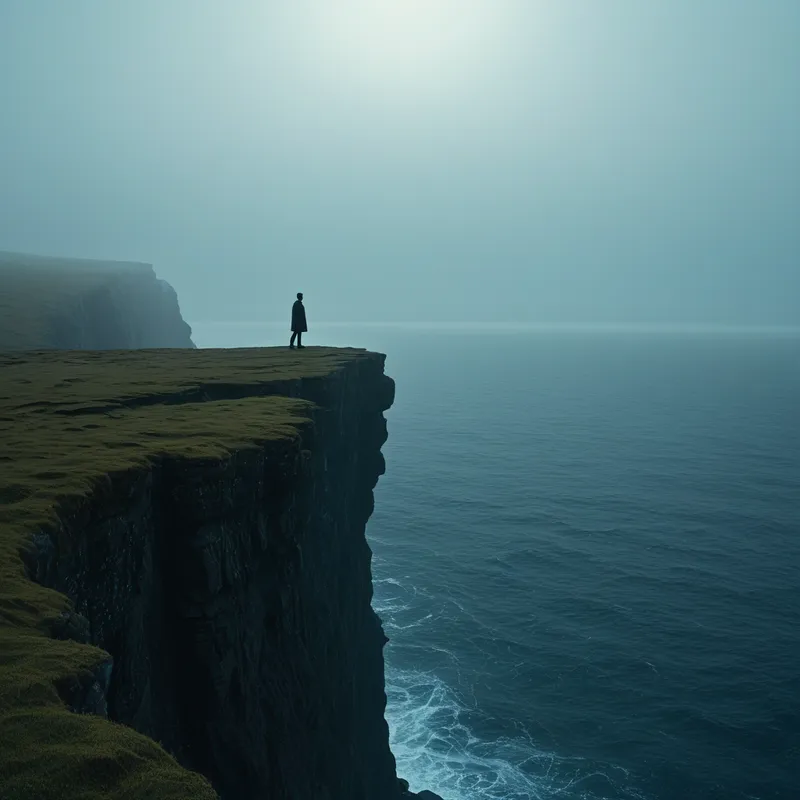
When this myth pattern surfaces in modern dreams, the dreamer is often at a precipice in their emotional life. To dream of standing on such a cliff, feeling the vertigo of the drop and the roar of the sea below, is to confront the edge of one’s own known identity. The somatic feeling is often one of both awe and terror in the chest and gut—the body recognizing a profound threshold.
The dream may feature a vast, emotional body of water (the unconscious) threatening to engulf or erode the stable land (the conscious ego). The psychological process at work is the confrontation with a grief, a love, or a passion so large it feels it could dissolve [the self](/myths/the-self “Myth from Jungian culture.”/). The dream is the psyche’s way of initiating the “weeping”—the necessary, often resisted, process of fully experiencing that emotion. The dream asks: What loss have you not mourned? What feeling is so vast you fear it will destroy you? The myth assures that this very process is what forges a stronger, more defined boundary between the inner world of feeling and the outer world of action.
Alchemical Translation
The individuation process, the journey toward psychic wholeness, requires a conscious relationship with the depths. The Cliffs of Moher myth models this not as a heroic conquest of the deep, but as a sacred demarcation born of relationship to it.
[The first stage](/myths/the-first-stage “Myth from Alchemical culture.”/) is the union—the love affair with the deep, chaotic, creative Fomorian aspect of the unconscious. This is the necessary, often tumultuous, immersion in instinct and passion. The second stage is the loss—the inevitable moment when that raw, unmediated connection cannot be sustained by the conscious personality; it is “scattered to the winds.” The critical, transformative third stage is the grieving at the boundary. This is the alchemical [nigredo](/myths/nigredo “Myth from Alchemical culture.”/).
Individuation does not mean reclaiming the lost paradise of unconscious unity, but building a conscious standpoint from the sacred material of its loss.
The giantess does not try to become the sea again. She turns her face to it, and from her fully felt sorrow, she creates a new, enduring form—the cliff. In psychological terms, [the ego](/myths/the-ego “Myth from Jungian culture.”/) is not the enemy of the unconscious; it is its necessary counterpart, formed and solidified through the conscious processing of deep emotional experience. The [triumph](/myths/triumph “Myth from Roman culture.”/) is not in having the love, but in having loved so deeply that the memory of it becomes an unshakeable part of your structure, your cliff, from which you can observe the depths without falling into them. You become the watchful guardian of your own boundary, forged in the salt and sorrow of your most profound attachments.
Associated Symbols
Explore related symbols from the CaleaDream lexicon: