The City of Ys Myth Meaning & Symbolism
A Breton legend of a glorious city, drowned by the sea when a princess's forbidden key unlocks the floodgates of chaos and consequence.
The Tale of The City of Ys
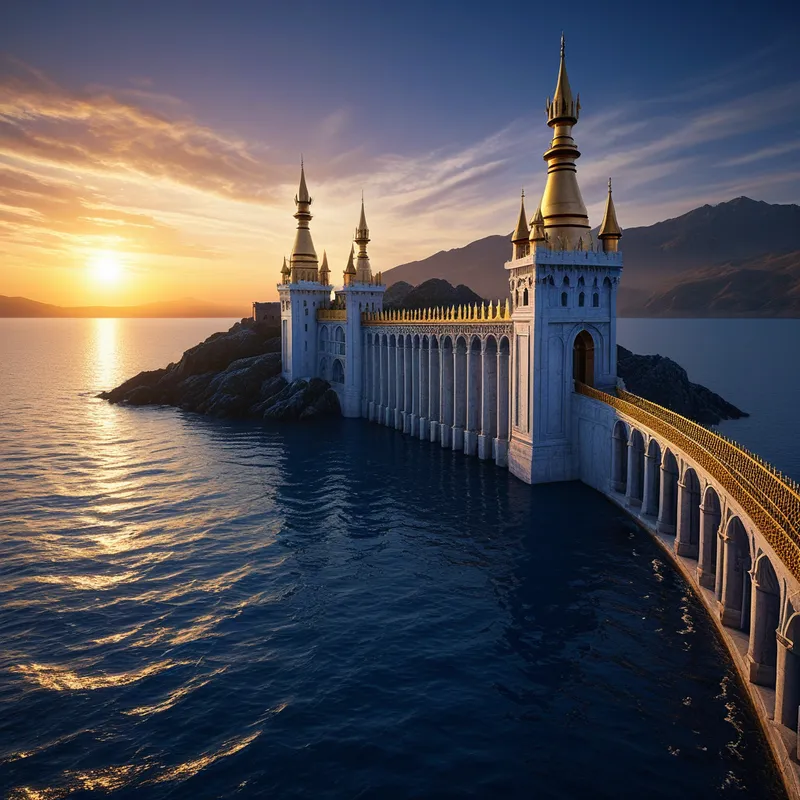
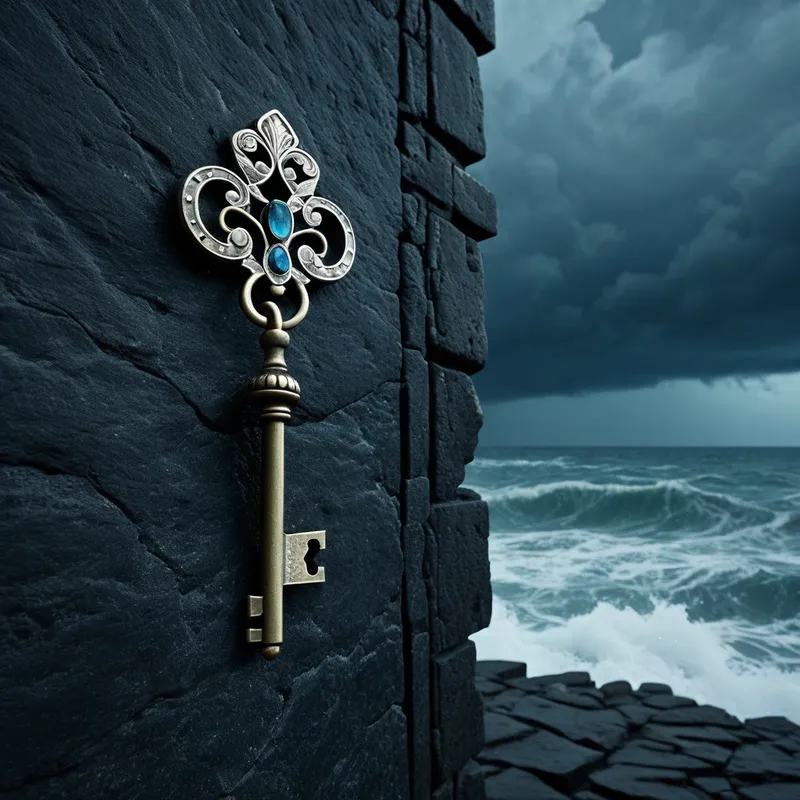
Hear now the tale of Ker-Ys, the fairest city that ever was or ever will be, a jewel set in the wild breast of the Armorican sea. Its walls were of white marble, its towers touched the low-slung Breton clouds, and its streets rang with the music of harps and the laughter of a people blessed. This glory was the work of Gradlon, a wise and pious king, but its protection was a gift from a deeper power. For the city was built below [the sea](/myths/the-sea “Myth from Greek culture.”/) level, a daring defiance of nature, saved from the hungry waves only by a magnificent dyke. And in this dyke was set a single, silver gate. The key to this gate Gradlon wore on a chain around his own neck, a sacred trust. None could open it but he.
To Gradlon was born a daughter, Dahut. Her hair was like spun night, her eyes held the shifting colours of the sea, and her spirit was as wild and untamed as the ocean storms. She loved the city’s splendour but chafed at its pious quiet. She dreamed of different music, of revels that lasted until dawn, of a freedom that knew no walls, not even those that held back the sea. The city, under her influence, began to change. The sober hymns were drowned out by wilder songs; virtue grew sleepy, and desire walked the streets with a bolder step.
One fateful night, a stranger came to Ys. A knight in red armour, with a voice like honey and shadow in his eyes. Dahut was captivated. He promised her a love as vast and deep as the ocean, a kingdom without limits. “Your city is beautiful,” he whispered, “but it is a cage. The great sea beyond holds mysteries your pious father fears. Give me the key to the gate, and I will show you a world where we can rule, unbound.”
Drunk on wine and this intoxicating promise, Dahut stole into her father’s chamber as he slept. The weight of the silver key was cold in her hand. [The world](/myths/the-world “Myth from Tarot culture.”/) held its breath. She crept to the massive dyke, the knight at her side. With a turn that echoed like a crack in the world’s foundation, the lock released. The knight’s laughter turned to a roar that was not human. He was no knight, but a demon of the deep, and as the gates swung open, the pent-up sea, a towering wall of black [water](/myths/water “Myth from Chinese culture.”/) and fury, rushed in.
The music died. The laughter turned to screams. The marble towers groaned and shattered. Gradlon awoke to the thunder of doom. Seizing Dahut, he mounted his magical steed, Morvarc’h, and fled the drowning streets. But the sea pursued, its waves like grasping hands. A voice boomed from the tempest—some say it was the saint Gwennolé—“King! The weight of sin drags you down! You must choose!” And Gradlon, his heart breaking with a father’s love and a king’s duty, made the terrible choice. He pushed Dahut from the saddle into the ravenous waves. The sea slowed, satisfied. Morvarc’h carried the broken king to safety, where he founded the city of Quimper. But behind him, where the fairest city had shone, there was only the endless, sighing sea. To this day, fishermen say that in the calm of morning, you can still hear [the drowned](/myths/the-drowned “Myth from Norse culture.”/) bells of Ys ringing from the deep.
Cultural Origins & Context
The legend of Ys is a cornerstone of Breton folklore, a poignant myth from a culture intimately wedded to the sea. Unlike the Irish or Welsh cycles preserved by literate monks, this story lived primarily in the oral tradition, told by fishermen, farmers, and village storytellers for centuries before being collected by folklorists in the 19th century. Its function was multifaceted. On one level, it was an aetiological myth, explaining the treacherous waters of the Bay of Douarnenez and serving as a stark warning about coastal living. On a deeper level, it was a moral and social narrative. It reinforced the peril of hubris—of building a civilization in defiance of natural law—and the catastrophic consequences of transgressing sacred boundaries, symbolized by the stolen key. The figure of Dahut, often later Christianized as a wilful sinner, may echo older, more ambivalent archetypes of sovereignty goddesses or figures of chaotic desire that must be controlled for the kingdom’s stability. The myth was the community’s way of wrestling with the very real perils of the sea, the tensions between desire and duty, and the ever-present threat of a prosperous order collapsing into chaos.
Symbolic Architecture
The [City](/symbols/city “Symbol: A city often symbolizes community, social connection, and the complexities of modern life, reflecting the dreamer’s relationships and societal integration.”/) of Ys is a profound [symbol](/symbols/symbol “Symbol: A symbol can represent an idea, concept, or belief, serving as a powerful tool for communication and understanding.”/) of the ego-[consciousness](/symbols/consciousness “Symbol: Consciousness represents the state of awareness and perception, encompassing thoughts, feelings, and experiences.”/) in its splendid, fragile [isolation](/symbols/isolation “Symbol: A state of physical or emotional separation from others, often representing a need for introspection or signaling distress.”/). Built below sea level, it represents a psychological state that has developed a complex and beautiful [identity](/symbols/identity “Symbol: Identity represents the sense of self, encompassing personal beliefs, cultural background, and social roles.”/), yet one that is fundamentally out of alignment with the greater, [unconscious depths](/symbols/unconscious-depths “Symbol: The hidden, primordial layers of the psyche containing repressed memories, instincts, archetypes, and collective wisdom beyond conscious awareness.”/) (the sea) that surround it. The dyke and the silver key symbolize the necessary, but tense, [barrier](/symbols/barrier “Symbol: A barrier symbolizes obstacles, limitations, and boundaries that prevent progression in various aspects of life.”/) between conscious [life](/symbols/life “Symbol: The symbol of ‘Life’ represents a journey of growth, interconnectedness, and existential meaning, encompassing both the joys and challenges that define human experience.”/) and the unconscious. It is a controlled [relationship](/symbols/relationship “Symbol: A representation of connections we have with others in our lives, often reflecting our emotional state.”/), where the [king](/symbols/king “Symbol: A symbol of ultimate authority, leadership, and societal order, often representing the dreamer’s inner power or external control figures.”/)-ego manages the flow.
The key is not merely an object; it is the principle of discrimination, the conscious choice to engage with or seal away the contents of the deep self.
Dahut embodies the repressed or exiled aspects of the [psyche](/myths/psyche “Myth from Greek culture.”/)—the wild [anima](/symbols/anima “Symbol: The feminine archetype within the male unconscious, representing soul, creativity, and connection to the inner world.”/), untamed instinct, and a thirst for experience that finds [the ego](/myths/the-ego “Myth from Jungian culture.”/)’s orderly [kingdom](/symbols/kingdom “Symbol: A kingdom symbolizes authority, belonging, and a sense of identity within a larger context or community.”/) stifling. Her [alliance](/symbols/alliance “Symbol: A formal or informal union between individuals or groups for mutual benefit, support, or protection.”/) with the Red [Knight](/symbols/knight “Symbol: The knight symbolizes honor, chivalry, and the pursuit of noble causes, reflecting the ideal of the noble warrior.”/), a classic [animus](/symbols/animus “Symbol: In Jungian psychology, the masculine inner personality in a woman’s unconscious, representing logic, action, and spiritual guidance.”/) or [shadow figure](/symbols/shadow-figure “Symbol: The shadow figure represents the repressed or hidden aspects of oneself, often embodying fears or unresolved conflicts that can impact personal growth.”/) of seductive, destructive potential, marks the [moment](/symbols/moment “Symbol: The symbol of a ‘moment’ embodies the significance of transient experiences that encapsulate emotional depth or pivotal transformations in life.”/) when repressed desire, conspiring with unconscious [shadow](/symbols/shadow “Symbol: The ‘shadow’ embodies the unconscious, repressed aspects of the self and often represents fears or hidden emotions.”/) elements, actively seeks to overthrow the ruling principle. The flooding is not a [punishment](/symbols/punishment “Symbol: A dream symbol representing consequences for actions, often tied to guilt, societal rules, or internal moral conflicts.”/) from an external god, but the inevitable psychic catastrophe when the barriers are dissolved not through [integration](/symbols/integration “Symbol: The process of unifying disparate parts of the self or experience into a cohesive whole, often representing psychological wholeness or resolution of internal conflict.”/), but through possession. [The ego](/myths/the-ego “Myth from Jungian culture.”/) (Gradlon) must then make the terrible, sacrificial [choice](/symbols/choice “Symbol: The concept of choice often embodies decision-making, freedom, and the multitude of paths available in life.”/) to let the possessed element (Dahut) be re-submerged to save the core of consciousness, albeit forever scarred by the [loss](/symbols/loss “Symbol: Loss often symbolizes change, grief, and transformation in dreams, representing the emotional or psychological detachment from something or someone significant.”/).
The Dreamer’s Resonance
When this myth stirs in modern dreams, it often signals a profound crisis of containment. The dreamer may experience dreams of overwhelming floods, of beautiful but fragile structures collapsing, or of being entrusted with a crucial object (a key, a code, a secret) that they lose or misuse. Somatically, this can feel like a rising panic, a sense of being “in over your head,” or a literal feeling of suffocation upon waking.
Psychologically, this is the process of a long-maintained defence or [persona](/myths/persona “Myth from Greek culture.”/) cracking under pressure from unconscious contents. The “City” is often a life structure—a career, a relationship, a self-image—that has been built on a foundation that ignores deeper needs or truths (the “sea level” of the authentic self). Dahut’s rebellion in the dream represents those ignored needs now erupting with destructive force. The dream is not forecasting literal doom, but sounding the alarm of an unsustainable psychic arrangement. It is [the Self](/myths/the-self “Myth from Jungian culture.”/) demanding a reconciliation, warning that if the conscious attitude does not voluntarily engage with the depths, the depths will engage with it, catastrophically.

Alchemical Translation
The alchemical journey mirrored in Ys is the [nigredo](/myths/nigredo “Myth from Alchemical culture.”/), the necessary descent and dissolution. The proud, isolated city (the [prima materia](/myths/prima-materia “Myth from Alchemical culture.”/) of the old personality) must be drowned, reduced to its components in the salty sea of the unconscious. This is not an end, but the brutal beginning of individuation.
The drowning of the city is the death of the old, rigidified ego-structure, making way for the possibility of a Self that is in dialogue with the ocean, not defiantly walled against it.
Gradlon’s terrible choice—pushing Dahut away—is a critical, if painful, stage. It represents the conscious ego relinquishing its identification with and possession by the chaotic complex. It is not the final integration of the anima, but the necessary separation from its demonic, destructive form. The founding of Quimper on solid ground symbolizes the next stage: building a new conscious attitude (albedo) informed by the catastrophe, humbled by the sea, but established in a more honest relationship with reality. The modern individual’s parallel process involves allowing a cherished but false self-image to “drown,” to endure the nigredo of depression or disorientation, and to make the hard choice to sacrifice an alluring but destructive pattern. From that flood, a more grounded and authentic life, forever mindful of the deep waters within, can slowly be built. The bells of the lost city, heard in moments of quiet, become not just memories of failure, but reminders of the depth that now sustains the new foundation.
Associated Symbols
Explore related symbols from the CaleaDream lexicon: