The Churning of the Ocean Myth Meaning & Symbolism
A cosmic collaboration between gods and demons churns the ocean of existence, birthing treasures, poisons, and the ultimate elixir of immortality.
The Tale of The Churning of the Ocean
In the dawn of an age, the world grew weary. The Devas had lost their luster, their power drained by time and conflict. Their adversaries, the Asuras, though mighty, were cursed with mortality’s shadow. A great pall of entropy hung over the three worlds. From this shared despair, a radical idea was born—not of war, but of collaboration. To regain their vitality and secure the nectar of immortality, the Amrita, they would have to churn the primordial ocean of milk, the Kshirasagara.
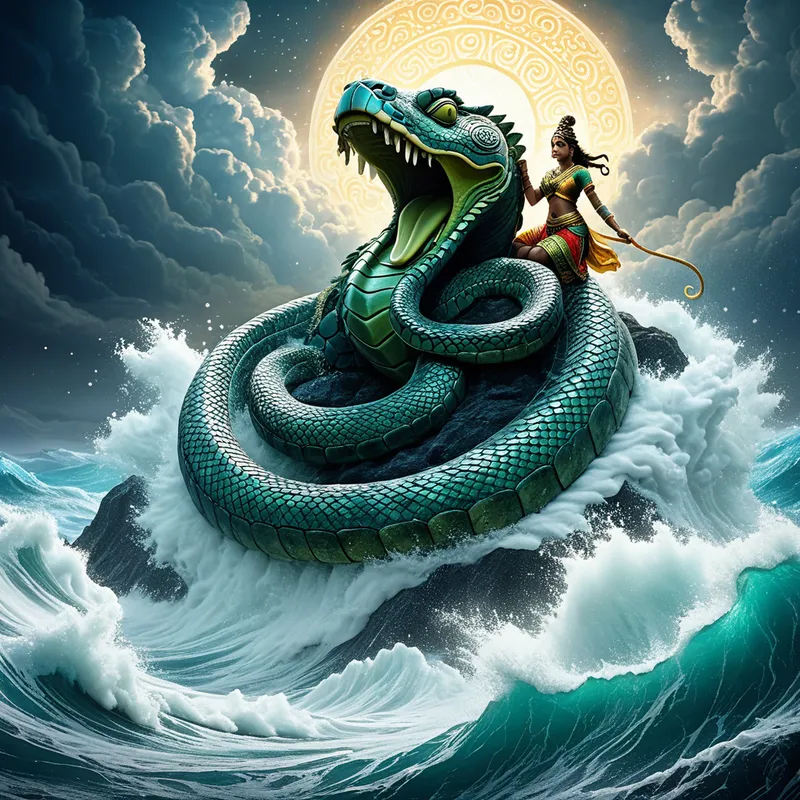
They uprooted the mighty mountain Mandara. They persuaded the king of serpents, the mighty Vasuki, to coil himself around the mountain’s peak. The Devas took hold of the serpent’s tail; the Asuras, his head. With a collective roar that shook the foundations of space, they began to pull. Back and forth, in a great cosmic tug-of-war, they heaved. The mountain span, grinding against the shell of the great turtle Kurma, who had risen from the depths to bear its weight.
The churning began. At first, only froth and foam. Then, the ocean, stirred to its very soul, began to yield its hidden treasures. First came Kamadhenu, the celestial cow. Then Varuni, the goddess of wine. The Parijata tree bloomed, scenting the cosmos. The moon, Chandra, was plucked from the waters and placed upon Shiva’s brow. From the foam rose Lakshmi, radiant, her gaze falling upon Vishnu. Airavata, the white elephant, and Uchchaishravas, the seven-headed horse, emerged, symbols of royal power.
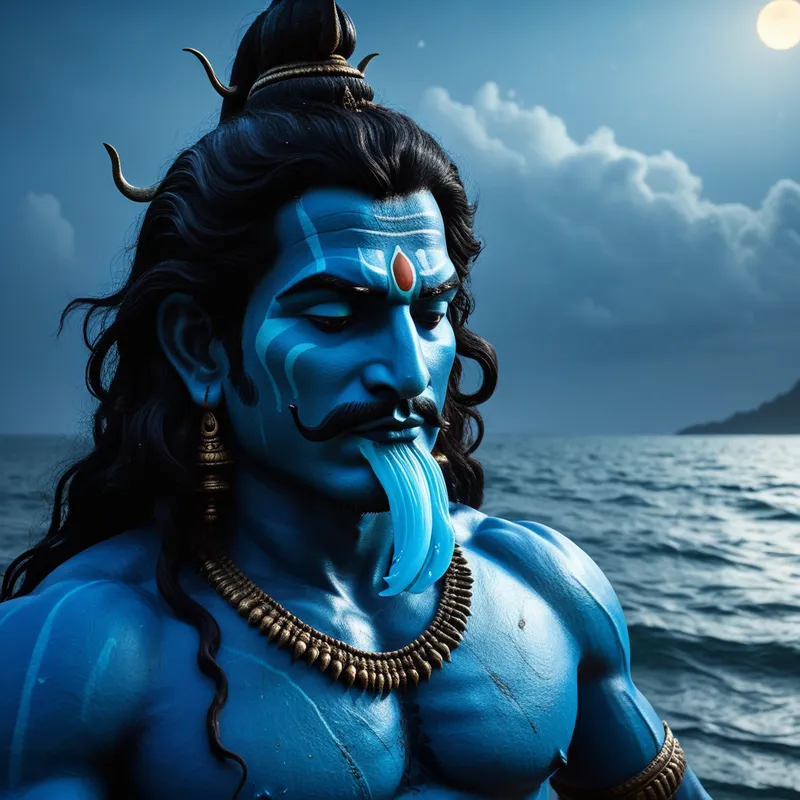
But the ocean was not only a womb of wonders. As the churning reached a fever pitch, a terrible, seething darkness erupted from the depths—a vile, suffocating poison known as Halahala. It spread like a black tide, threatening to consume all creation. The Devas and Asuras alike recoiled in terror. In that moment of cosmic crisis, the great ascetic Shiva stepped forward. With infinite compassion and a calm that stilled the universe, he gathered the virulent poison into his palms and drank it. To save the world, he held the poison in his throat, which turned blue forever, earning him the name Neelakantha.
Purified by this supreme sacrifice, the churning could continue. Finally, from the heart of the milky sea, arose Dhanvantari, holding aloft the glowing pot of Amrita. A fierce struggle erupted for the pot. Vishnu, the orchestrator, took the form of the enchanting Mohini to distract the Asuras, ensuring the elixir went to the Devas, restoring cosmic balance. The churning ceased. The mountain was returned. The serpent rested. And the world, though scarred by poison, was reborn through a collaboration of opposites.
Cultural Origins & Context
The myth of the Churning of the Ocean, or Samudra Manthan, is a cornerstone narrative from the great Puranic literature, most prominently detailed in the Mahabharata and the Vishnu Purana. It was not a story confined to temple walls but a living cosmology recited by storytellers and priests, a metaphysical map embedded in the collective consciousness of the culture. Its function was multifaceted: it explained the origins of celestial objects (the moon, the sun), divine beings, and natural wonders. More profoundly, it served as a societal allegory for the necessary, tense collaboration between order (Devas) and chaos (Asuras), between the forces of light and the powers of ambition, suggesting that the greatest treasures—and the greatest perils—emerge only when these opposites engage in a dynamic, creative struggle. It was a myth that validated the world’s complexity, teaching that creation is always preceded by a violent, collaborative agitation of potential.
Symbolic Architecture
The myth is a grand allegory for the process of psychological and spiritual transformation. The Kshirasagara is the unconscious itself—the vast, undifferentiated ocean of psychic potential, containing both our highest virtues and our deepest poisons.
The elixir is always found in the same sea as the poison. Wholeness demands we confront both.
The Devas and Asuras represent the conscious and unconscious, or the spiritual and material impulses within the psyche. They are not simply “good vs. evil,” but complementary opposites—the self’s need for order and its drive for power. Their collaboration signifies that profound change cannot be achieved by one aspect of the self alone; it requires the total engagement of our entire being, even the parts we deem demonic. Mount Mandara is the axis mundi, the steadfast spine of consciousness around which the transformation occurs. The serpent Vasuki is the coiled, primal energy (kundalini) that, when harnessed, provides the motive force for this inner revolution.
The sequential emergence of treasures maps the evolution of consciousness: sustenance (Kamadhenu), joy (Varuni), beauty (Lakshmi), and finally, the transcendent Self (Amrita). But the path is non-linear. The eruption of Halahala is the critical confrontation with the Shadow—the toxic, repressed aspects of the self that must surface during any deep psychological work. Shiva’s act is the archetype of conscious containment; the poison is not destroyed but integrated, transmuted into a mark of distinction (the blue throat). Immortality (Amrita) is not merely endless life, but the achievement of a timeless, integrated state of being, which often requires a trickster’s wisdom (Mohini) to secure from the grasp of undifferentiated desire.
The Dreamer’s Resonance
When this myth stirs in the modern dreamer, it signals a profound somatic and psychic process of upheaval. One may dream of being on a vast, turbulent body of water, or of participating in a great, exhausting collective effort. There is a palpable sense of straining, of a necessary but difficult collaboration with an “other” (a partner, a rival, an inner demon). The dreamer might feel the nausea of churning, the anxiety of what might surface.
This is the psyche’s own Samudra Manthan. The somatic feeling is one of deep agitation—the gut churning, the heart racing—as long-buried contents of the unconscious are stirred into awareness. The treasures that appear in the dream—a sudden gift, a beautiful figure, a guiding animal—are nascent potentials coming to light. But so too might be the poisons: dream images of black sludge, venomous creatures, or suffocating fumes. These are not signs of failure, but of depth. The dream is orchestrating a necessary confrontation. The critical question the dream poses is: Who, or what, in your psyche is playing the role of Shiva? What aspect of your consciousness can hold this toxicity without being destroyed by it, but instead, transformed by it?
Alchemical Translation
For the individual on the path of individuation, the Churning of the Ocean is the ultimate model of psychic alchemy. The first step is the recognition of lack—the “fatigue of the gods,” a feeling that one’s old, conscious attitudes are no longer life-giving. This initiates the heroic, yet collaborative, decision to engage the depths.
Individuation is not a solitary ascent but a churning collaboration with everything we have disowned.
The alchemical vessel is the totality of the psyche. The opposing forces we must harness are our inner Devas and Asuras—our altruism and our ambition, our spirituality and our sensuality, our light and our shadow. The “work” is the sustained, often exhausting, effort of self-confrontation and introspection (the pulling back and forth). The prima materia, the base stuff, is our unresolved complexes, memories, and potentials—the ocean of milk.
The sequence of emergence is non-negotiable in deep work. We cannot will ourselves straight to the elixir. We must first encounter and integrate our capacities for nourishment, pleasure, and beauty. But the central, terrifying, and essential phase is the appearance of the poison: our core wounds, our shame, our rage, our narcissism. The alchemical key is Shiva’s act: conscious suffering and containment. We do not project this poison onto others (the Asuras) or deny it (the fleeing Devas). We take it in, hold it in the vessel of awareness, and through that very act, detoxify it. It becomes a part of our identity, our “blue throat,” a testament to our capacity to hold contradiction.
Finally, the Amrita—the feeling of Self, of inner cohesion and timeless value—emerges. Yet even this final treasure is contested by the shadow. The Mohini phase represents the necessary “sleight of hand” of consciousness, the cunning required to secure this hard-won wholeness for the service of the greater Self, rather than letting it be consumed by the inflation of the ego. The churning stops. The mountain is returned. The integrated individual stands not as a perfect being, but as one who has churned the ocean of their own soul and learned to hold both the nectar and the memory of the poison within a single, conscious vessel.
Associated Symbols
Explore related symbols from the CaleaDream lexicon: