The Chorus in Greek Tragedy Myth Meaning & Symbolism
The collective voice of the city, witnessing the hero's fate, reflecting the audience's soul, and bridging mortal action with divine law.
The Tale of The Chorus in Greek Tragedy
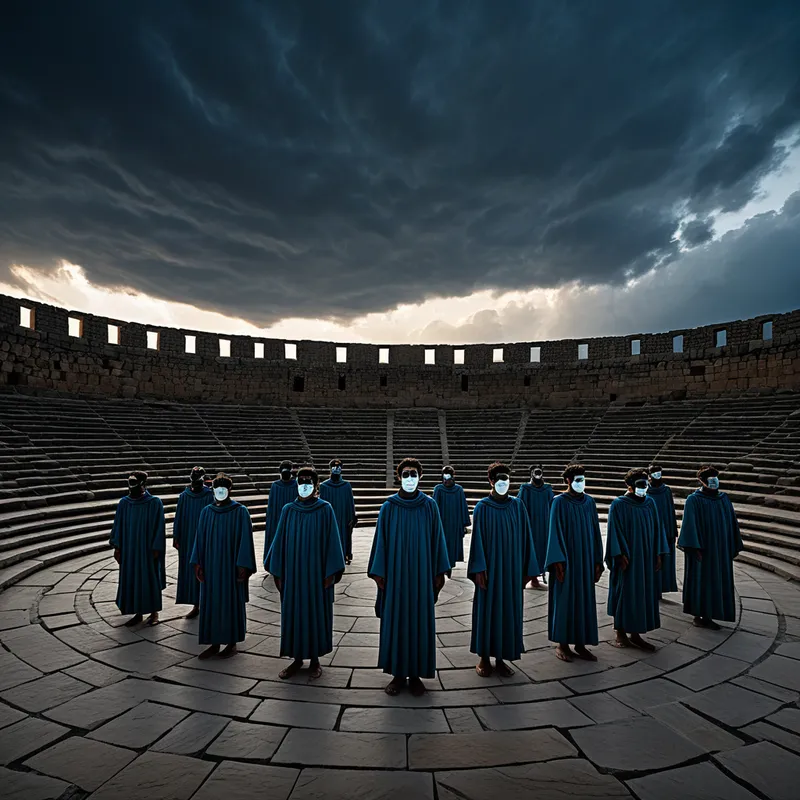
Beneath the vast, wine-dark bowl of the sky, where the scent of thyme and burnt offering hangs in the air, gather the people. Not as individuals, but as a single breath, a single heartbeat. They are the orchestra, the hollowed earth where the story is stamped into being by their feet. They wear not their own faces, but the face of the city—the face of elders, of sailors’ wives, of captive women, of Theban citizens haunted by a curse.
Watch them now, as the first note from the aulos pierces the expectant silence, a sound like a wounded bird. Their bodies move as one, a slow, turning wave. They are not here to act, but to be—to be the ground upon which the hero walks, the echo that returns his cry, the wall against which his fate will shatter.
When Oedipus, king and plague-bringer, rages in his blindness, it is their unified voice that rises, not in accusation, but in a shudder of cosmic pity. “Count no mortal happy till he has passed the final limit of his life secure from pain,” they sing, their chant a cold river flowing around his broken form. They witnessed his rise; they now chart his fall, measuring the distance between his pride and the dust.
When Antigone goes to her living tomb, defiant and alone, it is they who give voice to the terror and awe she silences. They sing of the invincible, unyielding laws of the gods, of love that conquers kingdoms, of the strange, chilling beauty of a will that cannot be bent. They are the tension in the air before the crack of doom.
They stand in the space between the audience, sweating and breathless on the sun-warmed stone, and the towering, suffering figures on the skene. They translate the divine madness into human pulse. They ask the questions the crowd dares not speak. They fear the fears of every person present. As the last blood is shed, as the last revelation tears the world apart, it is their final, solemn stanza that remains—a threnody that does not heal, but acknowledges. A collective sigh that settles over the ruins of the story, leaving the people in the twilight to carry the weight of understanding back to their own, smaller lives.
Cultural Origins & Context
The Chorus was not a theatrical invention but a cultural inheritance, rooted in the dithyramb—ecstatic hymns sung and danced in honor of Dionysus. These were communal, participatory rites, where the boundary between performer and citizen, human and god, was fluid. By the 5th century BCE in Athens, this ritual core was formalized within the Great Dionysia, a civic and religious festival where tragedy was performed as a competitive act of civic introspection.
The chorus, typically consisting of 12 or 15 citizens (trained but not professional actors), represented the polis itself—its conscience, its memory, its normative voice. They were funded by a choregos, making the production a literal and symbolic act of civic patronage. Their function was multifaceted: they were ideal spectators, emotional guides, moral commentators, and rhythmic breathers within the narrative’s relentless pace. Through them, the individual catastrophe of the hero was filtered through the collective soul of the community, ensuring the story was not merely witnessed, but metabolized by the body politic.
Symbolic Architecture
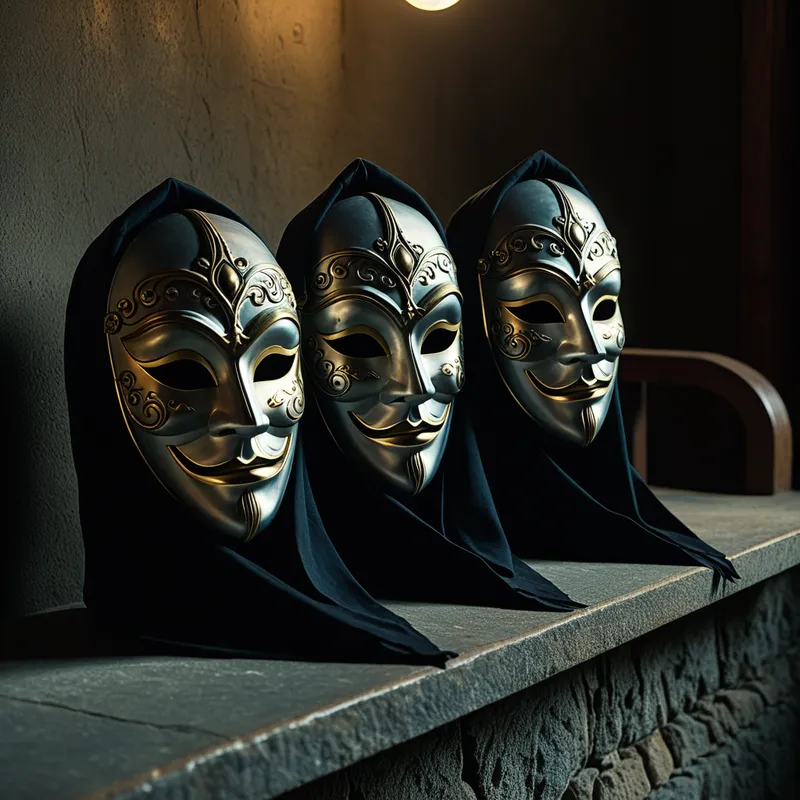
The Chorus is the mythic embodiment of the collective unconscious made audible and visible. It represents everything the solitary hero is not: communal, reflective, rhythmic, and anchored in tradition. The hero acts; the chorus processes. The mask they wear is the ultimate symbol—it erases individual identity to manifest a collective archetype.
The Chorus is the psyche’s internal council, the many voices within the one mind that witness, debate, and lament the actions of the central, executive “I.”
Psychologically, the chorus symbolizes the background of awareness against which the drama of the ego plays out. It is our internalized social norms, our ancestral voices, our inherited traumas and wisdoms. It is the part of us that knows the old stories and the likely consequences, that urges caution, that feels the collective weight of history. In their stasima (choral odes), they often expand the specific plight into universal principles—singing of the laws of the gods, the nature of love, or the fragility of fortune—thus connecting the personal to the cosmic. They are the function of meaning-making itself.
The Dreamer’s Resonance
To dream of a chorus is to dream of the Self in congress with its own multiplicity. One may dream of being surrounded by a group of identical, silent figures who mirror one’s movements, representing the conformist pressure of the persona. Alternatively, one might dream of being part of a chorus, feeling the profound relief and annihilation of individual responsibility, speaking in unison with a powerful, shared voice—this can signal a necessary immersion in a group process or a retreat from an unsustainable heroic stance.
More commonly, the modern dream chorus appears as a boardroom, a jury, a social media comment section, or a gathering of family members—all speaking with one, judgmental or advisory voice. The somatic experience is often one of being watched, measured, or surrounded. This dream motif surfaces when the individual is at a critical juncture, their conscious direction (the “hero”) being weighed against inner and outer collective values. The process is one of audience: the dreamer is being forced to see their own life as a drama witnessed by all the assembled parts of their psyche.

Alchemical Translation
The alchemical work modeled by the Chorus is not the hero’s journey, but the integration that follows the journey’s catastrophic end. The hero’s path is one of differentiation—breaking away, seeking glory, asserting will. The chorus represents the necessary, often painful, reintegration back into the whole.
Individuation is not becoming a solitary hero, but becoming the chorus that can hold the hero’s story without being destroyed by it.
For the modern individual, this means developing an inner capacity for witness. It is the cultivation of a part of the psyche that does not identify with the raging emotion, the desperate ambition, or the crushing failure, but can observe it, comment on its archetypal patterns, and connect it to larger human truths. This is the “sagely” function within. We transmute raw experience into wisdom by “chorusing” it—by giving it rhythmic form, poetic language, and placing it within a narrative larger than our own. The ultimate alchemy is when the individual ego, having endured its tragedy, learns to sit in the circle of its own inner chorus, listening to the collective wisdom of its parts, and adding its hard-won verse to the eternal, unfolding song.
Associated Symbols
Explore related symbols from the CaleaDream lexicon: