The Chorus Myth Meaning & Symbolism
The myth of the collective voice that witnessed all, judged none, and sang the world into being from the sacred space between actor and audience.
The Tale of The Chorus
Before the first actor drew breath, before a story was ever told by a single tongue, there was the Hum. It rose not from [the earth](/myths/the-earth “Myth from Hindu culture.”/) or [the sky](/myths/the-sky “Myth from Persian culture.”/), but from the space between—the hollow, expectant bowl of the hillside, the flat circle of beaten earth at its base. This was the orchestra, and it was empty. Yet it was not silent.
For the spirits of the place—the ghosts of every joy, grief, [triumph](/myths/triumph “Myth from Roman culture.”/), and folly ever felt by the people—gathered at the edge of the stone. They were formless, a murmuring cloud of memory and consequence. They had witnessed everything but had never spoken. They knew the end of every story from its beginning, yet had no voice to warn or console.
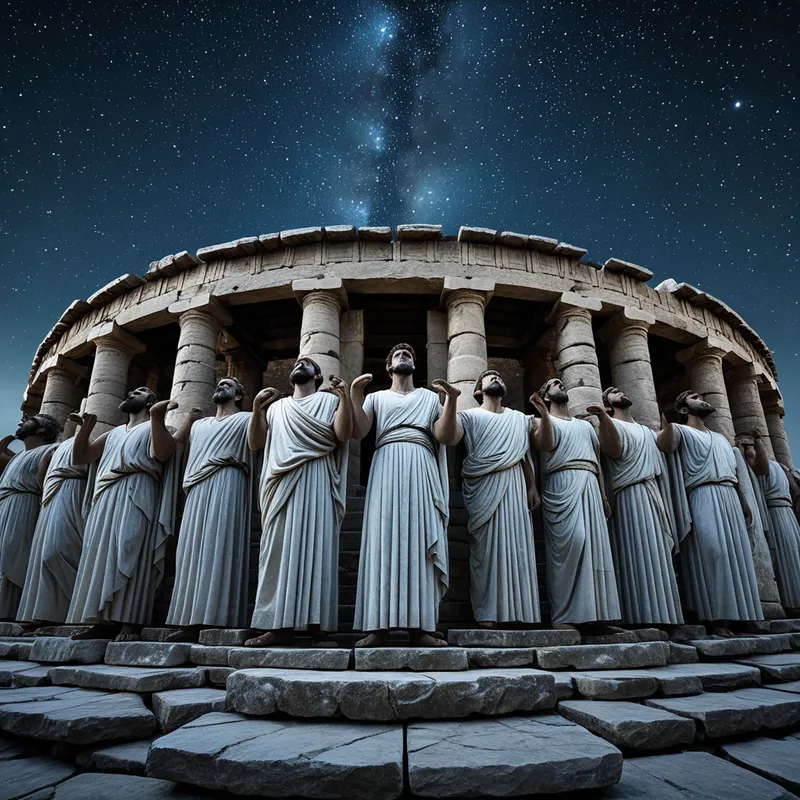
The gods, observing this tension, this unbearable weight of unwitnessed life, took pity. Dionysus, the breaker of boundaries, and [Mnemosyne](/myths/mnemosyne “Myth from Global/Universal culture.”/), the mother of remembrance, joined their powers. From the sacred earth of the orchestra, they drew up not one figure, but many. From the murmuring cloud, they wove not a single body, but a collective form—fifty beings, then twelve, then finally, a perfect, potent number. They were clad in simple robes, their faces obscured, yet each contained a thousand faces. They were the Chorus.
Their first breath was not a breath, but a song—a deep, resonant chord that shook the olive trees on the hill. They did not move to the center, but remained at the periphery, a living, breathing border between [the world](/myths/the-world “Myth from Tarot culture.”/) of the story and the world of [the watchers](/myths/the-watchers “Myth from Christian culture.”/). When the first hero, brash and blind, strode into the circle to claim his destiny, the Chorus did not stop him. They turned as one, a single organism with fifty heads, and began to speak.
They sang of his father’s crimes. They chanted the prophecy he had forgotten. They wailed a lament for the death he did not yet know he would cause. They were the echo of his choices, [the shadow](/myths/the-shadow “Myth from Jungian culture.”/) of his fate, the memory of the land itself. The hero raged against them, called them phantoms, but their words clung to him like dew. When he fell, as they had sung he would, it was they who knelt—not to gloat, but to gather the fragments of the tragedy. They sang his pain, transforming his solitary agony into a shared truth for every ear that heard them. They absorbed the shock of catharsis, channeled it through their unified form, and released it as a gift of understanding to the crowd shivering in the night air. They were [the vessel](/myths/the-vessel “Myth from Alchemical culture.”/) that made the poison of fate into a medicine for the soul.
Cultural Origins & Context
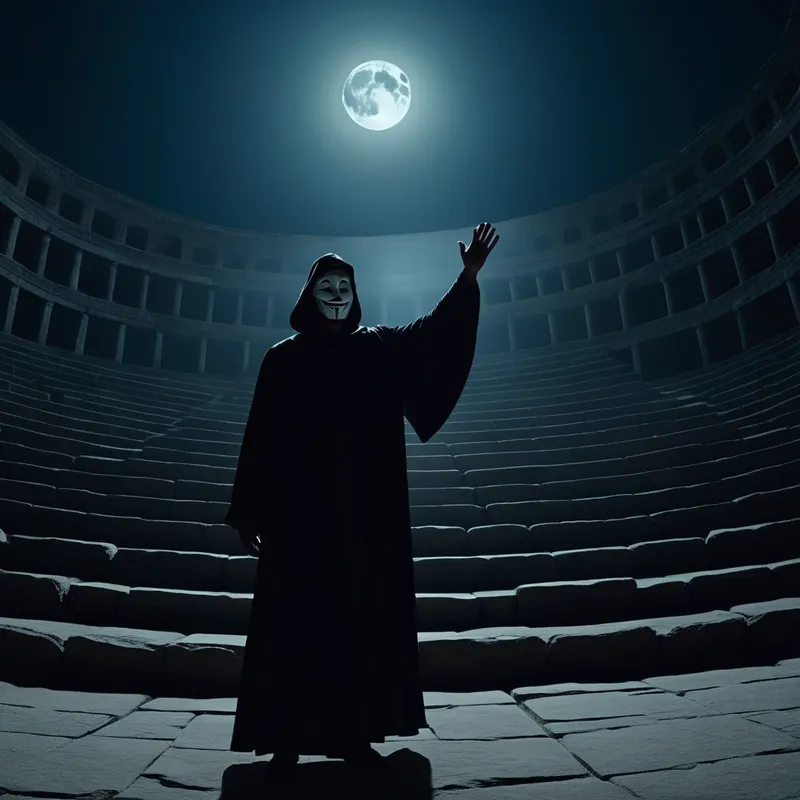
The Chorus is not a fictional invention, but a ritual evolution rooted in the dithyramb—frenzied, circular songs and dances performed in honor of Dionysus in 7th century BCE Greece. These were community acts, a blurring of individual identity in service of a collective ecstatic experience. As theater formalized in the 5th century BCE, notably in the City Dionysia, the Chorus became the mythic and structural backbone of tragedy and comedy.
Composed of citizen-amateurs (a profound civic duty), the Chorus was trained, funded, and costumed by a choregos. They represented the community—the elders of Thebes, the sailors of Athens, [the Furies](/myths/the-furies “Myth from Greek culture.”/) themselves—but always from a specific, grounded perspective. Their function was societal: to model collective response, to voice the ethical norms and anxious questions of the theatron (the seeing-place), and to provide rhythmic and musical structure to the drama. They were the original “ideal audience,” but one endowed with prophetic insight and lyrical power, guiding the real audience’s emotional and moral journey.
Symbolic Architecture
The [Chorus](/symbols/chorus “Symbol: A chorus in dreams symbolizes unity, collaboration, and the harmony of diverse voices contributing to a greater whole.”/) is the embodiment of the [collective unconscious](/symbols/collective-unconscious “Symbol: The Collective Unconscious refers to the part of the unconscious mind shared among beings of the same species, embodying universal experiences and archetypes.”/) made audible. It is not the voice of the individual ego, but the [murmur](/symbols/murmur “Symbol: A low, continuous, often indistinct sound suggesting hidden communication, subconscious messages, or collective voices beneath surface awareness.”/) of the tribe, the species, the archetypal patterns themselves.
The Chorus does not act; it witnesses. And in its profound witnessing, it transmutes event into meaning, isolating pain into shared truth.
Psychologically, it represents everything the conscious [protagonist](/symbols/protagonist “Symbol: The central character or hero in a narrative, representing the dreamer’s ego, agency, or the part of the self navigating life’s challenges.”/) tries to ignore: ancestral patterns, societal conscience, the inevitable consequences of hubris, and the deep, often uncomfortable, wisdom of the [body](/symbols/body “Symbol: The body in dreams often symbolizes the dreamer’s self-identity, personal health, and the relationship they have with their physical existence.”/) and the group. They are the known unknown. The [hero](/symbols/hero “Symbol: A hero embodies strength, courage, and the ability to overcome significant challenges.”/) stands for the singular “I”; the Chorus is the plural “We,” containing all the roles the hero refuses to play—the [victim](/symbols/victim “Symbol: A person harmed by external forces, representing vulnerability, injustice, or sacrifice in dreams. Often symbolizes powerlessness or moral conflict.”/), the critic, the elder, the comforter. They symbolize the field of [awareness](/symbols/awareness “Symbol: Conscious perception of self, surroundings, or internal states. Often signifies awakening, insight, or heightened sensitivity.”/) that surrounds any intense psychic [event](/symbols/event “Symbol: An event within dreams often signifies significant life changes, transitions, or emotional milestones.”/). An individual’s [trauma](/symbols/trauma “Symbol: A deeply distressing or disturbing experience that overwhelms the psyche, often manifesting in dreams as unresolved emotional wounds or psychological injury.”/) or triumph occurs in a vacuum without it; the Chorus provides the context, the [resonance](/symbols/resonance “Symbol: A deep, sympathetic vibration or connection, often in sound or feeling, that amplifies and harmonizes across systems.”/), the container that prevents the [psyche](/myths/psyche “Myth from Greek culture.”/) from shattering.
The Dreamer’s Resonance
To dream of a chorus is to encounter the psyche’s own integrative faculty. You may dream of a group of people speaking or moving in perfect, unsettling unison. They may recite your own thoughts back to you, or chant a repetitive phrase that holds a key emotional charge.
Somatically, this often accompanies a process of “coming to terms.” The dream-ego (the lone actor) is being confronted with a truth too large for it to hold alone. The Chorus appears to share the burden. The psychological process is one of moving from isolated identification (“my” problem, “my” pain) to a recognition of the shared, archetypal layer of the experience. It is the dream-mind’s way of building a container around a raw, unprocessed emotion—grief, shame, terror—by giving it a form, a rhythm, and a voice outside of [the self](/myths/the-self “Myth from Jungian culture.”/). The fear in such dreams is the fear of dissolution into the collective; the healing is the realization that one can be held by it without being erased.

Alchemical Translation
The alchemical journey of individuation is not a solo quest. It requires the confrontation and integration of all that one is not, of all the voices one has silenced. The myth of the Chorus models this precisely.
The modern individual, the “hero” of their own life, stands in the orchestra of their consciousness, focused on a goal, a trauma, a desired transformation. The Chorus represents the ignored inner community—the forgotten memories, the disowned traits (the shadow), the inherited family narratives, the body’s wisdom, the voice of the anima/animus. The initial encounter is often one of resistance; we experience these collective inner voices as intrusive thoughts, repetitive fears, or depressive loops.
The alchemical work is not to defeat the Chorus, but to learn its language, to allow its lament to become your libretto, and in doing so, to find that you are both the soloist and the song.
The transmutation occurs when the individual stops arguing with the chorus and begins to listen. To integrate the Chorus is to move from having a complex to holding a complexity. You are no longer just [Oedipus](/myths/oedipus “Myth from Greek culture.”/) raging against fate; you are also the Theban elders who understand the terrible beauty of the pattern. The “lead” of solitary suffering is transmuted into the “gold” of meaning when it is recognized as part of a larger, human story. The Chorus teaches that wholeness is not achieved in splendid isolation, but in sacred dialogue with the many selves that whisper at the edges of our being, singing us back into the collective stream of life from which we temporarily emerged.
Associated Symbols
Explore related symbols from the CaleaDream lexicon: