The Chemical Wedding Myth Meaning & Symbolism
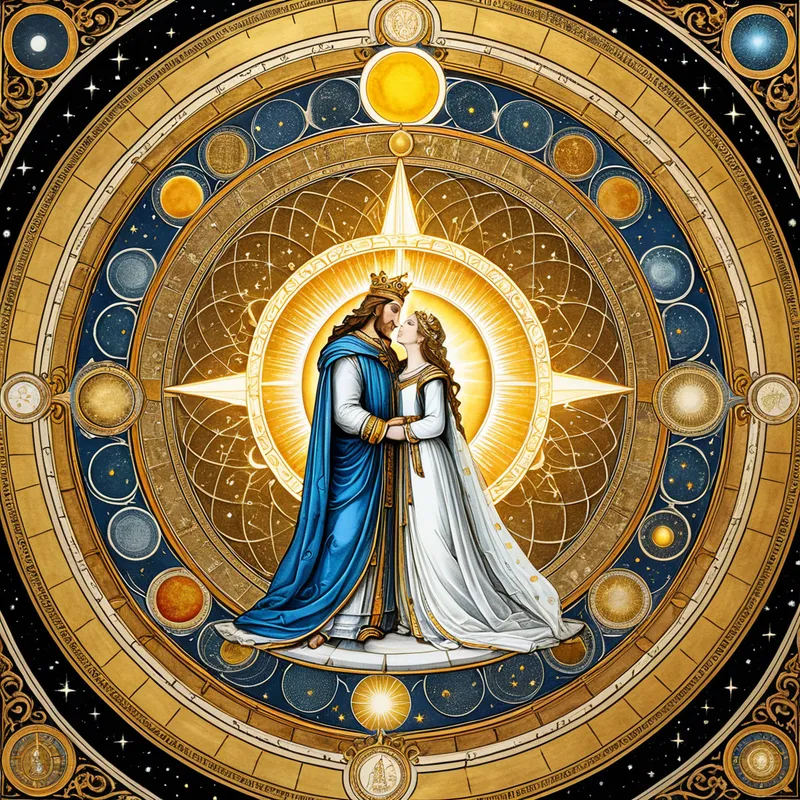
The sacred union of Sol and Luna, a divine marriage of opposites that births the Philosopher's Stone, symbolizing the ultimate alchemical and psychological transformation.
The Tale of The Chemical Wedding
Listen, and hear the tale whispered in the steam of the alembic and etched in the soot of the furnace. In the beginning, there was division. The World-Soul was cleft in two, and from this primordial wound sprang the great opposites: the King, radiant and unyielding as the noonday sun, and the Queen, deep and mutable as the shifting tides. He ruled a kingdom of arid, crystalline mountains; she, a realm of silent, silver seas. Between them stretched a vast and sterile desert, a land where nothing grew, for the Sun’s heat alone was scorching, and the Moon’s moisture alone was barren.
A great melancholy fell upon the cosmos. The King, in his golden hall, felt a hollow yearning for the cool, reflective depths. The Queen, in her pearlescent bower, longed for the fierce, defining light. Their separation was the root of all imperfection in the world—in metals, in plants, in the human soul. The elements themselves mourned, for without their sacred union, the Philosopher’s Stone could never be born, and the work of creation would remain forever unfinished.
Then, from the liminal space where dream logic reigns, the Mercurial Spirit arose. Neither male nor female, but both and beyond, it appeared as a winged messenger, a trickster, a guide. It spoke not in words, but in the language of symbols—the green lion, the ouroboros, the pelican feeding its young. It began the great work, the Nigredo. The King was stripped of his blinding corona, plunged into the blackness of the crucible. The Queen was dissolved, her silver form rendered into a mercurial flood. They suffered, purified in the fires of dissolution and the waters of chaos.
From this darkness emerged the Albedo, a dawn of shimmering white. The purified King and Queen, now pale and essential, were brought to a secret, enclosed garden—the Vas Hermeticum. Here, under a canopy of fixed stars, the Mercurial Spirit officiated. The King and Queen descended into a bath of union, a mystical coniunctio. This was no simple joining, but a total dissolution of boundaries, a chymical embrace where gold and silver lost themselves to become a new, unnamed substance.
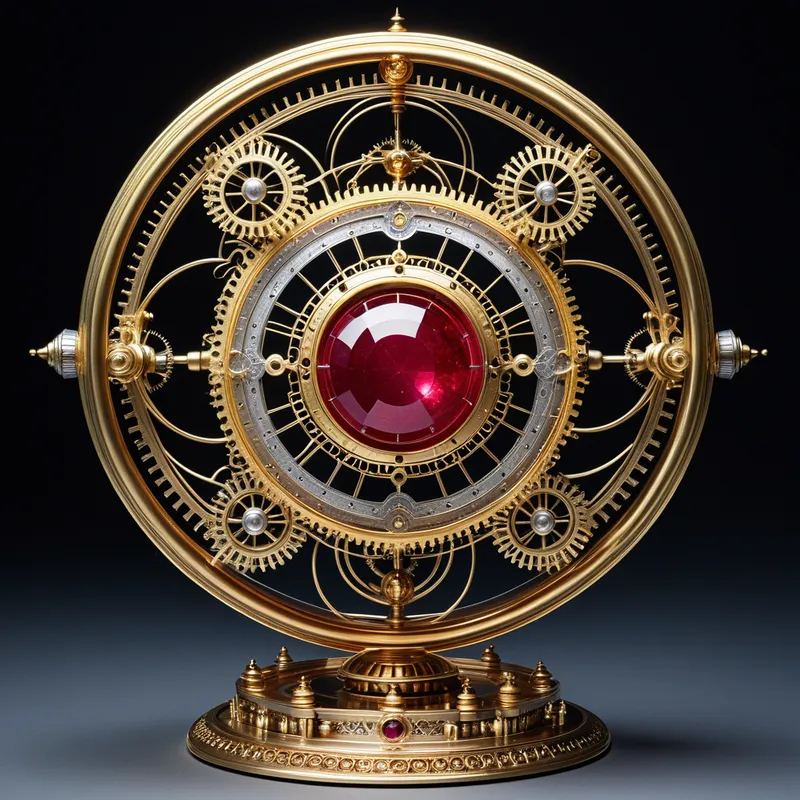
Their union blazed with the Rubedo, a royal crimson light that filled the vessel. From their perfect fusion, a child was born—not of flesh, but of spirit and matter perfected. The Rebis, the two-being-one, stood radiant. And in its hands, or perhaps as its very heart, gleamed the ultimate fruit of this sacred labor: the luminous, many-hued Philosopher’s Stone, the agent of transformation, the medicine for the world and the soul. The desert between the kingdoms bloomed eternally.
Cultural Origins & Context
The myth of the Chemical Wedding, or Chymische Hochzeit, is not a singular story from a lost civilization, but a deep, recurring pattern woven through the tapestry of Western esotericism. Its most famous literary incarnation is the 1616 Rosicrucian allegory, The Chymical Wedding of Christian Rosenkreutz, but its roots dig far deeper into the symbolic language of Hellenistic and medieval alchemy.
This was not a myth for the public square, but for the locked scriptorium and the secluded laboratory. It was passed down in encrypted manuscripts, laden with elaborate illustrations of copulating kings and queens, dragons, and celestial unions. The “culture” that nurtured it was a hidden, transnational fraternity of natural philosophers, physicians, and mystics who saw the processes of chemistry as a direct mirror of divine creation and psychic transformation. The myth functioned as a coded map, a narrative guide for the practitioner’s own spiritual and experimental Magnum Opus. To understand the story was to understand the secret operations of nature and self.
Symbolic Architecture
At its core, the Chemical Wedding is the archetypal drama of opposites yearning for reconciliation. It is the foundational blueprint for the process of individuation.
The King and Queen are not merely characters, but psychic principles. The King is Solar Consciousness—our ego, our will, our focused light of awareness. The Queen is Lunar Unconscious—the soul, the feeling function, the vast and mysterious inner ocean. The sterile desert is the life lived from only one pole: a life of dry intellect without feeling, or of diffuse emotion without direction.
The violent Nigredo stage is the necessary descent, the dark night of the soul. It represents the crushing of egoic certainties and the flooding of unconscious contents—a depression, a crisis, a profound disillusionment that breaks down the old, rigid structures of the personality.
The sacred marriage in the Vas Hermeticum is not a peaceful negotiation, but a fiery, total surrender. It is the ego consenting to be permeated by the unconscious, and the unconscious agreeing to be structured by consciousness.
The resulting Rebis symbolizes the transcendent function, the birth of a new, central authority within the psyche that can hold tension and channel the full spectrum of being. The Philosopher’s Stone is the symbolic prize: the fully integrated Self, which then has the “medicinal” power to transform one’s perception of and engagement with the world.
The Dreamer’s Resonance
When this myth stirs in the modern dreamer, it announces a profound interior process. You may dream of two figures—often a known man and woman, or symbolic animals like a lion and a swan—moving toward each other in a ritualistic manner. There is frequently a sense of momentous, sacred occasion. Alternatively, you might dream of a magnificent, impossible gem; a child of light; or a room that is both a laboratory and a bridal chamber.
Somatically, this can correlate with a feeling of deep internal reorganization—a humming tension between the head and the heart, a sense of pressure or heat in the chest, or a paradoxical feeling of both dissolution and incredible potency. Psychologically, you are in the crucible of a major life transition where previously separate parts of yourself—perhaps your professional ambition and your need for intimacy, your logic and your intuition—are demanding recognition and integration. The dream is a snapshot of the psyche’s innate drive toward wholeness, pushing through the inevitable chaos of the Nigredo toward the promise of union.
Alchemical Translation
For the modern individual, the Chemical Wedding provides a non-linear map for psychic transmutation. Our culture often prizes the Solar King—productivity, clarity, action—while marginalizing the Lunar Queen—receptivity, darkness, soulful ambiguity. The myth insists that any authentic wholeness requires a sacred, inner marriage.
The first step is recognizing the “sterile desert”: the feeling that despite achievements or relationships, something essential is missing. This acknowledgment initiates the Nigredo—a voluntary engagement with shadow material, therapy, creative blockage, or life crisis that feels like a death. It is the dissolution of the persona.
The Vas Hermeticus is the protected, intentional space we create for this work—the journal, the meditation cushion, the therapeutic container, the artistic practice. It is here we consciously bring our inner opposites into dialogue.
The “wedding” is the active, daily practice of holding the tension between these opposites without rushing to let one side “win.” It is allowing the thinker to feel deeply, and the feeler to think clearly. The birth of the Rebis is not a final state, but the emergence of a new capacity: the ability to act from a center that harmonizes both logos and eros. The “Philosopher’s Stone” is the tangible result—a life that feels more authentic, creative, and resilient, possessing the “transmutive” power to turn leaden experiences into golden wisdom. The work is never truly done, for the Wedding is both a singular event and an eternal process, the heartbeat of a soul continually creating itself anew.
Associated Symbols
Explore related symbols from the CaleaDream lexicon: