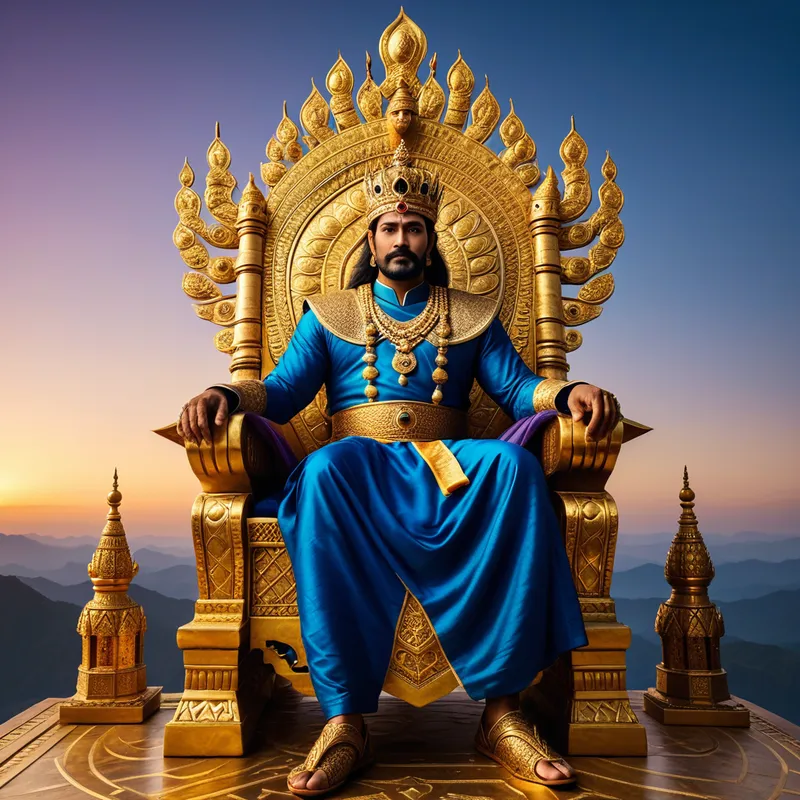
The Chakravartin Myth Meaning & Symbolism
The myth of the Chakravartin, the ideal world-ruler whose righteous reign brings peace and cosmic order, symbolizing the integration of the psyche.
The Tale of The Chakravartin
Listen, and let the story unfold.
In a time before time was measured, when [the earth](/myths/the-earth “Myth from Hindu culture.”/) was young and the heavens close, there existed a world of potential, a world waiting for its center. It was a world of scattered kingdoms, each ruled by its own pride, its own fear. Rivers flowed, but they carried the silt of conflict. Crops grew, but their harvest was hoarded. [The wind](/myths/the-wind “Myth from Various culture.”/) did not whisper of peace, but of the next border skirmish. The cosmos itself seemed to hold its breath, its great order fractured into a thousand competing fragments.
Then, in the heart of a kingdom known for its virtue, a prince was born. His birth was not marked by thunder, but by a profound silence that settled over the land—a silence so deep it felt like the universe listening. He was named Chakravartin. As a child, he did not play with toys of war, but observed the turning of [the potter’s wheel](/myths/the-potters-wheel “Myth from Hindu culture.”/), the cycle of the seasons, the path of the sun across [the sky](/myths/the-sky “Myth from Persian culture.”/). He saw the pattern in all things.
When he came of age and assumed the throne, he did not call for conquest. He sat in silent meditation at the center of his palace, which stood at the center of his capital, which lay at the center of his realm. He sought not to expand his borders, but to understand the borderless principle of Dharma. His rule was just, his heart compassionate, his mind clear as a mountain lake. He governed not from ambition, but from a profound sense of responsibility to the cosmic pattern.
And the cosmos responded.
One evening, as the king sat in contemplation, the air grew thick with the scent of night-blooming [jasmine](/myths/jasmine “Myth from Persian culture.”/) and ozone. A sound began, not from the earth, but from the fabric of space itself—a deep, resonant hum that was both a vibration and a melody. From the western sky, descending on a beam of molten gold, came the Chakra. It was not a weapon of destruction, but an instrument of perfect order. It spun silently before him, a wheel of celestial light, its hub a dark void of infinite potential, its rim sharp with the clarity of truth.
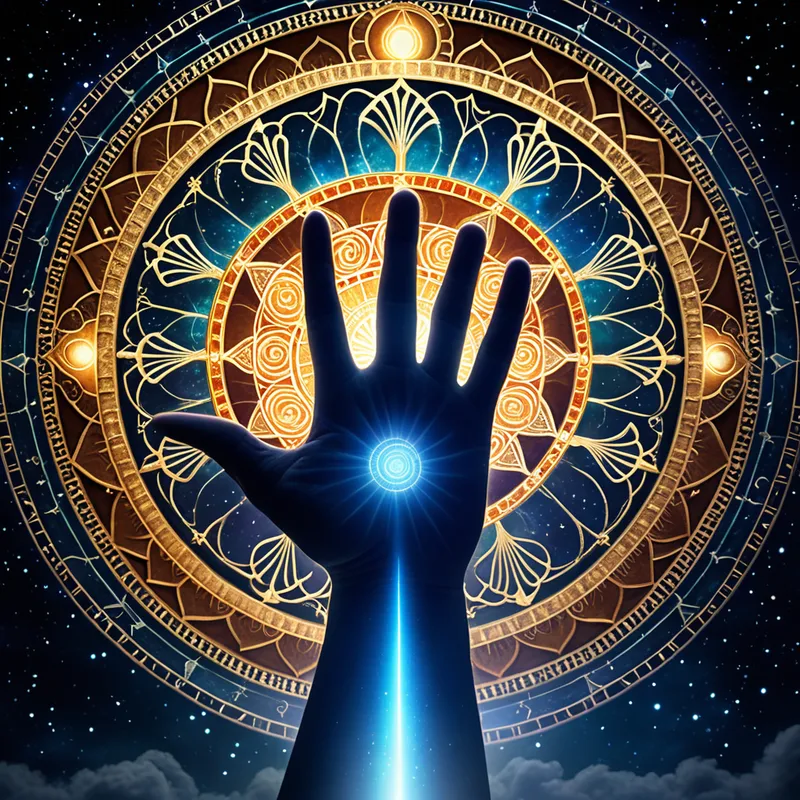
The king reached out, not in greed, but in recognition. As his fingers neared the radiant disc, it did not burn him. It shrank, becoming a palm-sized emblem of sovereignty, cool to the touch yet humming with immense power. This was the sign. The Chakra had chosen him.
With the Chakra leading [the way](/myths/the-way “Myth from Taoist culture.”/), the Chakravartin began to move. He did not march with an army, but proceeded in a stately procession. Where he went, a strange alchemy occurred. Kings who had fortified their gates against him found their suspicions melting like morning frost. They looked upon him and did not see a rival, but the embodiment of the order they themselves secretly craved. They opened their gates, not in surrender, but in homecoming. They offered their allegiance freely, for in his presence, their small, fearful kingdoms suddenly felt part of a greater, harmonious whole.
The seven royal treasures manifested around him: the miraculous wheel, the wish-fulfilling elephant and horse, the gem that lit the darkness, the queen of perfect virtue, the minister of boundless wisdom, and the general of invincible courage. These were not looted prizes, but emanations of his integrated state.
His journey was not a conquest, but a pacification—a calming of [the world](/myths/the-world “Myth from Tarot culture.”/)‘s fevered spirit. He reached the shore of the great ocean, the limit of the world. He rinsed his hands in the salt [water](/myths/water “Myth from Chinese culture.”/), a ritual of completion. He had not subjugated the world; he had reminded it of its own innate, latent order. He turned and went home, back to his capital at the center. And there he ruled, not by edict, but by his mere presence. The rains fell in season, the earth yielded bounty without toil, crime ceased, and life extended. The world, for a time, was not a collection of parts, but a single, breathing, harmonious being. He was its still center, the axis around which the wheel of the world turned in perfect, peaceful revolution.
Cultural Origins & Context
The myth of the Chakravartin is woven deeply into the fabric of Dharma literature, appearing in foundational texts like the Mahabharata, the Buddhist Pali Canon, and Jain scriptures. It is less the story of a single historical king and more a cosmological and political ideal—a template for perfect sovereignty. It functioned as a “mirror for princes,” instructing real-world rulers on the dharmic foundations of kingship: that true power derives from virtue, self-mastery, and alignment with Rta/Dharma, not from mere military force.
The myth was perpetuated by bards, monks, and scholars, serving a critical societal function. In a subcontinent often divided into myriad warring states, the Chakravartin represented a unifying vision of peace and cosmic order (Pax Cosmica). It offered a hope that fragmentation was not the eternal state, that a center could hold. It also established a sacred contract: the king’s legitimacy was contingent upon his righteousness. The descent of the Chakra was a divine endorsement, a symbol that heaven itself sanctioned a rule based on Dharma.
Symbolic Architecture
Psychologically, the Chakravartin is the [archetype](/symbols/archetype “Symbol: A universal, primordial pattern or prototype in the collective unconscious that shapes human experience, behavior, and creative expression.”/) of the integrated Self, the central governing principle of the [psyche](/myths/psyche “Myth from Greek culture.”/) that brings order to the inner [kingdom](/symbols/kingdom “Symbol: A kingdom symbolizes authority, belonging, and a sense of identity within a larger context or community.”/).
The Chakravartin does not conquer the outer world until he has first pacified the inner one. His sovereignty is an internal condition made manifest.
The scattered, warring kingdoms represent the disparate and often conflicting complexes of the unconscious: our ambitions, fears, desires, and inner critics, each ruling their own petty fiefdom of [behavior](/symbols/behavior “Symbol: Behavior encompasses the actions and reactions of individuals, often as a response to various stimuli or contexts.”/) and [emotion](/symbols/emotion “Symbol: Emotion symbolizes our inner feelings and responses to experiences, often guiding our actions and choices.”/). The [capital](/symbols/capital “Symbol: A capital city represents the center of power, governance, and national identity, often symbolizing authority, structure, and collective aspirations.”/) at the center is the emerging ego, attempting to establish order. The [king](/symbols/king “Symbol: A symbol of ultimate authority, leadership, and societal order, often representing the dreamer’s inner power or external control figures.”/)‘s initial [meditation](/symbols/meditation “Symbol: Meditation represents introspection, mental clarity, and the pursuit of inner peace, often providing a pathway for deeper self-awareness and spiritual growth.”/) signifies the conscious turn [inward](/symbols/inward “Symbol: A journey toward self-awareness, introspection, and the exploration of one’s inner world, thoughts, and unconscious mind.”/), the commitment to self-[knowledge](/symbols/knowledge “Symbol: Knowledge symbolizes learning, understanding, and wisdom, embodying the acquisition of information and enlightenment.”/) and ethical [clarity](/symbols/clarity “Symbol: A state of mental transparency and sharp focus, often representing resolution of confusion or attainment of insight.”/) (Dharma).
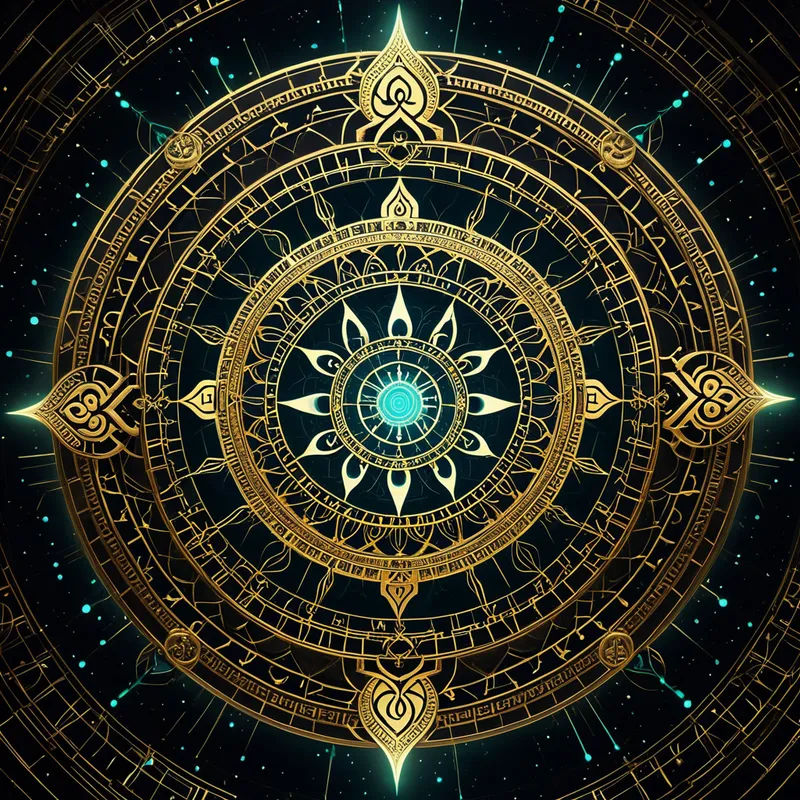
The divine [Chakra](/symbols/chakra “Symbol: In Hindu and yogic traditions, chakras are energy centers along the spine that govern physical, emotional, and spiritual well-being.”/) is the supreme [symbol](/symbols/symbol “Symbol: A symbol can represent an idea, concept, or belief, serving as a powerful tool for communication and understanding.”/). It is the [Mandala](/symbols/mandala “Symbol: A sacred geometric circle representing wholeness, the cosmos, and the journey toward spiritual integration.”/) made dynamic. Its descent represents a [moment](/symbols/moment “Symbol: The symbol of a ‘moment’ embodies the significance of transient experiences that encapsulate emotional depth or pivotal transformations in life.”/) of grace, where the conscious striving of [the ego](/myths/the-ego “Myth from Jungian culture.”/) aligns with the ordering principle of the deep Self. It is the tool of [integration](/symbols/integration “Symbol: The process of unifying disparate parts of the self or experience into a cohesive whole, often representing psychological wholeness or resolution of internal conflict.”/)—not by force, but by the irresistible power of [truth](/symbols/truth “Symbol: Truth represents authenticity, honesty, and the quest for knowledge beyond mere appearances.”/) and wholeness. The seven treasures are not external rewards but the innate capacities (wisdom, [compassion](/symbols/compassion “Symbol: A deep feeling of empathy and concern for others’ suffering, often involving a desire to help or alleviate their pain.”/), courage, joy, etc.) that naturally crystallize when [the Self](/myths/the-self “Myth from Jungian culture.”/) assumes its rightful rule.
The Dreamer’s Resonance
When this myth stirs in the modern dreamer, it often signals a profound process of psychic consolidation. One may dream of being in a chaotic, labyrinthine city (the fragmented psyche) and suddenly finding a quiet, central courtyard or a perfectly round room. One may dream of a spinning wheel, a gyroscope, or a calm eye at the center of a storm.
Somatically, this can feel like a release of chronic tension—the shoulders drop, the jaw unclenches. Psychologically, it is the experience of moving from a state of being lived by one’s complexes (“I am my anxiety,” “I am my anger”) to witnessing them from a centered place. The dreamer is not battling their inner “rebels” but, like the Chakravartin, is establishing a sovereignty so complete that the rebels willingly lay down their arms, recognizing a higher, more harmonious order. It is the dream of coming home to oneself.
Alchemical Translation
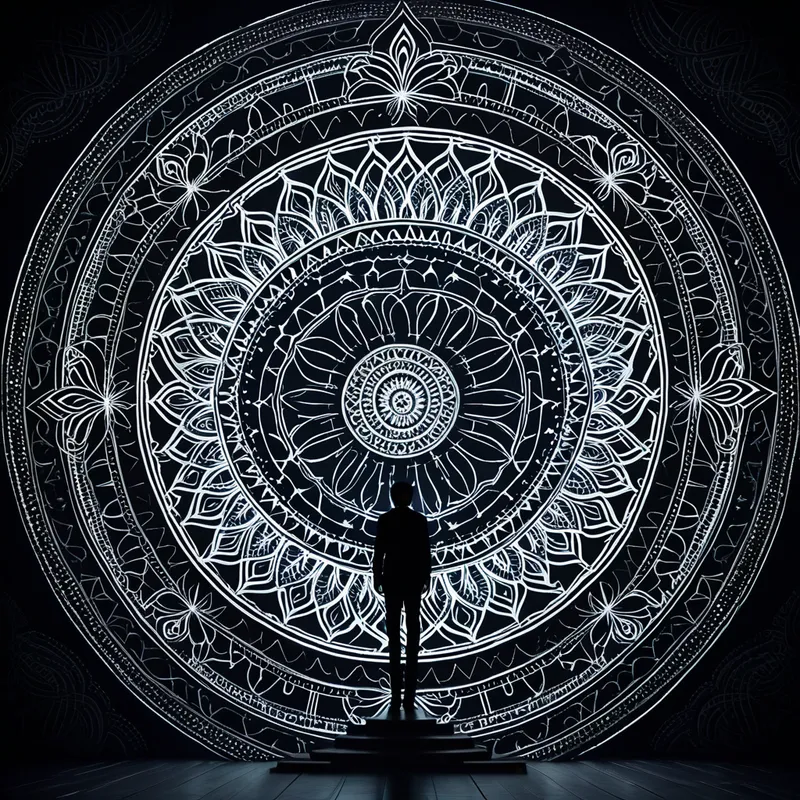
The alchemical journey of the Chakravartin is a precise map for the modern individuation process. It begins with the [nigredo](/myths/nigredo “Myth from Alchemical culture.”/): the dark, chaotic state of the uncentered life, ruled by competing impulses. The king’s meditation is the albedo: the purification, the commitment to consciousness and ethical reflection (Dharma as the inner moral compass).
The wheel does not roll to crush, but to define a boundary. Sovereignty is the conscious act of saying “this is the realm of my responsibility, and here, my word—my truth—is law.”
The descent of the Chakra is the [rubedo](/myths/rubedo “Myth from Alchemical culture.”/), the fiery conjunction of opposites—the ego and the Self unite. This grants the “[Philosopher’s Stone](/myths/philosophers-stone “Myth from Alchemical culture.”/)” of psychological life: the integrated personality. The subsequent pacifying journey is not about suppressing parts of oneself, but about inviting the orphaned, rebellious, or shadowy aspects of the psyche into a new, larger whole. The general, the minister, the queen—these are personified inner capacities that now serve the central Self.
Finally, washing the hands in the ocean is the citrinitas, the yellowing or realization. It signifies the recognition of limits—not the limits of failure, but the sacred boundary of the individuated Self. One rules the inner world completely, but does not seek to possess the outer. The process ends where it began, at the center, but now that center is awake, sovereign, and at peace. The wheel turns, but the axis is still. For the modern individual, becoming a Chakravartin means no longer being a subject to one’s own passing storms, but establishing an unshakable, compassionate sovereignty from which to engage the world.
Associated Symbols
Explore related symbols from the CaleaDream lexicon: