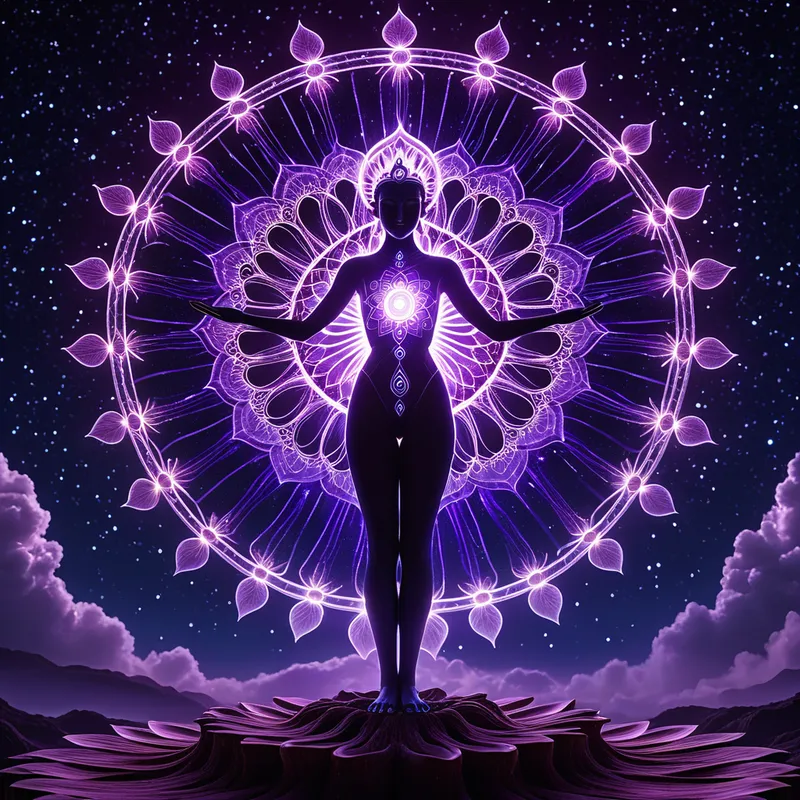
The Chakra System Myth Meaning & Symbolism
The story of the serpent goddess Kundalini ascending through seven luminous wheels of energy, awakening the divine within the human form.
The Tale of The Chakra System
Listen, and hear the story not written on any page, but felt in the silent pulse of your own blood. It begins in the deep, silent dark—not a dark of absence, but of potent, sleeping potential. Here, in the sacred cavern at the base of [the world](/myths/the-world “Myth from Tarot culture.”/)-tree of the body, she rests. She is [Kundalini](/myths/kundalini “Myth from Hindu culture.”/), a goddess in the form of a brilliant, sleeping serpent, coiled three and a half times around a black [lingam](/myths/lingam “Myth from Hindu culture.”/). She is the universe in seed form, the thunderbolt of creation, dreaming of her own awakening.
Her slumber is the slumber of the unremembered self. Above her, a vast and silent architecture awaits—a column of radiant gates, each a spinning wheel of [lotus](/myths/lotus “Myth from Hindu culture.”/) petals, each a world unto itself. The first gate, Muladhara, is a [lotus](/myths/lotus “Myth from Hindu culture.”/) of four crimson petals, heavy with the scent of earth and the deep, drumming rhythm of existence. It is [the foundation stone](/myths/the-foundation-stone “Myth from Mesopotamian culture.”/), [the anchor](/myths/the-anchor “Myth from Christian culture.”/) in the primal mud from which [the lotus](/myths/the-lotus “Myth from Hindu culture.”/) grows.
The call to awaken is not a shout, but a whisper—the sustained, single-pointed focus of the seeker in meditation, the sacred syllable Aum resonating through the silent channels, the [nadis](/myths/nadis “Myth from Hindu culture.”/). Stirred by this divine vibration, the serpent goddess begins to uncoil. She rises, a current of liquid lightning, piercing the first gate. [The earth](/myths/the-earth “Myth from Hindu culture.”/) energy transforms, becoming a creative, flowing force as she enters the second sphere, Svadhisthana, a lotus of six orange petals swirling like a watery [mandala](/myths/mandala “Myth from Buddhist culture.”/) of desire and becoming.
Her ascent is the great journey. At the solar plexus, the third wheel, Manipura, blazes with ten petals of yellow-gold fire. Here, she tempers her raw power into will. The journey is perilous; untamed, this fire can consume. But guided, it forges identity. She then rises to the heart, to Anahata, a lotus of twelve emerald and rose-gold petals. Here, the fire cools into compassion, the personal will expands into universal love. A profound stillness emerges, the cacophony of the lower worlds resolving into a single, harmonious chord—the “unstruck sound.”
Cleansed in the heart’s love, she ascends to the throat, to Vishuddha, a lotus of sixteen smoky violet petals. Here, truth is purified into expression; inner experience finds its authentic voice. Then, to the brow, to the command center of intuition: Ajna. This lotus of two luminous indigo petals is the throne of the inner guru, the eye that sees past, present, and future as one.
Her final ascent is a burst of transcendence. She pierces [the crown](/myths/the-crown “Myth from Various culture.”/) of the head, the thousand-petaled lotus of Sahasrara, which blooms like a fountain of amethyst and diamond light. Here, she meets her beloved, the lord [Shiva](/myths/shiva “Myth from Hindu culture.”/), the pure, still consciousness that has awaited her throughout eternity. Their union is not a collision, but a recognition—[Shakti](/myths/shakti “Myth from Hindu culture.”/) and [Shiva](/myths/shiva “Myth from Hindu culture.”/), energy and consciousness, are revealed as one. The seeker dissolves in that radiant, silent bliss. The serpent’s journey is complete; the individual drop has returned to the ocean of light.
Cultural Origins & Context
This map of the soul did not spring from a single author’s mind, but emerged gradually from the deep contemplative practices of ancient India. Its earliest seeds are found in the esoteric dialogues of the Upanishads (c. 800-200 BCE), which speak of vital channels (nadis) and centers of power within the subtle body. The system was fully articulated and systematized between the 8th and 12th centuries CE within the texts of Tantra and Hatha Yoga.
It was passed down not as public scripture, but as a secret, experiential knowledge (jnana) from guru to disciple. The function was profoundly practical: it provided a precise, psychophysiological blueprint for liberation ([moksha](/myths/moksha “Myth from Hindu culture.”/)). It was a technology of consciousness, showing the yogi exactly where to direct attention, breath ([prana](/myths/prana “Myth from Hindu culture.”/)), and mantra to systematically purify and awaken the latent divine energy within. In a societal context, it democratized the path to the divine, suggesting that the cosmos and its gods were not “out there,” but encoded within the human instrument itself.
Symbolic Architecture
The [chakra](/symbols/chakra “Symbol: In Hindu and yogic traditions, chakras are energy centers along the spine that govern physical, emotional, and spiritual well-being.”/) [system](/symbols/system “Symbol: A system represents structure, organization, and interrelated components functioning together, often reflecting personal or social order.”/) is a profound symbolic [architecture](/symbols/architecture “Symbol: Architecture in dreams often signifies structure, stability, and the framing of personal identity or life’s journey.”/) of the [psyche](/myths/psyche “Myth from Greek culture.”/)‘s evolution. It is a vertical [axis](/symbols/axis “Symbol: A central line or principle around which things revolve, representing stability, orientation, and the fundamental structure of reality or consciousness.”/) of transformation, mapping the [soul](/symbols/soul “Symbol: The soul represents the essence of a person, encompassing their spirit, identity, and connection to the universe.”/)‘s [journey](/symbols/journey “Symbol: A journey in dreams typically signifies adventure, growth, or a significant life transition.”/) from identification with the dense [material](/symbols/material “Symbol: Material signifies the tangible aspects of life, often representing physical resources, desires, and the physical world’s influence on our existence.”/) world to [fusion](/symbols/fusion “Symbol: The merging of separate elements into a unified whole, often representing integration of self, relationships, or conflicting aspects of identity.”/) with boundless [spirit](/symbols/spirit “Symbol: Spirit symbolizes the essence of life, vitality, and the spiritual journey of the individual.”/).
The spine is the axis mundi of the self, the ladder between earth and sky, matter and consciousness.
Each chakra is a world, a complete psychological and existential stage. The lower [triad](/symbols/triad “Symbol: A grouping of three representing spiritual unity, divine completeness, and cosmic balance across many traditions.”/) (Muladhara to Manipura) governs our animal [nature](/symbols/nature “Symbol: Nature symbolizes growth, connectivity, and the primal forces of existence.”/): survival, procreation, and tribal power. The [heart](/symbols/heart “Symbol: The heart symbolizes love, emotion, and the core of one’s existence, representing deep connections with others and self.”/) (Anahata) is the crucial pivot—the alchemical [vessel](/symbols/vessel “Symbol: A container or structure that holds, transports, or protects something essential, representing the self, emotions, or life journey.”/) where base instincts are transmuted into higher virtues. The upper [triad](/symbols/triad “Symbol: A grouping of three representing spiritual unity, divine completeness, and cosmic balance across many traditions.”/) (Vishuddha to Sahasrara) governs our spiritual [nature](/symbols/nature “Symbol: Nature symbolizes growth, connectivity, and the primal forces of existence.”/): [truth](/symbols/truth “Symbol: Truth represents authenticity, honesty, and the quest for knowledge beyond mere appearances.”/), [insight](/symbols/insight “Symbol: A sudden, deep understanding of a complex situation or truth, often arriving unexpectedly and illuminating hidden connections.”/), and unity. The [serpent](/symbols/serpent “Symbol: A powerful symbol of transformation, wisdom, and primal energy, often representing hidden knowledge, healing, or temptation.”/) [Kundalini](/symbols/kundalini “Symbol: A dormant spiritual energy coiled at the base of the spine, representing untapped potential and awakening consciousness through ascension.”/) is the libido itself—not merely sexual, but the total psychic [life](/symbols/life “Symbol: The symbol of ‘Life’ represents a journey of growth, interconnectedness, and existential meaning, encompassing both the joys and challenges that define human experience.”/)-force that, when consciously directed, fuels this entire transformative process.
The Dreamer’s Resonance
When this mythic pattern stirs in modern dreams, it signals a profound somatic and psychological process of integration. One may dream of climbing a luminous ladder, repairing a central column of light, or discovering a series of sealed rooms within one’s own house. A coiled snake in a basement may transform into a guiding light. These are dreams of Kundalini awakening.
Psychologically, this reflects a non-negotiable call from [the Self](/myths/the-self “Myth from Jungian culture.”/) to evolve. The dreamer is being pushed to integrate neglected aspects: perhaps a blocked root chakra manifests as dreams of crumbling foundations or financial terror, calling for grounding. A dormant sacral center may appear as dreams of frozen oceans or barren creative spaces, urging a reconnection with emotion and vitality. The ascent through [the chakras](/myths/the-chakras “Myth from Hindu culture.”/) in dream logic mirrors the conscious process of addressing core wounds, reclaiming personal power, opening the heart to compassion, speaking one’s truth, and ultimately seeking a wisdom beyond [the ego](/myths/the-ego “Myth from Jungian culture.”/). It is the psyche’s innate blueprint for healing and wholeness.
Alchemical Translation
The myth models the individuation process—the psychic transmutation of the lead of unconscious, fragmented living into the gold of an integrated, authentic Self. The journey begins in the “lead,” the unconscious identification with our instincts and social [persona](/myths/persona “Myth from Greek culture.”/) (the lower chakras). The call to meditation or deep self-inquiry is the first stirring of the serpent.
Individuation is the conscious enactment of the serpent’s climb—a voluntary engagement with the heat of one’s own complexes to distill their hidden wisdom.
The “alchemical fire” is the often-painful process of bringing shadow material (repressed fears, traumas, desires) from each psychic level into consciousness. The heart center is the [vas hermeticum](/myths/vas-hermeticum “Myth from Alchemical culture.”/), the sealed vessel where opposites—love and hate, self and other—are held in tension until they unite. The opening of the throat chakra is the creation of the philosophical stone in its first expression: authentic voice. The final stages (Ajna and Sahasrara) represent the culmination: the attainment of a perspective beyond the ego (the inner guru) and the realization of the Self as part of the transcendent, timeless whole. The union of Kundalini and Shiva is the ultimate alchemical marriage, the coniunctio oppositorum, where one experiences oneself not as a separate ego, but as the very process of conscious existence.
Associated Symbols
Explore related symbols from the CaleaDream lexicon: