
The Century-Old Tortoise Myth Meaning & Symbolism
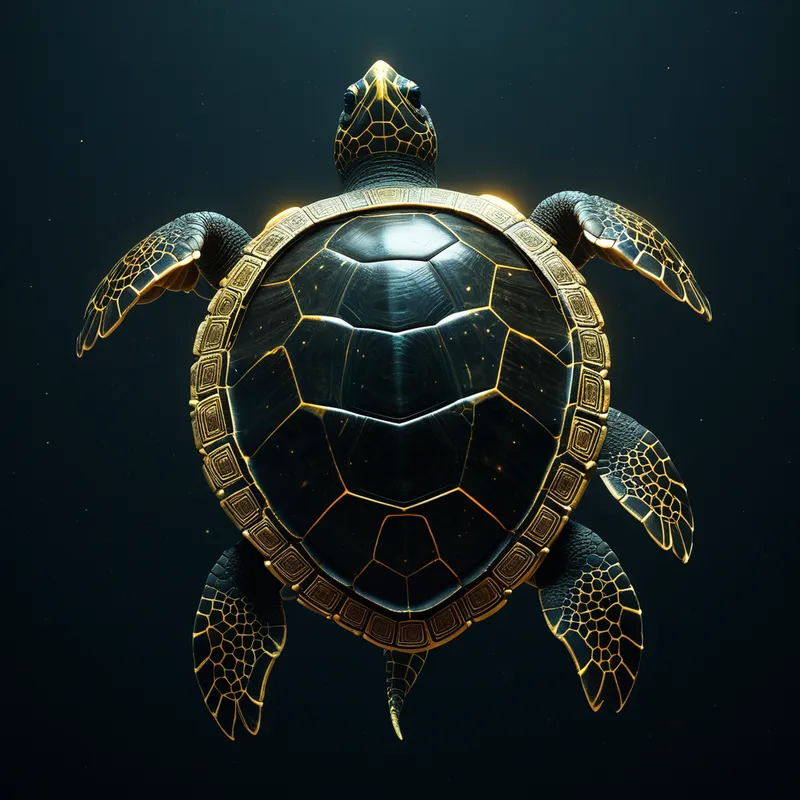
A celestial tortoise, burdened by the world's weight, endures eons to carry the cosmos, embodying the soul's patient journey toward ultimate wisdom.
The Tale of The Century-Old Tortoise
In the time before time, when the heavens were a formless broth and [the earth](/myths/the-earth “Myth from Hindu culture.”/) a churning sludge, the great deities [Pangu](/myths/pangu “Myth from Chinese culture.”/) had finished his labor. He lay down, his breath becoming [the wind](/myths/the-wind “Myth from Various culture.”/) and clouds, his voice the rolling thunder. But [the world](/myths/the-world “Myth from Tarot culture.”/) he shaped was soft, unstable, prone to sinking back into the watery chaos. The four pillars that held up [the sky](/myths/the-sky “Myth from Persian culture.”/) groaned under their new burden.
From the deepest, darkest waters of the Youming, a stirring began. Not a violent thrashing, but a slow, tectonic shifting of silt and stone. And from [the abyss](/myths/the-abyss “Myth from Kabbalistic culture.”/), it arose: a creature of such immense age and quiet power that the very [water](/myths/water “Myth from Chinese culture.”/) clung to its form like a second skin. This was the Century-Old [Tortoise](/myths/tortoise “Myth from Greek culture.”/), Xuanwu. Its shell was not mere bone, but a living landscape of cracked continents and fossilized rivers. Its eyes held the patient darkness of the ocean floor.
Without a word, for it had long forgotten speech, the Tortoise moved. It did not walk; the world adjusted beneath it. It found the place where the earth was weakest, where the muddy waters threatened to swallow the fledgling land. With a sigh that lasted a season, it settled its colossal bulk upon the trembling ground. The earth stilled. Then, with infinite care, it lifted its ancient head and placed the weight of the sky upon its broad, starred shell. The groaning of the pillars ceased. The cosmos found its balance.
And so it remained. Seasons turned into centuries, centuries into millennia. The Tortoise felt the slow dance of the stars carve new lines into its shell. It felt the birth of mountains as aches in its limbs, the flow of great rivers as a coolness across its belly. It bore the weight of dynasties rising and falling, of wars and songs and prayers—all just fleeting whispers against its eternal patience. It became the silent axis, the unwavering foundation. Its long vigil was not a punishment, but a purpose so vast that only a being of endless time could comprehend it. It was the world’s oldest memory and its most steadfast promise.

Cultural Origins & Context
The myth of the cosmic tortoise is not a single story from one text, but a foundational layer in the sedimentary rock of Chinese cosmological thought. Its earliest echoes are found in the symbolic association of the tortoise with longevity, stability, and divination. [Oracle bones](/myths/oracle-bones “Myth from Chinese culture.”/) from the Shang Dynasty were often turtle plastrons, their cracks read as messages from the ancestors and gods, linking the creature to cosmic knowledge.
The image crystallizes in the concept of the Si Xiang, where [the Black Tortoise](/myths/the-black-tortoise “Myth from Chinese culture.”/) (Xuanwu) governs the north, the direction of winter, water, and the unknown. This was not merely a guardian animal but a cosmological pillar. In various Daoist and folk traditions, the world is often depicted as being carried by a great tortoise (or a series of them), sometimes swimming in the cosmic ocean. It was a myth told not just for entertainment, but to explain the very stability of reality. It answered the profound, childlike question: “What holds the world up?” with an image of immense, patient endurance. It was a myth for farmers who understood the slow turning of the soil, for scholars who contemplated the long march of history, and for emperors who sought a mandate as solid as the tortoise’s shell.
Symbolic Architecture
The [Century](/symbols/century “Symbol: A 100-year period representing vast spans of time, historical change, and human legacy. Symbolizes both continuity and transformation across generations.”/)-Old [Tortoise](/symbols/tortoise “Symbol: Tortoises symbolize wisdom, longevity, and the importance of patience in achieving goals.”/) is the ultimate [symbol](/symbols/symbol “Symbol: A symbol can represent an idea, concept, or belief, serving as a powerful tool for communication and understanding.”/) of the Yin principle incarnate: receptive, enduring, hidden, and profoundly strong. Its power is not in attack, but in absolute, unshakeable [presence](/symbols/presence “Symbol: Presence in dreams often signifies awareness or acknowledgment of something significant in one’s life.”/).
To bear the weight of the cosmos is not to conquer it, but to become the vessel that makes its order possible.
Its [shell](/symbols/shell “Symbol: Shells are often seen as symbols of protection, transition, and the journey of personal growth.”/) represents the structured [universe](/symbols/universe “Symbol: The universe symbolizes vastness, interconnectedness, and the mysteries of existence beyond the individual self.”/) itself—the Tianming (Mandate of [Heaven](/symbols/heaven “Symbol: A symbolic journey toward ultimate fulfillment, spiritual transcendence, or connection with the divine, often representing life’s highest aspirations.”/)) made manifest in a protective, patterned carapace. The cracks and markings are the [Luoshu](/myths/luoshu “Myth from Chinese culture.”/), the sacred scripts of [fate](/symbols/fate “Symbol: Fate represents the belief in predetermined outcomes, suggesting that some aspects of life are beyond human control.”/) and natural law. Psychologically, the [shell](/symbols/shell “Symbol: Shells are often seen as symbols of protection, transition, and the journey of personal growth.”/) is the developed ego-[structure](/symbols/structure “Symbol: Structure in dreams often symbolizes stability, organization, and the framework of one’s life, reflecting how one perceives their environment and personal life.”/) and the superego—the necessary, often burdensome container of [identity](/symbols/identity “Symbol: Identity represents the sense of self, encompassing personal beliefs, cultural background, and social roles.”/), morality, and societal expectation that allows [consciousness](/symbols/consciousness “Symbol: Consciousness represents the state of awareness and perception, encompassing thoughts, feelings, and experiences.”/) to exist without dissolving back into [chaos](/symbols/chaos “Symbol: In Arts & Music, chaos represents raw creative potential, uncontrolled expression, and the breakdown of order to forge new artistic forms.”/).
The tortoise’s slow [movement](/symbols/movement “Symbol: Movement symbolizes change, progress, and the dynamics of personal growth, reflecting an individual’s desire or need to transform their circumstances.”/) symbolizes the [pace](/symbols/pace “Symbol: The rhythm or speed of movement, thought, or life, reflecting internal tempo, urgency, or harmony with one’s environment.”/) of deep psychological and spiritual growth, which operates on a timescale foreign to the frantic ego. Its [connection](/symbols/connection “Symbol: Connection symbolizes relationships, communication, and bonds among individuals.”/) to [water](/symbols/water “Symbol: Water symbolizes the subconscious mind, emotions, and the flow of life, representing both cleansing and creation.”/) and the [abyss](/symbols/abyss “Symbol: A profound void representing the unconscious, the unknown, or a spiritual threshold between existence and non-existence.”/) ties it directly to the unconscious, the primordial [source](/symbols/source “Symbol: The origin point of something, often representing beginnings, nourishment, or the fundamental cause behind phenomena.”/) from which all consciousness slowly emerges and upon which it ultimately rests. It is the [archetype](/symbols/archetype “Symbol: A universal, primordial pattern or prototype in the collective unconscious that shapes human experience, behavior, and creative expression.”/) of the foundational Self, the bedrock of the [psyche](/myths/psyche “Myth from Greek culture.”/) that supports the entire [drama](/symbols/drama “Symbol: Drama signifies narratives, emotional expression, and the exploration of human experiences.”/) of individual [life](/symbols/life “Symbol: The symbol of ‘Life’ represents a journey of growth, interconnectedness, and existential meaning, encompassing both the joys and challenges that define human experience.”/).
The Dreamer’s Resonance
When the Century-Old Tortoise surfaces in modern dreams, it rarely appears with fanfare. It is felt more than seen: a profound pressure on the chest, a sense of carrying an immense, invisible burden, or the image of one’s own back becoming heavy, rounded, and hard. The dreamer may be stuck in mud, moving with agonizing slowness through a landscape, or simply watching a tortoise in an aquarium, sensing its ancient gaze.
This is the psyche signaling a process of psychic integration under pressure. The dreamer is likely in a life phase of immense responsibility—caregiving, a demanding career, or a prolonged emotional ordeal. The tortoise does not come to complain, but to model. The somatic feeling of weight is the body acknowledging the real cost of sustaining one’s world. The dream asks: What are you carrying? Is it the authentic weight of your own destiny, or the misplaced burdens of others? The tortoise’s presence suggests the need to identify with the carrier, not just the burden—to find the deep, enduring strength within the situation itself, to transform crushing pressure into foundational stability.

Alchemical Translation
The individuation process modeled by the tortoise is the alchemy of patient embodiment. It is the opposite of the hero’s glorious quest. The [triumph](/myths/triumph “Myth from Roman culture.”/) here is not in slaying [the dragon](/myths/the-dragon “Myth from Chinese culture.”/), but in outlasting it; not in finding the treasure, but in becoming the vault that holds it.
[The first stage](/myths/the-first-stage “Myth from Alchemical culture.”/) is Descent into the Youming—the voluntary or forced immersion into the murky, unstructured waters of the unconscious (a depression, a loss, a period of stagnation). This is not failure, but the return to the source. The second is Acceptance of the Burden—the conscious realization that one’s life, with all its complexities, history, and responsibilities, is a cosmic weight that must be borne. This is [the ego](/myths/the-ego “Myth from Jungian culture.”/) aligning itself with [the Self](/myths/the-self “Myth from Jungian culture.”/)’s purpose.
The final transmutation is when the shell, once experienced as a heavy limitation, is recognized as the sacred pattern of one’s own unique existence—the cracks become a map of wisdom, not damage.
The “century” it takes is psychological time—the long, slow work of therapy, meditation, or simply faithful living. The goal is not to put the burden down, but to grow so large, so integrated, that the weight becomes inseparable from one’s being. One becomes the Zhong, the stable center around which one’s personal cosmos revolves. The Century-Old Tortoise teaches that true wisdom is not knowing everything, but having the strength to hold your piece of the world together, patiently, until your very substance becomes an inseparable part of the eternal order.
Associated Symbols
Explore related symbols from the CaleaDream lexicon: