The Ceiba World Tree Myth Meaning & Symbolism
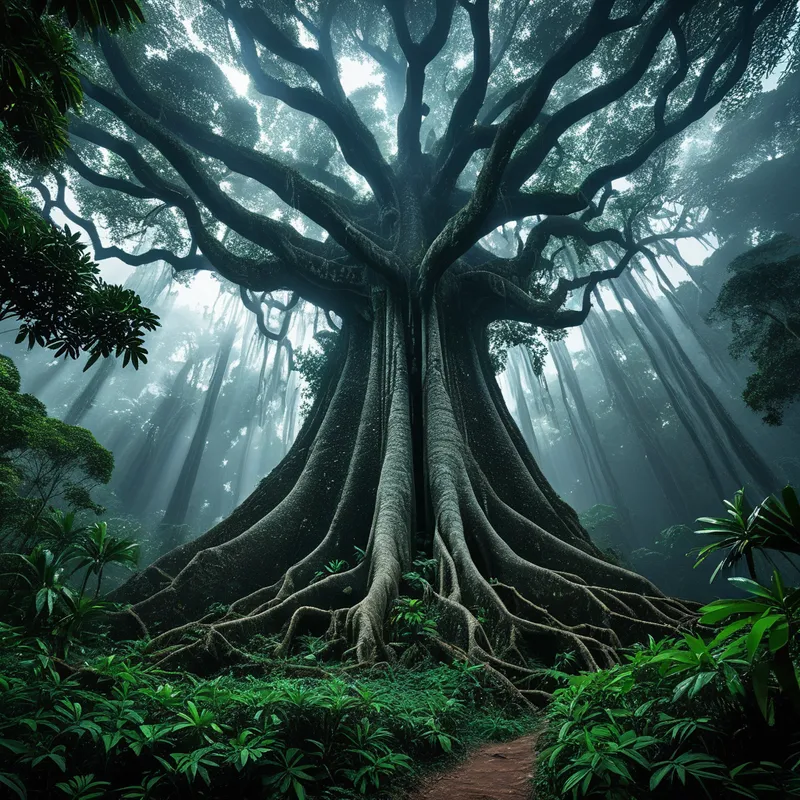
The Ceiba Tree is the sacred axis of the cosmos, its roots in the dark underworld, its trunk in our world, its branches holding up the heavens.
The Tale of The Ceiba World Tree
Listen. Before the first dawn, there was only the black, silent sea of Tehom. From its depths, the Heart of Sky and the Plumed Serpent willed the world to be. But a world is a heavy thing. It needed a pillar. It needed a spine.
So, from the very navel of the newly formed earth, it began. Not a sprout, but a surge. A great, groaning push of life erupted from the dark, wet belly of Xibalba. Up thrust a trunk, not of mere wood, but of solidified thunder. Its bark was like the hide of a primordial beast, studded with protective thorns. Its roots did not simply dig; they became the underworld, coiling around rivers of obsidian and chambers of bone, drinking from the waters of forgetfulness and memory. Here, in the perpetual gloom, the Lords of Xibalba whispered among its gnarled anchors.
The trunk pierced the world of men—the Middleworld. It stood in the absolute center, a mountain of living wood. Humans built their cities around its clearings, felt its shade. They heard the wind in its leaves as the breath of gods, saw its height as a ladder from their toil to something greater. Jaguars slept in its hollows, and the scent of its flowers was the very perfume of existence.
And then, the ascent. The branches did not merely spread; they lifted. They pushed against the fabric of the sky itself, Oxlahuntikú, parting the mists to hold up the sun, the moon, the wandering stars. In its highest boughs, which shimmered with a light not of this earth, celestial birds made their nests. The resplendent Principal Bird Deity perched here, and from this vantage, the great serpent of the sky, Waxaklajuun Ubaah Chan, would unfurl, a living bridge for spirits and kings.
This was no static thing. It was a conduit, a great churning axis. The souls of the dead descended through its roots to their rest or renewal. The prayers of the living, carried on the smoke of copal, ascended through its trunk. Rain fell from its leaves, and the life-blood of the world—water, sap, spirit—pulsed in a constant, vertical river. The Ceiba stood. It stands. The first, last, and eternal pillar of a breathing, layered cosmos.
Cultural Origins & Context
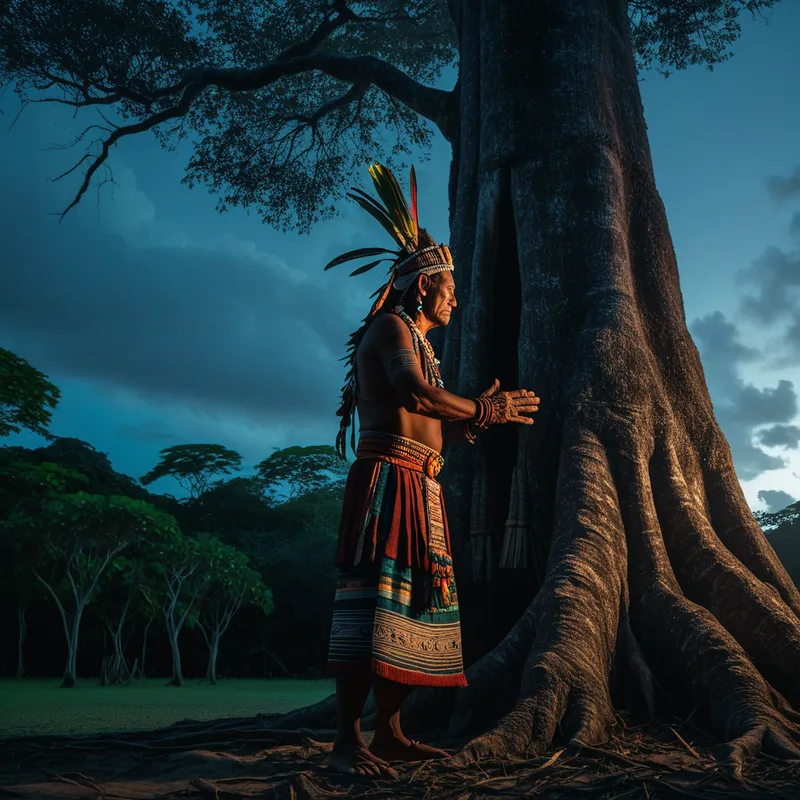
This profound cosmological concept was central to the worldview of many Mesoamerican peoples, including the Maya, Aztec (who knew it as the Yohualtecuhtli or associated it with Coatlicue), and others. It was not a single story told from beginning to end like a European fairy tale, but a fundamental, lived reality encoded in art, architecture, ritual, and daily life.
The myth was passed down through sacred texts like the Popol Vuh, through the intricate symbolism on ceramic vessels and temple friezes, and through the oral teachings of shamans and day-keepers. Its primary societal function was one of cosmic orientation. The Ceiba established order (itz) out of chaos. It located the human realm in a sacred geography, positioned between the divine and the chthonic. Cities were laid out as cosmograms, with central temples or plazas acting as the symbolic “trunk” of the world tree, mirroring the celestial order and ensuring the continuity of time, seasons, and the favor of the gods through ritual alignment.
Symbolic Architecture
At its core, the Ceiba is the archetypal Axis Mundi—the World Axis. It is the central pillar around which the psyche, like the cosmos, organizes itself.
The tree is not in the landscape; the landscape, and the self, are within the tree.
Its roots symbolize our deepest, often unconscious, foundations: instinct, ancestry, trauma, memory, and the fertile darkness from which creativity and new life must eventually emerge. The trunk represents the embodied ego and conscious life—our presence in the tangible world, our strength, and our resilience. The branches signify aspiration, intellect, spirit, and connection to the transpersonal—the higher ideals, visions, and cosmic patterns we seek to understand and embody.
The constant flow between these realms—sap rising, rain falling, souls traveling—illustrates the essential psychic truth of interconnectedness. No part exists in isolation. A healthy psyche requires acknowledging the dark roots, grounding in the solid trunk, and reaching for the luminous branches. The thorns on the trunk are not mere protection; they are the necessary boundaries and painful initiations that guard the integrity of the journey between realms.
The Dreamer’s Resonance
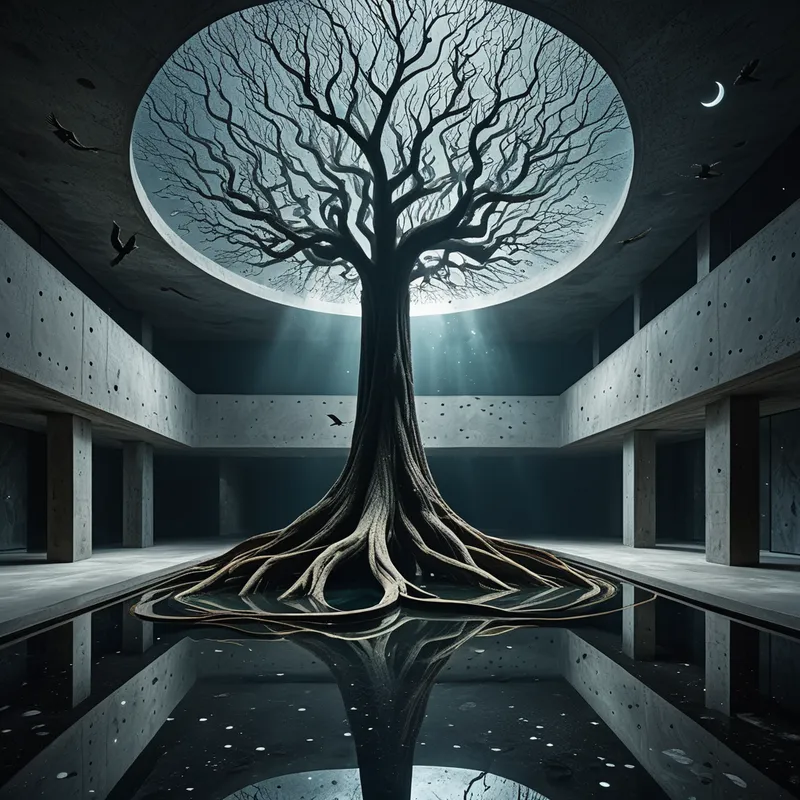
When this mythic pattern stirs in the modern dreamer, it often signals a profound process of recentering and vertical integration. Dreaming of a tree of immense, central scale—especially one with explicit upper and lower realms—suggests the psyche is actively working to re-establish inner order.
A dream focusing on the roots may coincide with somatic symptoms—a feeling of being ungrounded, anxiety, or old pains surfacing. The psyche is dredging the underworld of personal or ancestral history, seeking to heal a foundational wound. A dream of climbing the trunk, perhaps with great effort against the thorns, mirrors a conscious struggle for stability, identity, or purpose in waking life. A vision of the branches or celestial birds might appear during periods of inspiration, spiritual seeking, or when grappling with lofty ideas that feel disconnected from earthly reality.
The dream is an invitation to consciously inhabit all three levels—to bring the insights of the depths and the heights into the grounded reality of the present self.
Alchemical Translation
The Ceiba’s myth is a perfect map for the alchemical process of individuation—the Jungian journey toward psychic wholeness. The work is not to escape any realm, but to fully inhabit and connect them.
The first, often most difficult, operation is the descensus ad inferos: the descent into the roots. This is the confrontation with the shadow, with personal and collective trauma stored in the body and the unconscious. It is a sacrifice of ignorance. From this dark soil, the vital sap of authentic selfhood can begin to rise.
The second operation is the strengthening of the trunk: the conscious work of building a resilient ego-structure that can withstand the tensions between inner depths and outer heights. This is the development of discipline, integrity, and a grounded sense of “I am.”
The ultimate goal is not to live in the canopy, but to become the living tree—a conduit through which the nectar of the stars nourishes the roots, and the wisdom of the depths flowers in the light.
The final, ongoing process is the conscious alignment with the branches—the integration of transpersonal archetypes, symbols, and meanings (the Self). This is where personal life finds its place within a larger, meaningful pattern. The individual becomes a true axis mundi for their own world, a channel connecting the primal, the personal, and the cosmic. They become, in essence, a living omphalos, rooted, present, and crowned with purpose.
Associated Symbols
Explore related symbols from the CaleaDream lexicon:
- Tree of Life — The universal archetype of interconnectedness, growth, and cosmic order, of which the Ceiba is a specific, powerful Mesoamerican embodiment.
- Root — Represents the deep, often hidden foundations in the underworld of the unconscious, the source of ancestral memory and psychic nourishment.
- Sky — The realm of the branches, symbolizing higher consciousness, aspiration, celestial order, and the domain of gods and spirits.
- Earth — The solid ground of the Middleworld, the realm of human experience and embodied reality where the trunk stands firm.
- Serpent — The chthonic energy coiled in the roots of Xibalba and the celestial form in the branches, representing cyclical transformation and the conduit between realms.
- Bird — The spirit, vision, and divine messenger that inhabits the highest branches, connecting the human with celestial knowledge.
- Axis Mundi — The central world pillar or mountain; the Ceiba is the quintessential Mesoamerican expression of this symbol of cosmic center and stability.
- Temple — The human-built reflection of the World Tree, a sacred center designed to facilitate ritual connection between the earthly and divine realms.
- Bridge — The function of the Ceiba’s trunk, enabling the sacred passage of souls, prayers, and energies between the underworld, earth, and sky.
- Mountain — Another form of the Axis Mundi; the Ceiba is often conceptualized as a great, vertical mountain of wood reaching through the cosmos.
- Cave — The symbolic entrance to the underworld realm of the roots, a place of initiation, darkness, and return to the source.
- Light — The celestial illumination that filters through the canopy of the branches, representing divine knowledge, consciousness, and revelation descending into the world.