The Cave of Trophonius in Gree Myth Meaning & Symbolism
A terrifying Greek oracle where seekers descend into darkness to receive a vision, emerging forever changed by the encounter with the divine.
The Tale of The Cave of Trophonius in Gree
Listen, and hear of the oracle that was not spoken, but swallowed.
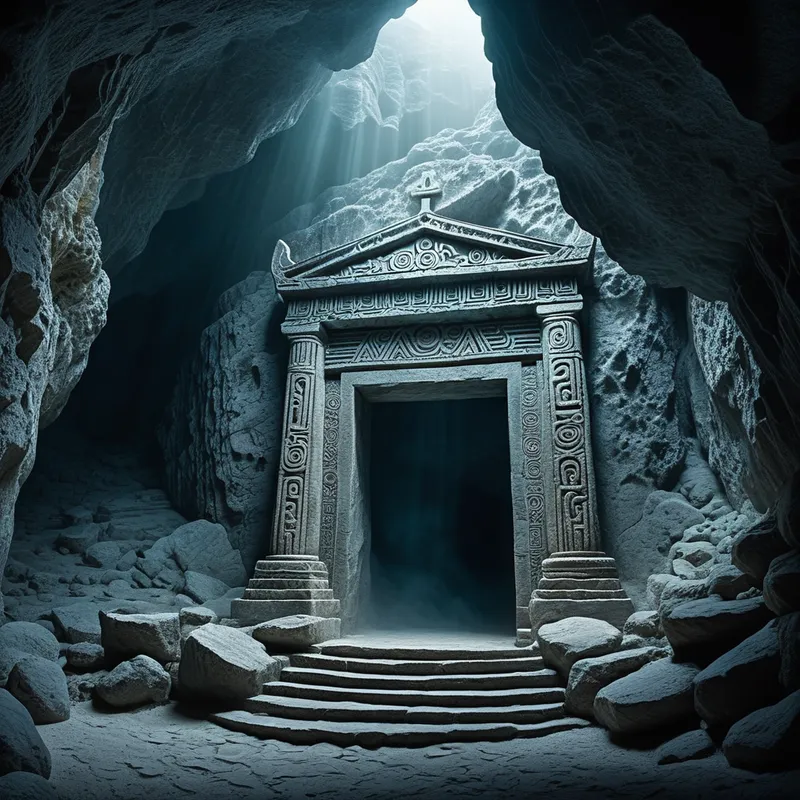
In the land of Boeotia, near the city of Lebadeia, there lies a cleft in [the earth](/myths/the-earth “Myth from Hindu culture.”/) so deep it drinks the daylight. This is no temple of laurel and light, no seat of a gracious Apollo like at Delphi. This is the sanctuary of Trophonius, son of Erginus, and his is a prophecy carved from darkness itself.
They say Trophonius and his brother Agamedes were master builders, architects to the gods. They built [the temple](/myths/the-temple “Myth from Jewish culture.”/) at Delphi, the treasury for King Hyrieus. But greed found them. They laid a secret stone in the treasury wall, a stone they could remove to steal the king’s gold. Hyrieus set a trap, and Agamedes was caught. To save his brother from a shameful death, or perhaps to share his fate, Trophonius struck off Agamedes’s head. The earth, pitying or punishing, opened and swallowed Trophonius whole. He did not die. He became the genius of that place, a chthonic power dwelling in the rock.
Centuries passed. The cleft became an oracle. But to consult Trophonius was to court madness. The seeker did not come lightly. For days, they lived in a special house, bathing in [the river](/myths/the-river “Myth from Buddhist culture.”/) Hercyna, sacrificing to the gods, eating sacred meat. Priests led them to the two springs: [Lethe](/myths/lethe “Myth from Greek culture.”/), to drink and forget their former life, and [Mnemosyne](/myths/mnemosyne “Myth from Global/Universal culture.”/), to drink and remember what they were about to see.
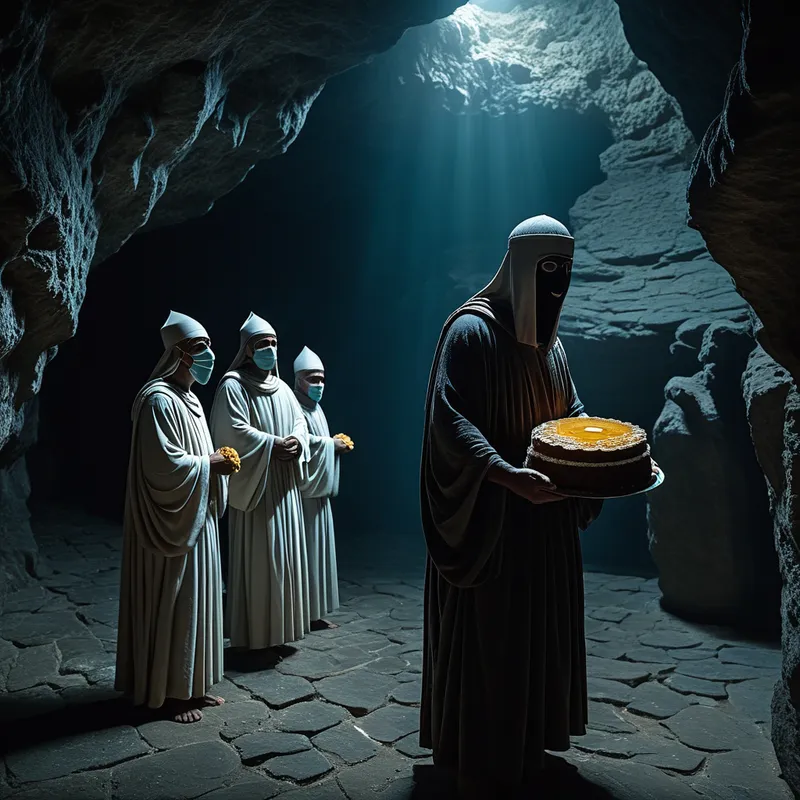
Then, at night, they approached the chasm. A narrow ladder descended into utter blackness. At the bottom, a small hole gaped. The seeker, feet first, holding honey cakes for [the underworld](/myths/the-underworld “Myth from Greek culture.”/) spirits, was pushed into the earth’s belly. A force, like a whirlpool, snatched them in. There, in the absolute dark, pressed by the living rock, the vision came. It was not a voice. It was a knowing, imparted through sheer terror—a flash of truth about fate, death, or [the self](/myths/the-self “Myth from Jungian culture.”/), seared into the soul. Sometimes it was a sight. Always, it was unbearable.
Then, as suddenly as they were taken, they were expelled, feet first again, back into [the world](/myths/the-world “Myth from Tarot culture.”/) of light. Priests sat them on the Throne of Mnemosyne, and there, trembling, face frozen in a rictus of awe or horror, they stammered out what they had seen. They were called the <abbr title=“Those who have laughed”; a term for initiates of the Trophonius oracle who were often seen with a fixed, grimacing smile after their ordeal”>gelōntes, “the ones who have laughed,” for their faces were forever marked by the grimace of that divine terror. They emerged not enlightened, but shattered and remade. They had been to the place where the self ends.
Cultural Origins & Context
The oracle of Trophonius was a historical reality, attested by numerous ancient writers including Pausanias, who left a detailed account of its rites. It flourished in the later classical and Hellenistic periods, a powerful counterpoint to the more famous oracles of Apollo. Its location in Boeotia, a region often considered rustic and mysterious by sophisticated Athenians, added to its aura of primal, uncanny power.
This was not a civic oracle for matters of state. It was a deeply personal, initiatory ordeal. The seeker underwent a ritualized [katabasis](/myths/katabasis “Myth from Greek culture.”/)—a descent into the [underworld](/myths/underworld “Myth from Greek culture.”/) while still alive. The function was not merely divination but transformation. The society that maintained this ritual understood that some truths are too terrible for daylight, that some knowledge requires the seeker to die a little. It was passed down through priestly lineages and the whispered testimonies of the gelōntes, serving as a cultural container for the most extreme forms of religious experience, a sanctioned encounter with [the abyss](/myths/the-abyss “Myth from Kabbalistic culture.”/) that lay beneath the ordered world of [the polis](/myths/the-polis “Myth from Greek culture.”/).
Symbolic Architecture
[The cave](/myths/the-cave “Myth from Platonic culture.”/) is the ultimate [symbol](/symbols/symbol “Symbol: A symbol can represent an idea, concept, or belief, serving as a powerful tool for communication and understanding.”/) of the unconscious—not [the personal unconscious](/myths/the-personal-unconscious “Myth from Jungian Psychology culture.”/) of forgotten memories, but the collective, chthonic unconscious, the bedrock of archetypal [reality](/symbols/reality “Symbol: Reality signifies the state of existence and perception, often reflecting one’s understanding of truth and life experiences.”/). Trophonius himself is the [archetype](/symbols/archetype “Symbol: A universal, primordial pattern or prototype in the collective unconscious that shapes human experience, behavior, and creative expression.”/) of the daimon who bridges the [human](/symbols/human “Symbol: The symbol of a human represents individuality, complexity of emotions, and social relationships.”/) and the subterranean divine. He is a “dead” [hero](/symbols/hero “Symbol: A hero embodies strength, courage, and the ability to overcome significant challenges.”/), a being who has passed into the [earth](/symbols/earth “Symbol: The symbol of Earth often represents grounding, stability, and the physical realm, embodying a connection to nature and the innate support it provides.”/) and become one with its dark wisdom.
The oracle does not speak; it incorporates. Truth is not heard but ingested, becoming part of the seeker’s flesh and bone.
The rites are a perfect symbolic map for psychic preparation: purification, the sacrifice of old identities (eating sacred [meat](/symbols/meat “Symbol: Meat in dreams often symbolizes sustenance, vitality, and the primal aspects of one’s nature, as well as potential conflicts or desires.”/)), the deliberate induction of [amnesia](/symbols/amnesia “Symbol: A dream symbol representing loss of memory, identity, or connection to one’s past, often linked to emotional trauma, avoidance, or transformation.”/) (Lethe) to clear the [psyche](/myths/psyche “Myth from Greek culture.”/)’s slate, followed by the activation of deep, non-personal [memory](/symbols/memory “Symbol: Memory symbolizes the past, lessons learned, and the narratives we construct about our identities.”/) (Mnemosyne). The descent [feet](/symbols/feet “Symbol: Feet symbolize our foundation, stability, and the way we connect with the world around us, often reflecting our sense of direction and purpose.”/)-first is a symbolic [rebirth](/symbols/rebirth “Symbol: A profound transformation where old aspects of self or life die, making way for new beginnings, growth, and renewal.”/) in reverse, a return to the [womb](/symbols/womb “Symbol: A symbol of origin, potential, and profound transformation, representing the beginning of life’s journey and the unconscious source of creation.”/) of the Earth [Mother](/symbols/mother “Symbol: The symbol of ‘Mother’ represents nurturing, protection, and the foundational aspect of one’s emotional being, often associated with comfort and unconditional love.”/) to be dissolved. The [honey](/symbols/honey “Symbol: A sweet, viscous substance produced by bees, symbolizing natural sweetness, reward, and nourishment.”/) cakes are the last offering of the conscious ego, [sweetness](/symbols/sweetness “Symbol: Represents pleasure, reward, and positive experiences, often linked to emotional satisfaction and life’s enjoyable moments.”/) to appease the shadowy contents one is about to meet. The violent, involuntary intake by the cave represents the [moment](/symbols/moment “Symbol: The symbol of a ‘moment’ embodies the significance of transient experiences that encapsulate emotional depth or pivotal transformations in life.”/) the unconscious actively seizes [the ego](/myths/the-ego “Myth from Jungian culture.”/), a state of overwhelming possession by a psychic content too large to comprehend.
The Dreamer’s Resonance
When this myth pattern stirs in modern dreams, it signals a profound, involuntary confrontation with the Self (in the Jungian sense). It is not a chosen therapy but a psychic emergency.
The dreamer may find themselves in a basement that descends further than possible, in a subway tunnel that becomes a living throat, or before a closet or cabinet whose interior is a vast, breathing darkness. The somatic feeling is one of being pulled, swallowed, or compressed. There is immense dread, the certainty of annihilation. This is the psyche’s ritual descent. The “vision” received is often not a clear image but a somatic knowing—a crushing weight of responsibility, [the void](/myths/the-void “Myth from Buddhist culture.”/) of meaninglessness, or the terrifying magnitude of one’s own potential. The dreamer awakes not with an answer, but with the irreversible knowledge of a question they can never un-ask. They are, psychologically, one of the gelōntes; their face in the morning mirror may feel unfamiliar, marked by an encounter that has altered them at the root.
Alchemical Translation
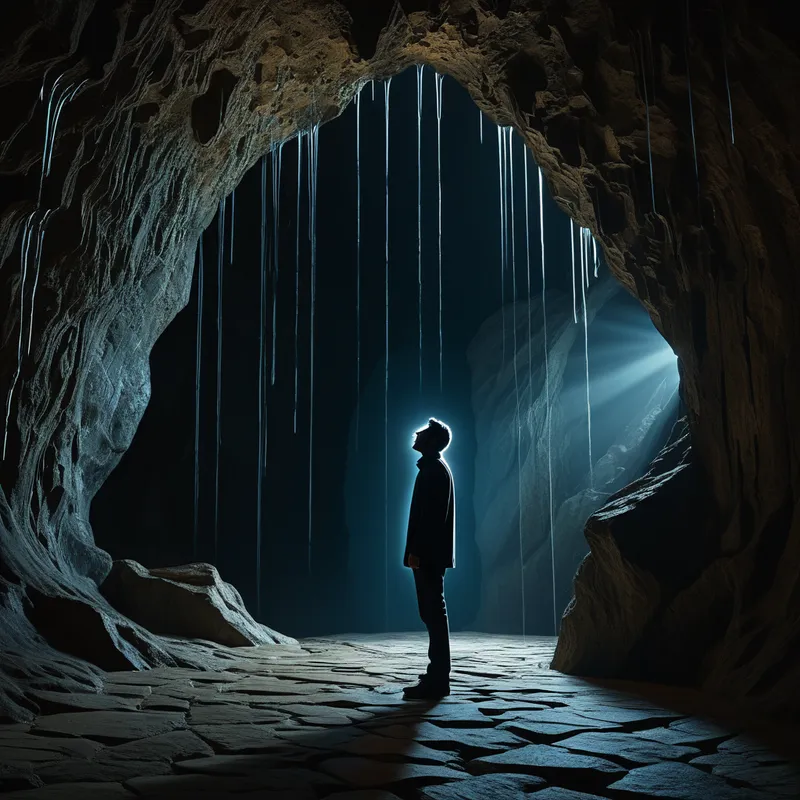
The ordeal of Trophonius models the individuation process at its most severe and non-negotiable stage: the [nigredo](/myths/nigredo “Myth from Alchemical culture.”/), the blackening, the descent into utter darkness where all light and certainty are extinguished.
The cave is the alchemical vessel where the lead of the persona is dissolved by the aqua regia of the unconscious.
The conscious mind, with its questions and desires (the seeker), is forcibly immersed in the [prima materia](/myths/prima-materia “Myth from Alchemical culture.”/) of the unconscious (the cave). The old identity is killed and digested. What emerges is not “enlightenment” in a blissful sense, but the albedo—a pallid, shocked clarity. The Throne of Mnemosyne is the beginning of integration, where the shattered ego must now piece together the revelation, translating the non-verbal, somatic truth into a narrative the conscious mind can bear. The seeker is forever bifurcated: a citizen of the day who has seen the night. This is the alchemical goal: not to escape darkness, but to have the darkness inscribed within one’s being, creating a creature capable of holding the tension between the human and the divine, the known and the unknowable. One becomes an oracle unto oneself, a living cave from which difficult truths may occasionally, and always traumatically, emerge.
Associated Symbols
Explore related symbols from the CaleaDream lexicon: