The Cave of the Nymphs Myth Meaning & Symbolism
A sacred cave where souls descend and ascend, guarded by nymphs, symbolizing the soul's perilous journey between the material and spiritual worlds.
The Tale of The Cave of the Nymphs
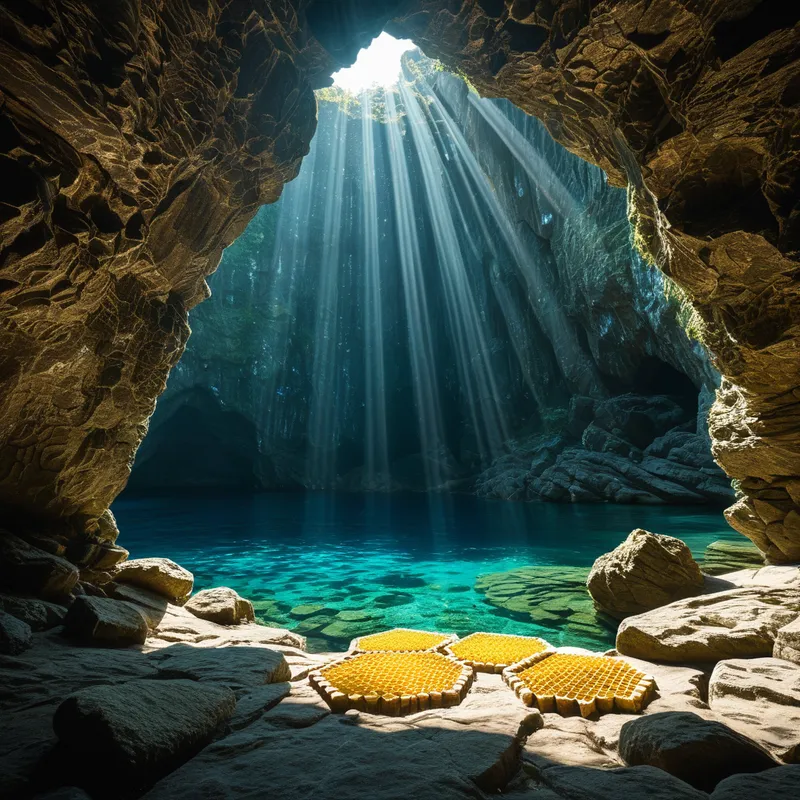
Listen, and let your mind travel to the wine-dark sea, to the rocky shores of Ithaca. There, in the north, near the ancient harbor, [the earth](/myths/the-earth “Myth from Hindu culture.”/) herself opens a mouth. It is no ordinary grotto, but a place where two worlds breathe. One entrance is turned for mortals, facing the chilling breath of the North Wind, Boreas. The other, a secret gate for the gods, smiles toward the gentle South, Notus.
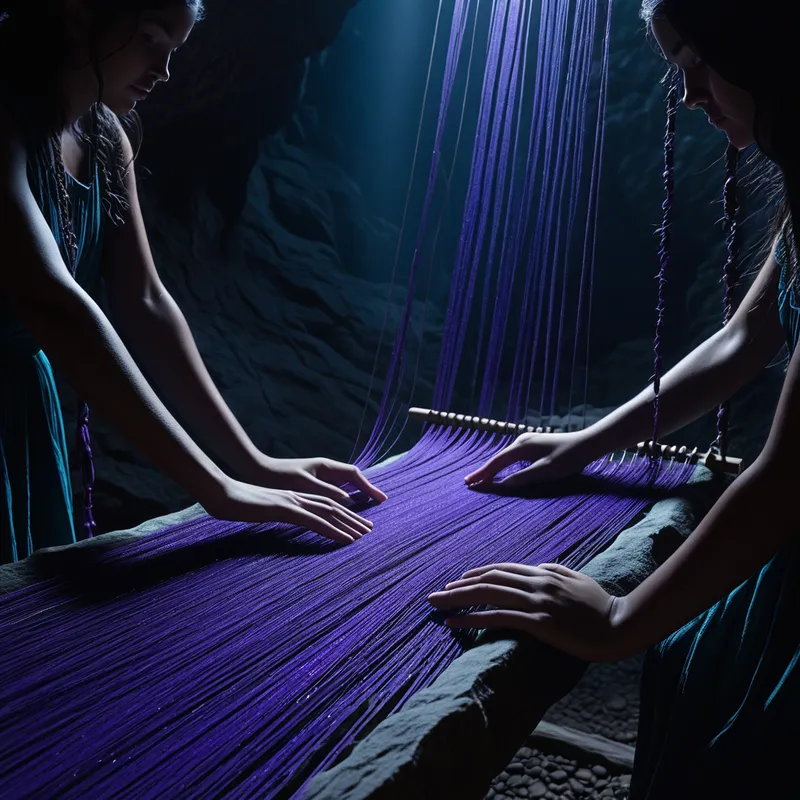
Step inside, if you dare. The air is cool and smells of wet stone and distant honey. Can you hear it? The eternal drip-drip of fresh [water](/myths/water “Myth from Chinese culture.”/) from stone basins, a sound older than kings. And there, in the perpetual twilight, they move. The [Nymphs](/myths/nymphs “Myth from Greek culture.”/), daughters of the earth-shaker himself, [Poseidon](/myths/poseidon “Myth from Greek culture.”/). They are weavers. Not of simple cloth, but of fate’s own fabric. Their looms, carved from the living rock, hum with activity. Upon them, they work sea-purple wool, a color deep as [the abyss](/myths/the-abyss “Myth from Kabbalistic culture.”/), shimmering like a dying sunset on the waves. This is their sacred, endless task.
But this cave is more than a workshop. It is a crossroads for souls. The poet tells us it is a psychopompeion—a conductor of spirits. Here, the pathways of life and death intersect. The souls of the dead, fleeting as shadows, flit down through the northern gate, the gate of mortals, drawn into [the cave](/myths/the-cave “Myth from Platonic culture.”/)’s dark embrace. And the souls seeking birth, bright and eager, ascend through the southern gate, the gate of the immortals, to enter [the world](/myths/the-world “Myth from Tarot culture.”/) of sun and struggle.
And it was here, in this numinous threshold, that a weary traveler once found refuge. [Odysseus](/myths/odysseus “Myth from Greek culture.”/), scarred and sea-tossed, finally home yet disguised as a beggar, was guided to this very cave by a swineherd. He hid the treasures gifted by the Phaeacians in its deep recesses, a final act of secrecy before his climactic return. In the silent watchfulness of the nymphs, amidst the drip of the sacred springs, the hero prepared for his last great ordeal, his soul pausing between one journey’s end and another’s bloody beginning.
Cultural Origins & Context
This haunting vision of the cave comes to us not from a grand epic’s central action, but from a profound digression within one. It is found in the later verses of [Homer](/myths/homer “Myth from Greek culture.”/)’s Odyssey (Book XIII), a passage that has captivated philosophers and mystics for millennia. While Homer plants the seed, it is the philosopher Porphyry who, centuries later, nurtures it into a full symbolic tree. In his treatise On the Cave of the Nymphs, he elevates the description from poetic setting to cosmic map.
This reflects a key function of Greek myth: to encode complex philosophical and theological ideas within narrative. The cave was not merely a setting for Odysseus’s practical need to hide treasure; for the ancient Greek listener, places like this were inherently charged. Caves were entrances to [the underworld](/myths/the-underworld “Myth from Greek culture.”/) ([Hades](/myths/hades “Myth from Greek culture.”/)), sites of oracle and initiation (like the cave at Delphi), and the dwellings of nymphs, who bridged the human and natural worlds. The myth, therefore, served a societal function as a metaphysical anchor—a story that explained the unseen architecture of the soul’s journey, grounding the terrifying mysteries of death and rebirth in a specific, knowable landscape of their own world.
Symbolic Architecture
The Cave of the Nymphs is a master [symbol](/symbols/symbol “Symbol: A symbol can represent an idea, concept, or belief, serving as a powerful tool for communication and understanding.”/) of the individuation process. It represents the [psyche](/myths/psyche “Myth from Greek culture.”/) itself—a hidden, [interior](/symbols/interior “Symbol: The interior symbolizes one’s inner self, thoughts, and emotions, often reflecting personal growth, vulnerabilities, and secrets.”/) [space](/symbols/space “Symbol: Dreaming of ‘Space’ often symbolizes the vastness of potential, personal freedom, or feelings of isolation and exploration in one’s life.”/) where the work of transformation occurs away from the conscious light of day.
The two gates are the pivotal symbols. The northern, mortal gate symbolizes descent, involution, and immersion into the [material](/symbols/material “Symbol: Material signifies the tangible aspects of life, often representing physical resources, desires, and the physical world’s influence on our existence.”/) world and the unconscious. The southern, immortal gate represents [ascent](/symbols/ascent “Symbol: Symbolizes upward movement, progress, spiritual elevation, or striving toward higher goals, often representing personal growth or transcendence.”/), evolution, and [emergence](/symbols/emergence “Symbol: A process of coming into being, rising from obscurity, or breaking through a barrier, often representing birth, transformation, or revelation.”/) into [consciousness](/symbols/consciousness “Symbol: Consciousness represents the state of awareness and perception, encompassing thoughts, feelings, and experiences.”/) and [spirit](/symbols/spirit “Symbol: Spirit symbolizes the essence of life, vitality, and the spiritual journey of the individual.”/). The cave is the liminal [chamber](/symbols/chamber “Symbol: A private, enclosed space representing the inner self, hidden aspects, or a specific stage in life’s journey.”/) where this [transmutation](/symbols/transmutation “Symbol: A profound, alchemical process of fundamental change where one substance or state transforms into another, often representing spiritual evolution or personal metamorphosis.”/) is prepared.
The soul does not travel a straight line, but a sacred spiral, forever descending into matter to gather experience and ascending into spirit to gain meaning.
The nymphs are the personified forces of this inner process. As weavers, they represent the [anima](/symbols/anima “Symbol: The feminine archetype within the male unconscious, representing soul, creativity, and connection to the inner world.”/) or the creative, connective, [fate](/symbols/fate “Symbol: Fate represents the belief in predetermined outcomes, suggesting that some aspects of life are beyond human control.”/)-shaping energies of the unconscious. Their sea-purple [wool](/symbols/wool “Symbol: A natural fiber representing warmth, protection, and connection to tradition. Often symbolizes comfort, labor, or spiritual purity.”/) signifies the profound, often murky [depths](/symbols/depths “Symbol: Represents the subconscious, hidden emotions, or foundational aspects of the self, often linked to primal fears or profound truths.”/) of the psychic substance from which the [tapestry](/symbols/tapestry “Symbol: The tapestry represents interconnected stories, creativity, and the weaving of personal and collective experiences into a cohesive narrative.”/) of a [life](/symbols/life “Symbol: The symbol of ‘Life’ represents a journey of growth, interconnectedness, and existential meaning, encompassing both the joys and challenges that define human experience.”/) is woven. The [stone](/symbols/stone “Symbol: In dreams, a stone often symbolizes strength, stability, and permanence, but it may also represent emotional burdens or obstacles that need to be acknowledged and processed.”/) looms imply that this process is ancient, structured, and part of the very [foundation](/symbols/foundation “Symbol: A foundation symbolizes the underlying support systems, values, and beliefs that shape one’s life, serving as the bedrock for growth and development.”/) of [reality](/symbols/reality “Symbol: Reality signifies the state of existence and perception, often reflecting one’s understanding of truth and life experiences.”/). The [honey](/symbols/honey “Symbol: A sweet, viscous substance produced by bees, symbolizing natural sweetness, reward, and nourishment.”/) and [water](/symbols/water “Symbol: Water symbolizes the subconscious mind, emotions, and the flow of life, representing both cleansing and creation.”/) within the cave are symbols of nourishment and purification available only to those who dare to enter their own [depths](/symbols/depths “Symbol: Represents the subconscious, hidden emotions, or foundational aspects of the self, often linked to primal fears or profound truths.”/).
The Dreamer’s Resonance
When this myth stirs in the modern dreamer, it signals a profound encounter with [the threshold](/myths/the-threshold “Myth from Folklore culture.”/) of [the Self](/myths/the-self “Myth from Jungian culture.”/). To dream of such a cave is to dream of initiation.
You may find yourself in a dark, natural enclosure—a basement that becomes a cavern, a tunnel that opens into a vast, interior space. There is often a sense of awe and trepidation. The presence of guiding, often feminine, figures (the nymphs) or the activity of crafting, weaving, or repairing something vital is common. There may be two doors, two paths, or two sources of light and dark. This is the somatic map of a psyche undergoing a major transition: the end of an old identity (descent through the north gate) and the painful, beautiful gathering of resources for a new one (ascent through the south gate).
The psychological process is one of numinous regression—a purposeful retreat from the demands of the [persona](/myths/persona “Myth from Greek culture.”/) and the conscious world to engage with the foundational layers of the unconscious. It is not a pathological withdrawal, but a sacred one. The dreamer is, like Odysseus, hiding their hard-won “treasures” (insights, potentials, vulnerabilities) in a safe, inner sanctum to protect them while the final battle for conscious integration is fought.
Alchemical Translation
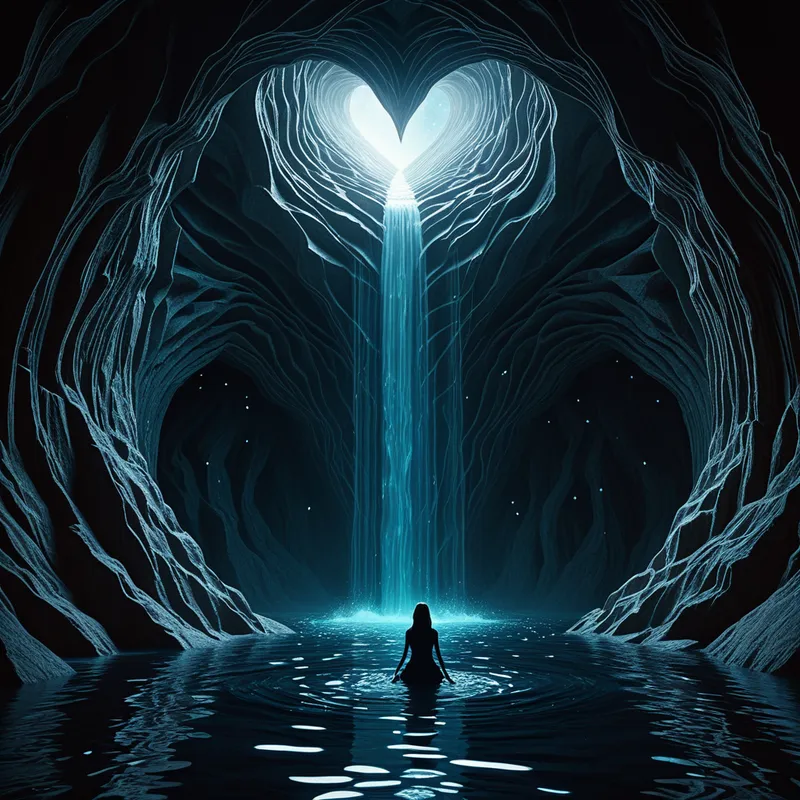
The alchemical journey mirrored in this myth is the [solve et coagula](/myths/solve-et-coagula “Myth from Alchemical culture.”/)—dissolve and coagulate. The soul’s descent into the cave is the solve: the dissolution of rigid ego structures, the facing of shadows, the immersion in the primal waters of the unconscious. Here, in the nymphs’ realm, the raw materials of the self are broken down.
The work of the nymphs at their looms is the hidden, mysterious process of recombination. They take the dissolved elements—[the sea](/myths/the-sea “Myth from Greek culture.”/)-purple confusion of our experiences, traumas, and joys—and begin to re-weave them into a new pattern. This is not done by the conscious ego, but by the autonomous, creative intelligence of the deeper psyche.
Individuation is not a act of willful creation, but of humble collaboration with the weavers within.
Finally, the ascent through the southern gate is the coagula: the emergence of a renewed consciousness, now carrying the pattern woven in the dark. Odysseus emerges from the cave not just to reclaim his palace, but to reclaim his true identity, having integrated the lessons of his long journey. For the modern individual, the “alchemical translation” is this: our greatest trials and most profound periods of introspective darkness are not meaningless. They are the necessary descent into our own Cave of the Nymphs, where the anima forces work to re-weave the tattered fabric of our being into a garment fit for the next phase of our journey—a garment dyed in the deep purple of lived experience and embroidered with the threads of hard-won wisdom.
Associated Symbols
Explore related symbols from the CaleaDream lexicon: