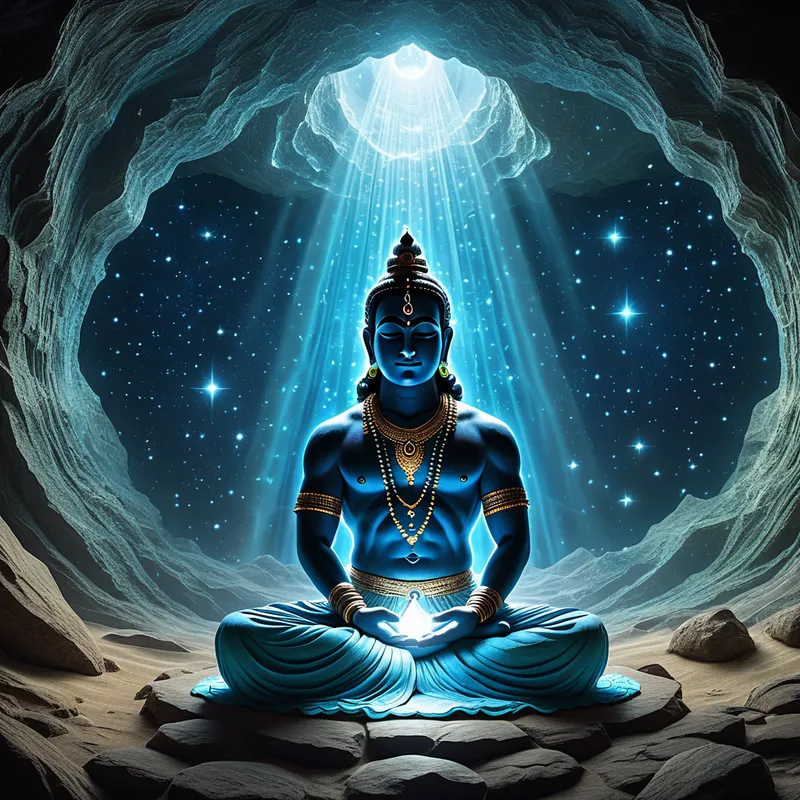
The Cave of the Heart Myth Meaning & Symbolism
A mythic journey into the innermost chamber of being, where the individual soul discovers its eternal, divine source.
The Tale of The Cave of the Heart
Listen. There is a cave that no map can chart, a cavern whose entrance is not of stone, but of longing. It lies not in the distant peaks of the Himalayas, but within the very fortress of the self. This is the tale of that hidden chamber.
The world was in twilight. Krishna, the divine charioteer, the flute-player whose song enchants creation itself, had completed his earthly play. The great war was over, the cosmic balance restored, yet a profound sorrow settled over the land of Vraja. His beloved cowherd friends and the gopis wept, for the one who had filled their hearts was preparing to depart. The air was thick with the scent of crushed tulsi leaves and unshed tears.
To his devoted friend Uddhava, a man of wisdom and royal duty, Krishna gave a final, impossible task. “Go to Vraja,” he said, his voice both gentle and firm as a mountain stream. “Console them. Tell them I am always with them.”
Uddhava journeyed, his heart heavy with philosophical truths he intended to impart. He found the gopis by the banks of the Yamuna, their bodies frail from fasting, their eyes pools of infinite grief. He spoke of the eternal, formless Brahman, of the soul’s immortality, of detachment. His words, polished and profound, fell upon them like stones into a deep well, producing only a hollow echo.
Then, the eldest among them, Lalita, smiled a smile of heartbreaking wisdom. “O Uddhava,” she whispered, her voice cracking like dry earth. “You speak of a truth that is far away. Our truth is here, in this ache. We do not seek the divine in the vast, empty sky. We have known Him in the touch of a hand, the sound of a flute, the stolen glance in the moonlit forest. If He is truly everywhere, as you say, then He is here, in this very pain. Find Him for us here.”
Her words struck Uddhava like a thunderbolt, shattering his intellectual certainty. He, the counselor, was now the one in need of guidance. Confused and humbled, he retreated to a solitary cave in the mountains to meditate, to seek the answer that logic could not provide.
In the deep silence of that stone womb, in the absolute dark where even thought seemed to die, Uddhava turned his awareness inward. He journeyed past the tumult of his senses, the chatter of his mind, the fortress of his ego. Deeper and deeper he went, into a profound interiority. And there, in the secret, innermost chamber—the guha—he did not find abstract principles.
He found a presence. A familiar, luminous presence seated in serene majesty. It was Krishna. Not the Krishna of distant legends, but the intimate Krishna of Vraja, smiling with infinite compassion. The flute was silent, yet the entire cave resonated with its unplayed song. The truth Lalita spoke of was not a concept to be understood, but a reality to be inhabited. The divine was not elsewhere. It was the very ground and substance of the heart’s deepest cavity. Uddhava emerged not with new words, but with a transformed silence. He had found the cave, and in finding it, he had found his way home.
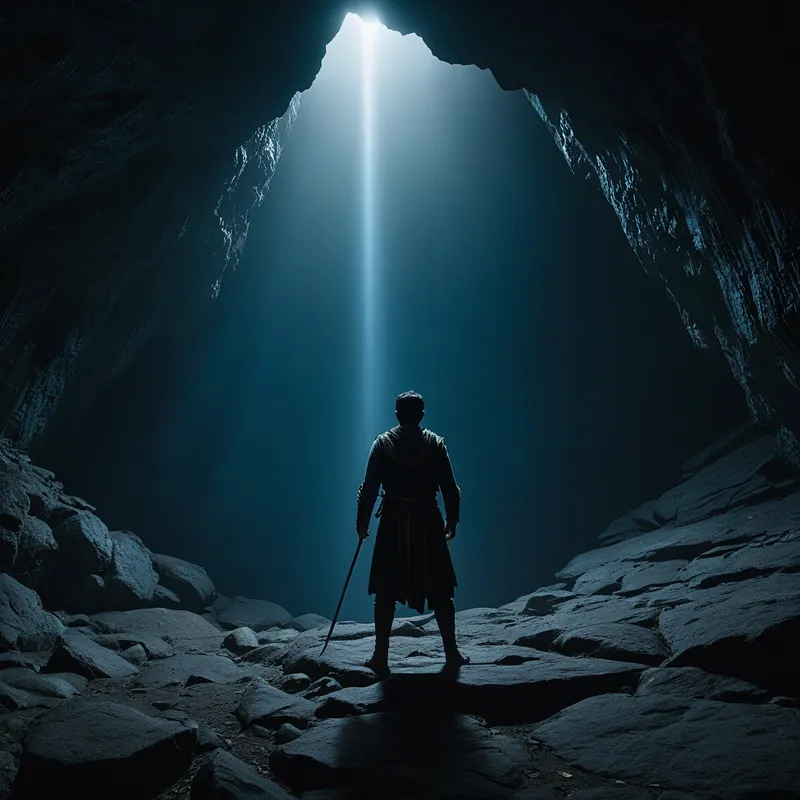
Cultural Origins & Context
This poignant narrative is woven into the vast tapestry of the Bhagavata Purana, specifically in its tenth canto. Composed in Sanskrit and dating to the early centuries of the first millennium, the Puranas served as “ancient lore” for the masses, translating complex Vedic philosophy into accessible, devotional stories. The tale of the Cave of the Heart sits at the crossroads of several powerful streams within Hindu culture: the intellectual Jnana Yoga, the devotional Bhakti Yoga, and the meditative Raja Yoga.
It was told by sages like Shuka to kings on the banks of the Ganga, not merely as entertainment, but as a functional map of consciousness. Its societal function was initiatory. For the householder like Uddhava, it modeled the necessary crisis where external duty and intellectual knowledge must yield to internal, experiential truth. For the devotee, it validated the supremacy of heartfelt love (prema) over scholasticism. The myth served as a bridge, showing that the ultimate goal of all paths—moksha—was not an external achievement, but the discovery of an inner, pre-existing sanctuary.
Symbolic Architecture
The myth’s power lies in its perfect symbolic architecture. The cave is the ultimate symbol of the unconscious, the hidden, the potential. The heart (hridaya) in Indian philosophy is not merely the emotional center, but the seat of consciousness itself—the “space within the heart” where the atman and the Brahman meet.
The journey to the cave is always a descent, a movement away from the sunlit world of appearances into the dark, fertile soil of origin.
Uddhava represents the disciplined mind and the socially-adapted ego. His initial failure with the gopis signifies the bankruptcy of mere intellectual understanding when confronted with raw, archetypal longing. The gopis embody bhakti in its purest, most desperate form: the soul’s irrational, all-consuming love for the divine. Their grief is not pathology, but the burning away of all that is not the beloved. Lalita’s challenge is the catalytic moment that cracks the seeker’s worldview open, forcing the journey inward.
Krishna’s dual presence—as the external friend who departs and the internal sovereign who is eternally present—maps the fundamental spiritual realization: the divine you seek is the consciousness with which you seek.

The Dreamer’s Resonance
When this mythic pattern stirs in the modern dreamer, it often manifests as dreams of exploration into basements, subways, underground tunnels, or natural caverns. There is a somatic quality of descending. The dream ego may feel apprehension, but also a compelling pull. These are not dreams of external adventure, but of internal archaeology.
Psychologically, this signals a critical phase where one’s established identity (the Uddhava-ego) is failing to “console” or make sense of a deep, perhaps inarticulate longing or grief (the gopi-soul). The conscious attitude has hit its limit. The dream-cave represents the unconscious offering itself as the only viable terrain for resolution. To dream of finding a luminous, peaceful space or a familiar, guiding figure in such a cave indicates the nascent experience of the Self—Jung’s term for the central, ordering archetype of the psyche. It is the psyche’s own imagery for the process of connecting with a guiding center deeper than the ego’s strategies.

Alchemical Translation
The alchemy modeled here is the transmutation of seeking into finding, and of distance into intimacy. The initial state is one of separation: Uddhava is separate from the gopis’ experience, the gopis are separate from Krishna, the divine is perceived as external. The nigredo, the blackening, is Uddhava’s confusion and the gopis’ desolation—the necessary dissolution of old certainties.
The hero’s journey concludes not by slaying a monster in the world, but by recognizing the monarch within the interior castle.
The journey into the cave is the mortificatio, the death of the outward-seeking ego. Uddhava’s meditation is the albedo, the whitening or purification, where in the silent dark, all projections are withdrawn. The dazzling discovery within is the rubedo, the reddening, the revelation of the golden king in his chamber—the lapis philosophorum or philosopher’s stone of the psyche. This is the culmination of individuation: the ego’s alignment with the Self.
For the modern individual, the myth does not prescribe ascetic retreat. It prescribes an inner orientation. The “cave” can be entered in moments of silent reflection, in therapy, in creative flow, or in any activity that demands we turn off the noise of the external world and attend to the subtle whisper from within. The triumph is the realization that what we most desperately seek—be it love, peace, purpose, or God—is not a prize to be won in the future, but the foundational reality of our own deepest, most hidden heart-space, waiting patiently in the dark to be acknowledged.
Associated Symbols
Explore related symbols from the CaleaDream lexicon: