The Cauldron of Plenty Myth Meaning & Symbolism
A magical cauldron that endlessly provides, guarded by otherworldly forces, becomes the object of a perilous quest for restoration and sovereignty.
The Tale of The Cauldron of Plenty
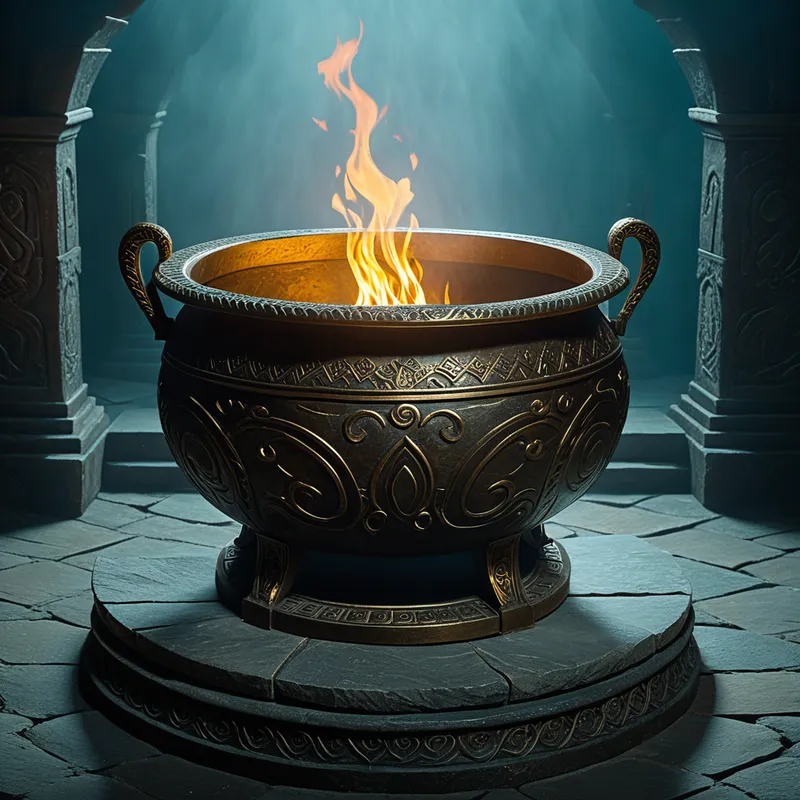
Listen. [The wind](/myths/the-wind “Myth from Various culture.”/) carries a memory older than stone. In the time between times, when [the world](/myths/the-world “Myth from Tarot culture.”/) was raw and the gods walked just beyond [the veil](/myths/the-veil “Myth from Various culture.”/), there existed a vessel of impossible grace. It was not forged in any mortal fire, but born from the sigh of the [Otherworld](/myths/otherworld “Myth from Celtic culture.”/). They called it the Cauldron of [the Dagda](/myths/the-dagda “Myth from Celtic culture.”/), and from its depths, no company ever went away unsatisfied.
It was kept in the Brugh na Bóinne, the great mound, by the Dagda himself, a lord whose club could slay nine men with one end and restore them to life with the other. His cauldron was his heart made manifest: bottomless, generous, a womb of perpetual becoming. To drink from it was to have one’s spirit mended; to be served from it was to know the fullness of belonging. It was the promise that scarcity was but a dream.
But shadows gather where light pools deepest. In a great war, a cataclysm of clashing spears and shattered oaths, the cauldron was lost. Or perhaps it was taken—borne away to a fortress of cold stone in the northern wastes, to the court of a king of the [Fomorians](/myths/fomorians “Myth from Irish culture.”/). This king, a giant of cold intent, hoarded its power. He used it not to feed, but to test; not to restore, but to withhold. The cauldron’s nature was inverted, its generosity locked behind a door of despair. The land itself began to wither in its absence, a king without a Sovereignty Goddess ruling a wasted throne.
So a quest was born, not for gold, but for restoration. A company of heroes, the bright and the brave, set sail on a sea that wept salt tears. They came to the fortress of ice and fear. The guardian was not a dragon, but a legion of the un-living, warriors slain and re-animated by the cauldron’s corrupted magic. To defeat them was impossible, for they rose again, whole, from the very vessel the heroes sought.
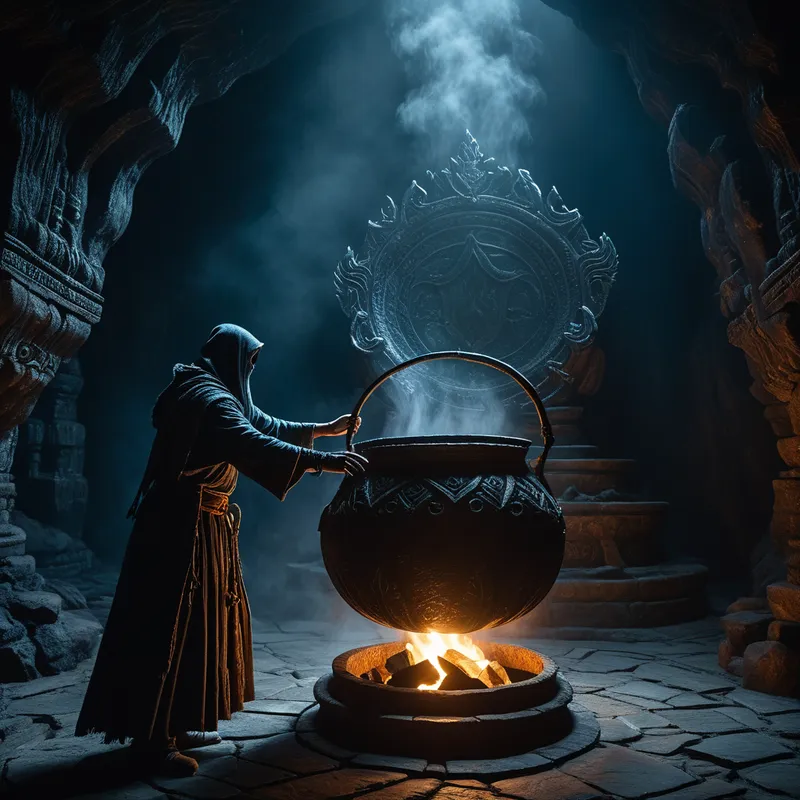
The air grew thick with the scent of iron and cold earth. The hero, often a figure like Cú Chulainn, or the cunning [Taliesin](/myths/taliesin “Myth from Celtic culture.”/) in the later Welsh echoes of the tale, faced the paradox. To win the cauldron, one must first be broken by it. In a moment of terrifying surrender, the hero allows himself to be cast into the cauldron’s depths—not to be consumed, but to be undone. The scalding waters dissolve the armor of the old self, the rigid identity. It is a death.
And from that death, a rebirth. The hero emerges, not merely healed, but remade. His eyes now see the weave of the world. With this transformed sight, he performs the impossible act: he destroys the cauldron. Or rather, he shatters its corrupted form, releasing its essence back into the world’s bloodstream. The fortress crumbles. The un-living find final rest. And the hero returns, not with a trophy, but with a secret: the true cauldron was never a [thing](/myths/thing “Myth from Norse culture.”/) to be owned, but a process to be undergone. The land, feeling this release, sighs a green and growing sigh.
Cultural Origins & Context
This myth echoes across the Celtic world, from the Irish Coire Ansic to the Welsh Pair Dadeni (the Cauldron of Rebirth). It was not a single story penned in a book, but a living pattern recited by filidh (poets) and bards by firelight, its details shifting like flame yet its core burning constant. Its primary function was cosmological: it explained the cycle of the year’s death and rebirth, the necessity of the king’s sacrifice for the land’s fertility, and [the Otherworld](/myths/the-otherworld “Myth from Celtic culture.”/)’s role as the ultimate source of life’s abundance.
The cauldron was a central symbol in a culture deeply attuned to reciprocity between the human and divine realms. Feasting was a sacred act, and a chieftain’s worth was measured by the openness of his hall and the fullness of his cauldron. The myth served as a dramatic, metaphysical guarantee: even when the land lay fallow and the tribe hungered, the potential for limitless renewal existed, waiting in the hidden places, accessible only through courage and correct action—often a blend of martial prowess and sacred wisdom.
Symbolic Architecture
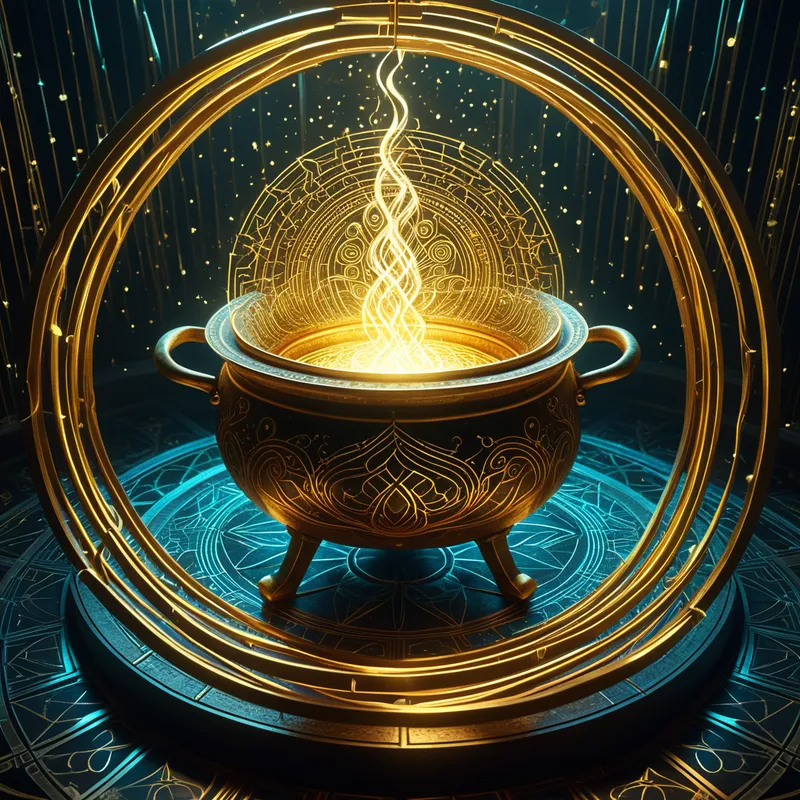
The [Cauldron](/symbols/cauldron “Symbol: A large metal pot for cooking or brewing, symbolizing transformation, nourishment, and hidden potential.”/) of Plenty is the archetypal [vessel](/symbols/vessel “Symbol: A container or structure that holds, transports, or protects something essential, representing the self, emotions, or life journey.”/) of transformation. It is the [womb](/symbols/womb “Symbol: A symbol of origin, potential, and profound transformation, representing the beginning of life’s journey and the unconscious source of creation.”/) of the Sovereignty [Goddess](/symbols/goddess “Symbol: The goddess symbolizes feminine power, divinity, and the nurturing aspects of life, embodying creation and wisdom.”/), the container where opposites—[life](/symbols/life “Symbol: The symbol of ‘Life’ represents a journey of growth, interconnectedness, and existential meaning, encompassing both the joys and challenges that define human experience.”/) and [death](/symbols/death “Symbol: Symbolizes transformation, endings, and new beginnings; often associated with fear of the unknown.”/), [scarcity](/symbols/scarcity “Symbol: A dream symbol representing lack, limitation, or insufficient resources, often reflecting fears of deprivation or unmet needs.”/) and [abundance](/symbols/abundance “Symbol: A state of plentifulness or overflowing resources, often representing fulfillment, prosperity, or spiritual richness beyond material needs.”/), brokenness and wholeness—are stirred into a new unity.
The cauldron does not merely fill what is empty; it dissolves what is rigid to make room for what is possible.
The [hero](/symbols/hero “Symbol: A hero embodies strength, courage, and the ability to overcome significant challenges.”/)’s [journey](/symbols/journey “Symbol: A journey in dreams typically signifies adventure, growth, or a significant life transition.”/) is not one of conquest, but of submission to a transformative process. The [guardian](/symbols/guardian “Symbol: A protector figure representing safety, authority, and guidance, often embodying parental, societal, or spiritual oversight.”/) warriors represent the defensive structures of the [psyche](/myths/psyche “Myth from Greek culture.”/)—our traumas, fixed identities, and old wounds—that are perpetually regenerated by the very [energy](/symbols/energy “Symbol: Energy symbolizes vitality, motivation, and the drive that fuels actions and ambitions.”/) (the cauldron) that could liberate us. The act of being cast into the cauldron symbolizes [the ego](/myths/the-ego “Myth from Jungian culture.”/)’s necessary [dissolution](/symbols/dissolution “Symbol: The process of breaking down, dispersing, or losing form, often representing transformation, release, or the end of a state of being.”/) in service to [the Self](/myths/the-self “Myth from Jungian culture.”/). It is the dark [night](/symbols/night “Symbol: Night often symbolizes the unconscious, mystery, and the unknown, representing the realm of dreams and intuition.”/) of the [soul](/symbols/soul “Symbol: The soul represents the essence of a person, encompassing their spirit, identity, and connection to the universe.”/), the alchemical solve (dissolution), where one is stripped bare to the core of being.
The final “breaking” of the cauldron is critical. It signifies that the [treasure](/symbols/treasure “Symbol: A hidden or valuable object representing spiritual wealth, inner potential, or divine reward.”/) cannot be integrated as an external power object. It must be internalized, its magic distributed. [The vessel](/myths/the-vessel “Myth from Alchemical culture.”/) breaks so that its contents—the [capacity](/symbols/capacity “Symbol: A measure of one’s potential, limits, or ability to contain, process, or achieve something, often reflecting self-assessment or external demands.”/) for endless [regeneration](/symbols/regeneration “Symbol: The process of renewal, restoration, and growth following damage or depletion, often representing emotional healing, transformation, or a fresh start.”/)—can flow into the individual and, by extension, the [community](/symbols/community “Symbol: Community in dreams symbolizes connection, support, and the need for belonging.”/).
The Dreamer’s Resonance
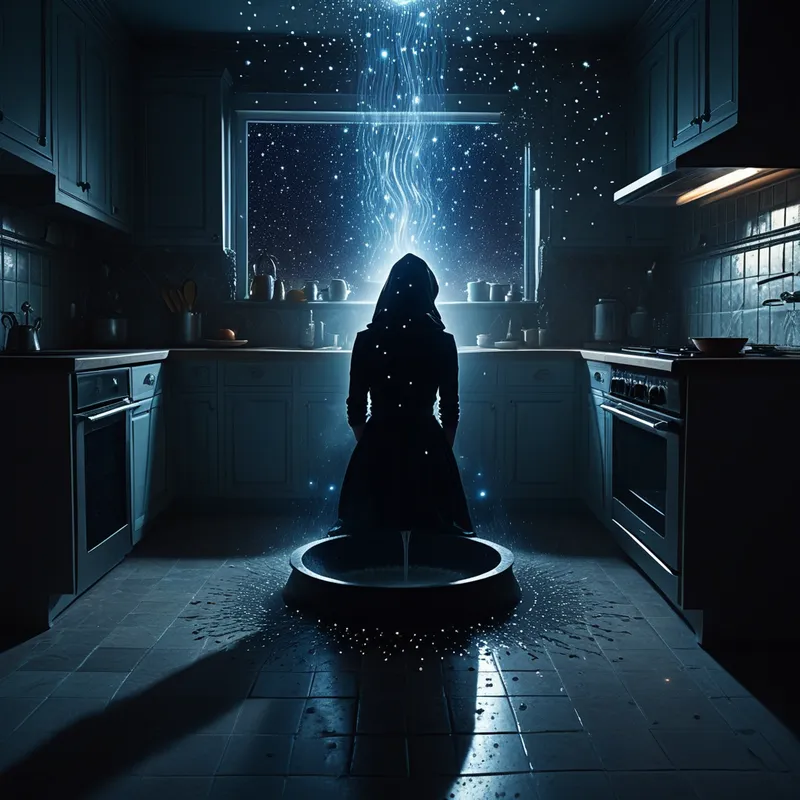
When this myth stirs in the modern unconscious, it often manifests in dreams of overwhelming containers: overflowing bathtubs, industrial vats, or cosmic sinks. The dreamer may be tasked with feeding a multitude with a single pot, or feel anxiety about a pot boiling over. Somatic sensations of being submerged in warm, enveloping fluid or, conversely, of being scalded, are common.
Psychologically, this signals a profound encounter with the Great Mother archetype in both her nurturing and her devouring aspects. The dreamer is at a threshold where an old way of being—a career, a relationship, a self-concept—has become a sterile fortress. The psyche is presenting the solution: a terrifying, total immersion in the unknown (the cauldron) to be remade. The resistance felt in the dream is the ego clinging to its familiar, even if painful, form. The dream is an invitation to a sacred death.
Alchemical Translation
For the individual on the path of individuation, the myth of the cauldron maps the process of psychic transmutation with stunning clarity. Our personal “cauldron” is the vessel of the soul itself, where the raw materials of experience—joy, trauma, love, failure—are cooked.
[The first stage](/myths/the-first-stage “Myth from Alchemical culture.”/) is The Theft: We experience a loss of innate wholeness. Our natural abundance (confidence, creativity, connection) feels stolen by external forces—a critical parent, a societal pressure, a personal failure—and locked away in a cold, internal fortress of complex and defense.
The quest is The Descent: Conscious life becomes a wasteland. We must turn inward, toward the very fortress of our pain (the guarded complex). The battle with the “un-living” is our engagement with repetitive, draining thought patterns and emotional reactions that seem to resurrect themselves no matter how we fight them.
The alchemical fire is not lit to destroy the contents, but to transmute the container.
The climax is The Immersion: This is the act of radical acceptance and shadow-work. We stop fighting the symptom and allow ourselves to be fully in the feeling, the memory, the brokenness. We enter our own cauldron. This is the ego’s sacrifice, a willing dissolution into the primal waters of the unconscious.
The resolution is The Distribution: Emerging, we do not “have” the cauldron. We become its function. The renewed capacity for self-nourishment, resilience, and creative life is no longer a sought-after object, but an integrated quality of being. We break the old, rigid vessel of our identity to become a flowing source. The treasure was never gold, but the golden, ever-renewing process of the soul’s own regeneration. We become, in our humble, human way, a cauldron of plenty for our own world.
Associated Symbols
Explore related symbols from the CaleaDream lexicon: