The Cattle of Helios Myth Meaning & Symbolism
A starving crew defies a sacred oath, slaughtering the immortal cattle of the Sun God Helios, bringing divine annihilation upon themselves.
The Tale of The Cattle of Helios
Hear now the tale that seals the fate of men who dare to feast upon the light of heaven itself. The salt-scarred ship of [Odysseus](/myths/odysseus “Myth from Greek culture.”/), a splinter of hope on the wine-dark sea, had survived the witch, the cyclops, and the whispering dead. Yet its greatest trial lay not in monster-haunted straits, but on a sun-drenched isle of terrible, radiant peace: Thrinacia.
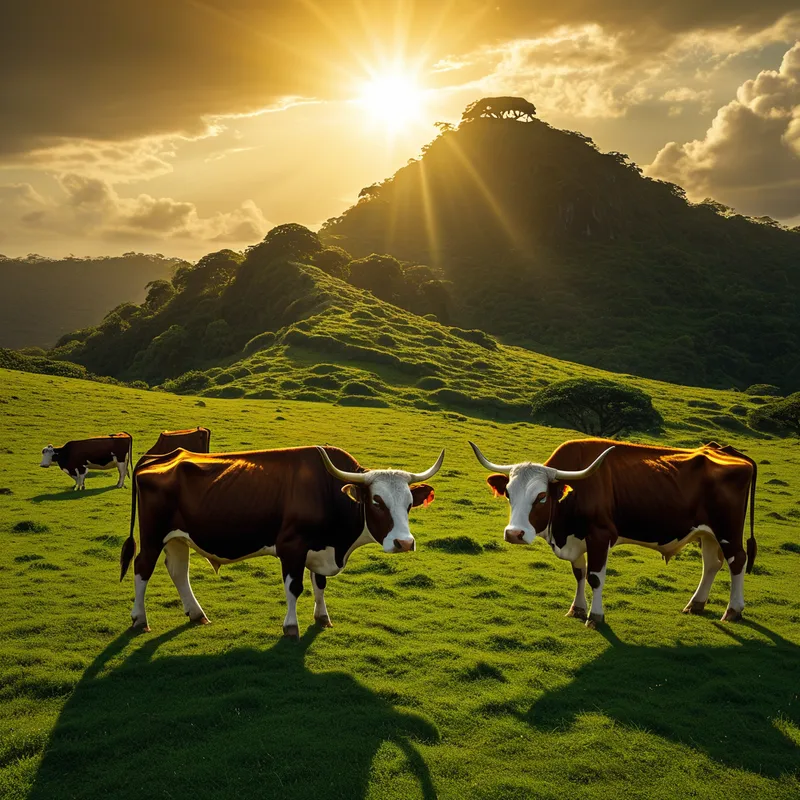
The island was a jewel set in [the sea](/myths/the-sea “Myth from Greek culture.”/)’s crown, lush with tender grasses and sweet streams. But this bounty was a trap woven of light. For this was the sacred pasture of [Helios](/myths/helios “Myth from Greek culture.”/), he who sees all from his chariot of fire. His cattle and sheep were not of mortal stock. Their hides shimmered with the pale gold of dawn, their horns were curved bronze, and their lowing was a sound that held the warmth of [the world](/myths/the-world “Myth from Tarot culture.”/). They were immortal, numinous, a moving part of the cosmic order.
As they made landfall, the voice of the dread sorceress Circe echoed in Odysseus’s mind, a prophecy more binding than any chain: Touch not the herds of Helios, for they belong to a god who hears and sees all things. Do this, and you shall die far from home, and your ship and comrades shall be destroyed.
Odysseus gathered his men, their faces gaunt from endless rowing, their eyes hollow. He made them swear a mighty oath by all they held sacred, by the salt of the sea and [the earth](/myths/the-earth “Myth from Hindu culture.”/) of Ithaca, that they would not lay a hand on a single sacred beast. They swore, and the air grew heavy with the weight of the promise.
For a month, the contrary winds held them prisoner. The ship’s stores of wine and barley-cake dwindled to nothing. Hunger, that old sailor’s companion, became a tyrant. It gnawed at their bellies and their oaths alike. While Odysseus climbed a peak to pray to gods who seemed not to listen, his men broke. The sight of the fat, beautiful cattle, moving unafraid among them, became an unbearable torment.
“Better to die once by the sea’s wrath,” one cried, his voice cracked with thirst, “than to waste away here by inches. If we make rich sacrifice to the gods, perhaps even Helios will forgive us.” It was the logic of desperation, a bargain struck with a hunger that drowns out the voice of fate.
They chose the finest of [the immortal](/myths/the-immortal “Myth from Taoist culture.”/) herd. The chosen beast did not bellow in fear; it stood, patient and luminous, as if awaiting a priest. The stroke of the blade was a sacrilege that silenced the very birds. They roasted the flesh that was never meant for fire. The smell that rose was not of savory meat, but something strange and wrong—like burning metal and spoiled honey. The hides upon the ground twitched and crawled. The spits of skewered meat lowed upon the fire.
High in his solar chariot, Helios felt the wound in his herd. He saw the black smoke of profane fire staining his bright sky. His rage was not the hot fury of Ares, but the cold, absolute wrath of a fundamental law broken. He went to Zeus and laid his case before the throne of heaven: [justice](/myths/justice “Myth from Tarot culture.”/), or he would take the sun down to the House of [Hades](/myths/hades “Myth from Greek culture.”/) and shine for the dead alone.
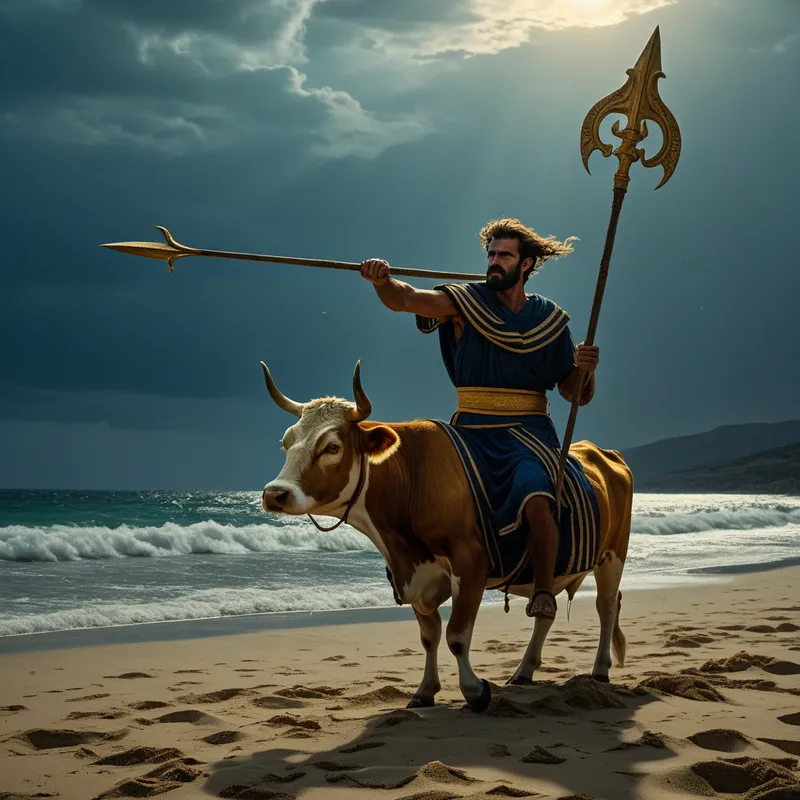
Zeus nodded. The promise of the king of gods is the turning of the world. As the sailors, their hunger briefly sated by the cursed meal, put out to sea, [the sky](/myths/the-sky “Myth from Persian culture.”/) assembled its vengeance. A sudden purple cloud swallowed the sun. [The wind](/myths/the-wind “Myth from Various culture.”/) died, then awoke as a screaming fury. A bolt of Zeus’s thunder, white and final, struck the ship’s heart. The mast exploded into splinters, the timbers burst asunder, and the men, their mouths still tasting the sun’ stolen flesh, were thrown into the raging foam. One by one, they drowned, their bodies food for the fish, their souls bound for the misty halls of the dead. Only Odysseus, who kept the oath and touched not the cattle, clung to the wreckage, spared to carry the memory of their transgression into a decade of further exile.
Cultural Origins & Context
This myth reaches us primarily through the resonant hexameter verses of [Homer](/myths/homer “Myth from Greek culture.”/)’s Odyssey, composed in the 8th or 7th century BCE but drawing on a far older oral tradition. For the ancient Greeks, this was not merely an adventure story but a foundational narrative about the boundaries of the human condition. It was performed by bards (rhapsodes) in aristocratic halls and public festivals, its rhythm and repetition serving as a cultural memory bank.
The function of the episode is multifaceted. On one level, it is a stark exemplum of divine justice and the inviolable nature of [themis](/myths/themis “Myth from Global/Universal culture.”/) (divine law and order). The cattle of Helios represent a portion of the cosmos that is explicitly off-limits to mortals; they are the property of a Titan, a pre-Olympian power whose domain is essential for all life. To harm them is to attack the cosmic order itself. Societally, it reinforced the supreme importance of the oath (horkos), which was the glue binding human agreements and human relationships to the divine. To break an oath sworn before the gods was to invite automatic, catastrophic retribution.
Symbolic Architecture
The myth is a perfect, terrifying model of a psychological and spiritual catastrophe. The sacred cattle are not merely livestock; they are symbols of numinous [energy](/symbols/energy “Symbol: Energy symbolizes vitality, motivation, and the drive that fuels actions and ambitions.”/) in its pure, untapped form—the vital, [life](/symbols/life “Symbol: The symbol of ‘Life’ represents a journey of growth, interconnectedness, and existential meaning, encompassing both the joys and challenges that define human experience.”/)-giving force of the sun, made manifest. They are the instinctual, creative, or spiritual libido that must be respected, not possessed.
To slaughter the sacred cattle is to commodify the numinous, to attempt to ingest the transcendent in order to fill a temporal emptiness. It is the ego’s attempt to consume the Self.
The [island](/symbols/island “Symbol: An island represents isolation, self-reflection, and the need for separation from the external world.”/) of Thrinacia is a liminal [space](/symbols/space “Symbol: Dreaming of ‘Space’ often symbolizes the vastness of potential, personal freedom, or feelings of isolation and exploration in one’s life.”/), a test of [character](/symbols/character “Symbol: Characters in dreams often signify different aspects of the dreamer’s personality or influences in their life.”/) disguised as a sanctuary. The [crew](/symbols/crew “Symbol: A crew often symbolizes collaboration, teamwork, and collective purpose, suggesting a need for shared goals and support from others in one’s journey.”/)’s [hunger](/symbols/hunger “Symbol: A primal bodily sensation symbolizing unmet needs, desires, or emotional voids. It represents craving for fulfillment beyond physical nourishment.”/) represents any all-consuming, desperate need—for [security](/symbols/security “Symbol: Security denotes safety, stability, and protection in one’s personal and emotional life.”/), for validation, for immediate [relief](/symbols/relief “Symbol: Relief signifies release from tension or discomfort, often representing emotional healing and liberation from burdens.”/) from psychic pain. Odysseus, here, represents the fragment of [consciousness](/symbols/consciousness “Symbol: Consciousness represents the state of awareness and perception, encompassing thoughts, feelings, and experiences.”/) that knows [the law](/symbols/the-law “Symbol: Represents external rules, societal order, moral boundaries, and the tension between personal freedom and collective structure.”/), the warning voice of the superego or the guiding principle. His men are the impulsive, id-driven [psyche](/myths/psyche “Myth from Greek culture.”/), willing to trade long-[term](/symbols/term “Symbol: The term often represents boundaries, defined concepts, or experiences that have a specific meaning in a given context.”/) wholeness for short-term satiation. The horrific detail of the [meat](/symbols/meat “Symbol: Meat in dreams often symbolizes sustenance, vitality, and the primal aspects of one’s nature, as well as potential conflicts or desires.”/) lowing on the spits is the ultimate [symbol](/symbols/symbol “Symbol: A symbol can represent an idea, concept, or belief, serving as a powerful tool for communication and understanding.”/) of the violation: the sacred does not die quietly; it protests its desecration in the very act.
[Helios](/symbols/helios “Symbol: Helios symbolizes the sun, embodying light, life, and divine energy in various mythological traditions.”/)’s appeal to Zeus marks the [moment](/symbols/moment “Symbol: The symbol of a ‘moment’ embodies the significance of transient experiences that encapsulate emotional depth or pivotal transformations in life.”/) when a personal transgression becomes a cosmic [crisis](/symbols/crisis “Symbol: A crisis symbolizes turmoil, urgent challenges, and the need for immediate resolution or change.”/). It is the point at which breaking an inner law triggers a systemic, self-annihilating [response](/symbols/response “Symbol: Response in dreams symbolizes how one reacts to situations, often reflecting the subconscious mind’s processing of events.”/) from the totality of the psyche.
The Dreamer’s Resonance
When this myth stirs in the modern unconscious, it rarely appears as golden cattle. Instead, one might dream of being forced by colleagues to violate a core personal ethic at work (“just fudge the numbers”), of stealing something priceless from a museum display knowing alarms will sound, or of desperately eating a forbidden, glowing fruit in a dead garden. The somatic feeling is one of intense anxiety mixed with compulsive need—a “hunger” so great it overrides all foresight.
The psychological process is one of shadow integration gone awry. The individual is faced with a legitimate need (the hunger) but chooses a path of violation to meet it. The dream is a warning from [the Self](/myths/the-self “Myth from Jungian culture.”/): you are about to, or have already, sacrificed your integrity, your connection to something sacred (a relationship, a creative gift, a moral principle) for immediate gratification or survival. The ensuing “storm” in waking life might be a sudden collapse of a project, a devastating betrayal, or a profound episode of depression and meaninglessness—the psyche’s way of dissolving the structure that housed the violation.

Alchemical Translation
In the alchemical journey of individuation, the Thrinacian ordeal represents the critical stage of the [nigredo](/myths/nigredo “Myth from Alchemical culture.”/)—the blackening, the utter despair and dissolution. It is the necessary catastrophe that follows the attempt to shortcut the process.
The true work is not to consume the golden cattle (the unintegrated Self), but to witness them, be sustained by their proximity, and endure the hunger. This is the agony of the vas ([the vessel](/myths/the-vessel “Myth from Alchemical culture.”/)) holding contradictory tensions without acting out. Odysseus, praying on the peak while his men fail below, models this differentiated consciousness: he feels the hunger but contains the impulse.
The storm that destroys the ship is not merely punishment; it is the alchemical solve—the ruthless dissolution of the old, oath-breaking identity. The crew, the undifferentiated psyche, must die for the conscious element (Odysseus) to proceed, humbled and stripped bare.
The [triumph](/myths/triumph “Myth from Roman culture.”/) is not in getting away with the theft, but in surviving the consequences of failing the test. For the modern individual, the “cattle of Helios” are those inner values, talents, or truths we are tempted to betray under pressure—to monetize our artistry into soulless work, to abandon our ethics for approval, to silence our voice for comfort. The myth teaches that such betrayal does not nourish; it poisons the soul’s foundation. The path to wholeness demands we honor the sacred herd within, even as we starve in the dark, trusting that a different wind will rise, but only if the oath to our deepest nature is kept.
Associated Symbols
Explore related symbols from the CaleaDream lexicon: