The Castle of Qaf Myth Meaning & Symbolism
A mystical quest to a remote cosmic mountain, where the seeker must confront the Simurgh to find the ultimate treasure of self-knowledge.
The Tale of The Castle of Qaf
Listen, and let your soul travel to the edge of the known world. Beyond the last maps, beyond the seas of darkness and the fields of wandering stars, lies a ring of mountains that encircles the very Earth. This is the Mount Qaf. Its peaks are not of stone as we know it, but of a single, immense emerald, whose light is the source of all the green in [the world](/myths/the-world “Myth from Tarot culture.”/). The air there is not air, but the breath of eternity, cold and sharp and tasting of origins.
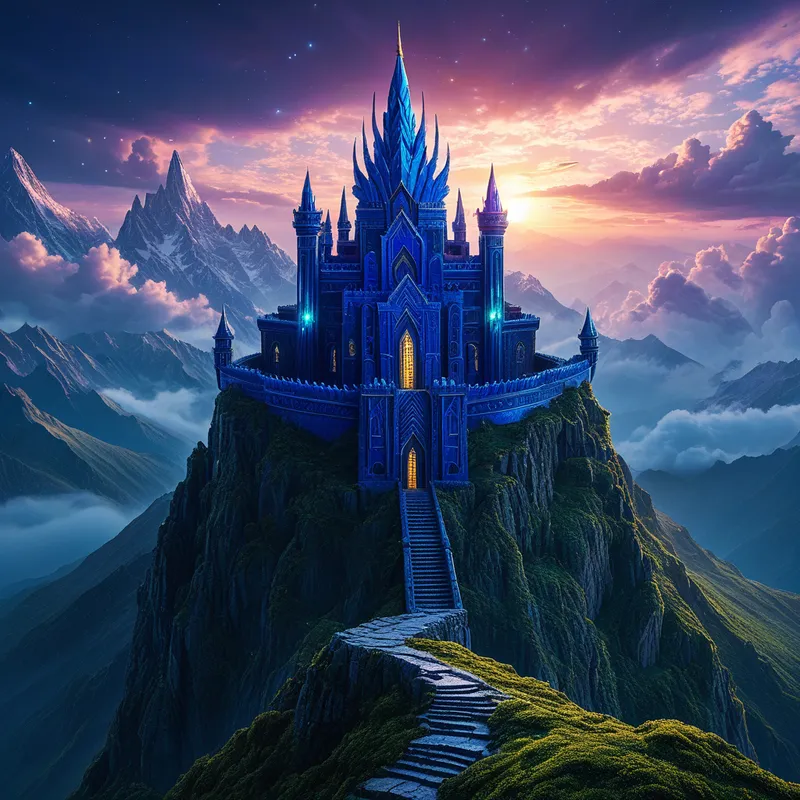
And upon the highest, most inaccessible peak of this emerald range stands the Castle. It is not built by human hands. It is a crystallization of divine thought, its spires like frozen music, its walls reflecting not images, but the truth of whoever gazes upon them. It is said that the sun itself must climb this mountain each dawn, and in its halls, time flows like honey—backward, forward, and in circles.
This Castle is the sanctuary and the throne of the [Simurgh](/myths/simurgh “Myth from Persian culture.”/). This is no ordinary bird. Its feathers are bronze and carry the sheen of thirty colors, each a world unto itself. Its shadow, when it flies, brings rain to parched lands a world away. Its cry is the sound that first stirred life in the clay. The [Simurgh](/myths/simurgh “Myth from Persian culture.”/) is both guardian and prisoner, sovereign and sage of the Castle, holding within its ancient awareness the secret of all things.
Many have heard the call. Kings with armies have perished in the foothills, their ambition turned to dust by the whispering winds. Philosophers have gone mad trying to chart a path, lost in [the labyrinth](/myths/the-labyrinth “Myth from Greek culture.”/) of their own logic. Only the pure of purpose, the one whose quest is not for gold or glory but for the annihilation of the false self, finds the hidden way. The path is one of shedding: of armor, of name, of memory. The mountain tests not strength, but sincerity. It presents not monsters, but mirrors.
The seeker climbs for lifetimes measured in heartbeats. They traverse valleys of silence and cliffs of despair. Finally, broken open, empty of everything but a single, burning question, they stand before the great gate of the Castle. There is no battle. There is only the overwhelming presence of the Simurgh, whose vast, compassionate eye sees every secret wound, every hidden vanity, every spark of true light. In that gaze, the seeker does not find a treasure chest or a [fountain of youth](/myths/fountain-of-youth “Myth from Various culture.”/). They find their own face, reflected in the cosmic bird’s plumage—not as they imagined, but as they truly are, a unique note in the symphony of creation. The Castle was not a destination, but a state of being. The Simurgh was not a prize to be won, but [the Self](/myths/the-self “Myth from Jungian culture.”/) to be recognized.
Cultural Origins & Context
The myth of the Castle of Qaf is a profound strand in the rich tapestry of Persian mystical literature, most famously woven into the epic poem Mantiq al-Tayr by the poet Attar. While its imagery draws from pre-Islamic Persian cosmology—where the Mount Qaf was seen as the literal boundary of the world—it was the Sufi mystics who transformed it into the ultimate allegory for the soul’s journey.
Told in coffeehouses, recited in royal courts, and whispered in the cloisters of khanqahs, this story functioned as a layered teaching. On one level, it was a fantastic adventure tale. On another, deeper level, it was a coded map of the Sufi path (tariqa). The Castle represented the station of divine proximity, the Simurgh symbolized God or the ultimate reality (al-Haqq), and the arduous journey stood for [the ego](/myths/the-ego “Myth from Jungian culture.”/)‘s (nafs) struggle toward annihilation (fana) and subsistence in God (baqa). It was a societal vessel for transmitting the most ineffable spiritual truths in a form that could captivate, inspire, and guide.
Symbolic Architecture
Psychologically, the Castle of Qaf is not a place, but a [symbol](/symbols/symbol “Symbol: A symbol can represent an idea, concept, or belief, serving as a powerful tool for communication and understanding.”/) of the integrated Self—the totality of the conscious and unconscious [psyche](/myths/psyche “Myth from Greek culture.”/). It is the remote, seemingly impossible center of our own being. [The emerald](/myths/the-emerald “Myth from Medieval European culture.”/) [mountain](/symbols/mountain “Symbol: Mountains often symbolize challenges, aspirations, and the journey toward self-discovery and enlightenment.”/) signifies the living, growing, but arduous process of psychological development. Emerald, green, is the color of the [heart](/symbols/heart “Symbol: The heart symbolizes love, emotion, and the core of one’s existence, representing deep connections with others and self.”/) center, of transformation, and of the natural world’s deepest wisdom.
The journey to the Castle is always an ascent away from the collective plain and into the unique, perilous heights of one’s own destiny.
The Simurgh is a majestic symbol of the [archetype](/symbols/archetype “Symbol: A universal, primordial pattern or prototype in the collective unconscious that shapes human experience, behavior, and creative expression.”/) of the Self. It is the ultimate unity that contains all opposites: immense yet gentle, ancient yet ever-renewing, utterly remote yet intimately reflective of the [seeker](/symbols/seeker “Symbol: A person actively searching for meaning, truth, or a higher purpose, often representing the dreamer’s own quest for identity or fulfillment.”/). In Attar’s telling, the thirty birds (si murgh in Persian) who survive the [journey](/symbols/journey “Symbol: A journey in dreams typically signifies adventure, growth, or a significant life transition.”/) look into the [lake](/symbols/lake “Symbol: A lake often symbolizes a place of reflection, emotional depth, and the subconscious mind, representing both tranquility and potential turmoil.”/) at the Simurgh’s court and see only their own [reflection](/symbols/reflection “Symbol: Reflection signifies self-examination, awareness, and the search for truth within oneself.”/); they are the Simurgh. This is the core [revelation](/symbols/revelation “Symbol: A sudden, profound disclosure of truth or insight, often through artistic or musical means, that transforms understanding.”/): the divine, the ultimate [treasure](/symbols/treasure “Symbol: A hidden or valuable object representing spiritual wealth, inner potential, or divine reward.”/), is not an external object, but the realized wholeness of the individual.
The [path](/symbols/path “Symbol: The ‘path’ symbolizes a journey, choices, and the direction one’s life is taking, often representing individual growth and exploration.”/)’s difficulty, requiring the shedding of [armor](/symbols/armor “Symbol: Armor represents psychological protection, emotional defense, and the persona presented to the world. It symbolizes both safety and the barriers that separate us from vulnerability.”/) and [identity](/symbols/identity “Symbol: Identity represents the sense of self, encompassing personal beliefs, cultural background, and social roles.”/), represents the necessary [dissolution](/symbols/dissolution “Symbol: The process of breaking down, dispersing, or losing form, often representing transformation, release, or the end of a state of being.”/) of the [persona](/symbols/persona “Symbol: The social mask or outward identity one presents to the world, often concealing the true self.”/)—[the mask](/myths/the-mask “Myth from Various culture.”/) we show the world—and the confrontation with the [shadow](/symbols/shadow “Symbol: The ‘shadow’ embodies the unconscious, repressed aspects of the self and often represents fears or hidden emotions.”/). One cannot enter the Castle of the Self while clinging to the trappings of the ego.
The Dreamer’s Resonance
When this myth stirs in the modern unconscious, it often manifests in dreams of immense, daunting structures or landscapes. One may dream of a brilliant, unattainable city on a cliff, a labyrinthine university library that contains the answer to everything, or a solitary lighthouse on a stormy promontory. The somatic feeling is one of simultaneous awe and anxiety—a pull toward the sublime and a fear of the exposure and effort required to reach it.
Such dreams signal a critical juncture in the dreamer’s psychological process. The psyche is announcing that the comforts of the known world (the [persona](/myths/persona “Myth from Greek culture.”/)‘s territory) have become a prison. A deeper, more authentic center of gravity is calling. The dream is an invitation to begin the “ascent,” which in waking life translates to engaging with a profound challenge: perhaps a creative endeavor that feels terrifying in its scope, the deep introspection of therapy, or a life change that demands a new identity. The feeling of being “dwarfed” by the mountain in the dream mirrors the ego’s correct perception of the Self’s vastness.
Alchemical Translation
The myth of Qaf is a perfect allegory for the Jungian process of individuation. The initial call is the stirring of Self, creating a divine discontent with the status quo. The journey through the valleys and up the cliffs is the [nigredo](/myths/nigredo “Myth from Alchemical culture.”/), [the dark night of the soul](/myths/the-dark-night-of-the-soul “Myth from Christian Mysticism culture.”/), where one confronts [the shadow](/myths/the-shadow “Myth from Jungian culture.”/), the anima/animus, and the painful illusions of the ego.
The alchemy occurs not in finding the gold, but in realizing that the base metal of the ego was always a fragmented reflection of the gold of the Self.
The arrival at the Castle gate, empty and broken open, represents the crucial stage of surrender. This is not defeat, but the dissolution of the ego’s rigid control, allowing for a new, more complex ordering. The final encounter with the Simurgh is the albedo and [rubedo](/myths/rubedo “Myth from Alchemical culture.”/)—illumination and integration. The seeker sees their own face in the Simurgh; the ego-consciousness recognizes its source and its place within the greater, archetypal pattern of the Self.
For the modern individual, this myth models the psychic transmutation from seeking external validation and goals (conquering the castle for its treasure) to embarking on an inner quest for authenticity and wholeness (becoming worthy of the castle by becoming oneself). The treasure is not seized; it is realized. The Castle of Qaf thus stands as an eternal symbol, reminding us that our greatest journey and our ultimate home are, mysteriously and beautifully, the same.
Associated Symbols
Explore related symbols from the CaleaDream lexicon: