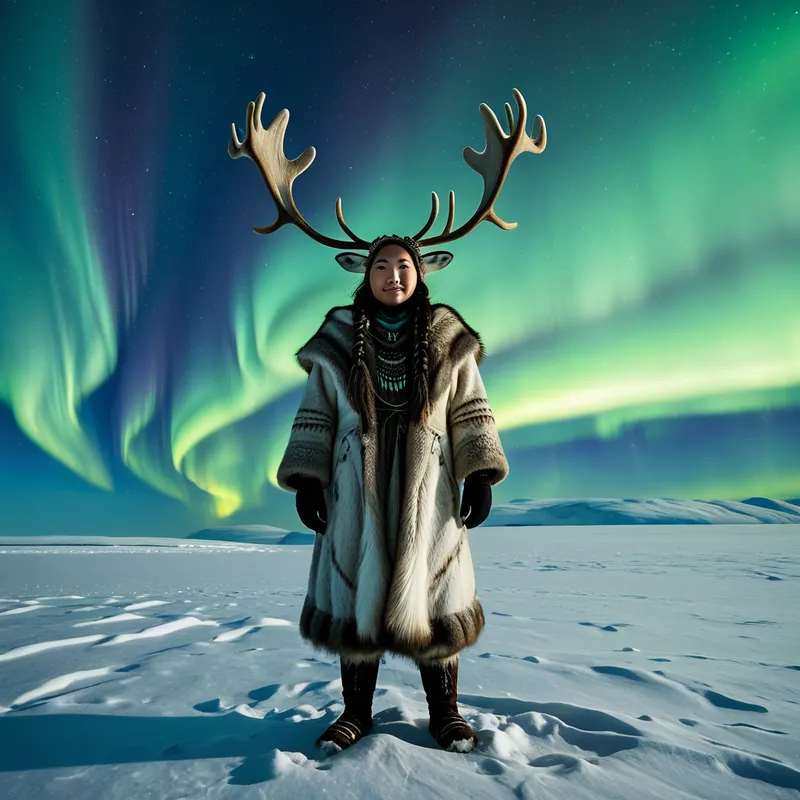
The Caribou Mother Myth Meaning & Symbolism
A myth of a woman who becomes the source of all caribou, embodying the ultimate sacrifice to ensure her people's survival in the Arctic.
The Tale of The Caribou Mother
In the time before memory, when the world was a vast, white silence and the wind sang the only song, the people grew hungry. The great herds of caribou had vanished, leaving only the ghost of their tracks beneath the snow. The hunters returned empty-handed, their eyes hollow. The children’s cries grew thin as the last strips of old hide boiled in the pot.
Among them was a woman. She was not a shaman, not a chief, but her heart ached with the hunger of all. One bitter twilight, as the sun bled into the horizon, she walked away from the camp. She walked until the voices of her people were swallowed by the keening wind, until only the immense, indifferent sky watched her. She stood on a barren rise, the cold biting through her parka, and raised her face to the spirits of the air and land.
“Take me,” she whispered, her breath a cloud of frost. “Do not let my people fade from the world. Let my body be the answer.”
The wind stilled. The very air seemed to listen. Then, a deep tremor shook the earth, not from below, but from within her. A profound warmth bloomed in her core, spreading outwards, a summer thaw in the depth of winter. Her bones began to ache, to stretch and sing a new song. From her head, a great, branching weight emerged—not pain, but purpose. Massive, sweeping antlers of bone and velvet crowned her.
Her skin prickled and thickened into a rich, brown hide. Her feet hardened into sharp, splayed hooves. The woman was no more. In her place stood the first and greatest of all caribou, a being of both human sorrow and animal majesty. She was The Caribou Mother.
She threw back her new head and gave a low, resonant call that echoed across the tundra. From the mist of her own breath, from the shadows of rocks, from the very ground where her tears had fallen, shapes began to form. One, then ten, then a hundred, then a river of living, breathing caribou surged into being around her, their coats shimmering, their breath creating a cloud that touched the sky. She turned, this great mother of the herd, and began to run. The earth thundered with the promise of life returning.
Back at the camp, the people heard the rumble. They saw the horizon darken and move. And when the herd poured into the valley, led by the magnificent one with eyes that held a familiar, profound love, they understood. The hunt was given. Life was returned. But it was no longer mere taking. It was a sacred exchange, born from a single, ultimate gift.

Cultural Origins & Context
This myth originates from the Inuit nations, particularly those of the Caribou Inuit groups who depended almost entirely on the vast migratory herds for survival. It was not merely a story but a foundational ethical and spiritual doctrine, passed down through generations by elders and storytellers during the long winter nights. Its function was multifaceted: it explained the origin of the caribou, established the rules of respectful hunting, and encoded the core Inuit value of Inua—the living spirit within all beings.
The myth served as a constant reminder that the animals they hunted were not just resources, but kin, born from a human ancestor’s sacrifice. This created a covenant of profound gratitude and responsibility. Every part of the animal was used; waste was a profound insult to the Caribou Mother’s gift. The story thus wove ecology, morality, and spirituality into a single, unbreakable thread, ensuring that survival never devolved into mere exploitation, but remained a sacred, reciprocal relationship.
Symbolic Architecture
At its [heart](/symbols/heart “Symbol: The heart symbolizes love, emotion, and the core of one’s existence, representing deep connections with others and self.”/), the myth of the Caribou [Mother](/symbols/mother “Symbol: The symbol of ‘Mother’ represents nurturing, protection, and the foundational aspect of one’s emotional being, often associated with comfort and unconditional love.”/) is a supreme [allegory](/symbols/allegory “Symbol: A narrative device where characters, events, or settings represent abstract ideas or moral qualities, conveying deeper meanings through symbolic storytelling.”/) of sacrifice and transformation. The woman does not petition a distant god; she becomes the [solution](/symbols/solution “Symbol: A solution symbolizes resolution, clarity, and the overcoming of obstacles, often representing a sense of accomplishment.”/). Her individual [identity](/symbols/identity “Symbol: Identity represents the sense of self, encompassing personal beliefs, cultural background, and social roles.”/) dissolves so that the collective identity—her people, and the very species that sustains them—may live.
The deepest nourishment often springs not from what we take, but from what we are willing to become for the sake of life itself.
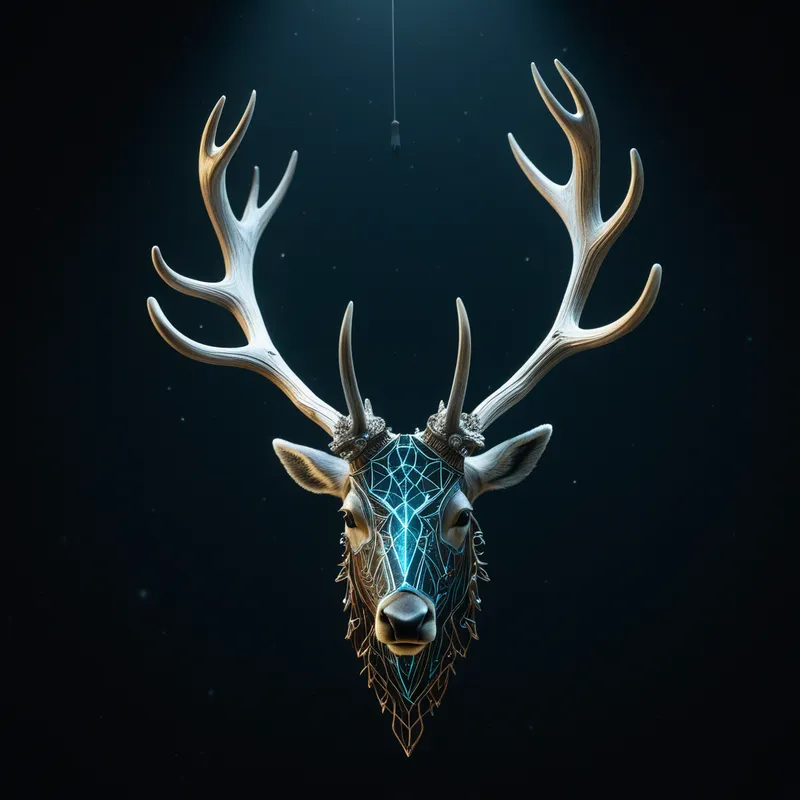
The antlers are a powerful [symbol](/symbols/symbol “Symbol: A symbol can represent an idea, concept, or belief, serving as a powerful tool for communication and understanding.”/). They are [crown](/symbols/crown “Symbol: A crown symbolizes authority, power, and achievement, often representing an individual’s aspirations, leadership, or societal role.”/) and burden, [weapon](/symbols/weapon “Symbol: A weapon in dreams often symbolizes power, aggression, and the need for protection or defense.”/) and [life](/symbols/life “Symbol: The symbol of ‘Life’ represents a journey of growth, interconnectedness, and existential meaning, encompassing both the joys and challenges that define human experience.”/)-giving branch. They represent the assumption of a monumental [responsibility](/symbols/responsibility “Symbol: Responsibility in dreams often signifies the weight of duties and the expectations placed upon the dreamer.”/)—to be the [source](/symbols/source “Symbol: The origin point of something, often representing beginnings, nourishment, or the fundamental cause behind phenomena.”/). Her transformation is not a [punishment](/symbols/punishment “Symbol: A dream symbol representing consequences for actions, often tied to guilt, societal rules, or internal moral conflicts.”/), but an [apotheosis](/symbols/apotheosis “Symbol: The transformation of a mortal into a divine or godlike state, representing ultimate spiritual elevation and transcendence of human limitations.”/); she ascends from [human](/symbols/human “Symbol: The symbol of a human represents individuality, complexity of emotions, and social relationships.”/) need to become a divine, providing entity. The myth also beautifully illustrates the Inuit worldview where boundaries between human, animal, and [spirit](/symbols/spirit “Symbol: Spirit symbolizes the essence of life, vitality, and the spiritual journey of the individual.”/) are fluid and permeable. Identity is not fixed but is a garment that can be changed according to the needs of the whole.
The Dreamer’s Resonance
When this myth stirs in the modern psyche, it often manifests in dreams of profound personal sacrifice or radical metamorphosis. You may dream of giving away something integral to your being—your voice, your creativity, your comfort—to feed a starving aspect of your life or family. You might dream of growing antlers, feeling a strange, bony wisdom erupting from your skull, symbolizing the emergence of a new, burdensome but life-sustaining responsibility.
Somatically, this can feel like a deep, aching pressure in the chest or head—the weight of a choice that will change everything. Psychologically, it is the process of confronting the “hunger winter” of the soul—a period of lack, creativity, or emotional famine—and realizing that the only way through is not to wait for rescue, but to transform your very substance into the resource that is needed. It is the dream of the ultimate caregiver, pushed to its mythic extreme.
Alchemical Translation
In the alchemy of individuation, the Caribou Mother models the stage of mortificatio and sublimatio—the dying of the old form and its uplifting into a higher purpose. The “old woman” (a conditioned identity, perhaps one of passive suffering or helplessness) must “die” on the tundra of crisis. This is not a literal death, but the death of a way of being.
The psyche’s most powerful transformations occur when we stop asking the world to feed us and instead consent to become nourishment for the world within and around us.
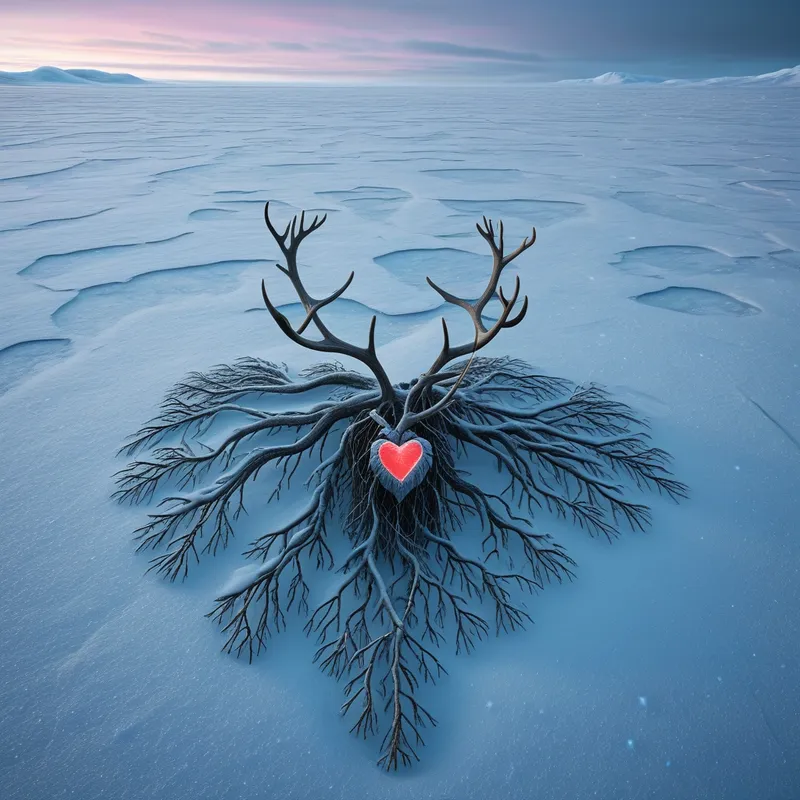
The alchemical fire is her desperate love, which burns away her human limitations. The transmutation is her bodily change into the Caribou Mother—the integration of an animal instinct (the caribou’s survival drive, its connection to earth and herd) with human consciousness and sacrifice. The “Philosopher’s Stone” produced is the enduring, self-replenishing herd—a symbol of the newfound inner resource that now sustains the psyche. For the modern individual, this myth calls us to ask: What inner or outer “famine” am I facing? What old identity must I consent to shed, to transform into, to become the source of my own renewal and the sustenance for my community? It is the ultimate instruction in creative, life-giving sacrifice.
Associated Symbols
Explore related symbols from the CaleaDream lexicon:
- Mother — The ultimate archetype of the life-giver, who transforms her own being to become the literal source of sustenance and continuity for her people.
- Sacrifice — The core action of the myth, representing the voluntary giving up of one’s own form and identity for the survival and flourishing of the greater whole.
- Transformation — The profound metamorphosis from human to animal deity, symbolizing the fluid nature of identity and the potential for radical change inherent in crisis.
- Herd — Represents the community, abundance, and the tangible result of sacred sacrifice; the life that flows from a single source.
- Antlers — Symbolize the crown of responsibility, the branching out of life, and the connection between the earthly (the herd) and the spiritual (the act of creation).
- Hunger — The driving force of the narrative, representing not just physical need but spiritual and communal famine that demands a profound response.
- Gift — The caribou are not taken but received as a gift from a transformed ancestor, establishing all life-sustaining acts as part of a sacred exchange.
- Bone — The foundational structure of the antlers and the animal, representing the enduring, essential framework that remains after transformation, the unyielding truth of the sacrifice.
- Earth — The tundra is the stage and participant, receiving the woman’s plea and ultimately giving form to the new herd from its own substance.
- Ritual — The entire myth underpins the ritual of the hunt, transforming it from an act of taking into an act of sacred reciprocity and remembrance.