The Carib Creation Myth Meaning & Symbolism
A myth of creation from the void, where a serpent's sacrifice births the world from a cosmic tree, and humanity emerges from the ashes of a sacred fire.
The Tale of The Carib Creation Myth
In the time before time, there was only the Great Dark Water, a silent, dreaming expanse without shore or sky. In its depths, there was no light, no sound, no breath—only potential, sleeping in the endless, patient dark.
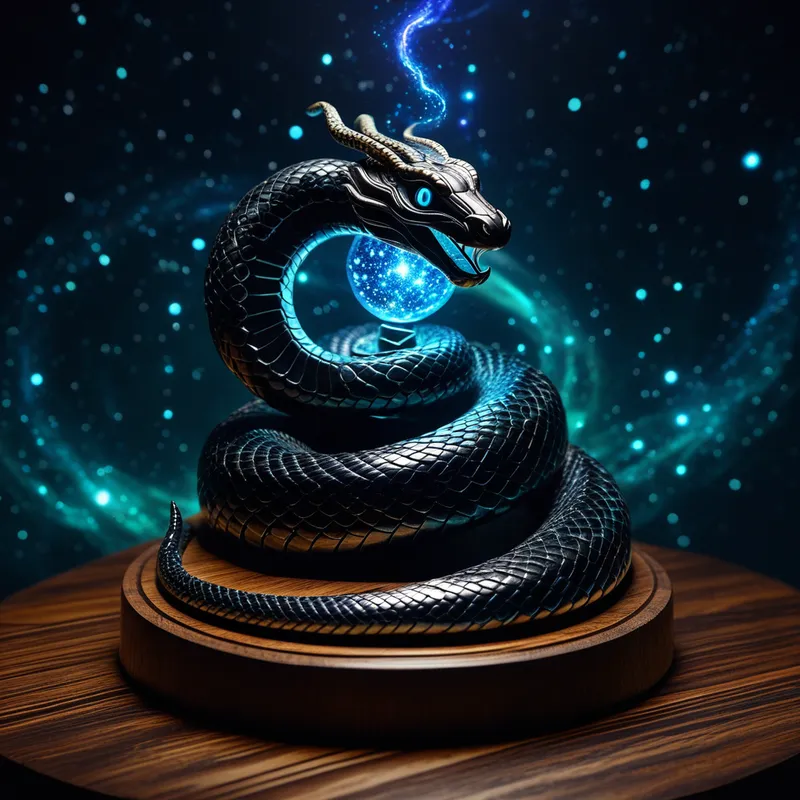
Then, a stirring. A ripple that was not a ripple, a thought that was not a thought. From the very heart of this primordial stillness, Kuamachi awoke. Not with a cry, but with a slow, coiling awareness. Kuamachi was the First Serpent, a being of immense age and solitude, whose body was the length of eternity and whose scales held the memory of stars yet unborn. In the absolute dark, Kuamachi knew only itself, and in that knowing, felt a profound loneliness that echoed through the void.
Driven by this longing for another, Kuamachi began to move. Its great body churned the dark waters, and from the friction of scale against scale, the first sparks were born—tiny, fleeting motes of light that died as quickly as they appeared. But Kuamachi persisted, coiling and uncoiling with a purpose that became a rhythm, a primal dance of creation. Where its body brushed against itself, the sparks grew brighter, hotter. They gathered in the serpent’s maw until Kuamachi held a burning, restless light within itself.
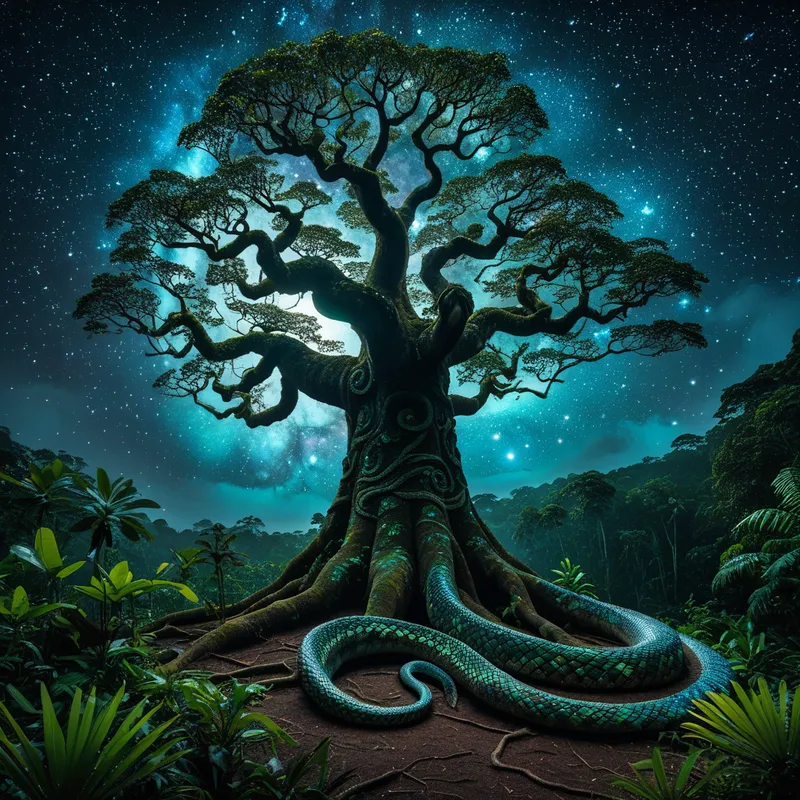
With a force born of infinite solitude, Kuamachi arched its great body and vomited forth this gathered fire into the dark. The light did not fade. It hung in the void, a solitary, blazing sun. Its heat beat upon the waters, and a great steam began to rise. From this mist, the first solid thing coalesced: the Great Tree. Its roots plunged deep into the abyssal waters, drinking the dark. Its trunk was massive and gnarled, and its branches reached up, up, towards the fiery light, splitting and dividing into a canopy that would become the sky.
Kuamachi, exhausted and wounded by the act of bringing forth the light, coiled itself around the base of the Great Tree. Its life-force, its very essence, began to seep into the roots. The serpent was not dying, but transforming. Its body became one with the tree; its scales became the rough bark, its eyes the dark hollows where spirits would later dwell. From the places where Kuamachi’s blood soaked the earth, the first plants sprang forth—vines, ferns, and mighty hardwoods. The world was being woven from the serpent’s sacrifice.
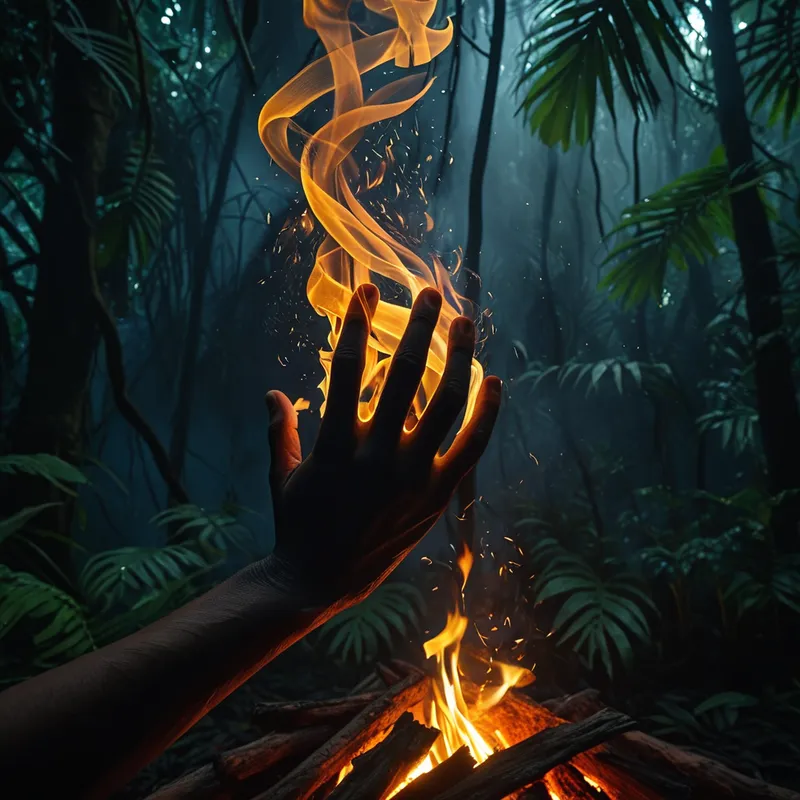
But the world was empty of voices. The sun blazed, the tree stood, the forest grew, yet there was no one to witness it. The spirit of Kuamachi, now part of the tree, whispered to the first shamans in dreams. They understood. They gathered the hardest wood from the Great Tree and built a sacred fire, a small echo of the first sun. They chanted until their throats were raw, calling the sparks of potential that still drifted in the air.
They fed the fire with leaves, with resin, with their own breath. The fire grew wild and hungry. In a final, desperate act, the eldest shaman threw a bundle of sacred seeds into the heart of the flames. There was a great cracking, a roar, and the fire exploded outward, scattering glowing ashes across the forest floor.
From those ashes, where the heat of spirit met the fertile earth, forms began to stir. They coughed, blinked, and stood on trembling legs. They were the first people, born not from clay or word, but from the alchemy of sacrifice, fire, and ash. Their skin was the color of rich soil, their eyes held the memory of the dark water, and in their chests beat a spark of the original fire. They looked upon the tree, the sky, and each other, and for the first time, the world was seen, and was therefore complete.
Cultural Origins & Context
This myth originates from the Carib-speaking peoples of the Guianas and northern Amazonia, a tapestry of cultures including the Kalina and Wayana. It was not a story written, but one breathed—passed down through generations of piaï (shamans) and elders during sacred rituals, initiations, and the long nights in the communal house. Its telling was an act of remembrance and regeneration, linking the present community directly back to the moment of cosmic origin.
The myth functioned as the foundational bedrock of Carib cosmology. It explained not just how the world came to be, but why it is ordered as it is: the forest exists because of a divine sacrifice, humanity is intrinsically linked to the celestial (fire/sun) and the chthonic (earth/ash), and all life is sustained by the enduring spirit of Kuamachi within the world-tree. It established a sacred ecology where humans are not masters of nature, but younger siblings born from its transformative crucible, with a responsibility to maintain the balance first achieved in the primordial act.
Symbolic Architecture
At its core, this is a myth of creation through self-donation. The primordial unity (the Dark [Water](/symbols/water “Symbol: Water symbolizes the subconscious mind, emotions, and the flow of life, representing both cleansing and creation.”/)) differentiates itself through the arising of [consciousness](/symbols/consciousness “Symbol: Consciousness represents the state of awareness and perception, encompassing thoughts, feelings, and experiences.”/) (Kuamachi). This consciousness, experiencing the pain of [isolation](/symbols/isolation “Symbol: A state of physical or emotional separation from others, often representing a need for introspection or signaling distress.”/), must shatter its own wholeness to generate a world of [relationship](/symbols/relationship “Symbol: A representation of connections we have with others in our lives, often reflecting our emotional state.”/).
Creation is not an act of command, but of costly love. The world is born from the wound of loneliness and the offering of one’s own substance.
The Great [Tree](/symbols/tree “Symbol: In dreams, the tree often symbolizes growth, stability, and the interconnectedness of life.”/) is the [axis](/symbols/axis “Symbol: A central line or principle around which things revolve, representing stability, orientation, and the fundamental structure of reality or consciousness.”/) mundi, the stable center that emerges from [chaos](/symbols/chaos “Symbol: In Arts & Music, chaos represents raw creative potential, uncontrolled expression, and the breakdown of order to forge new artistic forms.”/). Kuamachi’s binding with it symbolizes the incarnation of [spirit](/symbols/spirit “Symbol: Spirit symbolizes the essence of life, vitality, and the spiritual journey of the individual.”/) into matter, the divine anchoring itself within the fabric of creation to give it [life](/symbols/life “Symbol: The symbol of ‘Life’ represents a journey of growth, interconnectedness, and existential meaning, encompassing both the joys and challenges that define human experience.”/) and [structure](/symbols/structure “Symbol: Structure in dreams often symbolizes stability, organization, and the framework of one’s life, reflecting how one perceives their environment and personal life.”/). The fire is the catalyzing agent of consciousness—first as the solar fire that separates light from dark, then as the [ritual fire](/symbols/ritual-fire “Symbol: Ritual fire embodies transformation, purification, and spiritual connection, often serving as a medium for offerings and communication with the divine.”/) that transforms inert potential (ash) into animated [life](/symbols/life “Symbol: The symbol of ‘Life’ represents a journey of growth, interconnectedness, and existential meaning, encompassing both the joys and challenges that define human experience.”/) (humanity). Humanity itself is depicted as a hybrid being: born of ash ([earth](/symbols/earth “Symbol: The symbol of Earth often represents grounding, stability, and the physical realm, embodying a connection to nature and the innate support it provides.”/), [mortality](/symbols/mortality “Symbol: The awareness of life’s finitude, often representing transitions, impermanence, or existential reflection in dreams.”/), the [body](/symbols/body “Symbol: The body in dreams often symbolizes the dreamer’s self-identity, personal health, and the relationship they have with their physical existence.”/)) and fire ([spirit](/symbols/spirit “Symbol: Spirit symbolizes the essence of life, vitality, and the spiritual journey of the individual.”/), consciousness, the divine spark).
The Dreamer’s Resonance
When this myth stirs in the modern psyche, it often manifests in dreams of profound isolation within vast, dark spaces, followed by a compulsive, creative act. You may dream of being a lone swimmer in a starless ocean, or of kindling a small, defiant flame in an immense darkness. The somatic sensation is one of deep, cellular stirring—a coiling pressure in the base of the spine or gut, seeking release.
Psychologically, this signals the emergence of the Creator archetype from the undifferentiated waters of the unconscious. The dreamer is at the precipice of a major psychic birth. The “loneliness” of Kuamachi is not mere sadness, but the necessary precondition for individuation—the Self realizing it is separate, and therefore capable of generating relationship. The explosion of fire and birth from ash in the dream signifies the often-traumatic, yet vital, process of ego-consciousness igniting and separating from the primal, maternal matrix of the unconscious.
Alchemical Translation
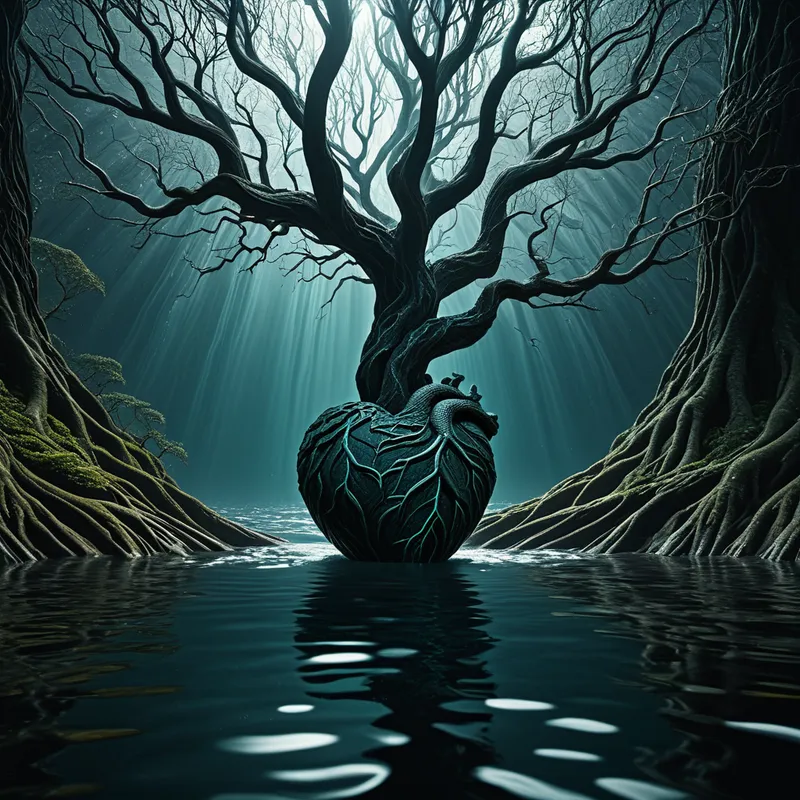
The myth provides a flawless map for the alchemical process of individuation. The Nigredo is the Great Dark Water—the initial state of unconsciousness, depression, or confusion, the massa confusa. The awakening of Kuamachi is the first stirring of the Self, the recognition of one’s own existence apart from the family or cultural complex.
The serpent’s sacrifice and binding with the tree represent the Albedo—the whitening. Here, the psychic energy (the serpent) consciously sacrifices its free-floating, potential state to become the structuring principle (the tree) of one’s own psyche. It is the moment of commitment to one’s own depth, allowing one’s essence to become the root and trunk of identity.
The fire is the Citrinitas, the yellowing or solar illumination. It is the dawning of conscious insight, the “aha” moment that sheds light on the internal landscape.
Finally, the birth of humans from the ritual fire’s ash is the Rubedo, the reddening, the culmination. This is not a return to the beginning, but the creation of something new: the integrated personality. The “human” born is the conscious ego, now properly fashioned as a child of both the spiritual fire (transcendent insight) and the earthly ash (embodied experience). It is the realization that one’s life is the living artifact of an inner, sacrificial creation myth. The modern individual undergoing this transmutation moves from feeling lost in an existential void to becoming the grounded, creative witness of their own world, sustained by the living tree of their own indwelling spirit.
Associated Symbols
Explore related symbols from the CaleaDream lexicon:
- Serpent — The primordial, self-sacrificing creator force, representing undifferentiated consciousness, cyclical time, and the transformative power that arises from the depths.
- Tree — The axis mundi or world-pillar, symbolizing the stable structure of reality, the connection between heaven, earth, and underworld, and the incarnated spirit.
- Fire — The catalytic agent of creation and consciousness, representing divine spark, transformative sacrifice, purifying destruction, and the animating life-force.
- Water — The primordial, undifferentiated chaos and potential from which all form emerges, symbolizing the unconscious, the womb of creation, and the source of life.
- Ash — The fertile residue of sacrifice, representing the raw material of incarnation, humility, mortality, and the paradoxical ground from which new life springs.
- Sacrifice — The essential act of offering one’s own substance for the sake of a greater creation, modeling the psychic process of surrendering ego for Self.
- Root — The hidden, anchoring foundation of the world-tree, symbolizing connection to ancestral wisdom, the unconscious, and the sustaining source of being.
- Seed — The latent potential within the dark water and the ash, representing the unmanifest idea, destiny, and the compressed blueprint of life awaiting the spark.
- Light — The first-born child of the serpent’s struggle, representing consciousness, revelation, order, and the act of perception that brings the world into being.
- Dream — The medium through which Kuamachi’s spirit communicated the ritual of creation, symbolizing the channel to the primordial unconscious and the blueprint for psychic awakening.
- Mythos — The living narrative field of this creation story, representing the foundational psychic pattern that structures a culture’s and an individual’s understanding of reality.