The Cailleach's Hare Myth Meaning & Symbolism
A myth of the ancient hag-goddess and her white hare, a creature of prophecy and power, whose capture reveals the deep bond between land and spirit.
The Tale of The Cailleach’s Hare
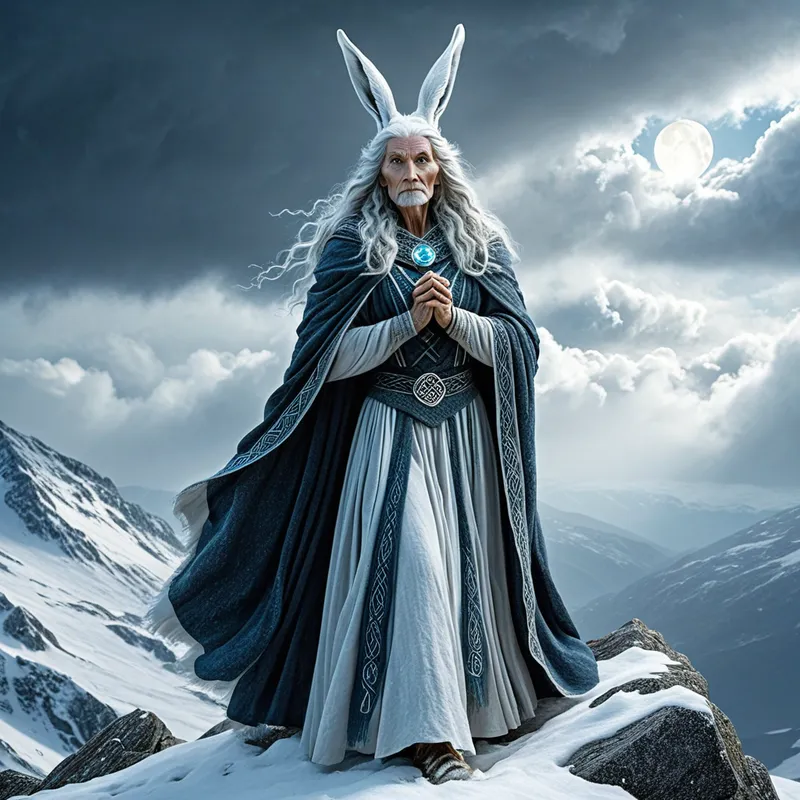
Listen now, and let the fire’s crackle become [the wind](/myths/the-wind “Myth from Various culture.”/) on the high, barren places. In the time before memory, when [the world](/myths/the-world “Myth from Tarot culture.”/) was raw bone and singing stone, there ruled a power as old as the first frost. She was the Cailleach, the Veiled One. Her hair was the long, pale grass of winter; her cloak, the heather-purple hills at dusk. Her staff struck [the earth](/myths/the-earth “Myth from Hindu culture.”/), and lochs sprang forth; her breath was the blizzard that sculpted the glens.
But her true companion was not the storm or the stone. It was a hare, white as the heart of a snowdrift, with eyes that held the cool, distant light of [the moon](/myths/the-moon “Myth from Tarot culture.”/) trapped in ice. This was no common creature. It was her familiar, her messenger, a sliver of her own wild soul given fleet-footed form. It knew the secret paths between the worlds, the hidden springs beneath the frozen earth, and the fate of kings. To see it was an omen; to catch it, a [thing](/myths/thing “Myth from Norse culture.”/) spoken of only in whispers.
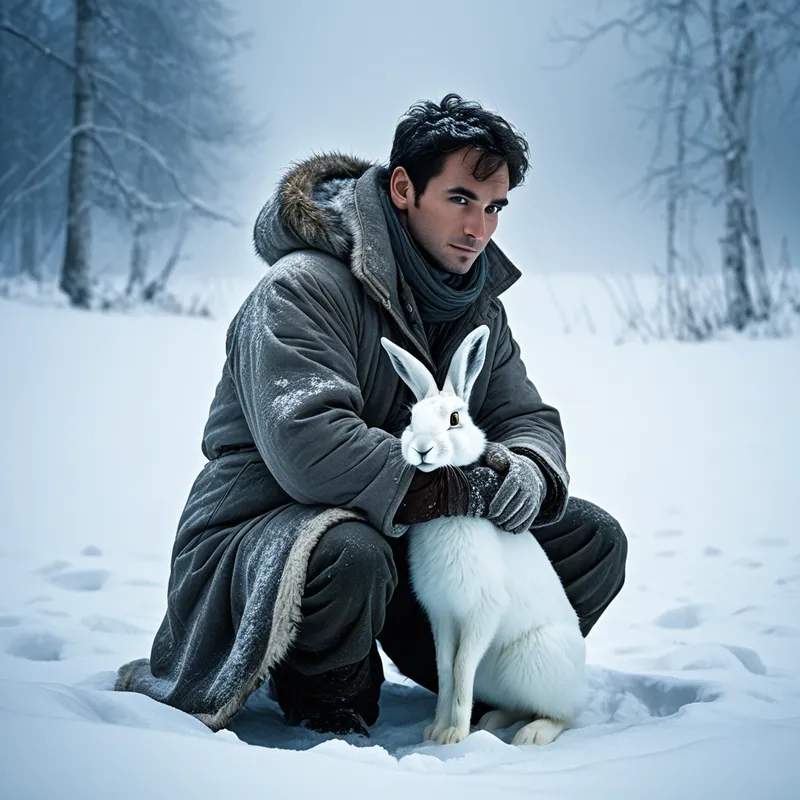
It came to pass that a young hunter, driven by a hunger deeper than that of the belly—a hunger for a name, for a sign that he was more than just another man—ventured into [the Cailleach](/myths/the-cailleach “Myth from Celtic culture.”/)’s high domain as the [Samhain](/myths/samhain “Myth from Celtic culture.”/) fires guttered low. The world was a monochrome of grey rock and white snow, silent but for the keening wind. His fingers were numb, his hope a faint ember. And then he saw it—a flash of impossible white against the granite, moving with a grace that seemed to defy the very weight of the world.
The chase was not one of speed, but of endurance and wit. The hare led him through crevices that breathed cold air, across frozen burns that sang beneath his feet, always just at the edge of sight, a phantom of the crags. [The hunter](/myths/the-hunter “Myth from African culture.”/)’s breath sawed in his chest; the mountain itself seemed to watch. Finally, in a corrie sheltered by skeletal rowan trees, he made his cast. The net fell, not with a triumphant shout, but with a hushed finality. There, trembling but not with fear, was the white hare.
He reached into the net. But as his hands closed around the creature, a profound stillness fell. The wind died. The hare did not struggle. It turned its [moonstone](/myths/moonstone “Myth from Various culture.”/) eyes upon him, and in their depths, he did not see an animal’s terror, but a vast, patient, ancient knowing. He felt the granite of the mountain in its bones, the chill of the deep earth in its blood. He was not holding prey. He was holding a mystery. A choice, heavy as a standing stone, settled upon his heart.
Cultural Origins & Context
This tale emerges from the Gaelic-speaking regions of Scotland and Ireland, a fragment of the vast, oral tapestry surrounding the Cailleach. Unlike the more formalized pantheons of classical mythology, the Cailleach exists in folklore, place-lore (dinnseanchas), and local legend, told by [the hearth](/myths/the-hearth “Myth from Norse culture.”/) to explain the shape of a landscape or the turn of the season. She is the personification of winter, the sculptor of mountains, and the ultimate sovereign of the wild land.
The hare, in Celtic symbology, was a creature of profound ambiguity and power. It was associated with the moon, with femininity, with swift intuition, and with [the Otherworld](/myths/the-otherworld “Myth from Celtic culture.”/). It was often considered taboo to hunt or eat, linked to witches and shapeshifters. The motif of a goddess or Otherworldly woman accompanied by a specific animal—a hare, a deer, a wolf—is a deep Indo-European archetype, signifying the deity’s intimate connection with the untamed essence of nature. This story would have been more than entertainment; it was a teaching. It encoded the proper relationship between humanity and the raw, sovereign power of the land (represented by the Cailleach), a relationship based not on domination, but on recognition, respect, and sometimes, fearful awe.
Symbolic Architecture
At its core, this myth is a map of a profound psychological encounter. The Cailleach represents the ultimate [Shadow](/symbols/shadow “Symbol: The ‘shadow’ embodies the unconscious, repressed aspects of the self and often represents fears or hidden emotions.”/) and the Great [Mother](/symbols/mother “Symbol: The symbol of ‘Mother’ represents nurturing, protection, and the foundational aspect of one’s emotional being, often associated with comfort and unconditional love.”/) in her transformative, wintry [aspect](/symbols/aspect “Symbol: A distinct feature, quality, or perspective of something, often representing a partial view of a larger whole.”/). She is not evil, but she is implacable, a force of necessary [dissolution](/symbols/dissolution “Symbol: The process of breaking down, dispersing, or losing form, often representing transformation, release, or the end of a state of being.”/) and hardened wisdom. Her [realm](/symbols/realm “Symbol: The symbol of ‘Realm’ often signifies the boundaries of one’s consciousness, experiences, or emotional states, suggesting aspects of reality that are either explored or ignored.”/) is the psychic high ground—the cold, clear, often lonely altitudes of the unconscious where our comforting illusions cannot survive.
The white hare is her emissary, a [symbol](/symbols/symbol “Symbol: A symbol can represent an idea, concept, or belief, serving as a powerful tool for communication and understanding.”/) of the elusive, guiding instinct.
It is the quick, silent intuition that darts ahead of rational thought, the fleeting glimpse of a deeper truth that vanishes if pursued with brute force.
To “hunt” it is [the ego](/myths/the-ego “Myth from Jungian culture.”/)‘s [quest](/symbols/quest “Symbol: A quest symbolizes a journey or search for purpose, fulfillment, or knowledge, often representing life’s challenges and adventures.”/) for meaning, power, or spiritual attainment. The capture, however, is the critical [juncture](/symbols/juncture “Symbol: A critical point of decision, transition, or convergence where paths, choices, or timelines meet, demanding action or reflection.”/). The hunter does not find a [trophy](/symbols/trophy “Symbol: The trophy symbolizes achievement, recognition, and the reward for perseverance in competitive endeavors.”/), but a mirror.
The moment of capture is the moment of confrontation with the Self, where the seeker realizes the sought-after wisdom is not an external object to be owned, but a conscious relationship to be negotiated with a part of one’s own soul.
The hare’s knowing gaze reflects back the hunter’s true intent, forcing a moral and existential [choice](/symbols/choice “Symbol: The concept of choice often embodies decision-making, freedom, and the multitude of paths available in life.”/): to exploit the power (kill the hare) or to honor it (release it). This is the archetypal choice between [inflation](/symbols/inflation “Symbol: A dream symbol representing feelings of diminishing value, loss of control, or expansion beyond sustainable limits in one’s life or psyche.”/)—being consumed by the power of the unconscious—and [integration](/symbols/integration “Symbol: The process of unifying disparate parts of the self or experience into a cohesive whole, often representing psychological wholeness or resolution of internal conflict.”/), forging a conscious bond with it.
The Dreamer’s Resonance
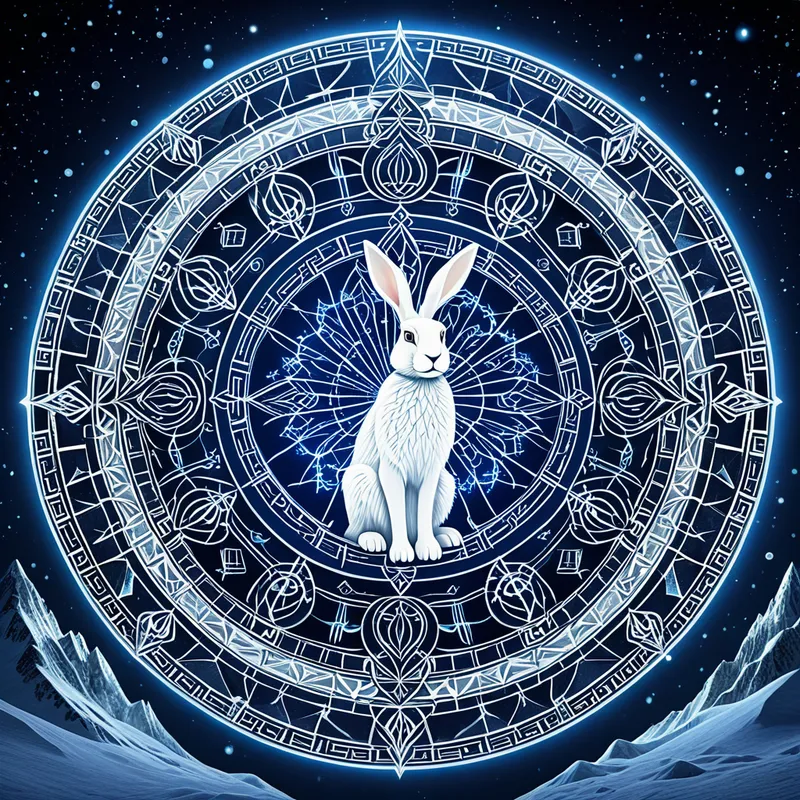
When this myth stirs in the modern dreamer, it often manifests in periods of psychic winter: times of stagnation, depression, creative barrenness, or a feeling of being lost in a cold, impersonal landscape. To dream of pursuing a white, elusive animal—especially a hare or deer—through a stark, frozen, or mountainous terrain is to dream the Cailleach’s hunt.
The somatic experience is one of chill, fatigue, and breathless pursuit. The dream-ego is striving, often fruitlessly, to grasp something vital. The pivotal moment in such a dream is the capture or the face-to-face encounter. Does the dreamer kill the creature? Does it speak? Does it transform? The dreamer’s reaction here is diagnostic. Horror or guilt suggests the ego perceives the instinct (the hare) as something alien and threatening to be destroyed. Awe, reverence, or a sense of profound communication suggests the beginning of integration. This dream pattern signals that a deep, instinctual wisdom from the [psyche](/myths/psyche “Myth from Greek culture.”/)’s wintry, foundational layers is seeking recognition. The process is not about warming up or escaping the cold, but about learning to see the stark, beautiful, and terrible truth that resides within it.
Alchemical Translation
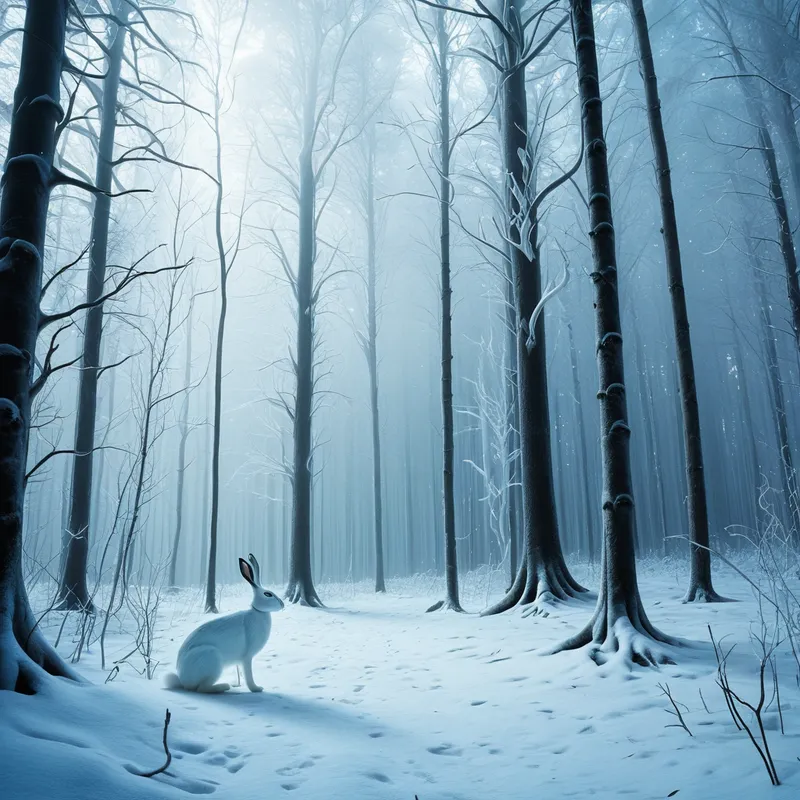
The alchemical journey mirrored here is the [Nigredo](/myths/nigredo “Myth from Alchemical culture.”/), the blackening or putrefaction. It is the necessary descent into the massa confusa, the chaotic, frozen state of primal matter (or psyche) where all previous forms break down. The Cailleach’s mountain is [the vessel](/myths/the-vessel “Myth from Alchemical culture.”/) for this operation. The hunter’s arduous, freezing climb is the ego’s voluntary submission to this dissolving process, driven by a deep, often inarticulate longing for transformation.
The capture of the hare is the moment the anima mundi, the world-soul or the spark of consciousness within the unconscious, is momentarily fixed. In psychological terms, it is when a content of [the collective unconscious](/myths/the-collective-unconscious “Myth from Jungian culture.”/) becomes so potent it can no longer be ignored; it must be consciously confronted.
The alchemical secret is that the agent of transformation is not the hunter, but the hare. The silent, lunar intelligence of the instinct transmutes the leaden, striving ego.
The choice to release the hare—the act of not claiming the power for the ego’s glory—is the Albedo, the whitening. It is the purification that comes from humility and right relationship. By honoring the sovereignty of the instinct (the Cailleach’s claim), the hunter does not lose the wisdom. Instead, he internalizes the relationship. He gains the hare’s qualities: swift intuition, knowledge of hidden paths, and a bond with the enduring, cyclical wisdom of the land. He is no longer just a hunter on the mountain; he has, in a sacred sense, become a part of its story. His individuation is not about conquering the winter, but about learning to carry its clear, necessary cold as a source of integrity and depth within himself, forever after.
Associated Symbols
Explore related symbols from the CaleaDream lexicon: