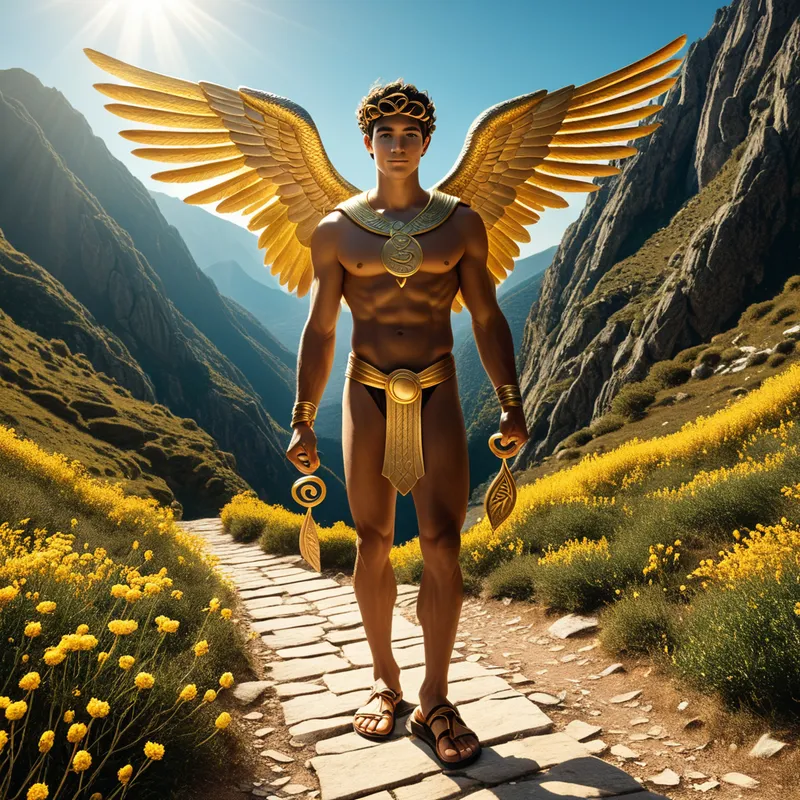
The Caduceus Myth Meaning & Symbolism
The story of Hermes receiving the winged staff entwined with serpents, a divine tool for mediating between opposites and guiding souls.
The Tale of The Caduceus
Before the first word was spoken, before the first oath was sworn between gods and men, there was a theft that shook the foundations of Olympos. It was not born of malice, but of a laughter that echoed from the very cradle.
In a shadowy cave on the slopes of Mount Cyllene, a child was born at dawn. Not a mewling babe, but [Hermes](/myths/hermes “Myth from Global/Universal culture.”/), son of Zeus and the nymph Maia. While his mother slept, exhausted from her labor, the infant’s eyes opened—not with the cloudy gaze of a newborn, but with the sharp, glittering light of cunning. He felt the cool stone of [the cave](/myths/the-cave “Myth from Platonic culture.”/) floor, heard [the wind](/myths/the-wind “Myth from Various culture.”/) sighing at the entrance, and knew he was meant for more than this dark womb.
He slipped from his swaddling clothes, his limbs already strong. His first steps did not falter; they carried him to the mouth of the cave, where a [tortoise](/myths/tortoise “Myth from Greek culture.”/) lumbered through the moss. A laugh, bright and clear, escaped him. With a divine thought and nimble fingers that should not have been so skilled, he hollowed the shell, strung it with gut, and crafted the first lyre. Its music was a spell, a sound never before heard—the joy of creation mixed with the whisper of trickery.
But the music sparked a deeper hunger. A restlessness, a need to act. He looked down the mountain and saw, gleaming in the twilight like moving treasures, the sacred cattle of his half-brother, Apollo. To steal from the god of light was madness. To an infant god of cunning, it was an irresistible song.
Under the cover of night, he descended. He drove the fifty cattle backward, so their hoofprints pointed toward the cave, not away from it. He fashioned sandals of bark and myrtle to disguise his own tiny tracks. He led them to a remote grove, and with a fire-stick rubbed to life—another first—he sacrificed two of the finest beasts. The smell of roasting meat and fat was his first sacrament to the Olympians, though none were invited.
When Apollo discovered the theft, his rage was a solar flare. He traced the impossible trail, his divine sight clouded by the infant’s clever ruse, until fury led him to the cave on Cyllene. There, Hermes lay innocently in his crib, swaddled once more, eyes wide with feigned sleep.
“Thief!” Apollo’s voice shook the mountain. “Return my cattle!”
Hermes merely yawned. “What cattle, glorious brother? I am but a newborn. See how I lie here?” But his eyes sparkled with a challenge no baby could possess.
The argument raged until they stood before their father, Zeus, on the high throne of Olympos. Apollo laid out his evidence with righteous heat. Hermes, with a disarming smile, told half-truths woven with such charm that the great hall of the gods rippled with suppressed laughter. Zeus, who himself cherished cleverness, did not punish. He commanded the truth, and Hermes, seeing the game was up, confessed—not with shame, but with a performer’s flourish.
To appease Apollo, he offered the lyre. The moment the Sun God’s fingers touched the strings, his anger melted into wonder. The music was so sublime it seemed to contain the very harmony of the spheres. In that moment of shared creation, Apollo’s loss was transmuted into gain.
Moved by this reconciliation, by the cunning that had turned conflict into a new bond, Apollo sought a gift in return. He took up a rod of olive wood—a simple shepherd’s staff. But this was no ordinary wood. He breathed upon it, and two serpents, embodiments of primal earth wisdom and potent duality, coiled around it in perfect, opposing symmetry. He then fastened wings at its crown, for the spirit must always rise above the entangled struggle below. He placed this staff, the Caduceus, into the infant god’s hand.
“With this,” Apollo declared, his voice now warm, “you shall mediate all things. You will guide travelers, still conflicts, and even lead souls to their final rest. For you have shown that between theft and gift, between lie and truth, there is a path only the clever of heart can walk.”
And so Hermes, the divine trickster, became the divine messenger, his laughter now tempered with the solemn power of the staff that could touch both life and death.
Cultural Origins & Context
The myth of the Caduceus is woven into the earliest strands of Greek cultural identity, primarily from the Homeric Hymn to Hermes, a text likely composed in the 6th century BCE. This was not a story for state ceremony, but one told by rhapsodes and poets at gatherings, a foundational tale explaining the nature of a god who was utterly integral to daily life. Hermes was the god of [the threshold](/myths/the-threshold “Myth from Folklore culture.”/), of the marketplace, of the road. His myth justified his domains.
The Caduceus itself was a pre-Greek symbol, likely of Mesopotamian origin, representing commerce and negotiation. The Greeks syncretized this powerful image with the story of Hermes, grounding its authority in divine narrative. Its function in society was multifaceted: a [herald](/myths/herald “Myth from Greek culture.”/)’s badge of office, a symbol of peaceful negotiation (it was used to sue for truce in war), and a protector for travelers. It marked Hermes as the one who could cross all boundaries—between gods and men, the living and the dead, truth and deception—with impunity. The myth served to explain how chaos (the theft) could be ritualized into a social order (communication, trade, safe passage), making the unpredictable forces of luck and chance into a system presided over by a relatable, clever deity.
Symbolic Architecture
At its core, the [Caduceus](/symbols/caduceus “Symbol: A winged staff entwined by two serpents, symbolizing healing, commerce, and divine messenger status.”/) is a map of dynamic [equilibrium](/symbols/equilibrium “Symbol: A state of balance, stability, or harmony between opposing forces, often representing inner peace or external order.”/). It is not a [symbol](/symbols/symbol “Symbol: A symbol can represent an idea, concept, or belief, serving as a powerful tool for communication and understanding.”/) of [static](/symbols/static “Symbol: Static represents interference, disruption, and the breakdown of clear communication or signal, often evoking feelings of frustration and disconnection.”/) [peace](/symbols/peace “Symbol: Peace represents a state of tranquility and harmony, both internally and externally, often reflecting a desire for resolution and serenity in one’s life.”/), but of active, intelligent mediation between opposing forces.
The central rod represents the [axis](/symbols/axis “Symbol: A central line or principle around which things revolve, representing stability, orientation, and the fundamental structure of reality or consciousness.”/) of [consciousness](/symbols/consciousness “Symbol: Consciousness represents the state of awareness and perception, encompassing thoughts, feelings, and experiences.”/), the [spine](/symbols/spine “Symbol: The spine symbolizes strength, support, and the foundational structure of one’s life and identity.”/) of the matter, the unwavering principle or [path](/symbols/path “Symbol: The ‘path’ symbolizes a journey, choices, and the direction one’s life is taking, often representing individual growth and exploration.”/) one must hold onto. The two serpents are the twin energies that perpetually challenge this center: light and dark, conscious and unconscious, giving and taking, [life](/symbols/life “Symbol: The symbol of ‘Life’ represents a journey of growth, interconnectedness, and existential meaning, encompassing both the joys and challenges that define human experience.”/) and [death](/symbols/death “Symbol: Symbolizes transformation, endings, and new beginnings; often associated with fear of the unknown.”/). They are not fighting; they are entwined in a generative, helical dance. Their upward spiral suggests that this engagement, when guided by the central will, is evolutionary.
The Caduceus does not choose one serpent over the other; it provides the sacred space where their confrontation becomes a conversation.
The wings signify the transcendent function, the [emergent property](/symbols/emergent-property “Symbol: A complex phenomenon arising from simpler interactions, where the whole becomes greater than the sum of its parts.”/) that arises from successfully holding the [tension](/symbols/tension “Symbol: A state of mental or emotional strain, often manifesting physically as tightness, pressure, or unease, signaling unresolved conflict or anticipation.”/) of the opposites. It is the [insight](/symbols/insight “Symbol: A sudden, deep understanding of a complex situation or truth, often arriving unexpectedly and illuminating hidden connections.”/), the [resolution](/symbols/resolution “Symbol: In arts and music, resolution refers to the movement from dissonance to consonance, creating a sense of completion, release, or finality in a composition.”/), the [soul](/symbols/soul “Symbol: The soul represents the essence of a person, encompassing their spirit, identity, and connection to the universe.”/)-[flight](/symbols/flight “Symbol: Flight symbolizes freedom, escape, and the pursuit of one’s aspirations, reflecting a desire to transcend limitations.”/) that becomes possible only after navigating the serpentine [labyrinth](/symbols/labyrinth “Symbol: The labyrinth represents a complex journey, symbolizing the intricate path toward self-discovery and understanding one’s life’s direction.”/) below. Hermes, as the [carrier](/symbols/carrier “Symbol: A tool or object that transports, holds, or conveys something from one place to another, often representing responsibility, burden, or the movement of ideas.”/), embodies the psychological faculty of the [trickster](/symbols/trickster “Symbol: A boundary-crossing archetype representing chaos, transformation, and the subversion of norms through cunning and humor.”/)-sage—the [ability](/symbols/ability “Symbol: In dreams, ‘ability’ often denotes a recognition of skills or potential that one possesses, whether acknowledged or suppressed.”/) to think laterally, to reframe conflict, to find the third way that is not a compromise but a transformation.

The Dreamer’s Resonance
To dream of the Caduceus is to dream of a profound internal negotiation reaching a critical point. The dreamer is likely in a situation of intense duality: a moral quandary, a conflict between heart and head, or a feeling of being pulled between two life paths.
Somatically, this may manifest as a tension along the spine, a feeling of being “twisted up” inside, or restless energy seeking an outlet. Psychologically, the dream signals that the unconscious is presenting a pair of opposing contents (the serpents) to consciousness. One serpent may represent a repressed instinct or shadow aspect, the other an overbearing moral or intellectual attitude. The dream of the Caduceus is the [psyche](/myths/psyche “Myth from Greek culture.”/)’s attempt to show that these forces are not meant to annihilate each other, but to be recognized, engaged with, and integrated around the core of [the Self](/myths/the-self “Myth from Jungian culture.”/). The appearance of the wings, even if only suggested, is a promise: if you can hold this tension without collapsing into one side or the other, a new capacity for freedom and perspective will emerge.
Alchemical Translation
The myth of the Caduceus is a perfect allegory for the alchemical process of individuation, the journey toward psychic wholeness. The infant Hermes represents the nascent, undifferentiated Self, full of potential but operating on pure, amoral impulse (the [prima materia](/myths/prima-materia “Myth from Alchemical culture.”/)). The theft of Apollo’s cattle is the necessary “sacred crime”—the act of engaging with the shining, dominant, conscious power (Apollo as solar consciousness, order, [logos](/myths/logos “Myth from Christian culture.”/)) from the shadowy, cunning, unconscious realm.
The conflict before Zeus is the [nigredo](/myths/nigredo “Myth from Alchemical culture.”/), the blackening, the stage of confrontation and confusion. The offering of the lyre is the key operation: the raw, trickster energy of the unconscious is transformed into a creative gift that the conscious mind can appreciate and utilize. This is the albedo, the whitening, where opposites begin to communicate.
The gift of the Caduceus is the symbol of the coniunctio oppositorum—the sacred marriage of opposites. It is the tool forged in reconciliation.
For the modern individual, this models the path of psychic transmutation. We first must “steal” energy from our one-sided conscious attitudes (our inner Apollo), often through symptoms, dreams, or rebellious feelings. We then must endure the inner conflict and judgment. The breakthrough comes not through victory of one side, but through the creative re-framing of the conflict itself—offering the “lyre” of a new insight. The reward is the Caduceus: the internalized capacity to mediate our own inner wars. We become our own Hermes, holding the staff that allows life and death, joy and sorrow, instinct and spirit, to coil around our central purpose, granting us the winged ability to navigate [the world](/myths/the-world “Myth from Tarot culture.”/) with fluidity and grace. [The trickster](/myths/the-trickster “Myth from Various culture.”/) becomes the guide, and chaos becomes the raw material for a more complex, more complete harmony.
Associated Symbols
Explore related symbols from the CaleaDream lexicon: