The Butterfly Dream Myth Meaning & Symbolism
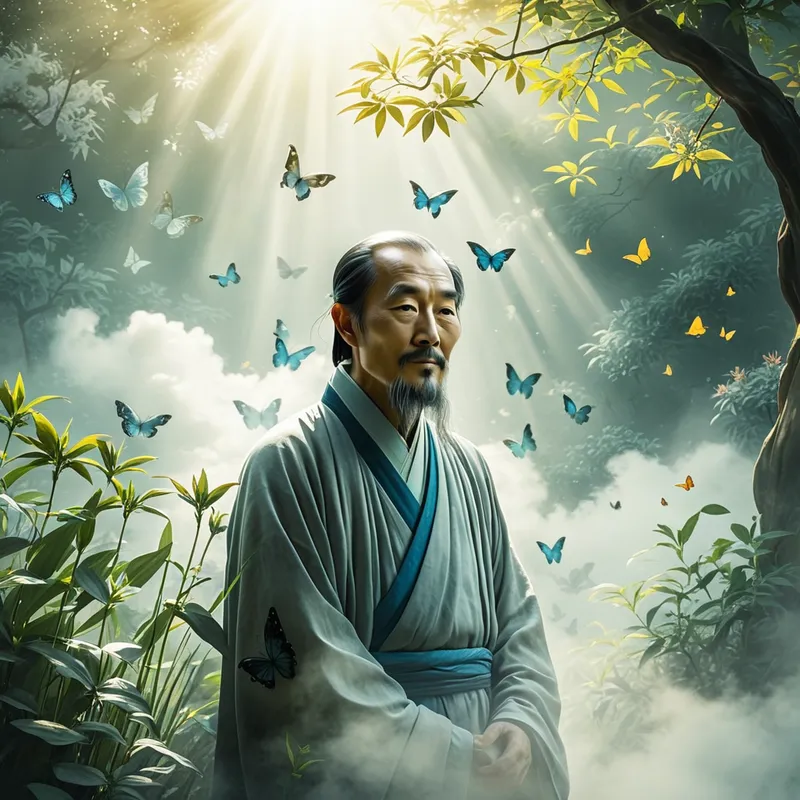
The philosopher Zhuangzi dreams he is a butterfly, then awakens, left to wonder if he is a man who dreamed of a butterfly, or a butterfly now dreaming he is a man.
The Tale of The Butterfly Dream
Once, in the time of the Warring States, when [the world](/myths/the-world “Myth from Tarot culture.”/) was a cacophony of ambition and dust, there lived a man named [Zhuangzi](/myths/zhuangzi “Myth from Chinese culture.”/). He was a keeper of mysteries, a man who walked the path of the Dao, finding truth not in the clamor of courts, but in the quiet rustle of leaves and the flow of unnamed streams.
One afternoon, weary from contemplation, he laid himself beneath an ancient plum tree. The air was heavy with the scent of loam and blooming things. Sunlight, filtered through a canopy of green, danced in shifting patterns on the ground. The distant murmur of the world faded, replaced by the drone of bees and the whisper of [the wind](/myths/the-wind “Myth from Various culture.”/). His breath slowed, his thoughts unraveled like silk thread, and the boundary between waking and sleeping grew thin, then vanished.
He was no longer Zhuangzi.
He was a butterfly—a creature of weightless joy. He felt the delicate architecture of his wings, thin as parchment and painted with the sun’s own palette. He knew, with a certainty deeper than thought, the butterfly’s knowing: the ecstasy of flight, the taste of nectar on the air, the pure, unselfconscious purpose of flitting from blossom to blossom. There was no memory of being a man, no burden of philosophy, no name. There was only the warm breeze, the dizzying freedom, the absolute and perfect reality of being a butterfly. He danced on the currents, a living fragment of [the sky](/myths/the-sky “Myth from Persian culture.”/)’s delight, utterly and completely himself.
Then—a shudder, a falling sensation.
His eyes opened. The dappled light was the same, the plum tree stood as before. But he lay on [the earth](/myths/the-earth “Myth from Hindu culture.”/), in the heavy, familiar vessel of a man. He sat up, his mind reeling. The sensation of wings was a phantom memory in his muscles. The taste of nectar was a ghost on his tongue.
A profound unease settled in his heart, not of fear, but of a dizzying, bottomless wonder. He looked at his own hands, solid and human, and then at a real butterfly flitting past.
Was I Zhuangzi who dreamed I was a butterfly? he wondered, the question echoing in the silent chamber of his soul. Or am I now a butterfly, dreaming I am Zhuangzi?
Between the man and the butterfly, he realized, there must be some form of transformation. But which was the dream, and which the dreamer? The question hung in the air, not as a puzzle to be solved, but as a doorway into an endless, shimmering mystery.
Cultural Origins & Context
This is not a myth of gods and monsters, but a philosophical parable from the mind of Zhuangzi, one of the two pillars of Daoism. It is found within the text that bears his name, the Zhuangzi, a collection of anecdotes, fables, and dialogues composed around the 4th century BCE. Unlike state-sanctioned histories or ritual texts, this story was passed down as a teaching tool, a mental grenade tossed into the earnest debates of Confucian scholars and Logicians of the day.
Its societal function was profoundly subversive. In a culture deeply concerned with proper roles, names, rituals, and a stable, hierarchical reality, Zhuangzi’s butterfly dream served as a direct challenge to the bedrock of conventional perception. It was told not to explain the cosmos, but to unsettle the listener’s certainty about their own place within it. It questioned the very validity of the distinctions—between self and other, human and nature, reality and illusion—upon which societal order was built. The story was a gateway to a more fluid, relational, and paradoxical understanding of existence, central to the Daoist pursuit of effortless action ([wu wei](/myths/wu-wei “Myth from Taoist culture.”/)) and spiritual freedom.
Symbolic Architecture
The myth’s power lies in its elegant, devastating simplicity. It constructs a symbolic [architecture](/symbols/architecture “Symbol: Architecture in dreams often signifies structure, stability, and the framing of personal identity or life’s journey.”/) that dismantles [the ego](/myths/the-ego “Myth from Jungian culture.”/)’s [fortress](/symbols/fortress “Symbol: A fortress symbolizes security and protection, representing both physical and psychological safety from external threats.”/).
The [Butterfly](/symbols/butterfly “Symbol: Symbolizes transformation, beauty, and the ephemeral nature of life.”/) is the ultimate [symbol](/symbols/symbol “Symbol: A symbol can represent an idea, concept, or belief, serving as a powerful tool for communication and understanding.”/) of transformation (hua), but here, its meaning is deepened. It represents a state of being unburdened by the conscious ego. It is pure id, instinct, and joyful immersion in the present [moment](/symbols/moment “Symbol: The symbol of a ‘moment’ embodies the significance of transient experiences that encapsulate emotional depth or pivotal transformations in life.”/), free from the [human](/symbols/human “Symbol: The symbol of a human represents individuality, complexity of emotions, and social relationships.”/) constructs of [identity](/symbols/identity “Symbol: Identity represents the sense of self, encompassing personal beliefs, cultural background, and social roles.”/), [memory](/symbols/memory “Symbol: Memory symbolizes the past, lessons learned, and the narratives we construct about our identities.”/), and [anxiety](/symbols/anxiety “Symbol: Anxiety in dreams reflects internal conflicts, fears of the unknown, or stress from waking life, often demonstrating the subconscious mind’s struggle for peace.”/). The [butterfly](/symbols/butterfly “Symbol: Symbolizes transformation, beauty, and the ephemeral nature of life.”/) lives in a state of perfect wu wei.
Zhuangzi the Man represents the conscious ego, the constructed self, with its [history](/symbols/history “Symbol: History in dreams often represents the dreamer’s past experiences, lessons learned, or unresolved issues that continue to influence their present.”/), its name, its social [role](/symbols/role “Symbol: The concept of ‘role’ in dreams often reflects one’s identity or how individuals perceive their place within various social structures.”/), and its intellectual ponderings. He is [the principle](/symbols/the-principle “Symbol: A fundamental truth, law, or doctrine that serves as a foundation for a system of belief, behavior, or reasoning, often representing moral or ethical standards.”/) of [differentiation](/symbols/differentiation “Symbol: The process of distinguishing or separating parts of the self, emotions, or identity from a whole, often marking a developmental or psychological milestone.”/) and [analysis](/symbols/analysis “Symbol: The process of examining something methodically to understand its components or meaning. In dreams, it represents the mind’s attempt to break down complex experiences.”/).
The core revelation is not about being a butterfly, but about the uncertainty that follows. The true symbol is the Question Mark that hangs between the two states.
The dream erases the [boundary](/symbols/boundary “Symbol: A conceptual or physical limit defining separation, protection, or identity between entities, spaces, or states of being.”/), proving the [psyche](/myths/psyche “Myth from Greek culture.”/) can fully inhabit realities other than the ego’s narrative. The awakening does not restore order, but inaugurates a [crisis](/symbols/crisis “Symbol: A crisis symbolizes turmoil, urgent challenges, and the need for immediate resolution or change.”/)—a fertile, psychological [limbo](/symbols/limbo “Symbol: A state of transition, uncertainty, or suspension between decisions, outcomes, or phases of life.”/). The myth symbolizes the [death](/symbols/death “Symbol: Symbolizes transformation, endings, and new beginnings; often associated with fear of the unknown.”/) of absolute, subjective certainty. It asks: What is the “I”? Is it the content of experience, or the [awareness](/symbols/awareness “Symbol: Conscious perception of self, surroundings, or internal states. Often signifies awakening, insight, or heightened sensitivity.”/) that witnesses it? The [story](/symbols/story “Symbol: The symbol of ‘Story’ represents the narrative woven through our lives, embodying experiences, lessons, and emotions that shape our identities.”/) suggests that clinging to a fixed identity is the fundamental delusion.
“I do not know whether I was then a man dreaming I was a butterfly, or whether I am now a butterfly dreaming I am a man.” This is the sound of the ego’s anchor being lifted.
The Dreamer’s Resonance
When this myth resonates in a modern dream, it rarely appears as a literal butterfly. Instead, it manifests as the experience of ontological shift. You may dream you are someone else—a different gender, a different age, a different species—and within the dream, this feels utterly and unquestionably real. The “you” with a job and a mortgage is not a memory; it simply does not exist. Upon waking, you are left with a profound somatic disorientation, a feeling that your waking identity is a costume you’ve just hastily put on.
This dream pattern signals a deep psychological process: the dissolution of a rigid ego-structure. The psyche is experimenting with other possible selves, challenging the dreamer’s identification with their current life narrative. It often occurs during periods of major transition, identity crisis, or spiritual awakening, when the old “I” is dying, but the new one has not yet coalesced. The unease upon waking is the friction between the fluid, boundless nature of the unconscious and the conscious mind’s desperate need for a stable, singular “me.” It is the somatic feel of psychic transformation in motion.
Alchemical Translation
In the alchemy of individuation, the Butterfly Dream models the crucial stage of [solutio](/myths/solutio “Myth from Alchemical culture.”/)—dissolution. The goal is not to become the butterfly (to regress to unconscious instinct), nor to stubbornly remain only Zhuangzi (to be rigidly identified with the ego). The alchemical [triumph](/myths/triumph “Myth from Roman culture.”/) is to hold the question, to live in the fertile, paradoxical space between.
The process begins when the conscious attitude (Zhuangzi) grows weary and submits to the unconscious (the dream). The unconscious then presents a completely alternative mode of being (the butterfly), experienced as more vivid, free, and authentic than waking life. This is the ego’s encounter with the shadow and other autonomous complexes—realities within the psyche that possess their own life and consciousness.
The critical alchemical work happens upon awakening. The immature psyche would dismiss the dream as “just a dream.” Zhuangzi, however, does the opposite. He takes the dream experience as seriously as waking experience. He allows the certainty of his ego-identity to be dissolved by the dream’s truth. This is the transmutation: moving from identity (“I am Zhuangzi”) to awareness (“There is experiencing, sometimes as a man, sometimes as a butterfly”).
The individuated Self is not the man or the butterfly, but the mysterious, dreaming awareness that can manifest as both. To know this is to wear one’s identity lightly, like a garment, and to move through the world with the freedom of the butterfly and the wisdom of the sage, no longer confused by the transformations.
The modern individual is called to this same alchemy. When life circumstances shatter a fixed identity—through loss, success, trauma, or love—the Butterfly Dream invites us not to hastily rebuild the same walls, but to wonder, with profound openness: “Who or what is dreaming this life?” In that question lies the freedom to transform.
Associated Symbols
Explore related symbols from the CaleaDream lexicon: