The Buryat Creation Myth Myth Meaning & Symbolism
A myth where a divine diver plunges into the primordial ocean to retrieve the earth, sacrificing his form to create the world from chaos.
The Tale of The Buryat Creation Myth
In the beginning, there was no land. There was no sky as we know it. There was only Dalai, the endless, dark, and churning water, stretching into eternity. Above it, in the formless void, lived the Tengri. They looked upon the featureless, restless sea and saw a profound loneliness. The world was asleep, and it needed a bed upon which to dream.
Among them was a spirit of great courage, sometimes named, sometimes known only by his deed. He was a diver, a being who could pierce the deepest dark. The Tengri called to him. “Go,” they said, their voices like wind through unseen mountains. “Plunge into the heart of Dalai. Seek the foundation. Bring us the seed of the earth.”
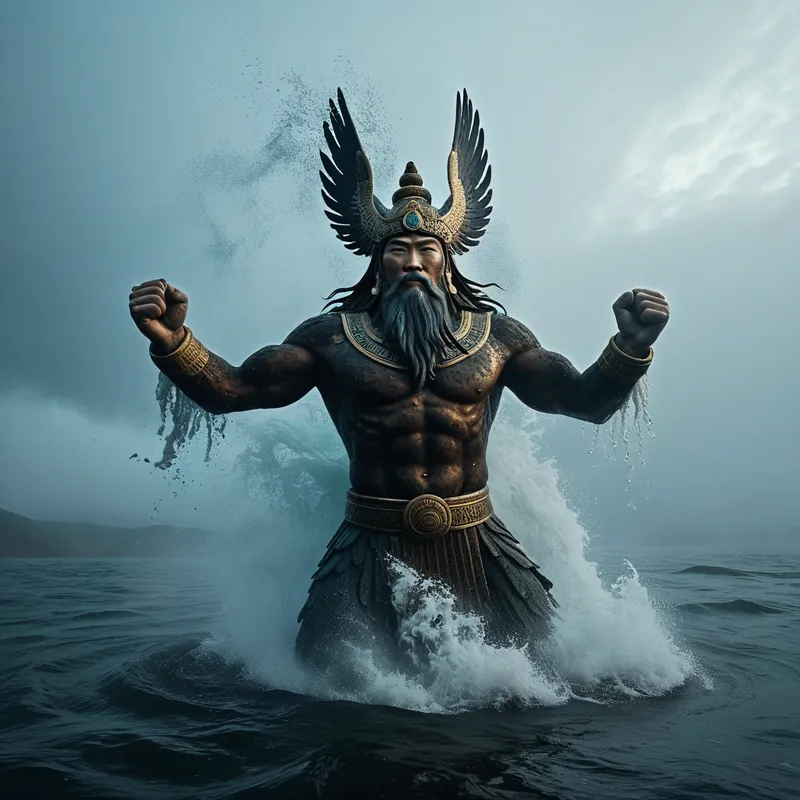
Without hesitation, the diver shaped himself for the descent. He took on a form both powerful and streamlined—often told as a mighty water-bird or a being with the keen eyes of an eagle and the strength of a man. He drew a great breath from the void and dove. Down he sped, through waters that were cold with the chill of non-being, through pressures that sought to crush possibility itself. The light from above faded into a profound, swallowing blackness. For an age, he fell, seeking a bottom that might not exist.
Just as his strength began to waver, his questing hands touched not more water, but a substance both soft and firm—the primordial silt at the world’s beginning. He clutched a great handful of this dark, fertile mud, turned, and fought his way back toward the distant memory of light. The ascent was a trial greater than the descent. The mud was heavy with the weight of a world yet unborn. The waters resisted, clinging to him, trying to reclaim the seed of solidity.
He broke the surface, gasping, and raised his prize to the Tengri. But as he did, exhaustion claimed him. The heroic form could no longer hold. As he sank beneath the waves for the last time, the precious earth slipped from his grasp, scattering into the ocean.
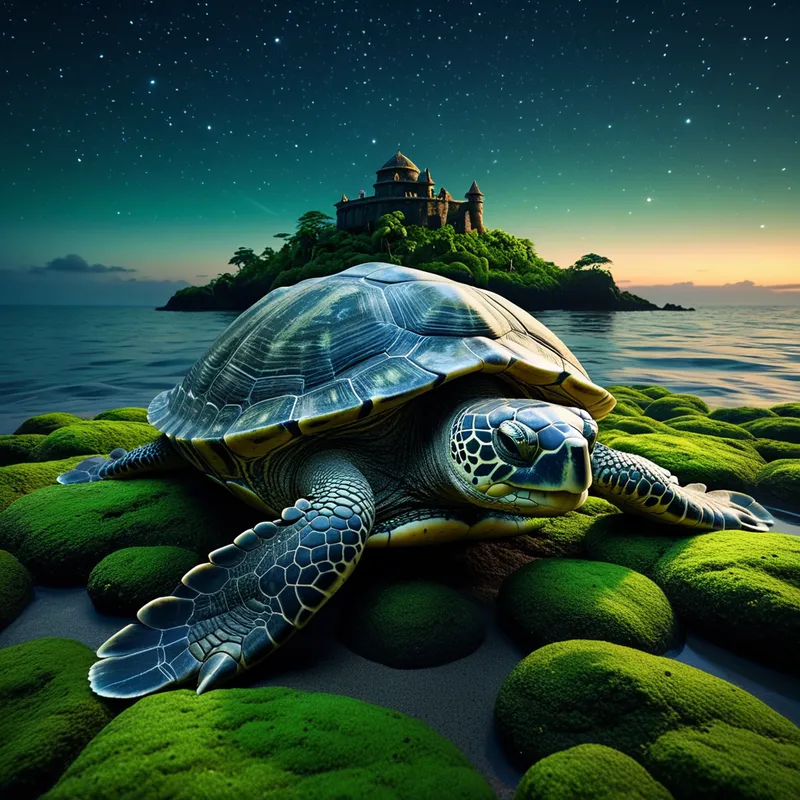
Yet this was not an end, but the first beginning. The Tengri saw the particles of earth floating and knew what must be done. They called to a great and ancient Turtle, a being of immense patience and endurance. “Carry this,” they commanded. The Turtle rose from the deep and offered its broad, immutable back. Upon it, the Tengri carefully gathered the scattered grains of mud.
They breathed upon it. They warmed it with the first light. The mud spread and grew, thickening upon the shell of the Turtle. It became steppe, mountain, and forest. It became the world-island. And from the body of the diver, who had sacrificed his form to bring forth the substance of land, life itself began to stir—the plants, the rivers, and later, the creatures and the people. The world was born from a dive into the unknown and a sacrifice upon the waters.
Cultural Origins & Context
This creation narrative belongs to the Buryat people, a Mongolian ethnic group indigenous to the region around Lake Baikal in southern Siberia. It is a core part of a rich, shamanic cosmology that predates Buddhism and later Orthodox Christian influences. The myth was not written in books but carried on the breath and in the memory of the community, told by elders and shamans (Böö) around hearth fires during the long, dark winters.
Its function was profound and practical. It rooted the people in their landscape, explaining not just the origin of the earth, but its very nature: the world as a stable, living entity carried on the back of a Turtle, surrounded by and born from the endless waters. It established a cosmic order where humanity’s role was one of respect and reciprocity with the Tengri above, the spirits of the land, and the foundational creatures below. The myth was a map of reality, teaching that existence is founded upon sacrifice, that life emerges from a courageous engagement with chaos, and that stability is a gift borne by ancient, patient beings.
Symbolic Architecture
At its [heart](/symbols/heart “Symbol: The heart symbolizes love, emotion, and the core of one’s existence, representing deep connections with others and self.”/), this is a myth of the first act of distinction—the [separation](/symbols/separation “Symbol: A spiritual or mythic division between realms, states of being, or consciousness, often marking a transition or loss of connection.”/) of solid from fluid, order from [chaos](/symbols/chaos “Symbol: In Arts & Music, chaos represents raw creative potential, uncontrolled expression, and the breakdown of order to forge new artistic forms.”/), something from nothing. The primordial Dalai represents the unconscious, the undifferentiated state of potential that exists before the ego’s formation.
The hero is not the one who conquers, but the one who consents to be transformed by the depths. His dive is the first act of consciousness, a willing descent into the formless to retrieve the material of a self.
The diver-god embodies the archetypal [Hero](/symbols/hero “Symbol: A hero embodies strength, courage, and the ability to overcome significant challenges.”/)’s [journey](/symbols/journey “Symbol: A journey in dreams typically signifies adventure, growth, or a significant life transition.”/) in its most essential form. His [mission](/symbols/mission “Symbol: A mission in dreams represents one’s aspirations and goals, often linked to a sense of purpose or commitment.”/) is one of retrieval, not conquest. His sacrifice—the [dissolution](/symbols/dissolution “Symbol: The process of breaking down, dispersing, or losing form, often representing transformation, release, or the end of a state of being.”/) of his original form—signifies the necessary [death](/symbols/death “Symbol: Symbolizes transformation, endings, and new beginnings; often associated with fear of the unknown.”/) of a prior state of being to allow for the [birth](/symbols/birth “Symbol: Birth symbolizes new beginnings, transformation, and the potential for growth and development.”/) of something new and more complex. The [earth](/symbols/earth “Symbol: The symbol of Earth often represents grounding, stability, and the physical realm, embodying a connection to nature and the innate support it provides.”/) he brings back is the prima materia, the raw, foundational substance of the psyche. The [Turtle](/symbols/turtle “Symbol: The turtle symbolizes wisdom, longevity, and the importance of taking one’s time.”/) is a magnificent [symbol](/symbols/symbol “Symbol: A symbol can represent an idea, concept, or belief, serving as a powerful tool for communication and understanding.”/) of the Self, the [archetype](/symbols/archetype “Symbol: A universal, primordial pattern or prototype in the collective unconscious that shapes human experience, behavior, and creative expression.”/) of wholeness and the ultimate [foundation](/symbols/foundation “Symbol: A foundation symbolizes the underlying support systems, values, and beliefs that shape one’s life, serving as the bedrock for growth and development.”/). It provides the stable, enduring base upon which the conscious [personality](/symbols/personality “Symbol: Personality in dreams often symbolizes the traits and characteristics of the dreamer, reflecting how they perceive themselves and how they believe they are perceived by others.”/) (the world-[island](/symbols/island “Symbol: An island represents isolation, self-reflection, and the need for separation from the external world.”/)) can be built and integrated.
The Dreamer’s Resonance
When this mythic pattern stirs in the modern soul, it often manifests in dreams of deep water, of diving or falling into abysses, or of finding oneself on a precarious but stable island. One might dream of retrieving a precious, muddy stone from a dark lake, or of feeling the ground shift only to discover it is supported by a living creature.
These dreams signal a profound somatic and psychological process: the ego’s necessary engagement with the unconscious. The “water” is the emotional and instinctual depths. The “dive” is an act of courage where one consciously seeks the foundational truths buried beneath the surface of daily life—repressed memories, innate potentials, or core wounds. The initial feeling is often of being overwhelmed, of losing one’s familiar form (anxiety, identity crisis). The appearance of the stable base—the Turtle, the island—is the dream’s assurance that this terrifying process has a purpose: the creation of a more authentic, grounded Self.
Alchemical Translation
The alchemical journey of individuation mirrors this myth precisely. It begins in the massa confusa, the chaotic “primordial ocean” of one’s unexamined life.
The first work is the nigredo, the blackening, the descent into the dark waters. Here, the old, heroic ego must dissolve so that the essential, earthy self can be found.
The diver’s courageous plunge is the act of introspection and shadow-work. The handful of mud is the raw, often “dirty” or shameful truth one retrieves about oneself—the genuine but unrefined material of one’s character. The scattering of this mud represents the initial feeling that the effort is futile, that the insights are too fragmented to build upon.
The Tengri here symbolize the ordering, transcendent function of the psyche—the inner compass that knows how to assemble the fragments. The Turtle is the emerging archetype of the Self, providing a stable, non-egoic center. The process culminates in the albedo and rubedo—the washing and warming of the earth by the divine breath—which translates to integrating these retrieved truths into a coherent, living worldview. One does not return from this journey the same. Like the diver, one’s old form is sacrificed. But from that sacrifice, a world is born—a conscious, grounded, and resilient personality, carried by the deep, enduring stability of the true Self.
Associated Symbols
Explore related symbols from the CaleaDream lexicon:
- Water — The primordial, chaotic unconscious from which all forms of consciousness and life must emerge, representing both the source of all things and the peril of dissolution.
- Earth — The foundational substance of the self and the world, retrieved from chaos and symbolizing solidity, reality, and the material for creation.
- Turtle — The archetypal symbol of the Self, providing immense stability, patience, and the foundational support upon which the conscious personality is built.
- Hero — The part of the psyche that voluntarily descends into the unknown to retrieve what is needed for growth, embodying courage and the spirit of sacrifice.
- Sacrifice — The essential process of surrendering an old form or state of being to allow for the creation of something new and more complete.
- Mountain — The land that forms upon the Turtle’s back, representing the achieved, solid structure of the conscious ego and its aspirations, born from the depths.
- Ocean — The vast, encompassing realm of the collective unconscious, surrounding the island of individual consciousness, both nurturing and threatening.
- Bird — Reflecting the diver’s often-avian form, symbolizing the ability to traverse different realms (sky/water) and the keen vision needed to find foundation in chaos.
- Spirit — The divine breath of the Tengri that animates the inert mud, representing the transcendent, ordering principle that turns potential into actuality.
- Journey — The core narrative of the dive and return, mapping the essential psychological process of descent into and reintegration from the unconscious.
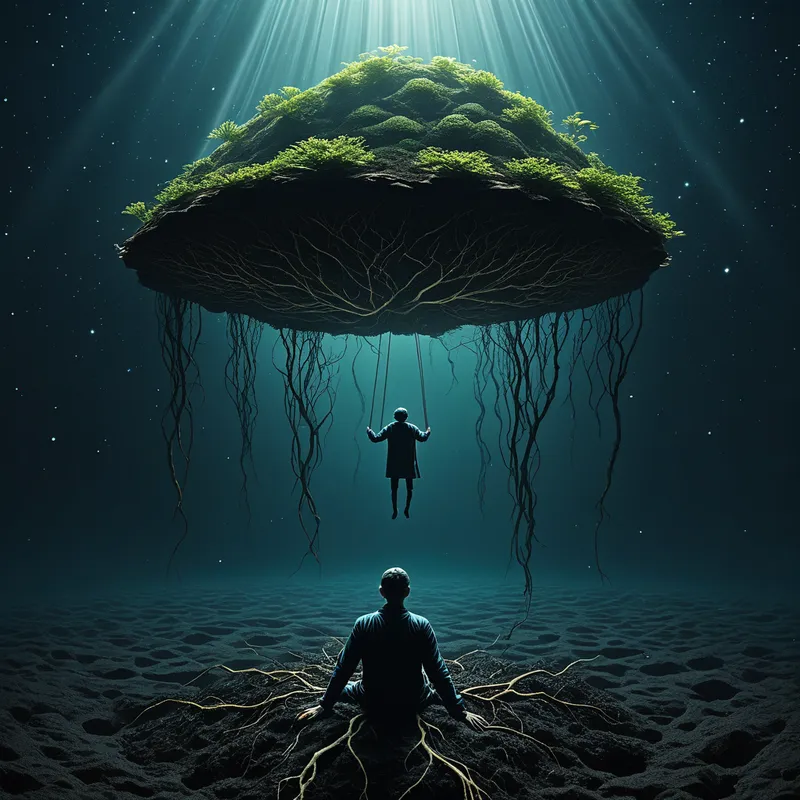
- Root — The hidden, anchoring connections that form from the diver’s sacrificed body, symbolizing how our deepest foundations are often born from what we are willing to lose.
- Rebirth — The ultimate outcome of the myth, where a new world and a new state of being are born from the dissolution of the old in the creative waters.