The Burdens of Pharisees Myth Meaning & Symbolism
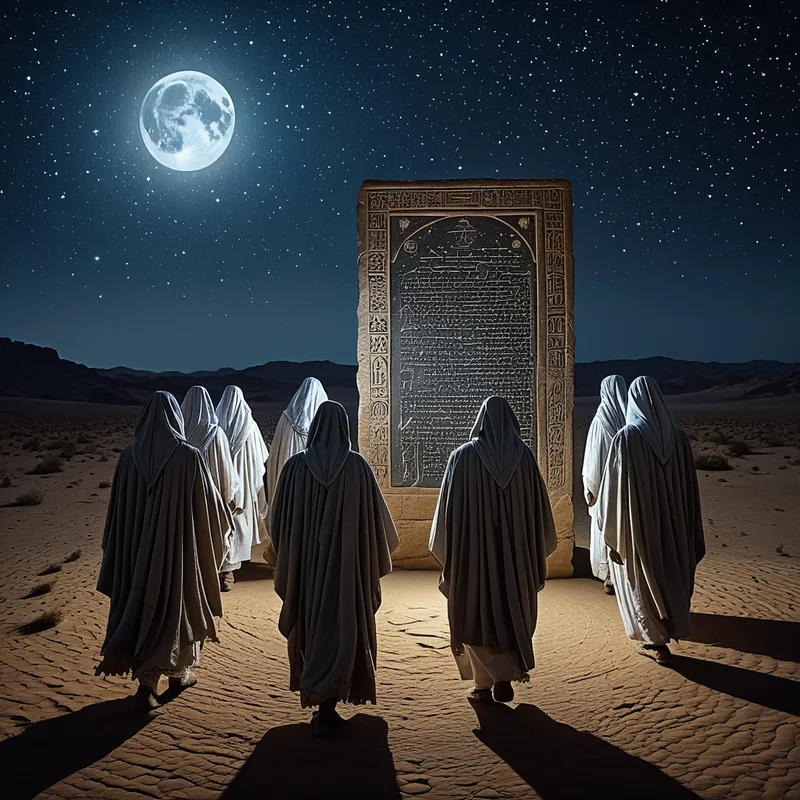
A spectral procession of ancient scribes, eternally bearing the unbearable weight of the laws they created but could not live by.
The Tale of The Burdens of Pharisees
Listen, and you will hear the whisper on [the wind](/myths/the-wind “Myth from Various culture.”/) that carries not sand, but sighs. It is the sound of footsteps that never find rest, the soft, terrible rustle of parchment that binds instead of frees.
In the deep hours, when [the moon](/myths/the-moon “Myth from Tarot culture.”/) hangs like a silver censer over the Judean desert, they appear. Not as living men, but as echoes clad in the memory of fine linen and broad phylacteries. They are [the Pharisees](/myths/the-pharisees “Myth from Biblical culture.”/) of a forgotten twilight, scholars and teachers whose names are lost to all but the dust. Yet their burden remains, luminous and terrible.
Each one bears upon his back a weight not of stone, but of word. It is [the Law](/myths/the-law “Myth from Biblical culture.”/), their life’s work, the intricate tapestry of commandment and commentary they wove with zealous thread. In life, they laid these bundles—heavy with “thou shalt” and “thou shalt not”—upon the shoulders of the people, tying them up with knots of stricture while their own spirits remained aloof, untouched by the gravity of their own decrees.
Now, in this eternal procession, the balance is restored. The law they externalized has become internal, their spiritual substance made manifest. The scrolls and tablets glow with a cold, blue-white fire, searing through their spectral robes to press upon the very essence of their being. They do not walk to any temple or holy city. They walk the perimeter of their own making, a perfect, endless circle around an empty altar. Their faces, glimpsed in profile against [the star](/myths/the-star “Myth from Tarot culture.”/)-flecked black, are not of anger, but of a profound, weary astonishment. The burden they championed, the identity they built upon meticulous observance, has become their entire world, their prison and their purpose.
There is no dialogue, only the rhythm of labored breath and the soft, crushing sound of weight settling deeper into ghostly shoulders. They seek no help, for in their paradigm, to be burdened is to be righteous, and to cast off the load would be the ultimate transgression. Their punishment is not one of fiery torment, but of perfect, ironic fulfillment: to forever bear the literal embodiment of the spiritual weight they refused to carry in their hearts. The dawn never comes to release them. They fade with the approaching light, only to coalesce again with the next twilight, forever caught between the day of action and the night of consequence, bearing what they built, forever.
Cultural Origins & Context
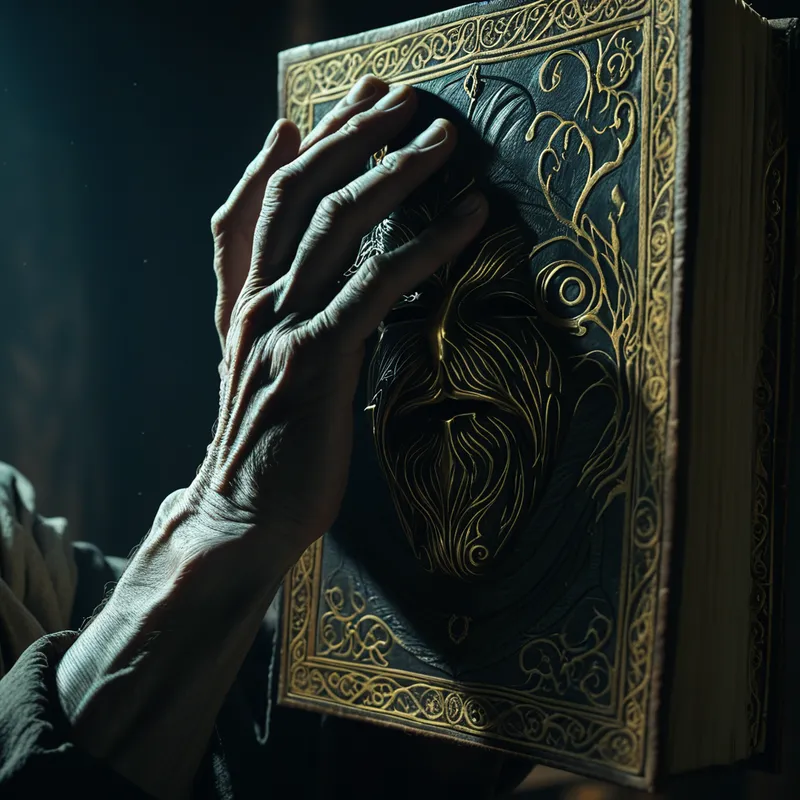
This haunting spectral narrative does not originate from a single, canonical biblical text, but emerges from the fertile ground of apocryphal tradition and medieval Christian folklore. It is a myth born from commentary, a story told to illustrate a spiritual principle articulated in the Gospel of Matthew: “They tie up heavy, cumbersome loads and put them on other people’s shoulders, but they themselves are not willing to lift a finger to move them.”
Passed down through monastic teachings, homilies, and the vivid imagination of faithful communities, the tale served as a potent moral and pedagogical tool. It was a story told not to chronicle history, but to shape conscience. Its function was societal and psychological: to warn against the perils of spiritual hypocrisy, legalism, and the separation of doctrine from compassion. It externalized an internal danger—the human capacity to use ideology as a weapon against others and a shield for [the self](/myths/the-self “Myth from Jungian culture.”/)—and gave it a form that could be seen, feared, and remembered. The myth served as a narrative mirror for the established religious culture, reflecting [the shadow](/myths/the-shadow “Myth from Jungian culture.”/) side of piety back to itself.
Symbolic Architecture
At its core, the myth is a masterful depiction of the [psyche](/myths/psyche “Myth from Greek culture.”/) turned against itself through literalism and disassociation. The Pharisees represent the part of the [personality](/symbols/personality “Symbol: Personality in dreams often symbolizes the traits and characteristics of the dreamer, reflecting how they perceive themselves and how they believe they are perceived by others.”/)—individual or collective—that conflates rules with righteousness, form with substance. Their burden is the symbolized Superego in its most tyrannical form: an internalized lawgiver that has forgotten its [purpose](/symbols/purpose “Symbol: Purpose signifies direction, meaning, and intention in life, often reflecting personal ambitions and core values.”/) of [guidance](/symbols/guidance “Symbol: The act of receiving or seeking direction, advice, or leadership in a dream, often representing a need for clarity, support, or a higher purpose on one’s life path.”/) and become an end in itself.
The heaviest burdens are not made of stone, but of solidified spirit—dogma that has lost its connection to the living soul.
The glowing tablets and scrolls symbolize [knowledge](/symbols/knowledge “Symbol: Knowledge symbolizes learning, understanding, and wisdom, embodying the acquisition of information and enlightenment.”/) and law that have become dead, weighty objects rather than living, illuminating truths. The fact that the burdens are luminous indicates they contain light ([truth](/symbols/truth “Symbol: Truth represents authenticity, honesty, and the quest for knowledge beyond mere appearances.”/), wisdom) but in a frozen, burdensome state. The eternal desert [path](/symbols/path “Symbol: The ‘path’ symbolizes a journey, choices, and the direction one’s life is taking, often representing individual growth and exploration.”/) signifies the [sterility](/symbols/sterility “Symbol: Represents inability to create, grow, or produce, often linked to emotional barrenness, creative blocks, or existential emptiness.”/) and lack of [fertility](/symbols/fertility “Symbol: Symbolizes creation, growth, and abundance, often representing new beginnings, potential, and life force.”/) that comes from a [life](/symbols/life “Symbol: The symbol of ‘Life’ represents a journey of growth, interconnectedness, and existential meaning, encompassing both the joys and challenges that define human experience.”/) governed solely by external judgment and arid regulation. There is no [water](/symbols/water “Symbol: Water symbolizes the subconscious mind, emotions, and the flow of life, representing both cleansing and creation.”/), no growth, only the endless repetition of a circuit that leads nowhere. The procession itself is a powerful [symbol](/symbols/symbol “Symbol: A symbol can represent an idea, concept, or belief, serving as a powerful tool for communication and understanding.”/) of collective [shadow](/symbols/shadow “Symbol: The ‘shadow’ embodies the unconscious, repressed aspects of the self and often represents fears or hidden emotions.”/)—a group [identity](/symbols/identity “Symbol: Identity represents the sense of self, encompassing personal beliefs, cultural background, and social roles.”/) built on a principle that ultimately enslaves its adherents.

The Dreamer’s Resonance
When this myth pattern stirs in the modern dreamscape, it rarely appears as ancient scribes. Instead, the dreamer becomes the Pharisee, or encounters the burden in contemporary guise. One may dream of being crushed under a mountain of paperwork where every form is a judgment of their worth. They may be in a house where every room has a different, impossible rule posted on the door, and a ghostly voice (a parent, a boss, a critic) enumerates their failures. The somatic experience is key: a feeling of profound weight on the chest or shoulders, labored breathing, and a paralyzing inability to move freely.
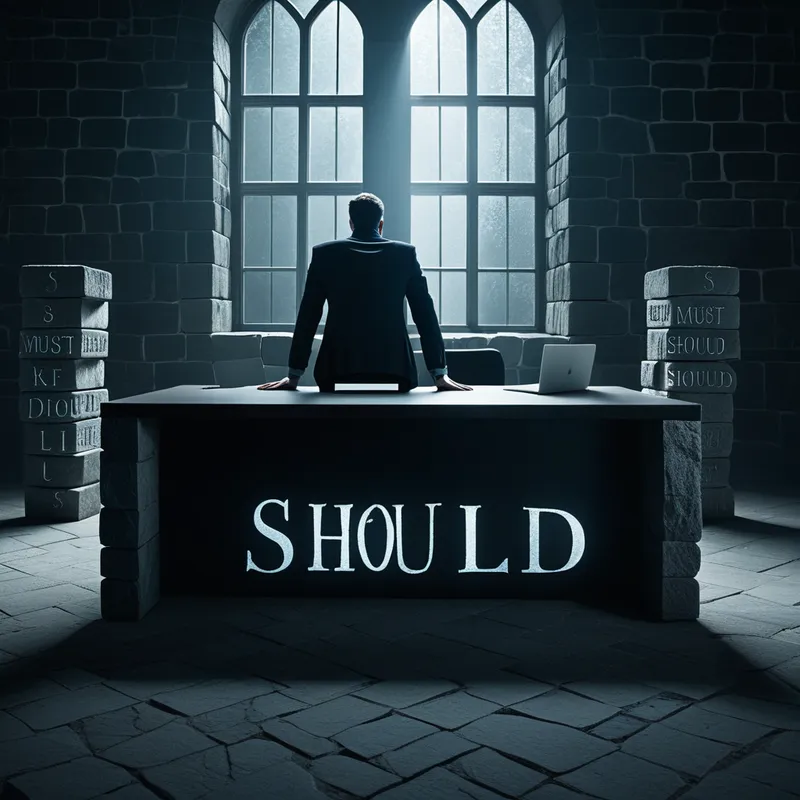
Psychologically, this dream signals a confrontation with what Jung called the Shadow, specifically the “righteous” or “dogmatic” shadow. The dreamer is carrying a weight of “shoulds,” inherited expectations, or self-imposed standards that have become disconnected from their authentic needs and spirit. The dream is a cry from the soul against a life of performance for an external audience. It marks a point where the [persona](/myths/persona “Myth from Greek culture.”/)—[the mask](/myths/the-mask “Myth from Various culture.”/) of the good, rule-following self—is cracking under its own weight, inviting a necessary crisis of integrity.
Alchemical Translation
The alchemical process modeled here is not one of fiery combustion, but of a slow, painful [solutio](/myths/solutio “Myth from Alchemical culture.”/)—a dissolving of solidified forms. The myth presents the [nigredo](/myths/nigredo “Myth from Alchemical culture.”/), the blackening: the recognition of the leaden, burdensome state of the spirit. The Pharisees are trapped in this initial, darkest stage, unable to proceed because they mistake the burden for their identity.
For the modern individual undergoing individuation, the myth maps the essential first step: seeing the burden as a burden, and recognizing one’s own complicity in carrying it. This is the dissolution of [the ego](/myths/the-ego “Myth from Jungian culture.”/)’s identification with the rule-maker.
Liberation begins not by casting the stone away in rebellion, but by holding it up to the light of consciousness until its frozen light melts back into wisdom.
The transmutation occurs when the individual dares to ask: “Whose law am I bearing? Does this weight serve life, or only the form of life?” This inquiry is the alchemical fire. The heavy stone tablet must be internalized in a new way—not as a weight to be carried, but as a substance to be transformed. The letters of the law must be decoded not as literal commands, but as symbols pointing toward a deeper, personal ethic of integrity. The goal is not lawlessness, but a law written on the heart, which is light as a feather because it is aligned with the true self. The endless, circular desert path must be abandoned for a risky, uncharted journey inward, where the burden is slowly unpacked, examined, and its frozen light released to illuminate the unique path of the individual soul. The Pharisee must die so that [the pilgrim](/myths/the-pilgrim “Myth from Christian culture.”/) may be born.
Associated Symbols
Explore related symbols from the CaleaDream lexicon: