The Buddha's Noble Silence Myth Meaning & Symbolism
The Buddha, asked about the ultimate nature of reality, responds not with doctrine but with a silence that speaks more profoundly than any teaching.
The Tale of The Buddha’s Noble Silence
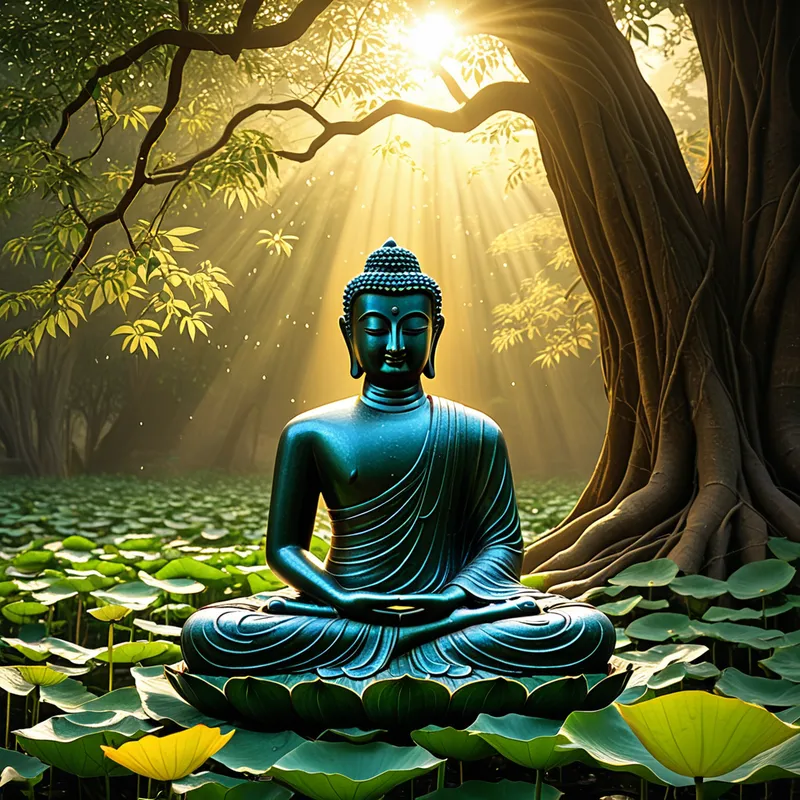
The air in the grove was thick, not with humidity, but with the weight of unspoken thought. The scent of trampled grass and old earth rose from where the seekers sat, their robes the color of dried clay and twilight. At their center sat the Tathagata, the Thus-Gone One, a man who had walked to the world’s edge and returned. His silence was not empty; it was a presence, a polished stone at the bottom of a clear pool.
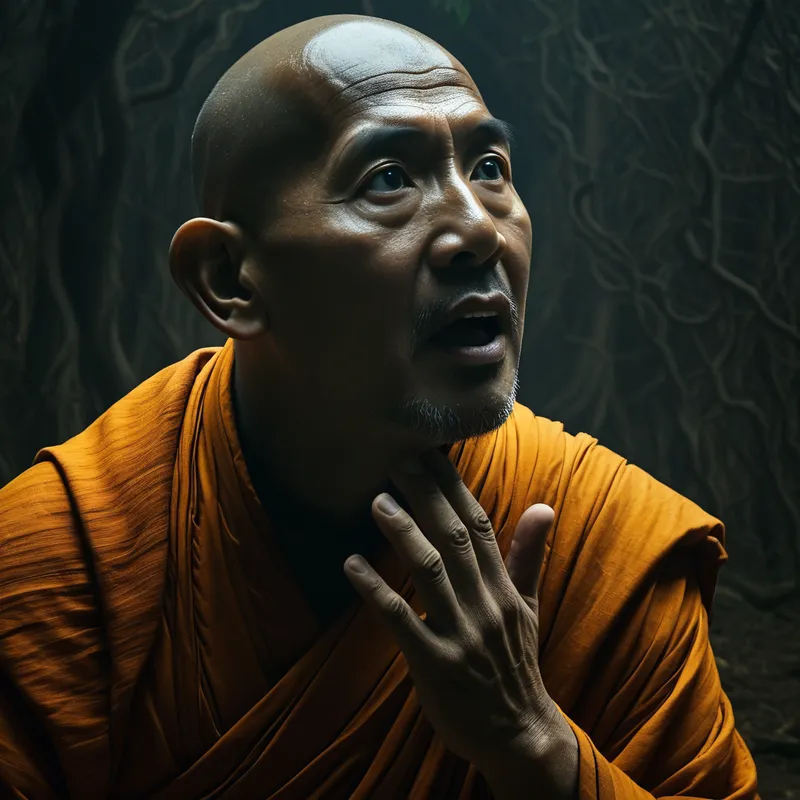
A monk named Mālunkyāputta could bear it no longer. The questions coiled in his belly like serpents, his mind a cage of buzzing what-ifs and why-nots. He pushed forward, the dust clinging to his knees. “Venerable One,” he began, his voice cracking the stillness like a dry twig. “The world—is it eternal or not eternal? Is it finite or infinite? Does the Tathagata exist after death, or not exist, or both, or neither? Tell us, Blessed One! If you do not explain these things, I will abandon the path and return to the ordinary life!”
A ripple passed through the assembly. To challenge the Awakened One so! Yet the Buddha’s face did not change. He regarded the monk not with anger, but with a boundless, compassionate depth, like the sky regarding a single, agitated cloud.
He spoke, and his voice was the sound of a river flowing over smooth stones. “Mālunkyāputta, did I ever say to you, ‘Come, live the holy life under me, and I will declare to you these answers’?”
The monk faltered. “No, Venerable Lord.”
“Then, foolish man, who are you to set conditions?” The Buddha’s words were gentle, yet they fell with the finality of a mountain. He told a parable: a man is struck by a poisoned arrow. A surgeon comes to remove it, but the wounded man cries, “Wait! I must first know the caste of the man who shot me! The height of the bow! The type of wood in the shaft!” He would die, the Buddha said, with his questions unanswered, the arrow still festering in his flesh.
“The holy life,” the Buddha concluded, his tone settling into an even deeper calm, “does not depend on these views. Whether such views are held or not, there is still birth, aging, death, sorrow, and suffering—and the cessation of all this. I teach only suffering and the end of suffering.”
And then, he returned to silence. But this silence was different. It was not a refusal, but an answer. It was a vast, open space into which the monk’s frantic questions fell and simply vanished, like stones dropped into an ocean. The Buddha did not move. He simply sat, embodying the very peace he taught—a peace that existed prior to, and beyond, all conceptual wrangling. The conflict was not resolved with logic; it was dissolved in presence. The rising action of intellectual rebellion met not a counter-argument, but the profound, unshakable resolution of stillness. The grove itself seemed to breathe a sigh, the tension evaporating under the sun of a wisdom that needed no declaration.
Cultural Origins & Context
This episode, known as the “Unanswered Questions” or the “Ariya Tuṇhībhāva,” is recorded in the Dīgha Nikāya and the Majjhima Nikāya. It emerged from the oral tradition of the early Sangha, likely recounted by disciples to illustrate a critical pedagogical and philosophical boundary. In the intellectually fertile, debate-driven climate of ancient India, where thinkers like the Lokayatas and the Jain ascetics posited elaborate cosmologies, the Buddha’s position was radical.
The myth functioned as a societal and doctrinal compass. For monastics, it was a warning against diṭṭhi—dogmatic clinging to views—which was seen as a fetter binding one to suffering. For the lay community, it positioned Buddhism as a pragmatic path of liberation, not a metaphysical puzzle. The tellers of this tale were not bards seeking entertainment, but teachers guiding students away from intellectual dead ends and toward experiential practice. It served to protect the core, transformative message of the Dhamma from being diluted into abstract philosophy.
Symbolic Architecture
The myth’s power lies in its symbolic inversion. The hero’s triumph is not an act of speech, but of resonant quiet. The Buddha, the archetypal Sage, does not slay a dragon of ignorance with the sword of logic; he simply ceases to feed it.
The deepest truths are not spoken; they are the silence from which all meaningful speech arises.
The poisoned arrow symbolizes the immediate, visceral reality of dukkha. The wounded man’s intellectual demands represent the egoic mind’s desperate attempt to contextualize, control, and avoid the raw, present-moment experience of pain through conceptualization. The Buddha’s silence, therefore, is not a void of knowledge, but the fullness of a wisdom that understands some questions are malformed. They arise from a framework—the framework of a self existing in a solid, objective world—that the entire teaching seeks to help us see through.
Psychologically, the Buddha represents the integrated Self, the consciousness that has moved beyond the ego’s compulsive narrative-building. Mālunkyāputta symbolizes the neurotic, grasping intellect, the part of the psyche that believes if it can just label reality correctly, it can control it. The conflict is the eternal clash between being and thinking, between direct experience and the conceptual map we mistake for the territory. The silence is the resolution: a return to the pre-conceptual ground of being.

The Dreamer’s Resonance
When this myth patterns a modern dream, the dreamer is often at a profound intellectual or existential impasse. They may dream of asking urgent questions of a silent teacher, shouting in a soundless room, or finding that crucial texts are blank. The somatic feeling is often one of frustrating paralysis coupled with a strange, burgeoning peace.
This dream signals a psychological process where the conscious, problem-solving mind has hit its limit. The ego has exhausted its catalog of concepts and is being invited, or forced, to surrender. The dreamer is undergoing what in depth psychology might be called an ego dissolution in service of the Self. The silence in the dream is not abandonment; it is the presence of a deeper intelligence—the unconscious itself—refusing to engage on the terms of the ego’s limited language. It is a call to stop thinking about and start experiencing. The dream prompts a shift from the head to the entire somatic being, a descent from the tower of abstraction into the grounded reality of the body and the heart.

Alchemical Translation
The alchemical process modeled here is the transmutation of leaden intellectual certainty into the gold of embodied wisdom. The initial stage (nigredo) is the monk’s confusion and desperate demand—the heat and agitation of the mind in conflict. The Buddha’s parable of the arrow is the albedo, the washing clean: it clarifies the purpose, stripping away the irrelevant to reveal the essential task (the removal of suffering).
The alchemy of silence is the fire that burns away the questioner, leaving only the open space in which the true answer can be lived.
The Noble Silence itself is the culmination, the rubedo or reddening. It represents the birth of a new mode of consciousness where the need for a definitive, conceptual answer dies. The ego’s demand for a map is sacrificed. What is born is the capacity to be the territory—to inhabit direct, unmediated experience without the filter of “is it eternal or not?”
For the modern individual, this translates to the practice of holding space for the unanswerable. It is the courage to dwell in the “don’t know mind” amidst life’s biggest questions—of purpose, mortality, and meaning. The psychic triumph is not in solving the riddle, but in realizing you are not the riddle-solver; you are the vast, silent awareness in which all riddles appear and disappear. It is the individuation step where one moves from identifying as the thinker of thoughts to becoming the conscious container of all experience, including the experience of not knowing. The path becomes walking itself, not a debate about the destination.
Associated Symbols
Explore related symbols from the CaleaDream lexicon: