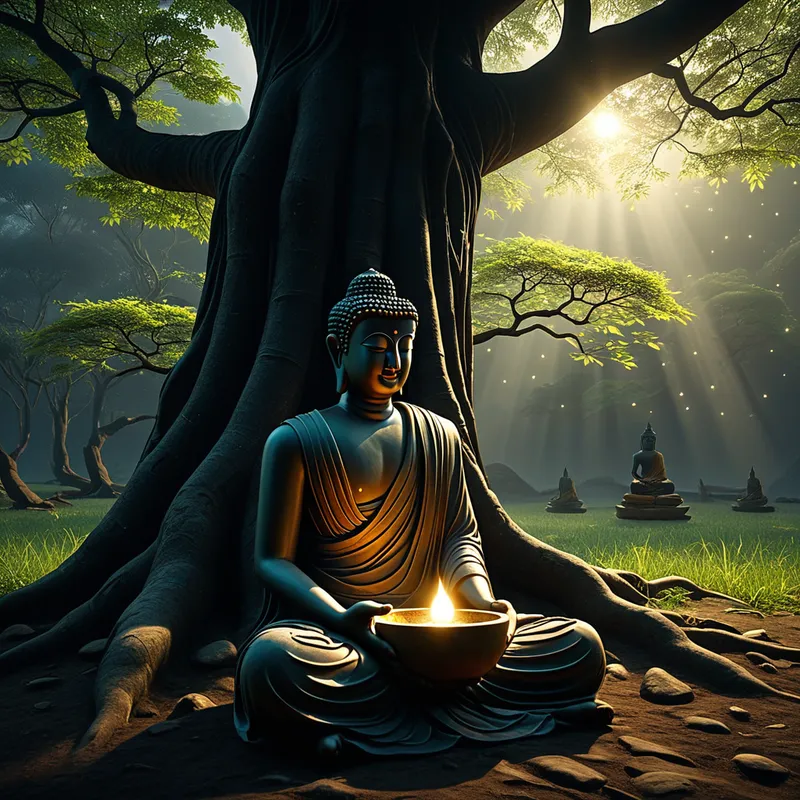
The Buddha's Bowl Myth Meaning & Symbolism
A myth of the Buddha's simple alms bowl, offered by humble deities, becoming a sacred vessel that receives the cosmos and symbolizes perfect emptiness.
The Tale of The Buddha’s Bowl
In the time after the great awakening, when the Tathagata walked the dusty roads of the [Ganges](/myths/ganges “Myth from Hindu culture.”/) plain, he carried with him the ultimate teaching, yet he possessed nothing. His robes were patched, his feet were bare, and his hands were empty. For sustenance, he relied on the ancient practice of pindapata, moving from village to village with an open heart and an open hand.
Yet, [the earth](/myths/the-earth “Myth from Hindu culture.”/) itself whispered that this was no ordinary mendicant. The one who had conquered Mara and seen the ceaseless turning of the wheel of life needed a vessel worthy of the truth he carried—not a vessel of gold, but of meaning.
The story unfolds that two humble merchants, Tapussa and Bhallika, having made the first lay offering of honey and rice cakes, saw the Awakened One had no bowl to receive it. Moved, they searched and returned with two simple stone bowls. [The Buddha](/myths/the-buddha “Myth from Buddhist culture.”/) accepted them with a nod that held the gravity of a mountain and the lightness of a leaf. But the tale deepens, as all true myths do, into the realm of the celestial.
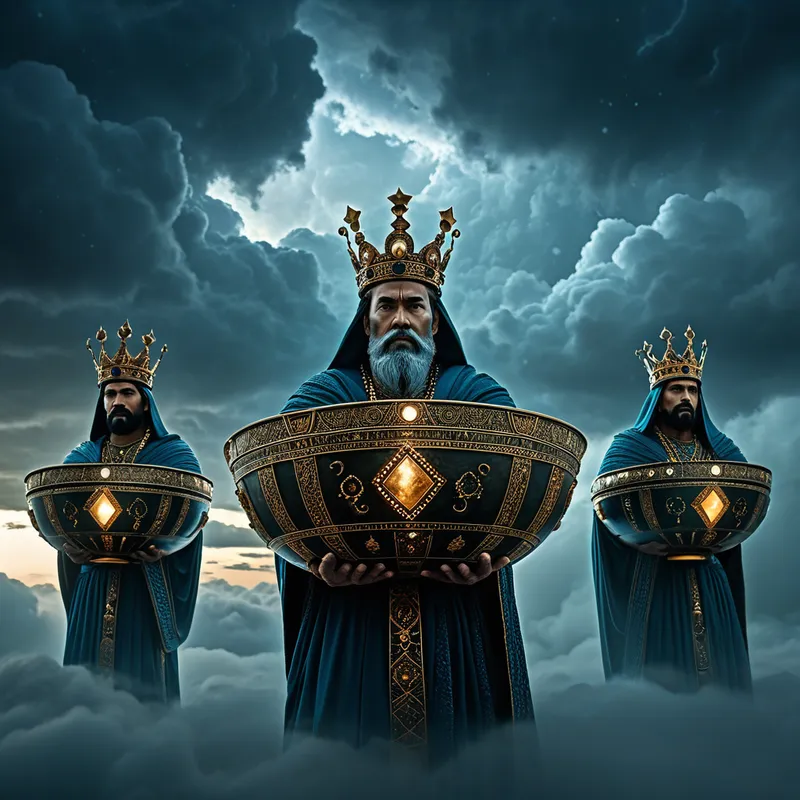
Hearing of this need, the Four Great Kings descended from their heavenly abodes. Vaisravana, Virudhaka, Dhrtarastra, and Virupaksha each arrived bearing a magnificent offering: a bowl carved from radiant sapphire, one from luminous ruby, another from gleaming gold, and a fourth from flawless crystal. These were not mere utensils; they were jewels of cosmic sovereignty, fit for a universal monarch.
The Buddha stood silently, a still point amidst this divine splendor. To accept one would be to show favor. To refuse all would be to spurn celestial grace. In that moment of profound equilibrium, he did neither. He reached not for the jewels, but for the simple, coarse stone bowls from the merchants. And then, in an act of silent alchemy, he took all four divine bowls from the kings. One by one, he stacked them in his hands—sapphire upon ruby, gold upon crystal. Then, with a breath that seemed to draw the universe into alignment, he pressed them together.
There was no clang of metal, no shatter of gem. There was only a fusion of essence. The four became one. The resplendent jewels and the humble stone merged into a single, seamless vessel. It was the color of the monsoon sky at dusk, holding the sheen of stone and the depth of jewel within its curve. It was neither poor nor rich. It was the Buddha’s Bowl, the Pātra. A vessel born of earthly need and heavenly offering, unified by the touch of awakened mind. From that day forth, it received not just rice and curry, but the devotion of worlds.
Cultural Origins & Context
The myth of the Buddha’s Bowl is woven into the fabric of early [Sangha](/myths/sangha “Myth from Buddhist culture.”/) lore, found in texts like the Vinaya Pitaka (the monastic code) and later amplified in devotional commentaries and [Jataka tales](/myths/jataka-tales “Myth from Buddhist culture.”/). Its primary function was not merely biographical but deeply pedagogical. For monastic communities, the bowl (patra) was, and remains, one of the few permissible possessions—a literal and symbolic support for life. This myth sanctified that object, transforming it from a practical tool into a sacred symbol of the monastic path itself.
The story was passed down by monks as both a lesson in humility and a testament to the Buddha’s transcendent, unifying power. It served societal functions: it validated the dignity of lay offering (the merchants), integrated pre-existing cosmological beliefs (the Vedic-turned-Buddhist guardian kings), and demonstrated the Buddha’s authority over all realms. The bowl became a caitya, a focal point for devotion, with legends claiming it was enshrined and venerated for centuries. It modeled [the Middle Way](/myths/the-middle-way “Myth from Buddhist culture.”/) in narrative form—rejecting both ascetic deprivation and royal opulence to find the profound in the unified.
Symbolic Architecture
The [bowl](/symbols/bowl “Symbol: A bowl often represents receptivity, nourishment, and emotional security, symbolizing the dreamer’s needs and desires.”/) is the central [symbol](/symbols/symbol “Symbol: A symbol can represent an idea, concept, or belief, serving as a powerful tool for communication and understanding.”/), an empty circle waiting to be filled. Its [emptiness](/symbols/emptiness “Symbol: Emptiness signifies a profound sense of void or lack in one’s life, often related to existential fears, loss, or spiritual quest.”/) is its perfection.
The ultimate vessel is defined not by what it is made of, but by the boundless space it contains.
The Four Kings represent the totality of the worldly [cosmos](/symbols/cosmos “Symbol: The entire universe as an ordered, harmonious system, often representing the totality of existence, spiritual connection, and the unknown.”/)—the four cardinal directions, [the four elements](/myths/the-four-elements “Myth from Greek culture.”/), and all states of heavenly and earthly power. Their four separate bowls symbolize the fragmented, conditioned offerings of [samsara](/myths/samsara “Myth from Buddhist culture.”/): glory, [wealth](/symbols/wealth “Symbol: Wealth in dreams often represents abundance, security, or inner resources, but can also symbolize burdens, anxieties, or moral/spiritual values.”/), power, and purity, each attractive yet ultimately partial. The two [stone](/symbols/stone “Symbol: In dreams, a stone often symbolizes strength, stability, and permanence, but it may also represent emotional burdens or obstacles that need to be acknowledged and processed.”/) bowls of the merchants represent the dualities of [human](/symbols/human “Symbol: The symbol of a human represents individuality, complexity of emotions, and social relationships.”/) [life](/symbols/life “Symbol: The symbol of ‘Life’ represents a journey of growth, interconnectedness, and existential meaning, encompassing both the joys and challenges that define human experience.”/)—gain and [loss](/symbols/loss “Symbol: Loss often symbolizes change, grief, and transformation in dreams, representing the emotional or psychological detachment from something or someone significant.”/), praise and blame, pleasure and pain—the basic, gritty [reality](/symbols/reality “Symbol: Reality signifies the state of existence and perception, often reflecting one’s understanding of truth and life experiences.”/) of embodied existence.
The [Buddha](/symbols/buddha “Symbol: The image of Buddha embodies spiritual enlightenment, peace, and a quest for inner truth.”/)’s act of unifying them is the myth’s psychic core. He does not choose between the celestial and the earthly, nor between the four separate splendors. He accepts and unifies them all. Psychologically, this represents the [integration](/symbols/integration “Symbol: The process of unifying disparate parts of the self or experience into a cohesive whole, often representing psychological wholeness or resolution of internal conflict.”/) of the [psyche](/myths/psyche “Myth from Greek culture.”/)’s fragmented complexes—the inner “kings” and “merchants,” our lofty spiritual ambitions and our humble, [material](/symbols/material “Symbol: Material signifies the tangible aspects of life, often representing physical resources, desires, and the physical world’s influence on our existence.”/) needs. The unified bowl is the symbol of the integrated Self, where all opposites are held in a harmonious, functional whole. It is no longer “this” or “that” but the container that makes use of all things without being defined by any of them.

The Dreamer’s Resonance
When this myth stirs in the modern unconscious, it may manifest in dreams of vessels: a cracked cup, a bottomless well, a precious gem that is also plain clay. The dreamer might be searching for a container or trying to carry too many separate bowls, each spilling its contents. The somatic sensation is often one of emptiness in the gut—not a fearful void, but a pregnant, receptive hollow.
This dream pattern signals a profound process of psychological receptivity. [The ego](/myths/the-ego “Myth from Jungian culture.”/), accustomed to identifying with its contents (its achievements, its wounds, its roles), is being called to identify instead with the capacity to hold. It is the process of making space. The conflict in the dream—the choice between a splendid but singular offering and a humble one—mirrors the psyche’s struggle to integrate its disparate parts into a cohesive identity. The dream urges the dreamer toward a state of non-preferential awareness, where the value is not in what is held, but in the holding itself.
Alchemical Translation
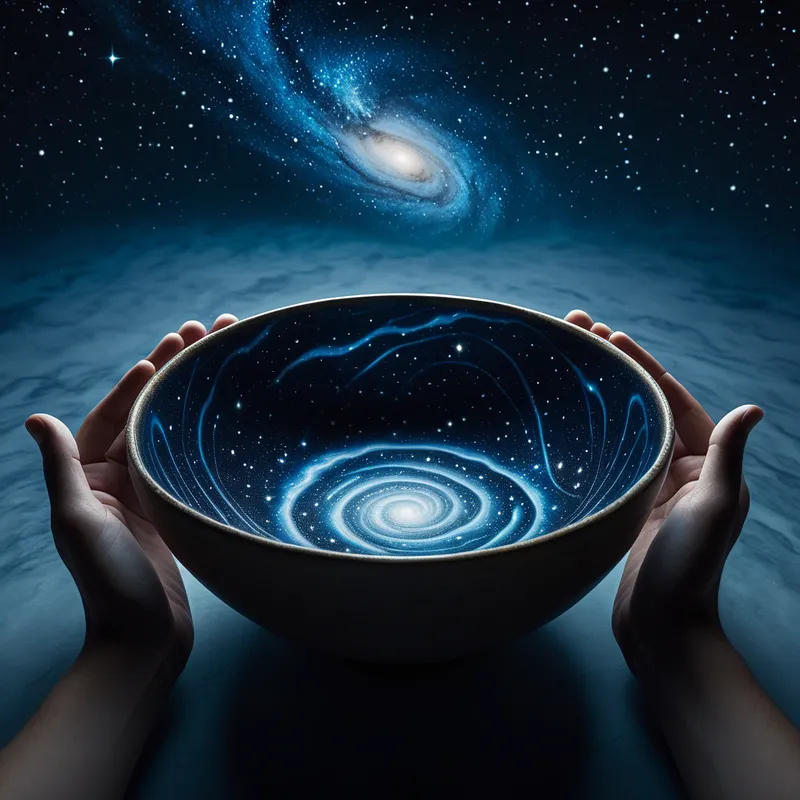
The alchemical process modeled here is the opus contra naturam—the work against our natural, fragmented state. Our initial condition is to be like the Four Kings: we possess splendid, isolated parts of ourselves we proudly present to [the world](/myths/the-world “Myth from Tarot culture.”/) (our intellect, our compassion, our strength, our intuition), but they remain separate, competing for primacy. Or, we are like the merchants, identified only with our basic, dualistic struggles.
Individuation is the silent pressure that fuses the jewel of the spirit with the stone of the body, creating a vessel strong enough to bear the weight of the cosmos yet simple enough to hold a daily meal.
The [Nigredo](/myths/nigredo “Myth from Alchemical culture.”/), the blackening, is the moment of need—the Buddha with empty hands. It is the acknowledgment of lack, the fertile void that precedes creation. The Albedo, the whitening, is the offering of the separate bowls—the bright, distinct aspects of [the self](/myths/the-self “Myth from Jungian culture.”/) coming into conscious view. The [Rubedo](/myths/rubedo “Myth from Alchemical culture.”/), the reddening, is the fusion. This is the critical, transformative fire: the application of conscious attention (the Buddha’s mindful act) that presses these fragments into a new, indissoluble unity.
For the modern individual, this translates to the hard, patient work of self-acceptance. It is not about acquiring more (more wisdom, more peace, more success). It is about taking what you already are—your glorious potentials and your humble flaws—and applying the steady pressure of non-judgmental awareness until they cease to be contradictions and become the singular, unique vessel of your life. Your “bowl” is your embodied consciousness. Your daily practice, your relationships, your work—this is the alms you receive and the offering you give. The myth teaches that enlightenment is not somewhere else. It is the quality of the container you bring to this very moment, an emptiness that makes perfect room for the world.
Associated Symbols
Explore related symbols from the CaleaDream lexicon: