The Buddha Myth Meaning & Symbolism
A prince abandons his palace to seek the end of suffering, finding enlightenment beneath a tree and teaching the path to liberation for all beings.
The Tale of The Buddha
Listen. In a time when [the world](/myths/the-world “Myth from Tarot culture.”/) was heavy with the perfume of [jasmine](/myths/jasmine “Myth from Persian culture.”/) and the weight of unasked questions, there was a kingdom cradled in the foothills of the snow-capped mountains. In the palace of Kapilavastu, a prophecy echoed: the newborn prince, [Siddhartha Gautama](/myths/siddhartha-gautama “Myth from Buddhist culture.”/), would become either a great king or a great sage. His father, King Śuddhodana, fearing the loss of an heir, built for his son a palace of seamless pleasure. Walls of perfumed sandalwood enclosed gardens where every season was spring. The prince knew only beauty, youth, and health; his wife, the exquisite Yaśodharā, and his newborn son, Rāhula, were the jewels of this perfect world. Suffering was a myth, banished beyond the high walls.
But the soul thirsts for truth, and the walls, for all their height, could not hold back eternity. Driven by a deep, unnameable restlessness, the prince commanded his charioteer, Channa, to take him beyond the gates. There, in the dusty streets of the city he was born to rule, he saw what had been hidden from him. First, he saw an old man, body bent and trembling, a living map of time’s erosion. Then, a man fever-wracked and groaning, a testament to the body’s betrayal. Then, a funeral procession, the mourners wailing as a lifeless form was carried to the pyre. The air, once sweet with palace flowers, now smelled of decay and despair. Finally, he saw a wandering ascetic, his face serene, his eyes holding a peace that the palace’s riches could never offer. These were the Four Sights, and they shattered his world.
That very night, while the palace slept in silken stupor, he took one last look at his sleeping wife and child. The moonlight silvered their faces. With a heart torn between love and a vast, calling emptiness, he mounted his horse Kanthaka, and with Channa at his side, he rode into the enveloping dark. At the forest’s edge, he exchanged his princely robes for the simple rags of a seeker, cut his hair, and sent his weeping companions back. He was now a śramaṇa, alone.
For years, he walked the razor’s edge of austerity. He studied with the greatest teachers, mastering states of profound meditation. He joined a group of ascetics and pushed his body to the brink of annihilation, eating a single grain of rice a day, until he was little more than a skeleton draped in skin. Yet liberation did not come. Realizing the futility of both indulgence and extreme denial, he accepted a simple bowl of milk-rice from a village woman named Sujātā. His companions, seeing him break his fast, left in disgust.
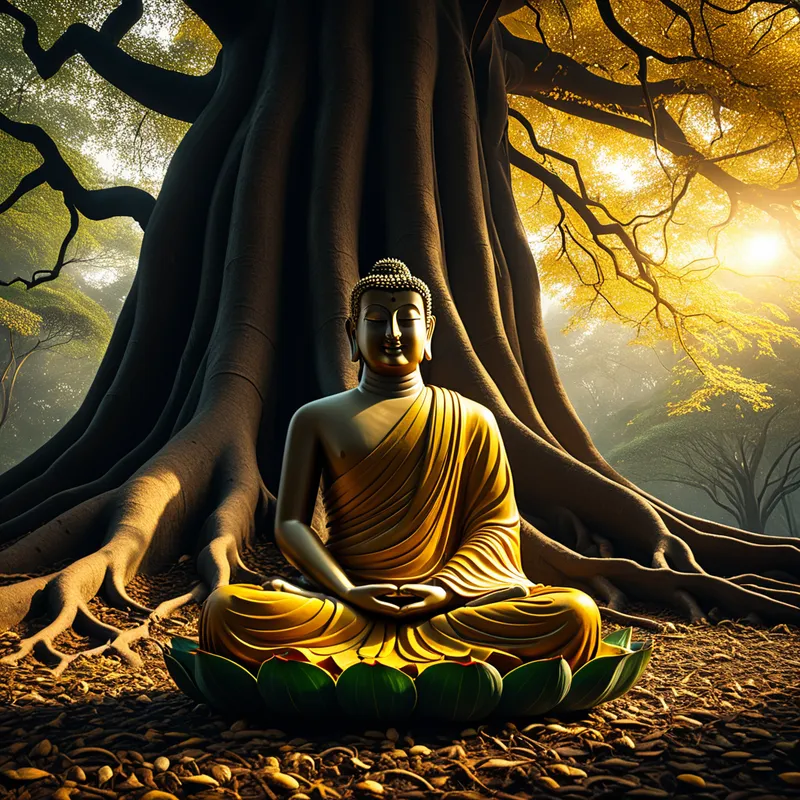
Alone, he made a vow beneath a spreading Bodhi Tree. “Let my skin, my nerves, and my bones wither away. Until I have attained the supreme awakening, I will not move from this seat.” Then, Māra, the personification of death and desire, attacked. He sent armies of demons, visions of terrifying monsters, then his beautiful daughters to seduce him. He hurled doubts: “Who are you to claim this seat? What witness do you have?” Siddhartha did not fight. He simply touched [the earth](/myths/the-earth “Myth from Hindu culture.”/) with his right hand, calling the great goddess Bhūmi to bear witness to his countless lifetimes of virtue. [The earth](/myths/the-earth “Myth from Hindu culture.”/) thundered in response, and Māra’s illusions vanished like mist in sunlight.
As the last star of dawn glimmered in [the sky](/myths/the-sky “Myth from Persian culture.”/), his mind pierced the final veil. He saw, with utter clarity, the endless cycle of birth, suffering, death, and rebirth—Saṃsāra. He saw the chain of cause and effect that binds beings to this wheel. And he saw the path to its cessation. In that moment, he was no longer Siddhartha the seeker. He was the Buddha. For seven weeks, he dwelt in the bliss of Nirvāṇa, wondering if this truth could be taught. Moved by compassion for a world drowning in suffering, he arose. He walked to Deer Park at Sarnath, found his five former ascetic companions, and set in motion the Wheel of Dharma with his first teaching. The path was open to all.

Cultural Origins & Context
This is not a myth of a distant, cosmic deity, but the story of a human being’s quest, rooted in the historical context of 5th-6th century BCE Magadha. It emerged from a vibrant, pluralistic landscape of Vedic ritualism, emerging Jainism, and countless schools of wandering philosophers debating the nature of reality and [the self](/myths/the-self “Myth from Jungian culture.”/). The tale was first transmitted orally by the monastic community, the Saṅgha, as part of the Sutta Piṭaka. It functioned as a foundational narrative, less about worship and more about exemplification. It provided an authoritative model for renunciation, perseverance, and the possibility of achievement. For laypeople, it was an inspiring story of supreme human potential. For monastics, it was the archetypal map of their own journey from householder to awakened one, legitimizing their lifestyle and ultimate goal.
Symbolic Architecture
The myth is a perfect symbolic [blueprint](/symbols/blueprint “Symbol: A blueprint represents the foundational plan or design for something, often symbolizing potential, structure, and the mapping of one’s inner self or future.”/) for the [psyche](/myths/psyche “Myth from Greek culture.”/)’s [journey](/symbols/journey “Symbol: A journey in dreams typically signifies adventure, growth, or a significant life transition.”/) from identification with the [persona](/symbols/persona “Symbol: The social mask or outward identity one presents to the world, often concealing the true self.”/) to the realization of the Self.
The palace is the encapsulated ego, a false paradise built on the repression of life’s wholeness. It is the comfort zone of known suffering, preferring familiar pain to the terror of the unknown.
The Four Sights are not random misfortunes but the inevitable [eruption](/symbols/eruption “Symbol: A sudden, violent release of pent-up energy or emotion from beneath the surface, often representing transformation or crisis.”/) of the repressed contents of the [collective unconscious](/symbols/collective-unconscious “Symbol: The Collective Unconscious refers to the part of the unconscious mind shared among beings of the same species, embodying universal experiences and archetypes.”/)—aging, sickness, [death](/symbols/death “Symbol: Symbolizes transformation, endings, and new beginnings; often associated with fear of the unknown.”/), and the seeking [spirit](/symbols/spirit “Symbol: Spirit symbolizes the essence of life, vitality, and the spiritual journey of the individual.”/)—into the conscious mind. They represent the call to individuation, which cannot be ignored. The Great Renunciation is the ultimate act of psychological courage: sacrificing the known world (the adapted [personality](/symbols/personality “Symbol: Personality in dreams often symbolizes the traits and characteristics of the dreamer, reflecting how they perceive themselves and how they believe they are perceived by others.”/)) for the sake of the unknown Self. The austerities symbolize [the ego](/myths/the-ego “Myth from Jungian culture.”/)’s misguided attempt to conquer the psyche through willpower and self-[punishment](/symbols/punishment “Symbol: A dream symbol representing consequences for actions, often tied to guilt, societal rules, or internal moral conflicts.”/), a spiritual dead-end.
The [Bodhi Tree](/symbols/bodhi-tree “Symbol: The sacred fig tree under which Siddhartha Gautama attained enlightenment, symbolizing awakening, wisdom, and the interconnectedness of all life.”/) is the [axis](/symbols/axis “Symbol: A central line or principle around which things revolve, representing stability, orientation, and the fundamental structure of reality or consciousness.”/) mundi, the still point where the personal psyche aligns with the cosmic order. Māra’s assault is the climactic confrontation with the [Shadow](/symbols/shadow “Symbol: The ‘shadow’ embodies the unconscious, repressed aspects of the self and often represents fears or hidden emotions.”/) in its totality—our fears, desires, doubts, and the seductive pull of [regression](/symbols/regression “Symbol: A psychological or spiritual return to earlier states of being, often involving revisiting past patterns, memories, or developmental stages for insight or healing.”/). The [earth](/symbols/earth “Symbol: The symbol of Earth often represents grounding, stability, and the physical realm, embodying a connection to nature and the innate support it provides.”/)-touching [gesture](/symbols/gesture “Symbol: A non-verbal bodily movement conveying meaning, emotion, or intention, often symbolic in communication and artistic expression.”/) (Bhūmisparśa Mudrā) is profound: enlightenment is not an escape from [reality](/symbols/reality “Symbol: Reality signifies the state of existence and perception, often reflecting one’s understanding of truth and life experiences.”/), but a deeper grounding in it. It is the Self, rooted in the bedrock of what is, witnessing and integrating the ego’s struggles.
The Dreamer’s Resonance
When this myth stirs in modern dreams, it signals a profound crisis of meaning and a call to awaken from psychological sleep. Dreaming of being trapped in a gilded cage or a sterile, perfect environment points to a life lived for the “palace”—social expectations, material success, or a curated identity that has become a prison. Visions of sudden decay, illness, or funerals in dreams are not premonitions but the psyche’s urgent presentation of the repressed realities of one’s own life: a dying relationship, a neglected passion, the sickness of inauthenticity.
A dream of abruptly leaving everything behind—walking out of a job, a home, a family—often terrifies the dreamer. This is not a literal instruction but a symbolic representation of the necessary inner renunciation: leaving behind an outmoded self-concept, a defensive pattern, or a toxic belief system. The somatic experience is often one of simultaneous terror and immense relief, a cracking open of the chest. To dream of sitting silently under a tree while chaos rages around you indicates the nascent emergence of the inner witness, the Self, beginning to hold steady against the onslaught of neuroses (Māra’s armies).
Alchemical Translation
The Buddha’s journey is the alchemical opus of the soul: from the massa confusa of palace life (unconscious identification), through the [nigredo](/myths/nigredo “Myth from Alchemical culture.”/) of the Four Sights and austerities (confrontation with shadow and despair), to the albedo of Sujātā’s nourishment (acceptance and care of the embodied self), culminating in the [rubedo](/myths/rubedo “Myth from Alchemical culture.”/) of enlightenment under [the Bodhi Tree](/myths/the-bodhi-tree “Myth from Buddhist culture.”/) (the integration of opposites into a transcendent, unified consciousness).
The alchemical gold is not a thing to be possessed, but a state of being to be realized: the unshakable peace that comes when the ego stops claiming ownership of experience.
For the modern individual, the myth does not prescribe physical renunciation. It maps the inner process. The “palace” is any identity we cling to for security. “Going forth” is the internal act of turning awareness inward, questioning our deepest assumptions. The “asceticism” is the discipline of mindfulness, the fasting from distracting mental chatter. The battle with “Māra” is our daily confrontation with anxiety, craving, and self-doubt. Enlightenment, in psychological terms, is the moment when the center of gravity shifts from the ego-complex to the Self. One becomes grounded in a witnessing consciousness that observes pleasure and pain, success and failure, birth and death, without being enslaved by them. The final teaching at Deer Park is the culmination: the integrated individual, having realized their own nature, naturally turns to relate to the world from a place of compassion, not compulsion. The wheel turns, not of suffering, but of liberated activity in the world.
Associated Symbols
Explore related symbols from the CaleaDream lexicon: