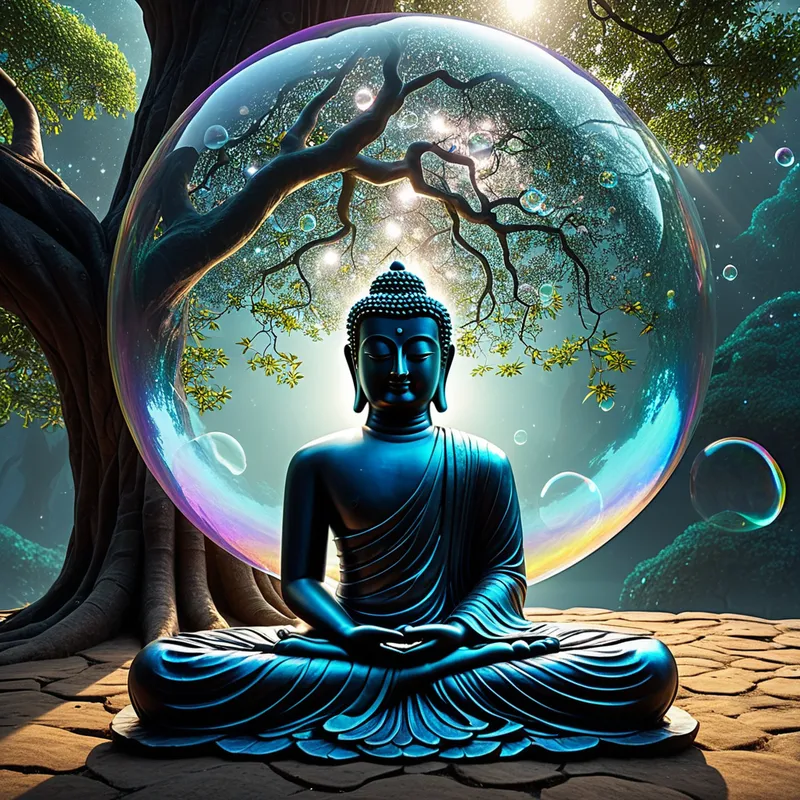
The Bubble Simity Myth Meaning & Symbolism
A teaching on the nature of self, comparing the human form to a shimmering, rainbow-hued bubble that forms, glistens, and vanishes in a single breath.
The Tale of The Bubble Simile
Listen. The air is still, heavy with the scent of damp earth and night-blooming [jasmine](/myths/jasmine “Myth from Persian culture.”/). Beneath the ancient, spreading limbs of the Bodhi tree, a figure sits unmoving. This is not a king, though he was born to a throne. This is [the Buddha](/myths/the-buddha “Myth from Buddhist culture.”/), [Siddhartha Gautama](/myths/siddhartha-gautama “Myth from Buddhist culture.”/), who has seen to the heart of all things. Around him, a company of monks, the [Sangha](/myths/sangha “Myth from Buddhist culture.”/), sit in the hushed silence of deep attention. They have asked the unaskable: “What are we? This body, this mind, this feeling of ‘I’ that suffers and strives?”
The Buddha does not answer with a treatise. He opens his eyes, and his gaze is like still [water](/myths/water “Myth from Chinese culture.”/). He raises his hand, not in blessing, but in pointing. The morning sun, newly risen, slants through the leaves. In a shaft of that golden light, motes of dust dance. And there, born from the moisture on a blade of grass, warmed by the sun’s breath, a bubble forms.
See it. It is a tiny universe, a perfect sphere. [The world](/myths/the-world “Myth from Tarot culture.”/) bends upon its surface: the green of the leaves, the blue of [the sky](/myths/the-sky “Myth from Persian culture.”/), the serene face of the teacher, the expectant faces of the disciples—all captured, inverted, and made miniature. It shimmers with impossible colors, a rainbow stolen from the air. It is breathtakingly beautiful, a jewel spun from nothing.
The monks watch, captivated. For a moment, it seems a permanent wonder. It floats, delicate and radiant, the epitome of fragile perfection. Then, a breeze—the softest exhalation of the waking world—touches it. There is no crash, no shatter. A mere cessation. A silent pop. The rainbow vanishes. The reflected world dissolves. The water returns to the air from which it came. Where there was luminous form, there is now only empty space.
The Buddha’s hand remains, now pointing at the emptiness where the bubble was. His voice, when it comes, is not loud, but it fills the silence left behind. “Thus, monks, are the five aggregates. Thus is form. Thus is feeling. Thus is perception. Thus are mental formations. Thus is consciousness. See them as a bubble. See them as a mirage. See them as a dream.”
In that moment, the teaching is not heard; it is seen. It is felt in the heart’s sudden lurch, in the recognition of that fragile, gorgeous, utterly empty [thing](/myths/thing “Myth from Norse culture.”/) that was, for a moment, everything.

Cultural Origins & Context
This is not a myth of gods and monsters, but a simile, a pointed analogy drawn from the observable world. It is found in the Digha Nikaya and the Anguttara Nikaya, part of the Pali Canon. Its teller is the historical Buddha, and its first audience was his monastic community. Its function was radically pragmatic: to deconstruct the most stubborn object of human attachment—the sense of a solid, enduring self.
In the context of 5th-century BCE India, a land steeped in philosophies debating the nature of Atman, the Bubble Simile was a quiet revolution. It bypassed intellectual debate and pointed directly to experience. It was a tool for Vipassana meditation. Monks were instructed to contemplate their own body and mind with this image, not as doctrine to believe, but as a lens through which to see reality itself, thereby uprooting clinging and the suffering it inevitably brings.
Symbolic Architecture
The bubble is a master [symbol](/symbols/symbol “Symbol: A symbol can represent an idea, concept, or belief, serving as a powerful tool for communication and understanding.”/) of Anicca, Dukkha, and Anatta—[impermanence](/myths/impermanence “Myth from Buddhist culture.”/), unsatisfactoriness, and non-self. Its [architecture](/symbols/architecture “Symbol: Architecture in dreams often signifies structure, stability, and the framing of personal identity or life’s journey.”/) is profound in its simplicity.
The Sheen: The [rainbow](/symbols/rainbow “Symbol: Rainbows symbolize hope, promise, and the beauty found after turmoil, often viewed as a bridge between the earthly and divine.”/) play of light on the bubble’s surface represents the alluring, sensory world (Maya). It is the [beauty](/symbols/beauty “Symbol: This symbol embodies aesthetics, harmony, and the appreciation of life’s finer qualities.”/) of form, the pleasure of feeling, the [clarity](/symbols/clarity “Symbol: A state of mental transparency and sharp focus, often representing resolution of confusion or attainment of insight.”/) of thought, the [drama](/symbols/drama “Symbol: Drama signifies narratives, emotional expression, and the exploration of human experiences.”/) of [identity](/symbols/identity “Symbol: Identity represents the sense of self, encompassing personal beliefs, cultural background, and social roles.”/). We mistake this dazzling display for substance.
The Hollow Core: The bubble is empty. Its beautiful form encloses… nothing. This is the [heart](/symbols/heart “Symbol: The heart symbolizes love, emotion, and the core of one’s existence, representing deep connections with others and self.”/) of the teaching on Anatta. What we call “I” is a configuration of transient processes—physical and mental—arising and passing due to causes and conditions. Like the bubble, it has a functional [reality](/symbols/reality “Symbol: Reality signifies the state of existence and perception, often reflecting one’s understanding of truth and life experiences.”/) but no solid, central essence.
The Inevitable Pop: The bubble’s [fate](/symbols/fate “Symbol: Fate represents the belief in predetermined outcomes, suggesting that some aspects of life are beyond human control.”/) is certain from its [birth](/symbols/birth “Symbol: Birth symbolizes new beginnings, transformation, and the potential for growth and development.”/). Its existence is a brief [tension](/symbols/tension “Symbol: A state of mental or emotional strain, often manifesting physically as tightness, pressure, or unease, signaling unresolved conflict or anticipation.”/) between forming and dissolving forces. This is the [truth](/symbols/truth “Symbol: Truth represents authenticity, honesty, and the quest for knowledge beyond mere appearances.”/) of Dukkha. To cling to a bubble is to guarantee disappointment. Its pop is not a tragedy, but a natural [conclusion](/symbols/conclusion “Symbol: A conclusion can symbolize resolution, closure, and the finality of experiences or decisions.”/), revealing the empty, peaceful [space](/symbols/space “Symbol: Dreaming of ‘Space’ often symbolizes the vastness of potential, personal freedom, or feelings of isolation and exploration in one’s life.”/) that was always there.
To see the bubble as a bubble is the moment of liberation. The beauty is no less beautiful, but the heart is no longer deceived by it.
Psychologically, the bubble represents the constructed self—[the ego](/myths/the-ego “Myth from Jungian culture.”/). It is the necessary, functional interface with the world, shimmering with our achievements, relationships, and self-concepts. Yet, when we over-identify with this bubble, believing it to be our true, permanent core, we live in constant, low-grade [anxiety](/symbols/anxiety “Symbol: Anxiety in dreams reflects internal conflicts, fears of the unknown, or stress from waking life, often demonstrating the subconscious mind’s struggle for peace.”/)—the somatic [anticipation](/symbols/anticipation “Symbol: A state of excited expectation about future events, often involving hope, anxiety, or readiness for what is to come.”/) of the pop.
The Dreamer’s Resonance
When this myth surfaces in the modern [psyche](/myths/psyche “Myth from Greek culture.”/), it often manifests in dreams of profound fragility and luminous transparency. You may dream of living in a house of glass that could shatter at any moment, or of holding a precious, glowing orb that begins to dissolve in your hands. You may see your own face in a mirror as a reflection on water, perfectly clear yet rippling away into nothingness.
These are not nightmares of destruction, but somatic communications from the deeper self. They signal a psychological process where a long-held self-structure—a belief about who you are, a role you’ve played, an identity you’ve cherished—is reaching its natural end. The dream ego is confronting its own conditioned, impermanent nature. The anxiety felt is the clinging; the awe at the beauty is the recognition of the life that was lived within that form. The dream is an initiation into a more fluid state of being, urging you to release your grip and witness the dissolution not as a loss, but as the truth of how things are.

Alchemical Translation
The individuation process, the journey toward psychological wholeness, requires the alchemical dissolution of the ego’s rigid structures. The Bubble Simile provides a precise model for this psychic transmutation.
[The first stage](/myths/the-first-stage “Myth from Alchemical culture.”/) is Formation: We create a coherent ego-bubble from the moisture of our experiences and the warmth of our desires. It is necessary for navigating childhood and early adulthood. The second stage is Illumination: We invest this bubble with radiant importance. We polish it with success, color it with relationships, and defend it as “me.” This is the stage of life where the bubble is at its most dazzling and seemingly solid.
The alchemical work begins with the third stage: Contemplation. This is the meditative, therapeutic act of turning attention inward to observe the bubble itself—not its reflections, but its nature. We see its hollowness, its dependence on external conditions, its inherent transience. This is often precipitated by a crisis—the “breeze” of failure, loss, or meaninglessness that threatens the structure.
The pop is not annihilation, but the revelation of the vessel that contains the bubble. The self dies into consciousness.
The final stage is Transmutation. The pop occurs. The specific, rigid identity dissolves. This is experienced not as emptiness in the nihilistic sense, but as spaciousness. The energy that was bound up in maintaining the brittle form is released back into the psyche. What remains is not nothing, but the aware, open space in which bubbles of thought, feeling, and identity continually form and vanish. You are no longer the bubble; you are the knowing sky in which it briefly appears. This is the alchemical gold: a consciousness that participates in life fully, lovingly, but without the desperate, suffering-filled cling to any one form. You live, at last, with the freedom and lightness of one who knows the secret of the bubble.
Associated Symbols
Explore related symbols from the CaleaDream lexicon: