
The Brisingamen Necklace Myth Meaning & Symbolism
The goddess Freyja acquires a dazzling necklace from four dwarves, paying a sacred price, only to have it stolen, sparking a chain of cosmic consequences.
The Tale of The Brisingamen Necklace
Listen, and hear a tale spun from firelight and shadow, from the forges of the earth and the halls of the gods. It begins not in Asgard, but in the deep, stone-veined heart of the world, where the sons of the earth, the dwarves, toil.
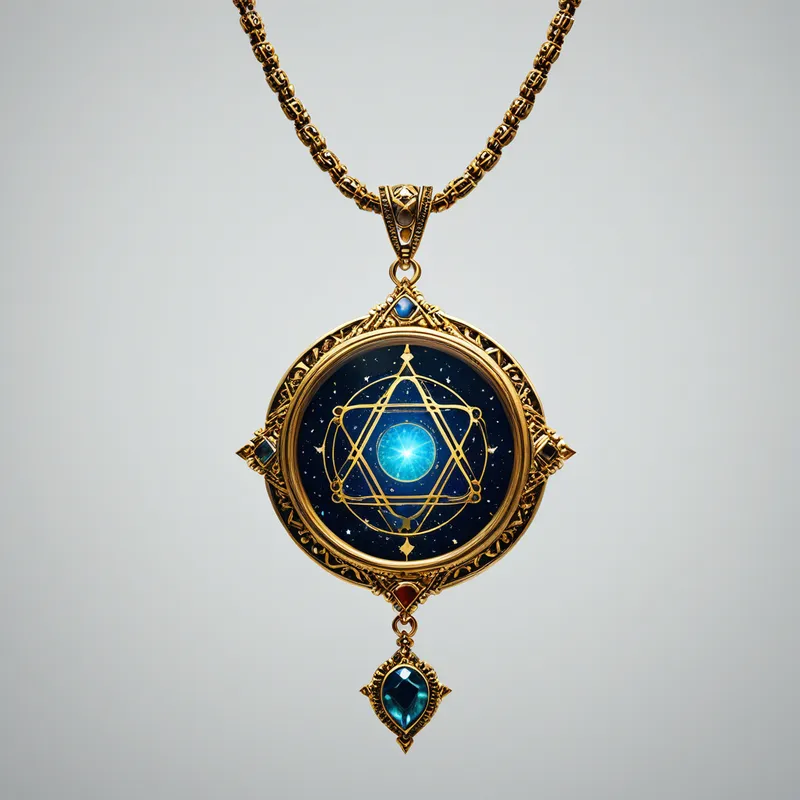
Their names were Alfrigg, Dvalin, Berling, and Grerr. In their cavern, lit by the breath of the forge, they worked a metal brighter than the sun and stones that held the light of captured stars. From this labor was born the Brisingamen, a torque of such devastating beauty that it seemed to sing a silent song of allure and power. Its very presence made the air shimmer.
The song reached the ears of Freyja, she of the falcon-feather cloak, mistress of Fólkvangr. Her desire, once kindled, was a force of nature. She traveled to the dwarves’ stony realm, and when she beheld the necklace, her heart was seized. “Name your price,” she said, her voice like honey and steel.
The dwarves, their eyes gleaming in the forge-light, spoke as one. “Gold? We have mountains of it. Our price is you, Lady of Vanir. A night with each of us, and the Brisingamen is yours.” The air grew still. Here was a choice: to walk away from the heart’s deepest yearning, or to pay a price written not in coin, but in the very fabric of her being. Freyja, whose domain was the full spectrum of desire, did not hesitate. For four nights, she stayed in the mountain’s heart, and the necklace passed into her keeping, a gleaming symbol of a contract sealed in the dark.
But such a prize draws eyes other than admiring ones. Loki, the shape-shifter, the bringer of trouble, saw the necklace and saw an opportunity. He went to Odin, the Allfather, and whispered of Freyja’s transaction, painting it with the brush of shame. Odin, ever seeking advantage, commanded Loki to steal the necklace for him.
So, when Freyja slept in her sealed chamber Sessrúmnir, Loki transformed. He became a tiny, desperate fly, buzzing at the stone walls until he found a crack so slender it seemed impossible. He squeezed through, his form aching, and found the goddess in deep slumber, the Brisingamen clasped tight. To take it, he had to become a man again, and with deft, thief’s fingers, he undid the clasp and fled into the night.
Freyja awoke to cold emptiness at her throat. A fury colder than the rivers of Hel rose within her. She went to Odin, knowing the scent of his schemes. “My treasure is gone,” she declared, her voice promising storms.
Odin, from his high seat Hliðskjálf, set the price for its return. “You will stir a war between two mighty kings,” he said. “You will make them fight until the earth is soaked, and you will use your magic to revive the dead to fight again, eternally, in an endless cycle of strife. Do this, and your necklace will be restored.”
And so it was done. The world of men became a chessboard for divine restitution. War was unleashed, the dead rose, and the cycle of violence turned. Only then did the Brisingamen, now a pendant heavy with new meaning, return to rest upon Freyja’s breast, a prize forever marked by the shadow of its loss and the terrible cost of its recovery.

Cultural Origins & Context
The myth of the Brisingamen survives in fragments, primarily in the later Poetic Edda and the more narrative Prose Edda of Snorri Sturluson. It is a story that belongs to the complex tapestry of tales surrounding the Vanir deities, particularly Freyja. Unlike the more structured, hierarchical myths of the Aesir, stories of the Vanir often carry a raw, earthy, and deeply personal quality, dealing directly with fertility, desire, and sacred exchange.
The tale was likely part of an oral tradition performed by skalds (poets) and storytellers, not as a simple moral fable, but as a narrative exploring the potent, often dangerous, forces that govern the world and the gods themselves. It functioned as a cultural mirror, reflecting understandings of value, transaction, and consequence. Freyja’s actions—her unabashed desire and her willingness to engage in a direct, physical exchange—show a deity operating outside a purely patriarchal economy of honor. The myth acknowledges female desire and agency as a cosmic force, one that is powerful enough to create and acquire objects of great worth, but which also exists within a web of social judgment and political manipulation, as seen in Odin and Loki’s roles.
Symbolic Architecture
At its core, the Brisingamen is a symbol of inordinate value and the complex economy of the soul required to obtain and hold it. It is not merely a piece of jewelry; it is an embodiment of Freyja’s essence—her seidr (magic), her allure, her sovereignty.
The price of the treasure is always a measure of the treasure itself. What we are willing to exchange reveals what we truly value.
The four dwarves represent the chthonic, elemental forces of crafting and creation. They are the unconscious, instinctual powers that can forge wonders, but they demand a payment in kind: a full engagement with the raw, often “unrefined” aspects of life and self. Freyja’s payment is a sacred, if transgressive, hieros gamos (sacred marriage) with these earthy powers, integrating them to claim her prize.
Loki’s theft represents the inevitable shadow that follows luminous value—the envy, the gossip, the external (and internal) forces that seek to separate us from our hard-won wholeness. Odin’s cruel restitution—an eternal, engineered war—symbolizes the harsh, often disproportionate, cosmic laws of cause and effect. The recovery of the self is never a simple return; it alters the landscape of the world around us.
The Dreamer’s Resonance
When this myth stirs in the modern psyche, it often manifests in dreams of potent, luminous objects just out of reach, or of precious things being stolen. To dream of the Brisingamen pattern is to be in a somatic and psychological process of valuation and integration.
The dreamer may be negotiating with their own “dwarves”—the skilled but often overlooked or repressed parts of the self (the diligent worker, the creative artisan, the stubborn realist) that hold the key to crafting something of profound personal value. The feeling is one of intense longing coupled with a deep, instinctual knowing of the cost. The “theft” in the dream points to a perceived loss of self-worth, beauty, or creative power, often precipitated by an inner “Loki”—self-sabotaging thoughts, the critical inner voice, or a sense of betrayal. The dream signals that a part of the psyche feels its core value has been compromised and that a challenging, perhaps conflict-ridden, journey of reclamation must begin.

Alchemical Translation
The myth models the alchemical process of psychic transmutation, or individuation. The Nigredo, the initial blackening, is Freyja’s descent into the mountain—the conscious engagement with the shadowy, instinctual realm (the dwarves) to obtain the raw material of the Self. This is a necessary dissolution of old moralities and personas.
The forging of the necklace itself is the Albedo, the whitening—the careful, skillful crafting of a cohesive identity or life’s work from this raw experience. But the work is not complete. Loki’s theft initiates the Citrinitas, the yellowing—the painful realization that this nascent Self is vulnerable to predation, both from external critics and internal doubts.
Individuation is not the acquisition of a static prize, but the ongoing, often fierce, guardianship of a dynamic truth.
Odin’s imposed task is the final stage, the Rubedo, the reddening. The eternal war symbolizes the lifelong, often exhausting, integration of opposites—life and death, creation and destruction, love and strife. Freyja must not just own her power (the necklace), she must wield it in the world, accepting that her actions will have sweeping, unavoidable consequences. The necklace returned is no longer a simple object of desire; it is a symbol of a Self that has been claimed, lost, and redeemed through transformative action. It is the philosopher’s stone of the soul—the fully integrated personality that has paid its price in full and wears its history as its greatest adornment.
Associated Symbols
Explore related symbols from the CaleaDream lexicon: