The Bridge of Dharma Myth Meaning & Symbolism
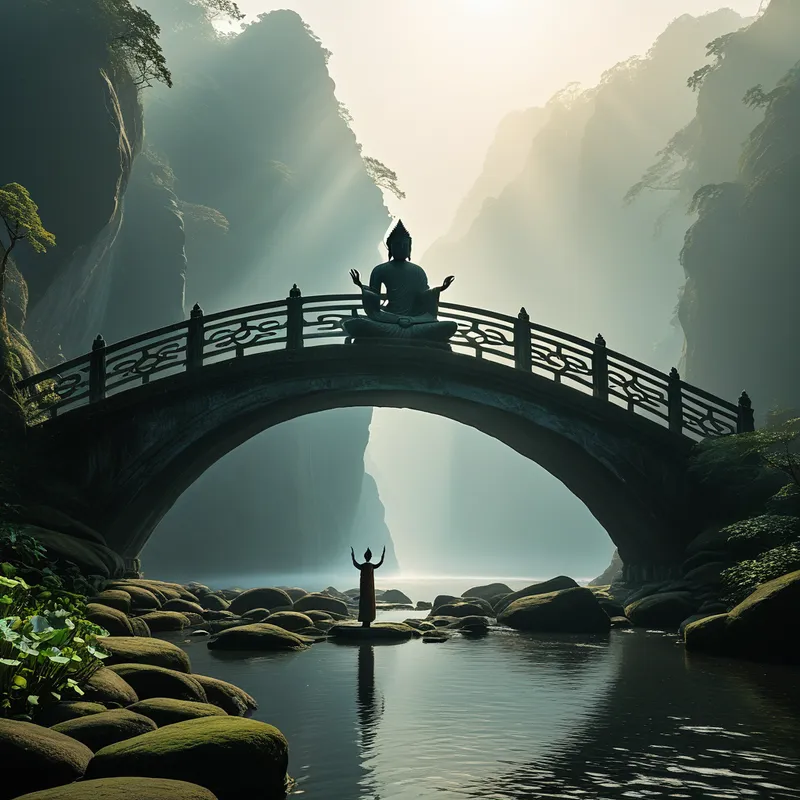
A mythic bridge spanning a chasm of ignorance, guarded by wisdom and compassion, offering passage from suffering to liberation for those who can walk its narrow way.
The Tale of The Bridge of Dharma
Listen. There is a chasm that was not carved by river or quake. It is the chasm of [Samsara](/myths/samsara “Myth from Buddhist culture.”/), wide as [the world](/myths/the-world “Myth from Tarot culture.”/) and deep as time. On its near shore, the ground is familiar—a landscape of longing and loss, of fleeting joy and certain sorrow. The air is thick with the perfume of attachment and the chill wind of fear. All beings wander here, building transient homes in the dust.
From the far shore, which no eye on this side can truly see, comes only a sound: a silence so profound it is like a melody, and a light so gentle it could be mistaken for darkness. It is [Nirvana](/myths/nirvana “Myth from Buddhist culture.”/). To most, it is a rumor, a poet’s fancy. But to a few, it is a heartbeat in the chest, an unbearable pull.
And between these shores hangs the Bridge.
It does not appear to all. It manifests only when a heart, cracked open by suffering or illuminated by a sudden, terrible grace, truly wishes to cross. It is not a bridge of wood and iron. It is woven from the threads of intention, [karma](/myths/karma “Myth from Hindu culture.”/), and wisdom. To the untrained eye, it seems a slender, trembling path of moonlight over an abyss. Some say it is a single hair’s breadth wide. Others say it is as vast as [the sky](/myths/the-sky “Myth from Persian culture.”/), but one must walk it alone.
The guardian of the Bridge is not a wrathful deity with a flaming sword, but the embodiment of the path itself: [Prajnaparamita](/myths/prajnaparamita “Myth from Buddhist culture.”/), the Mother of All Buddhas. She is the bridge, and she is the toll-keeper. Her presence is the cool clarity after a storm, the sharp insight that cuts through illusion. She asks no questions, for [the pilgrim](/myths/the-pilgrim “Myth from Christian culture.”/)’s own mind provides the interrogation.
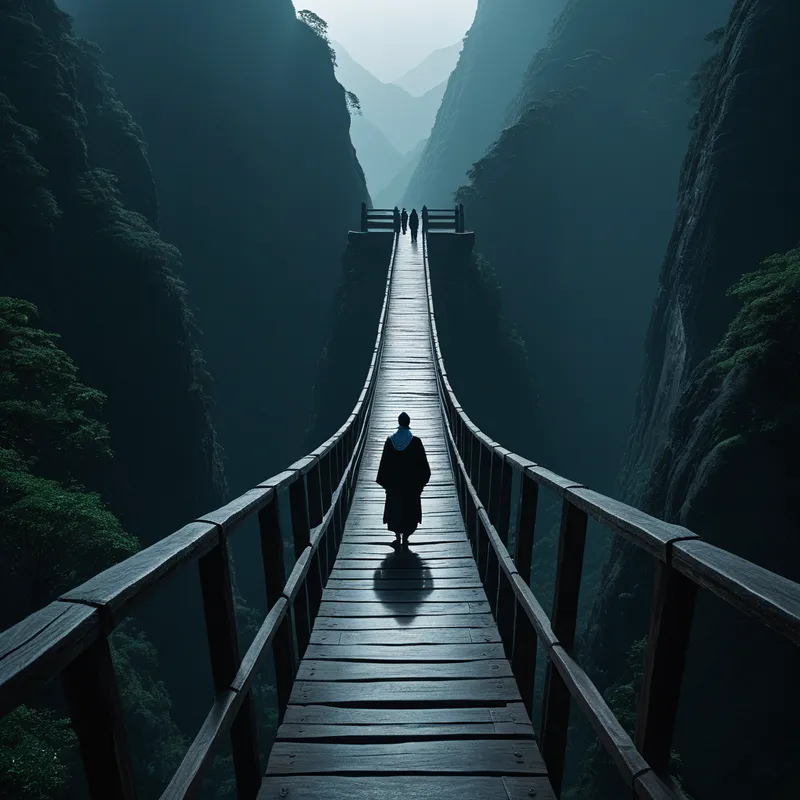
To step upon it is to feel the solid world dissolve. The comforting weight of identity, of “I” and “mine,” grows insubstantial. The winds of [the abyss](/myths/the-abyss “Myth from Kabbalistic culture.”/)—the howling gales of doubt, the seductive whispers of old desires—rake at the traveler. The bridge seems to narrow, to vanish beneath the foot. Many turn back, clinging to the known misery of the shore.
But the one who continues does not walk with the feet of the body. They walk with the feet of the mind, steadied by metta and guided by sati. Each step is a letting go: a cherished view released, a hidden hatred acknowledged and dissolved, a fear faced and seen as empty. The bridge, in response, grows more luminous, more firm. It is not that the chasm vanishes, but that the walker’s need for solid ground vanishes.
The crossing is the realization. There is no triumphant arrival on a foreign shore, for the pilgrim understands, mid-step, that the shore they left and the shore they sought were never two. The bridge was not a means to an end, but the embodiment of the end itself—the living truth of the Majjhima Patipada. In that moment of perfect balance, where seeking falls away, the myth ends. Or rather, it begins.
Cultural Origins & Context
The motif of the Bridge of Dharma is not a single, codified myth from a specific [sutra](/myths/sutra “Myth from Hindu culture.”/), but a pervasive and potent archetype woven throughout Buddhist thought, particularly in <abbr title=“The “Great Vehicle” tradition of Buddhism, emphasizing the Bodhisattva path.”>Mahayana and <abbr title=“The “Diamond Vehicle” or esoteric tradition of Buddhism.”>Vajrayana traditions. It is the narrative crystallization of the core Buddhist doctrine: the path from suffering to liberation. It appears in parables, in meditation instructions, and in the symbolic language of mandalas and lama’s teachings.
This was not a story told for entertainment around a fire. It was a map, transmitted from teacher to student in monastic universities like Nalanda, or whispered in the ear of a dying person as a guide for the bardo. Its societal function was profoundly practical: to provide a visceral, imaginative model for the psychological ordeal of awakening. It made the abstract Noble Eightfold Path into a landscape one could traverse. It externalized the internal journey, giving the practitioner a mythic container for their own terror, doubt, and potential [triumph](/myths/triumph “Myth from Roman culture.”/).
Symbolic Architecture
The bridge is the ultimate [symbol](/symbols/symbol “Symbol: A symbol can represent an idea, concept, or belief, serving as a powerful tool for communication and understanding.”/) of transition, but of a specific kind. It is not a casual crossing. It represents the razor’s edge of the present [moment](/symbols/moment “Symbol: The symbol of a ‘moment’ embodies the significance of transient experiences that encapsulate emotional depth or pivotal transformations in life.”/), the only point where transformation can occur.
The near shore is the conditioned self, the egoic mind entangled in its own narratives. The far shore is not a place, but a state of being—unconditioned awareness. The chasm is the illusion of separation between the two.
The bridge’s narrowness signifies the [precision](/symbols/precision “Symbol: The quality of being exact, accurate, and meticulous. It represents control, clarity, and the elimination of error in thought or action.”/) of right mindfulness and right view. There is no [room](/symbols/room “Symbol: A room in a dream often symbolizes the self, representing personal space, mental state, or aspects of one’s identity.”/) for the baggage of self-importance or fixed opinions. The howling winds are the kleshas, the afflictive emotions that threaten to destabilize the [seeker](/symbols/seeker “Symbol: A person actively searching for meaning, truth, or a higher purpose, often representing the dreamer’s own quest for identity or fulfillment.”/). The [guardian](/symbols/guardian “Symbol: A protector figure representing safety, authority, and guidance, often embodying parental, societal, or spiritual oversight.”/), Prajnaparamita, symbolizes the terrifying, liberating sword of wisdom that cuts through the very concept of a solid, separate walker. To meet her is to be deconstructed.
The act of walking is the practice itself—ethics, [meditation](/symbols/meditation “Symbol: Meditation represents introspection, mental clarity, and the pursuit of inner peace, often providing a pathway for deeper self-awareness and spiritual growth.”/), and wisdom applied in each moment. The [discovery](/symbols/discovery “Symbol: The act of finding something previously unknown, hidden, or lost, often representing personal growth, new opportunities, or hidden aspects of the self.”/) that the bridge is the [destination](/symbols/destination “Symbol: Signifies goals, aspirations, and the journey one is on in life.”/) encapsulates the non-dual [heart](/symbols/heart “Symbol: The heart symbolizes love, emotion, and the core of one’s existence, representing deep connections with others and self.”/) of the teaching: <abbr title=“The doctrine of “emptiness,” the lack of inherent, independent existence in all phenomena.”>[Sunyata](/myths/sunyata “Myth from Buddhist culture.”/). The [path](/symbols/path “Symbol: The ‘path’ symbolizes a journey, choices, and the direction one’s life is taking, often representing individual growth and exploration.”/) and the goal are not separate.
The Dreamer’s Resonance
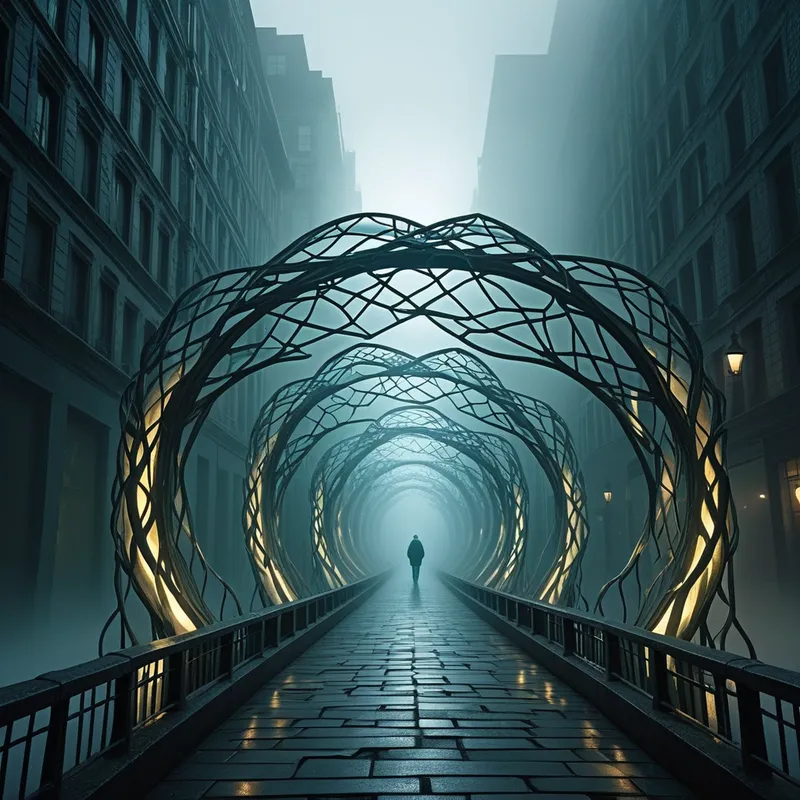
When this myth stirs in the modern unconscious, it often manifests in dreams of profound transition and existential choice. The dreamer may find themselves on a narrow ledge, a fragile glass walkway between skyscrapers, or a log spanning a raging river. The setting is modern, but the psychic architecture is ancient.
The somatic experience is key: a gripping fear in the gut, vertigo, the feeling of the body freezing or trembling. This is the [psyche](/myths/psyche “Myth from Greek culture.”/)’s recognition that a core identity structure is being challenged. To cross in the dream requires a surrender of control, a letting go of a long-held attitude, relationship, or self-image that feels like a “solid shore.” The dream is an invitation to experience the death of an old self. The terror is real, for [the ego](/myths/the-ego “Myth from Jungian culture.”/) rightly perceives its own dissolution. Yet, dreams where the crossing is made, even partially, are often followed by a waking sense of spaciousness and relief—a taste of the “other shore” as a state of being within.
Alchemical Translation
For the modern individual engaged in the process of individuation, the Bridge of Dharma models the critical passage from ego-consciousness to a dialogue with [the Self](/myths/the-self “Myth from Jungian culture.”/). The ego, comfortable on its known shore of [persona](/myths/persona “Myth from Greek culture.”/) and adaptation, must eventually confront the abyss of the unconscious—the repressed contents, [the shadow](/myths/the-shadow “Myth from Jungian culture.”/), the archetypal depths.
The alchemical work is not to destroy the ego, but to persuade it to walk the bridge, to risk its own relative reality for the sake of a greater wholeness.
The bridge is the transcendent function, the symbol born from the tension of opposites (conscious/unconscious, known/unknown) that makes a new attitude possible. The winds of doubt are the resistance of the personal complex. The wisdom-figure of Prajnaparamita is akin to the archetype of the Wise Old Woman or the Self, presenting the terrifying gift of self-knowledge.
The triumph is not the inflation of becoming “enlightened,” but the humble, ongoing practice of crossing. Each time we observe a reactive emotion without identifying with it, each time we choose compassion over righteousness, each time we sit in meditation with the chaos of our own mind—we are placing a foot on that narrow, luminous path. We are learning to walk the bridge, discovering that the solid ground we sought was, itself, the freedom of the step.
Associated Symbols
Explore related symbols from the CaleaDream lexicon: