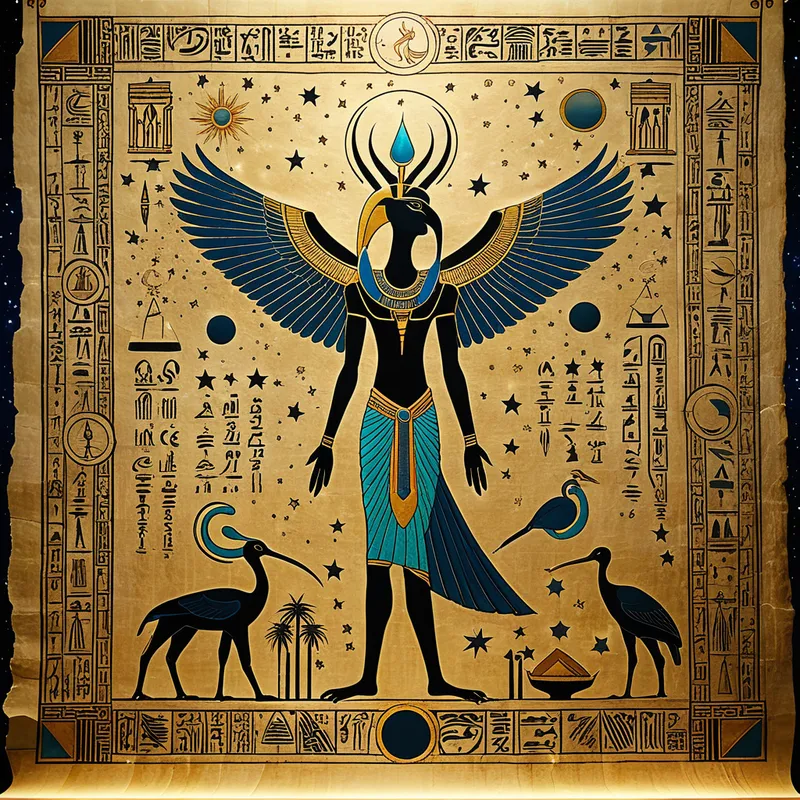
The Book of Thoth Myth Meaning & Symbolism
A prince seeks the forbidden Book of Thoth, unlocking divine power but unleashing a curse that demands the ultimate sacrifice.
The Tale of The Book of Thoth
In the deep, silent heart of time, when the gods walked closer to the black soil of Kemet, there existed a secret. It was not a secret of gold or armies, but of the very fabric of creation. This was the Book of [Thoth](/myths/thoth “Myth from Global/Universal culture.”/), penned by the god of wisdom himself. Its [papyrus](/myths/papyrus “Myth from Egyptian culture.”/) pages held the spells to understand the speech of animals, to see the gods in their true forms, and to command the heavens and [the earth](/myths/the-earth “Myth from Hindu culture.”/). It was power absolute, and for that reason, it was hidden away from [the world](/myths/the-world “Myth from Tarot culture.”/) of mortals, sealed in a series of nested boxes of gold, silver, and iron, and sunk to the bottom of the Nile at Memphis, guarded by serpents that could not be slain.
Into this silence strode a prince of great learning and restless spirit: Neferkaptah. His mind was a library, yet one book was missing. He heard whispers of the Book in the halls of [the temple](/myths/the-temple “Myth from Jewish culture.”/) scribes, tales told in hushed tones of the knowledge that could make a man rival a god. A fire ignited within him—not of greed, but of an insatiable hunger to know. He sought out the oldest priest, who warned him with trembling voice of the god’s wrath, but the warning was like wind against stone. Neferkaptah’s destiny was set.
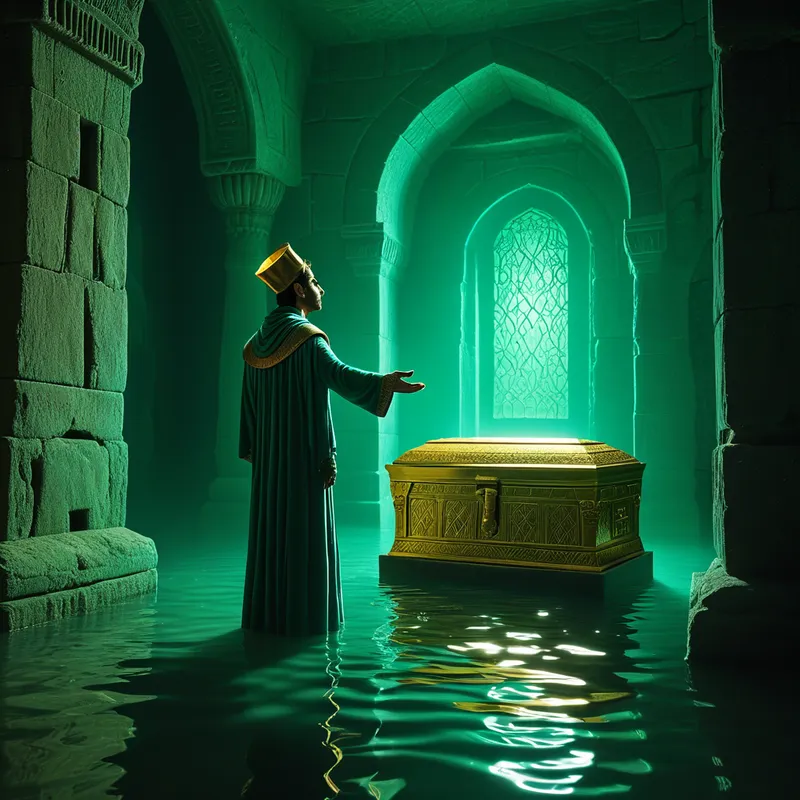
His journey was a descent. He went to the riverbank at midnight, bearing charms and incantations. He wrestled with the guardian serpents, not with a sword, but with magic, putting them into a deep sleep. He dove into the dark, cold waters, feeling the weight of the deep upon him. He found the boxes, one within another, and broke their seals. When his hands finally touched the Book, a light not of this world filled the [water](/myths/water “Myth from Chinese culture.”/). He read a single page, and suddenly, he understood the language of the crocodiles sliding past him and heard the secret songs of the fish. He had stolen fire from the divine hearth.
But Thoth knew. The god’s anger was not a storm, but a curse woven into fate itself. As Neferkaptah returned to the surface, triumphant, [the shadow](/myths/the-shadow “Myth from Jungian culture.”/) fell. First, his young son, Merib, drowned in the Nile, pulled down by the unseen force of the curse. In a grief that shook the heavens, Neferkaptah used the Book’s power to retrieve the boy’s body and recite a spell so potent it restored [the child](/myths/the-child “Myth from Alchemy culture.”/)’s ability to speak from the afterlife, a hollow victory. Then his beloved wife, Ahwere, took her own life in despair. Finally, standing alone in his palace surrounded by the ghosts of his family, Neferkaptah understood the price. He laid the Book upon his chest, lay down between his wife and son, and ended his own life. The Book was buried with them, returning to a tomb, a different kind of deep. The knowledge remained, but its cost was written in blood and silence.
Cultural Origins & Context
This potent myth survives primarily in a Demotic script papyrus from the Ptolemaic period, a tale told not in formal temple inscriptions but likely as a narrative for educated elites. It functions as a sophisticated cautionary tale. In a culture where magical texts (Books of the Dead) were commonplace and the written word was considered inherently powerful, this story explores the dangerous frontier between permissible sacred knowledge and the forbidden divine prerogative. It was a reminder from the scribal class itself that some thresholds are not for mortals to cross, no matter how noble their intellect. The myth served to reinforce the cosmic order, Maat, by demonstrating the catastrophic personal consequences of disrupting it, even in the pursuit of wisdom.
Symbolic Architecture
At its core, the myth is not about a physical book but about the [archetype](/symbols/archetype “Symbol: A universal, primordial pattern or prototype in the collective unconscious that shapes human experience, behavior, and creative expression.”/) of [Gnosis](/symbols/gnosis “Symbol: Direct, intuitive spiritual knowledge or enlightenment that transcends ordinary understanding, often associated with mystical experiences and esoteric traditions.”/)—[knowledge](/symbols/knowledge “Symbol: Knowledge symbolizes learning, understanding, and wisdom, embodying the acquisition of information and enlightenment.”/) that fundamentally alters the knower’s [relationship](/symbols/relationship “Symbol: A representation of connections we have with others in our lives, often reflecting our emotional state.”/) with [reality](/symbols/reality “Symbol: Reality signifies the state of existence and perception, often reflecting one’s understanding of truth and life experiences.”/). The Book represents the totality of conscious understanding, [the ego](/myths/the-ego “Myth from Jungian culture.”/)’s fantasy of complete intellectual mastery over the mysteries of [life](/symbols/life “Symbol: The symbol of ‘Life’ represents a journey of growth, interconnectedness, and existential meaning, encompassing both the joys and challenges that define human experience.”/), [death](/symbols/death “Symbol: Symbolizes transformation, endings, and new beginnings; often associated with fear of the unknown.”/), and the divine.
The Book of Thoth is the psyche’s ultimate fantasy of control: to name every shadow, to command every instinct, to render the unconscious completely conscious.
Neferkaptah is the embodiment of the heroic ego, the part of us that believes it can, through sheer will and intellect (his prowess as a scribe and magician), seize the core [truth](/symbols/truth “Symbol: Truth represents authenticity, honesty, and the quest for knowledge beyond mere appearances.”/) of existence. The nested boxes are the layers of the unconscious itself, and the serpents are the primal, instinctual guardians of that [depth](/symbols/depth “Symbol: Represents profound layers of consciousness, hidden truths, or the unknown aspects of existence, often symbolizing introspection and existential exploration.”/). His tragedy is the tragedy of identification with the archetype of the wise old man without the necessary humility or [integration](/symbols/integration “Symbol: The process of unifying disparate parts of the self or experience into a cohesive whole, often representing psychological wholeness or resolution of internal conflict.”/). He acquires the knowledge (assimilates the archetype) but is consumed by it because his [human](/symbols/human “Symbol: The symbol of a human represents individuality, complexity of emotions, and social relationships.”/) [vessel](/symbols/vessel “Symbol: A container or structure that holds, transports, or protects something essential, representing the self, emotions, or life journey.”/) cannot contain the divine current. The [curse](/symbols/curse “Symbol: A supernatural invocation of harm or misfortune, often representing deep-seated fears, guilt, or perceived external malevolence.”/) is the autonomous [reaction](/symbols/reaction “Symbol: A reaction in a dream signifies the subconscious emotional responses to situations we face, often revealing our coping mechanisms and fears.”/) of [the Self](/myths/the-self “Myth from Jungian culture.”/), the total [psyche](/myths/psyche “Myth from Greek culture.”/), against this egoic [inflation](/symbols/inflation “Symbol: A dream symbol representing feelings of diminishing value, loss of control, or expansion beyond sustainable limits in one’s life or psyche.”/). The [loss](/symbols/loss “Symbol: Loss often symbolizes change, grief, and transformation in dreams, representing the emotional or psychological detachment from something or someone significant.”/) of his [family](/symbols/family “Symbol: The symbol of ‘family’ represents foundational relationships and emotional connections that shape an individual’s identity and personal development.”/)—son, [wife](/symbols/wife “Symbol: The symbol of a ‘wife’ in a dream often represents commitment, partnership, and personal relationships, reflecting one’s desires for intimacy or connection.”/), and finally his own life—symbolizes the total [dissolution](/symbols/dissolution “Symbol: The process of breaking down, dispersing, or losing form, often representing transformation, release, or the end of a state of being.”/) of the personal, relational world when one becomes possessed by a transpersonal archetypal force.
The Dreamer’s Resonance
When this myth pattern stirs in the modern dreamer, it often manifests as dreams of discovering a hidden, potent book, a secret file, or a source code that explains “everything.” The somatic experience is one of exhilarating discovery followed by dread or paralysis. Psychologically, this indicates a critical encounter with a content of the unconscious that is too vast, too potent, for the current ego-structure to integrate. The dreamer may be in a phase of intense intellectual or spiritual seeking, risking what James Hollis calls “falling into the hands of the living God”—an encounter with a numinous truth that demands a death of the old self. The subsequent “curse” in dreams might be images of personal relationships fracturing, a job loss, or a depression, representing the psyche’s forced correction of an imbalanced trajectory. The dream is a warning: the knowledge you seek will require a sacrifice you have not yet consented to give.

Alchemical Translation
The alchemical process modeled here is the perilous stage of [Nigredo](/myths/nigredo “Myth from Alchemical culture.”/) and the confrontation with the shadow of wisdom itself—hubris. For the modern individual, the path of individuation is not about stealing the Book, but about earning the right to read a single, relevant passage.
The true alchemy is not in possessing the Book, but in surviving the drowning that its first page invites.
The initial desire for ultimate knowledge (Neferkaptah’s quest) is necessary; it is the call to growth. The struggle with the guardians (the serpents) is the hard, necessary work of confronting one’s own defenses and fears. The moment of obtaining the Book is the inflation, the temporary, blinding identification with an archetype. The curse—the loss—is the inevitable mortificatio, the humbling dissolution. The [triumph](/myths/triumph “Myth from Roman culture.”/) is not in Neferkaptah’s life, but in the final image: the Book buried with him. This is the integration. The potent, transpersonal knowledge is not discarded; it is taken into the tomb, the place of transformation. It becomes part of the soul’s composition for the journey through [the underworld](/myths/the-underworld “Myth from Greek culture.”/) (the unconscious). The modern individuation process asks us to seek the Book, to be shattered by its meaning, and to learn that enlightenment is not about wielding power, but about being irrevocably altered by a truth that then travels with us into our own depths. We do not command the magic; we are buried with it, and in that dark union, a slower, more authentic transformation begins.
Associated Symbols
Explore related symbols from the CaleaDream lexicon: