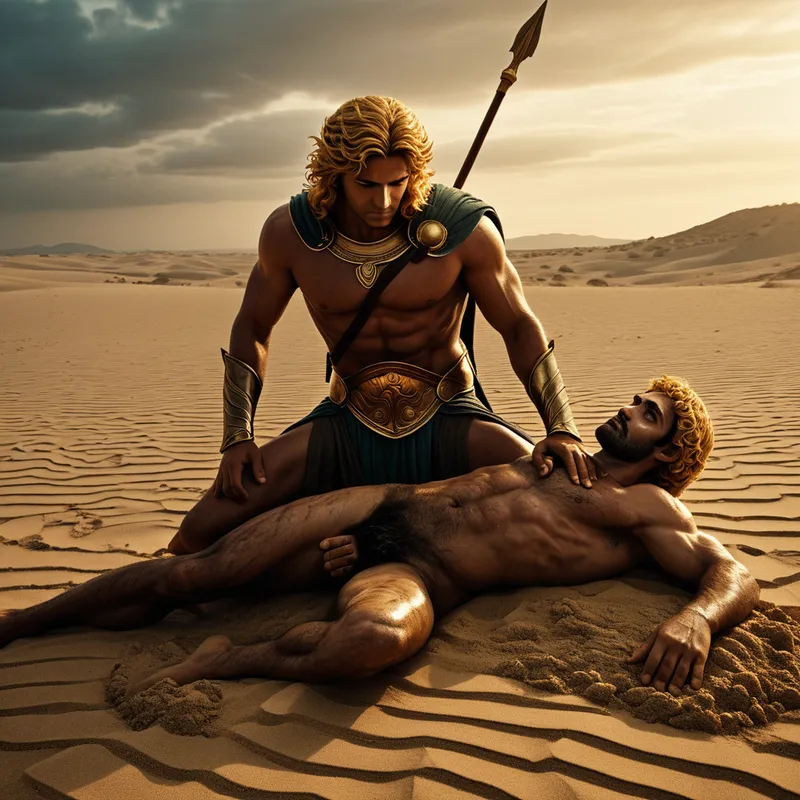
The Bond of Achilles and Patroclus Myth Meaning & Symbolism
A warrior's divine rage is ignited only by the loss of his beloved companion, transforming private grief into a public, world-altering cataclysm.
The Tale of The Bond of Achilles and Patroclus
Hear now the song of the Achilles, whose name means grief of the people, and of Patroclus, whose name means glory of the father. It begins not on the windy plains of Troy, but in the quiet halls of youth. A boy, exiled for an accidental killing, is sent to the court of King Peleus. There, he meets the king’s son, a youth already touched by prophecy, his heel held by the fire that his immortal mother could not bear for him to feel. This boy was Patroclus. The prince was Achilles. In that first meeting, a look passed between them—a recognition deeper than blood, a bond that would become the axis upon which the fate of empires turned.
Years flowed like the river Lethe, and the bond deepened. They were taught by the wise centaur Chiron in the shadow of Mount Pelion. They learned the lyre and the healing arts, the names of stars and the ways of the spear. Achilles was the flame, brilliant and destined to burn swiftly; Patroclus was the hearth, steady and containing. When the call to war came for Helen, Achilles, knowing a short, glorious life awaited him at Troy, chose to go. And where he went, Patroclus followed, not as a shadow, but as his other half—his therapon, his soul’s attendant.
At Troy, the prophecy unfolded. A quarrel with Agamemnon over a stolen prize, the girl Briseis, struck Achilles’ pride to the quick. He withdrew. He let his Myrmidons, his fierce ant-men warriors, sit idle in their black ships while their comrades died on the plain. He sang of glory to his lyre, but his heart was a stone. Only Patroclus could approach him, could speak to the man beneath the godlike rage.
Then came the day the Trojan fire reached the ships. The Greeks were routed. Patroclus, his heart breaking for the dying men, came to his friend. He did not plead for Achilles’ pride. He pleaded for the lives of their companions. “Let me wear your armor,” he said, his voice steady. “Let them see the flash of your shield and think you have returned to the fight. It will turn the tide.” Achilles, his eyes dark with a terrible foreknowledge, agreed. He clasped the breastplate onto Patroclus, helmed him, and looked into the face of his beloved. “Do not pursue Hector,” he warned, his voice a raw whisper. “Drive them from the ships and come back to me.”
The Myrmidons roared as Patroclus, shining in Achilles’ divine armor, led the charge. The Trojans fell back, terror in their hearts. The ships were saved. But then, on the crest of victory, a god-sent frenzy took hold of Patroclus. He forgot the warning. He pursued Hector to the very walls of Troy. There, the god Apollo struck the armor from his back, and in the sudden confusion, a Trojan spear found him. Then Hector drove home the final blow.
The news flew on silent wings to the black ships. When Achilles heard, a sound emerged from him that was not human—a cry that stilled the birds in the sky and chilled the blood of every warrior on the plain. He tore his hair and poured dust on his head. His divine mother, Thetis, rose from the waves to hold her son as he wept, knowing his own death now rushed toward him. Grief became purpose. Rage became a force of nature. Achilles, armed in new, god-forged armor, returned to the battlefield not for glory, but for vengeance. He became War itself, carving a path of slaughter to Hector, killing him, and dishonoring his body. But the flame, having burned with its brightest, most terrible heat, was soon to be extinguished. The bond was broken, and with it, the world of the hero.
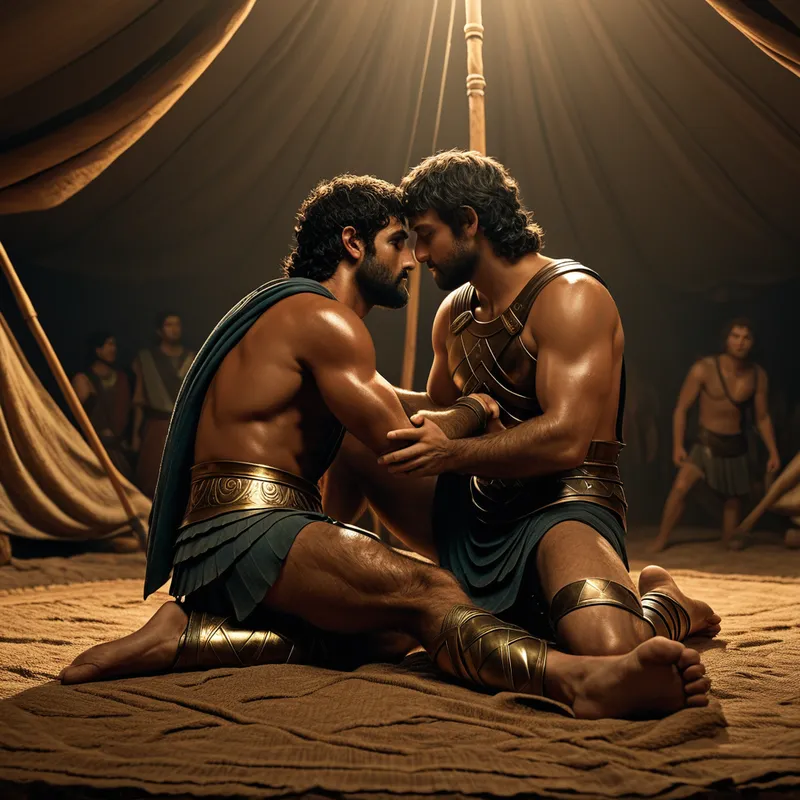
Cultural Origins & Context
This story is the throbbing heart of Homer’s Iliad, an epic poem crystallized from a long oral tradition around the 8th century BCE. It was not mere entertainment; it was the cultural software of the Hellenic world. Bards recited these verses at feasts, weaving a shared identity of values: arete (excellence), timē (honor), and the inescapable weight of moira (fate). The bond of Achilles and Patroclus sits at the epic’s core, a human counterpoint to the divine squabbles and heroic boasts.
Their relationship was debated even in antiquity. The Classical Athenians of the 5th century BCE, like the playwright Aeschylus, often interpreted it through the lens of pederasty, an institutionalized mentorship and erotic relationship between an older and younger male. Yet Homer’s text itself is more profound and subtle. It speaks of philotēs—a deep, loving friendship that is the highest form of social bond, stronger than kinship. Achilles calls Patroclus “the man I loved beyond all other comrades, loved as my own life.” Their bond functioned in the narrative as the ultimate catalyst. Achilles’ withdrawal over a point of honor is a personal crisis; Patroclus’ death transforms it into a cosmic one, demonstrating that the deepest wounds are not to pride, but to love.
Symbolic Architecture
At its symbolic core, this myth is about the fatal entanglement of the personal and the archetypal, the human heart and the heroic role. Achilles is the Kleos-bound Self, the individual destined for legendary, impersonal fame. Patroclus represents the psyche, the soul-companion, the connective tissue to ordinary humanity, empathy, and care.
The hero’s armor is his destined role, but it is hollow without the soul that animates it from within.
Patroclus donning Achilles’ armor is a profound symbolic act: the soul temporarily assuming the mask of the godlike Self. It is a necessary but doomed inflation. The psyche cannot sustain the full, ruthless weight of the archetypal destiny. Its foray into that realm ends in its annihilation. Patroclus’ death is the shattering of the personal connection that kept the heroic ego grounded. What follows is not true heroism, but a berserker rage—a pure, unchecked, destructive force of the Self, now utterly disconnected from human feeling. Achilles’ subsequent actions are not noble; they are a desecration, revealing the monster that the uninhibited, grief-maddened archetype can become.
The Dreamer’s Resonance
When this myth stirs in the modern unconscious, it often manifests in dreams of profound partnership and catastrophic loss. You may dream of a twin, a beloved companion, or a part of yourself that is suddenly, violently taken. The setting is often a battlefield—a workplace, a family conflict, an internal struggle—where you have withdrawn your energy (Achilles in his tent).
The somatic feeling is one of a vital, sustaining connection being severed, followed by a surge of cold, focused, and terrifying power. This is the psyche signaling a critical juncture: a part of you that provided balance, compassion, or grounding (your inner Patroclus) has been sacrificed to the demands of a driven, ambitious, or inflated identity (your inner Achilles). The dream asks: What have you sacrificed at the altar of your role? What beloved aspect of your own soul lies dead on the plains of your ambition? The grief that follows in the dream is not just sadness; it is the raw material for a terrifying, and potentially destructive, transformation.

Alchemical Translation
The alchemical journey modeled here is the Nigredo—the blackening, the descent into utter despair and putrefaction that is the necessary first stage of transmutation. The conscious ego (Achilles) forges a pact with its destiny, but it is a brittle, prideful construct. Its necessary counterpart, the soulful animating principle (Patroclus), is sent to do its work and is destroyed in the process.
The death of the companion is the death of the old mode of being. The rage that follows is the fire that reduces the ego to its essential, primal matter.
For modern individuation, this myth warns that we cannot don the armor of our potential—become the leader, the artist, the healed person—using only the force of will and destiny. We must integrate the soul-work. Patroclus’ error was pursuing Hector, the externalized enemy. The true alchemical work is not in pursuing and slaying the outer “Hector,” but in turning the rage inward, to burn away the attachments that caused the withdrawal in the first place: the brittle pride, the narcissistic wound (Agamemnon’s insult).
The ultimate transmutation, hinted at after the Iliad’s end, is in the famous scene where the broken Achilles finally returns Hector’s body to his father, King Priam. In that moment of shared grief with his enemy, the inhuman rage finally breaks, and the human being re-emerges, tempered by unspeakable loss. The bond with Patroclus is not undone; it becomes the eternal wound through which compassion can finally flow. The gold produced is not glory, but a heartbreaking, hard-won wisdom: that our deepest connections are the anchors of our humanity, and their loss, while destroying one world, forces the birth of a more conscious, albeit sorrowful, self.
Associated Symbols
Explore related symbols from the CaleaDream lexicon: