The Bog Bodies Myth Meaning & Symbolism
A myth of ritual sacrifice to the bog, where chosen ones are offered to the earth to ensure the land's fertility and the tribe's survival.
The Tale of The Bog Bodies
Listen. [The wind](/myths/the-wind “Myth from Various culture.”/) does not blow here; it waits. This is the place of the bog, where [the sky](/myths/the-sky “Myth from Persian culture.”/) drinks [the earth](/myths/the-earth “Myth from Hindu culture.”/) and the earth drinks [the sky](/myths/the-sky “Myth from Persian culture.”/). The [water](/myths/water “Myth from Chinese culture.”/) is the colour of strong tea and old blood, and it holds secrets tighter than a fist.
In the days when the tribe’s bellies were hollow with hunger, when the rains refused to fall and the cattle grew thin, the elders would turn their faces not to the sun, but to the cold, flat eye of the marsh. A choosing would be made. Not of the weakest, but of the finest. The one with hair like summer barley, or eyes like the forest pool, or hands that could soothe a fevered brow. They would be called the Gevolgad, the pledged one.
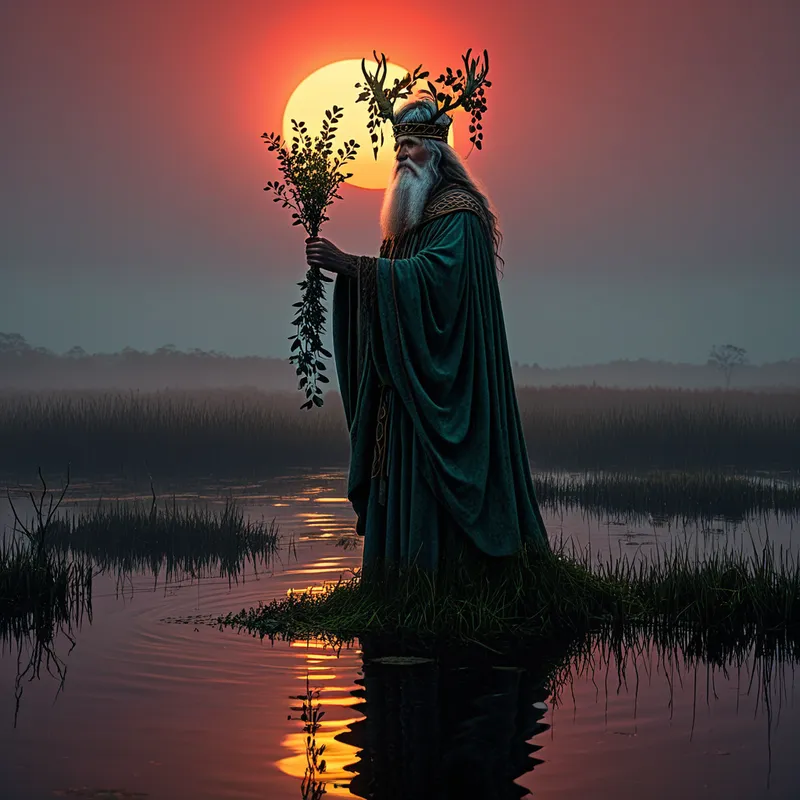
They were not dragged. They were led, with solemnity, to the water’s edge. Their last meal was one of richness—barley cakes, a haunch of pork—food of the living, consumed for the journey. Their skin was anointed with oil that smelled of bog myrtle and decay, the perfume of [the threshold](/myths/the-threshold “Myth from Folklore culture.”/). Sometimes, their hair was braided with care; a final, tender act. A crown of mistletoe, cut with a golden sickle, might be placed upon their brow. This was not a king of men, but a king for the Tellus Mater, the waiting mother beneath the peat.
Then, the moment of crossing. The druid’s chant, a low drone that vibrated in the chest more than the ear. The Gevolgad would step into the cold embrace. The water, thick and hungry, would take them slowly. It did not splash; it swallowed. A weight, a stone or a hurdle of woven willow, would ensure the gift was received. The dark water would close over [the crown](/myths/the-crown “Myth from Various culture.”/) of mistletoe, over the wide, unblinking eyes fixed on the grey sky. Bubbles would rise, a last breath given to the mud. And then, stillness. A perfect, awful stillness.
The tribe would watch, their own breath held. And in the days that followed, if the gods were pleased, the rains would come. The grass would green. The sacrifice was accepted. The body was gone to the other world, to parley with the spirits of the land. It did not rot in the earth. It was changed by it, preserved in the tannic heart of the bog, becoming a part of the land’s own body, a treaty written in flesh and leather and hair.
Cultural Origins & Context
The so-called “Bog Bodies”—the astonishingly preserved remains of hundreds of individuals found in peat bogs across Northern Europe, many from Celtic Iron Age societies—are not characters from a single, codified myth. They are the archaeological reality from which myth must be inferred. The Celts left no written records of their rituals; their stories were oral, performed by bards and druids. What we have are the physical testimonies: the bodies themselves, with their signs of ritualized violence, careful binding, and occasional symbols of high status.
This was a culture intimately woven with the natural world, seeing divinity in groves, springs, and, crucially, liminal spaces. Bogs were neither land nor water, but a terrifying and sacred in-between—a perfect gateway to the [Sídhe](/myths/sdhe “Myth from Celtic / Irish culture.”/) or [the underworld](/myths/the-underworld “Myth from Greek culture.”/). The act was likely a desperate contract with the chaotic, often cruel forces of nature. The myth we can reconstruct is one of do ut des: “I give so that you may give.” The sacrifice of a human life, the ultimate currency, was offered to restore balance, ensure a chieftain’s sovereignty, or appease deities like the [Matronae](/myths/matronae “Myth from Roman culture.”/) or the capricious gods of fertility.
Symbolic Architecture
At its core, this is not a myth of [punishment](/symbols/punishment “Symbol: A dream symbol representing consequences for actions, often tied to guilt, societal rules, or internal moral conflicts.”/), but of exchange and [transmutation](/symbols/transmutation “Symbol: A profound, alchemical process of fundamental change where one substance or state transforms into another, often representing spiritual evolution or personal metamorphosis.”/). The bog is the alchemical [crucible](/symbols/crucible “Symbol: A vessel for intense transformation through heat and pressure, symbolizing spiritual purification, testing, and alchemical change.”/).
The ultimate offering is not destruction, but a sacred transaction where the individual becomes the bridge between worlds.
The [Victim](/symbols/victim “Symbol: A person harmed by external forces, representing vulnerability, injustice, or sacrifice in dreams. Often symbolizes powerlessness or moral conflict.”/) is also the Volunteer (willing or not, their [role](/symbols/role “Symbol: The concept of ‘role’ in dreams often reflects one’s identity or how individuals perceive their place within various social structures.”/) is sacralized). They represent the part of the [community](/symbols/community “Symbol: Community in dreams symbolizes connection, support, and the need for belonging.”/)—its vitality, its [innocence](/symbols/innocence “Symbol: A state of purity, naivety, and freedom from guilt or corruption, often associated with childhood and moral simplicity.”/), its future—that must be surrendered to secure the whole. Psychologically, they symbolize a precious psychic content—a talent, a hope, a cherished [identity](/symbols/identity “Symbol: Identity represents the sense of self, encompassing personal beliefs, cultural background, and social roles.”/)—that must be consciously “killed” or surrendered for a greater [integration](/symbols/integration “Symbol: The process of unifying disparate parts of the self or experience into a cohesive whole, often representing psychological wholeness or resolution of internal conflict.”/) to occur.
The Bog is the [womb](/symbols/womb “Symbol: A symbol of origin, potential, and profound transformation, representing the beginning of life’s journey and the unconscious source of creation.”/)-tomb of the Magna Mater. It is the unconscious itself: preservative and corrosive, a keeper of memories and a dissolver of ego. The act of [deposition](/symbols/deposition “Symbol: A formal act of removing or setting down something or someone, often from a position of authority or height, representing transition, testimony, or release.”/) is a literal immersion into the unconscious, a willing descent into the murky, transformative waters of the [psyche](/myths/psyche “Myth from Greek culture.”/) where clear distinctions dissolve.
The Binding (so common in the remains) is profoundly symbolic. It restricts the physical form, but in mythic terms, it may bind the sacrifice’s [spirit](/symbols/spirit “Symbol: Spirit symbolizes the essence of life, vitality, and the spiritual journey of the individual.”/) to its [task](/symbols/task “Symbol: A task represents responsibilities, duties, or challenges one faces.”/), or signify their role as a captive of the divine, a guaranteed offering.
The Dreamer’s Resonance
When this mythic pattern stirs in the modern dreamer, it often manifests as dreams of being trapped in mud, quicksand, or thick, dark water. There is a somatic weight, a feeling of being pulled down and held. One might dream of being chosen for a terrible but necessary task, or of willingly walking into a dark lake.
This is the psyche signaling a profound process of psychic sacrifice. The dreamer is at a point where an old way of being, a long-held attitude or a foundational self-concept, must die so that new life can emerge. The feeling of dread is [the ego](/myths/the-ego “Myth from Jungian culture.”/)’s resistance to this necessary dissolution. The bog in the dream is the holding environment of the unconscious, where this death-and-rebirth process is incubated. The dream is an invitation to stop struggling against the “sinking” feeling—the depression, the stuckness—and to understand it as a sacred, if terrifying, descent. The body preserved in the dream-bog is the nascent self, the potential identity being pickled in the soul’s own acids until it is ready to be unearthed, transformed.
Alchemical Translation
The alchemical journey mirrored in this myth is the [nigredo](/myths/nigredo “Myth from Alchemical culture.”/). It is the essential first step of putrefaction, without which no transmutation is possible.
For the individual, the “Bog Body” process is the conscious enactment of a necessary ending. It is the decision to offer up a part of oneself—the overachiever, the eternal caretaker, the victimized identity—on the altar of growth. This is not passive suffering; it is a ritualized surrender. You anoint the part to be sacrificed with understanding (the oil), you honor it (the last meal, the braided hair), and then you consciously let it sink into the depths of your being.
Individuation demands a king’s ransom: you must pay with the self you know to gain the Self you are.
The period in the “bog”—the depression, the liminal confusion, the feeling of being in-between identities—is where the magic happens. The tannins of introspection and the anaerobic environment of withdrawal preserve the core essence while dissolving the superficial. What emerges, potentially years later, is not a corpse, but a testament. Like the Lindow Man or Tollund Man, the unearthed self is startlingly preserved, bearing the marks of its ordeal but possessing a serene, otherworldly authority. It has become an artifact of its own transformation, a bridge between your old world and the new. You have made a treaty with your own depths, and the fertility that returns is an authentic life, rooted in the rich, dark soil of the soul.
Associated Symbols
Explore related symbols from the CaleaDream lexicon: