The boat of Charon ferrying so Myth Meaning & Symbolism
A spectral ferryman demands a coin to carry the dead across a dark river, a threshold between worlds that no soul can cross alone.
The Tale of The boat of Charon ferrying so
Listen. There is a shore where all footsteps finally end. It is not sand, nor stone, but a substance of silence, a beach of compressed memory. Here, the air does not move, yet it carries a chill that has never known the sun. This is the bank of the Acheron, or sometimes the Styx—a [water](/myths/water “Myth from Chinese culture.”/) so deep and dark it drinks the light, a current of pure forgetting.
And on this shore, they gather. The recently unbound. They shimmer with the last echoes of warmth, of laughter, of pain. They are form and formless, still wearing the ghostly impression of their faces. They look across the black expanse. There is no bridge. There is only the water, and the waiting.
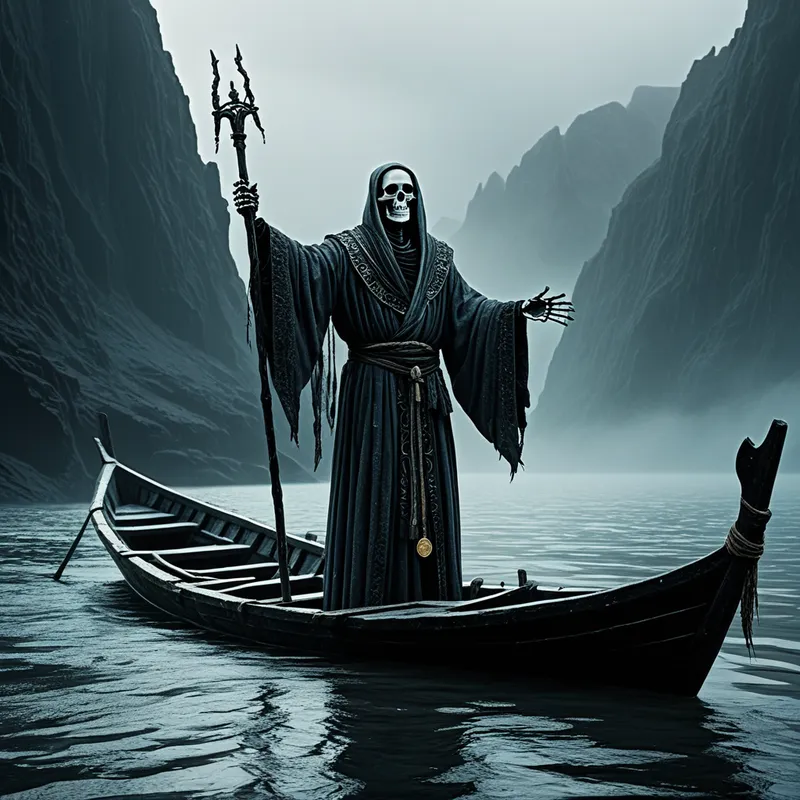
From [the mist](/myths/the-mist “Myth from Celtic culture.”/), a sound: the slow, wet drag of a pole in deep mud. A shape resolves—a long, low boat, black as a hole in [the world](/myths/the-world “Myth from Tarot culture.”/). And in it, a figure. He is old, older than the mountains that cradle the rivers of the living. His cloak is the grey of forgotten tombs, his flesh not bone, but the idea of bone, hardened by eternity. He is Charon. His eyes are not eyes, but pools reflecting nothing.
The boat grinds against the silent shore. He does not speak. He only extends a hand—a skeletal [thing](/myths/thing “Myth from Norse culture.”/) that seems to pull the very darkness around it. His meaning is clear, older than language.
This is the first and final law of this crossing: Passage requires payment.
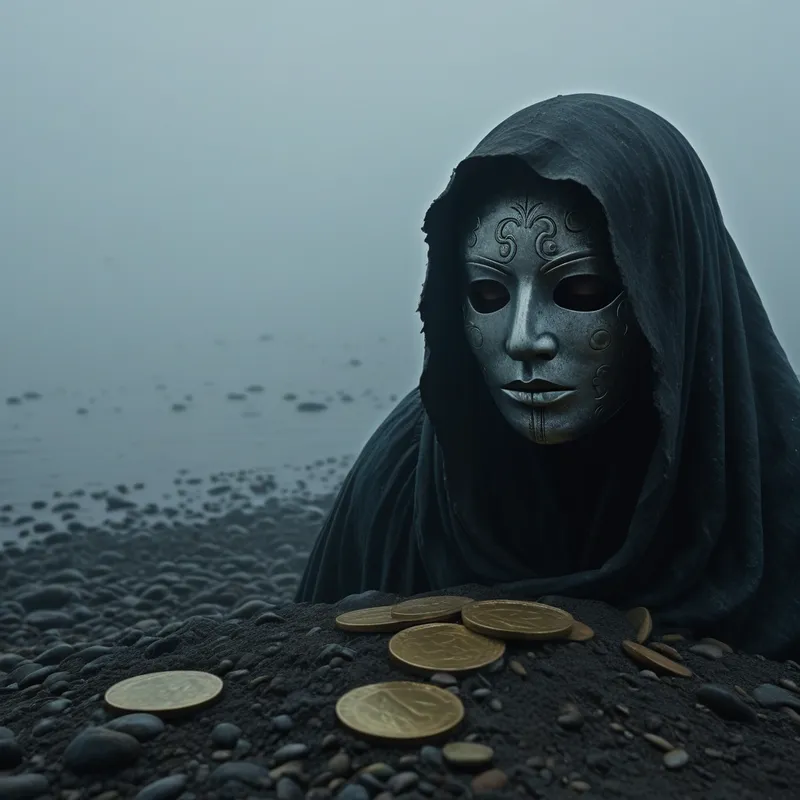
A tremor goes through the gathered shades. Some, whose bodies were laid to rest with love and ritual, reach into the folds of their memory. From lips sealed by death, or from hands placed in ceremony, they produce it: the obol. A simple coin, placed under the tongue or on the eyes. It glints with a dull, cold light, the last echo of the world of metals and markets. They place it in that waiting hand. The hand closes. A barely perceptible nod.
One by one, the paid souls are permitted to step into [the vessel](/myths/the-vessel “Myth from Alchemical culture.”/). It sits low in the water, a cup of shadows. They huddle, silent, as Charon turns his back, plants his pole, and pushes off. The journey is soundless but for the lap of black water and the groan of ancient wood. The far shore approaches—a land of deeper mist, where shapes of judges and fields await. They cross the uncrossable.
But look—back on the near shore. A figure remains. It clutches at its chest, its mouth, finding nothing. It was buried without the coin. No rite, no love, no coin. It stretches its arms towards the receding boat, a silent scream in its hollow face. Charon does not turn. The boat grows distant. The shade is left on the bank of silence, not for a year, or a century, but for a hundred years of wandering that barren shore, listening to the whispers of the forgotten, until its time may come again. The price must be paid. [The ferryman](/myths/the-ferryman “Myth from Various culture.”/) waits, but he does not bargain.
Cultural Origins & Context
The figure of Charon finds his most detailed literary berth in the Greek epic tradition, most notably in Book VI of Virgil’s Aeneid and as a fixture in the art and funerary practices of the ancient Greco-Roman world. However, the archetype of the [psychopomp](/myths/psychopomp “Myth from Greek culture.”/) who demands a toll at a watery threshold is a truly global motif. From the [Osiris](/myths/osiris “Myth from Global/Universal culture.”/) ferrying the justified dead in his [solar barque](/myths/solar-barque “Myth from Egyptian culture.”/) across the night sky, to the [rainbow bridge](/myths/rainbow-bridge “Myth from Universal culture.”/) of Asgard which may be seen as a luminous, guarded crossing, the pattern is universal.
The societal function was profoundly practical and psychological. The ritual of placing the coin in the mouth of the deceased was a concrete act of love and duty, ensuring the loved one’s safe passage. It transformed abstract grief into a sacred transaction, providing solace to the living and a defined destiny for the dead. The myth enforced social and religious order: proper burial rites were not mere tradition; they were the essential fuel for the soul’s journey. It was told not just by bards, but enacted at every graveside, a story made flesh by a piece of silver.
Symbolic Architecture
The myth is a masterful map of a fundamental psychic process: the crossing from one state of being to another. Every element is a profound [symbol](/symbols/symbol “Symbol: A symbol can represent an idea, concept, or belief, serving as a powerful tool for communication and understanding.”/).
The [River](/symbols/river “Symbol: A river often symbolizes the flow of emotions, the passage of time, and life’s journey, reflecting transitions and movement in one’s life.”/) is not merely a [boundary](/symbols/boundary “Symbol: A conceptual or physical limit defining separation, protection, or identity between entities, spaces, or states of being.”/) but the [prima materia](/myths/prima-materia “Myth from Alchemical culture.”/) of transition itself. It is the emotional and psychic [chaos](/symbols/chaos “Symbol: In Arts & Music, chaos represents raw creative potential, uncontrolled expression, and the breakdown of order to forge new artistic forms.”/) that must be navigated to move from conscious [identity](/symbols/identity “Symbol: Identity represents the sense of self, encompassing personal beliefs, cultural background, and social roles.”/) ([life](/symbols/life “Symbol: The symbol of ‘Life’ represents a journey of growth, interconnectedness, and existential meaning, encompassing both the joys and challenges that define human experience.”/)) to integrated unconsciousness ([death](/symbols/death “Symbol: Symbolizes transformation, endings, and new beginnings; often associated with fear of the unknown.”/)/[rebirth](/symbols/rebirth “Symbol: A profound transformation where old aspects of self or life die, making way for new beginnings, growth, and renewal.”/)).
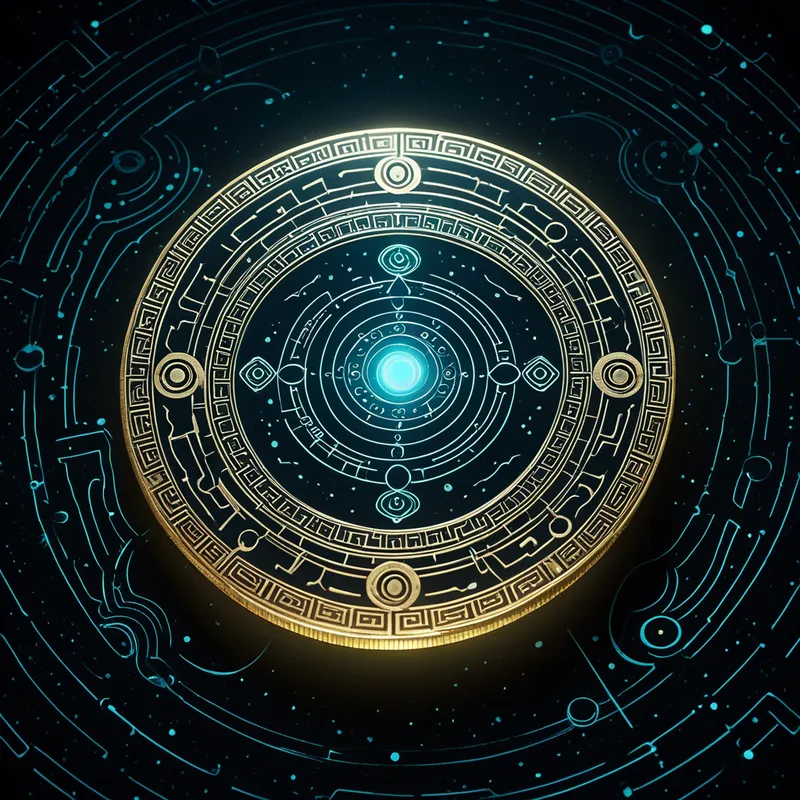
The coin is not currency, but consciousness. It is the fully realized weight of a life examined, the earned value that grants passage to meaning.
Charon is the uncompromising gatekeeper of the deep Self. He is not evil, but impersonal, a function of the [psyche](/myths/psyche “Myth from Greek culture.”/) itself. He represents [the law](/symbols/the-law “Symbol: Represents external rules, societal order, moral boundaries, and the tension between personal freedom and collective structure.”/) that profound change has a cost. You cannot enter the [realm](/symbols/realm “Symbol: The symbol of ‘Realm’ often signifies the boundaries of one’s consciousness, experiences, or emotional states, suggesting aspects of reality that are either explored or ignored.”/) of the unknown—whether the [afterlife](/symbols/afterlife “Symbol: A symbolic journey beyond death, representing transition, the unknown, and ultimate questions about existence, purpose, and what follows life.”/) or a new stage of psychological [integration](/symbols/integration “Symbol: The process of unifying disparate parts of the self or experience into a cohesive whole, often representing psychological wholeness or resolution of internal conflict.”/)—carrying all your old baggage. Something must be surrendered.
The Coin (Obol) is the crux. It symbolizes the quid pro quo of transformation. In psychological terms, it is the hard-won [insight](/symbols/insight “Symbol: A sudden, deep understanding of a complex situation or truth, often arriving unexpectedly and illuminating hidden connections.”/), the acknowledged [shadow](/symbols/shadow “Symbol: The ‘shadow’ embodies the unconscious, repressed aspects of the self and often represents fears or hidden emotions.”/), the conscious sacrifice, or the fully felt [grief](/symbols/grief “Symbol: A profound emotional response to loss, often manifesting as deep sorrow, yearning, and a sense of emptiness.”/) that one must “pay” to move forward. To arrive at the shore without it is to be stuck in a psychic [limbo](/symbols/limbo “Symbol: A state of transition, uncertainty, or suspension between decisions, outcomes, or phases of life.”/)—the hundred years of wandering—repeating old patterns, unable to progress.
The Dreamer’s Resonance
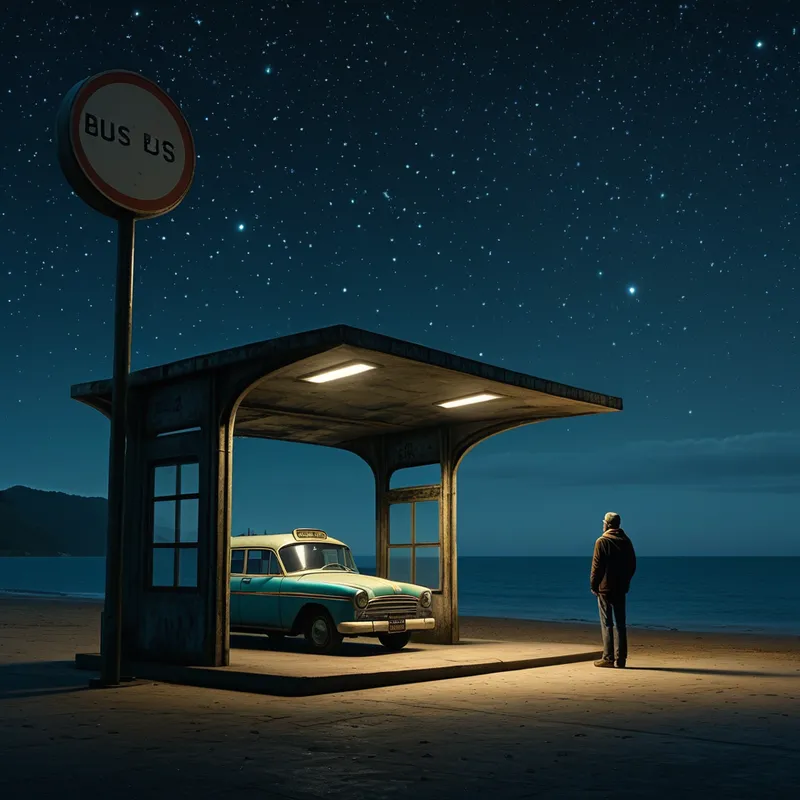
When this myth surfaces in modern dreams, the dreamer is at a profound threshold. The somatic feeling is often one of cold dread, of being unprepared for an impending exam or journey. You may dream of fumbling for bus fare as the driver glares, of missing a crucial ferry, or of standing before a toll booth with empty pockets.
This is the psyche signaling a necessary transition—the end of a relationship, a career, an identity, a phase of life—that the conscious mind is resisting. The “coin” you lack is the piece of self-knowledge or emotional acceptance you have not yet minted. Perhaps it is the admission of fault, the acceptance of loss, or the courage to leave behind what is familiar. Charon in the dream is the inner imperative, the non-negotiable demand of the soul for payment in the currency of truth before it will allow you to cross into the new, unknown country of your becoming.
Alchemical Translation
The alchemical process mirrored here is the [nigredo](/myths/nigredo “Myth from Alchemical culture.”/), the descent into darkness and dissolution, which is a prerequisite for purification and rebirth. The journey across the black river is [the ego](/myths/the-ego “Myth from Jungian culture.”/)’s dissolution in the waters of the unconscious.
Individuation is not a free ride. It is a transaction with the ferryman of your own depths. The obol is the part of your conscious persona you must willingly place on his tongue to gain passage to your wider Self.
The modern individual undertaking this “crossing” must ask: What is my obol? What is the specific, non-negotiable price for my next stage of growth? It may be the comfort of victimhood, the armor of cynicism, or the shiny coin of others’ approval. To place it in Charon’s hand is an act of supreme courage—to pay with a piece of your current identity for the promise of a more complete one. The myth assures us that the ferryman will come, [the threshold](/myths/the-threshold “Myth from Folklore culture.”/) will appear. Our task is not to avoid the shore, but to ensure we have done the inner work to have the fare ready. For to be left wandering the bank is to remain in a living death, while those who pay cross into the mystery, where the next phase of the soul’s great work awaits.
Associated Symbols
Explore related symbols from the CaleaDream lexicon: