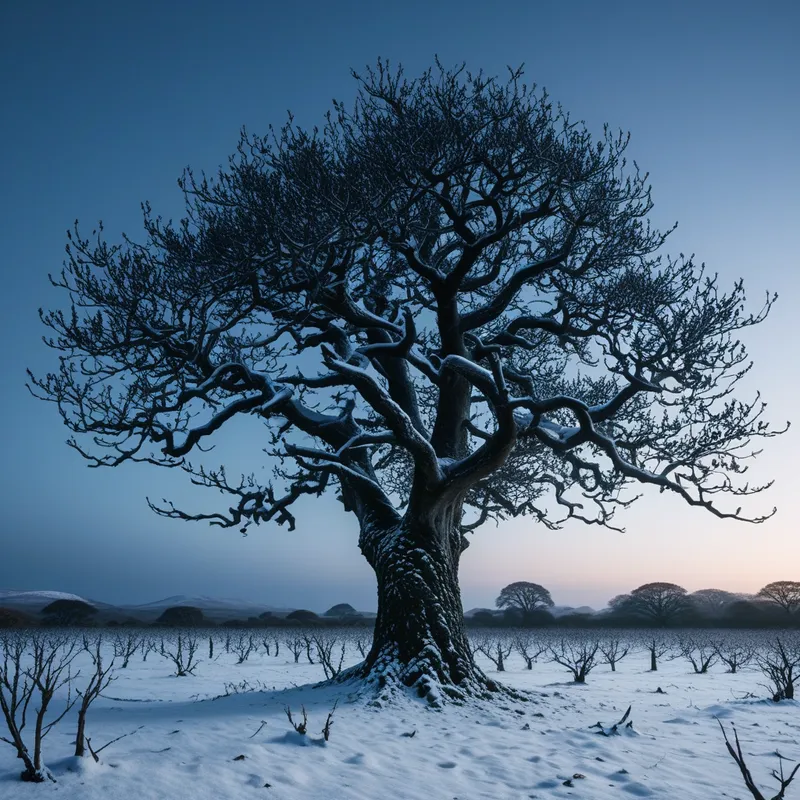
The Blackthorn Myth Meaning & Symbolism
A myth of a fierce guardian spirit, the Blackthorn embodies the paradox of harsh protection and hidden sweetness, guiding through winter's trial to spring's renewal.
The Tale of The Blackthorn
Listen, and I will tell you of the time when [the world](/myths/the-world “Myth from Tarot culture.”/) was raw and the borders were thin. It was the season of [Samhain](/myths/samhain “Myth from Celtic culture.”/), when [the veil](/myths/the-veil “Myth from Various culture.”/) between the worlds is but a sigh. The land was turning inward, the green fire of summer banked to embers. In this hushed, expectant time, the people prepared for the long dark.
But the dark that year held more than cold. A creeping malaise, a spirit of lethargy and despair, began to seep from the forgotten places. It was the púca of forgetfulness, and it whispered that the sun would not return, that the stores would fail, that hope itself was a foolish dream. [The hearth](/myths/the-hearth “Myth from Norse culture.”/)-fires guttered low, and in the hearts of the people, a chill took root that no physical flame could touch.
The chieftain, a man named Donnán, saw his people fading. He sought counsel from the fili, an old woman whose eyes held the depth of the forest pools. “The cure for this sickness lies beyond the comfort of the hearth,” she said, her voice like dry leaves. “You must seek the Guardian of [the Threshold](/myths/the-threshold “Myth from Folklore culture.”/), the one who holds the gate between death and life. Find the Draighean in its full, unforgiving power. It bars [the way](/myths/the-way “Myth from Taoist culture.”/). You must ask passage, and pay its price.”
Donnán wrapped himself in a wolf-skin and set out alone, leaving the fading circle of firelight. He walked into the naked woods, where [the wind](/myths/the-wind “Myth from Various culture.”/) had teeth and [the moon](/myths/the-moon “Myth from Tarot culture.”/) was a sliver of ice. For three days and three nights he journeyed, guided only by the increasing sense of a watchful, prickling presence. Finally, in a frost-rimed clearing at the edge of a sheer drop, he found it.
The Blackthorn was not a single tree, but a living wall of antiquity. Its branches were blacker than the winter night, twisted and interlocked like ancient bones. Every inch was armored with thorns longer than a man’s finger, sharp and cruel. No leaf, no berry, no sign of life adorned it. It was pure, stark boundary, the embodiment of “No.” The air around it hummed with a silent, defensive fury. This was the Guardian. To pass meant to be shredded.
Despair threatened to swallow Donnán. But then he remembered his people’s hollow eyes. He did not draw his bronze knife to hack a path. Instead, he knelt in the frozen earth before the thorny wall. He offered no grand speech, only his silent, steadfast presence, his need, and his respect for the Guardian’s harsh duty.
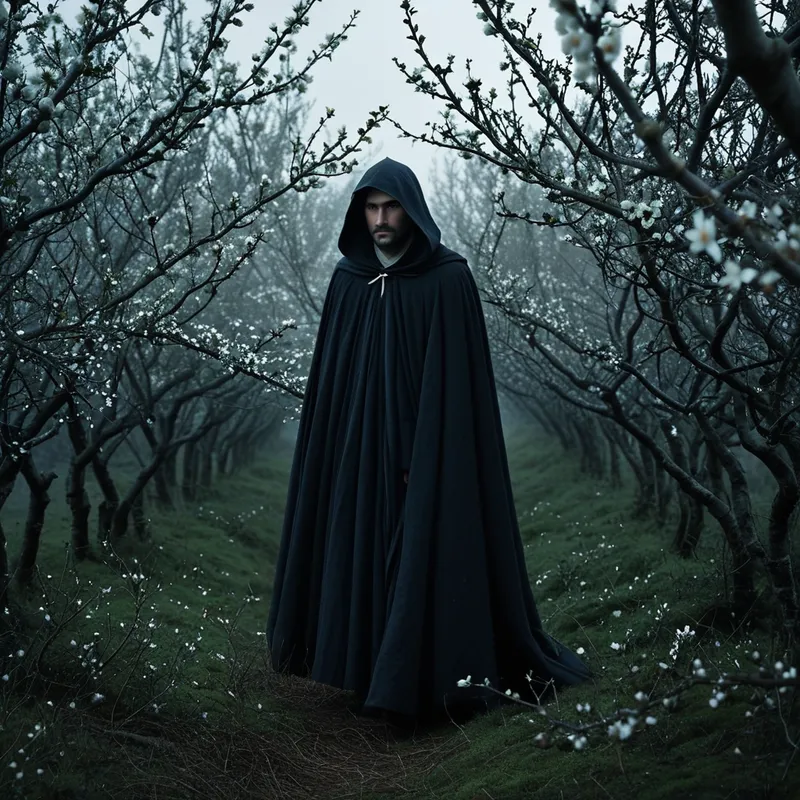
He waited. The cold bit to his marrow. The thorns seemed to lean closer. Just as he felt his life ebbing, a change stirred. Not a softening, but a focusing. The moon broke from the clouds, casting a silver light. And there, upon the branch directly before his face, a miracle occurred. From the heart of the blackest, most vicious knot of wood, a single, perfect blossom pushed forth. It was a burst of purest white, five-petaled and fragile, glowing with its own gentle light against the darkness. It held the promise of spring in a scent so faint and sweet it was almost a memory.
A deep, resonant understanding, not in words but in the substance of his spirit, flowed into Donnán. The Guardian was not just a barrier; it was the protector of the latent life within the death of winter. Its harshness shielded the tender potential. The price was not blood, but the willingness to endure the harsh season, to stand before the thorns without violence, and to witness the hidden sweetness that only exists because of the protection.
The blossom fell, a speck of white on the dark ground. And where it fell, the interlocked branches of the Blackthorn silently, slowly, unraveled just enough—a narrow, arched passageway, lined with thorns. Donnán passed through, feeling their points scratch but not pierce his skin. On the other side, he found not a magical land, but a sheltered grove where the first, hardy green shoots of the coming year were already pushing through the frost. He gathered them, a [talisman](/myths/talisman “Myth from Global culture.”/) of life returning.
When he returned to his people, the mere sight of the green in his hand, and the light of hard-won knowing in his eyes, broke [the púca](/myths/the-pca “Myth from European Folklore culture.”/)‘s spell. The hearth-fires burned bright again. They had remembered: life is defended by necessary harshness, and sweetness is born from surviving the thorn.
Cultural Origins & Context
The Blackthorn, or Draighean, holds a potent and ambivalent place in the Celtic world-view, particularly in Irish and Brythonic traditions. Unlike the noble oak or the mystical hazel, the Blackthorn’s lore was not the sole province of the Aos Dána. Its myth was woven into the fabric of everyday folk belief and practical wisdom. It was a tree of the commons, of the hedgerow and the boundary ditch, and its stories were told by farmers, warriors, and wise women as much as by bards.
Its primary societal function was as a symbol of protection through adversity. Blackthorn sticks, known as shillelaghs, were not merely weapons but badges of authority and self-reliance. Planting Blackthorn marked property boundaries more effectively than any stone, creating a living, impenetrable fence. This physical role translated into a spiritual one: it was considered a guardian against malevolent spirits, especially during Samhain, when its berries were ripe. To cut or disrespect a Blackthorn without cause was to invite misfortune, a belief underscoring its sacred, if fearsome, nature.
The myth of the Blackthorn as a spiritual guardian, as told here, synthesizes these folk beliefs. It personifies the tree’s observed natural cycle—its fierce, barren aspect in deep winter, followed by its startlingly early blossoming before leafing—and elevates it to a cosmological principle. It served as a narrative anchor for a culture deeply attuned to seasonal cycles, teaching that the most forbidding barriers often protect the most vital truths, and that the approach to the sacred requires respect for its defensive power.
Symbolic Architecture
Psychologically, the Blackthorn myth maps the territory of the [Shadow](/symbols/shadow “Symbol: The ‘shadow’ embodies the unconscious, repressed aspects of the self and often represents fears or hidden emotions.”/) and [the principle](/symbols/the-principle “Symbol: A fundamental truth, law, or doctrine that serves as a foundation for a system of belief, behavior, or reasoning, often representing moral or ethical standards.”/) of enantiodromia—the [emergence](/symbols/emergence “Symbol: A process of coming into being, rising from obscurity, or breaking through a barrier, often representing birth, transformation, or revelation.”/) of an unconscious opposite. The Blackthorn itself is the ultimate [symbol](/symbols/symbol “Symbol: A symbol can represent an idea, concept, or belief, serving as a powerful tool for communication and understanding.”/) of necessary [defense](/symbols/defense “Symbol: A protective mechanism or barrier against perceived threats, representing boundaries, security, and resistance to external or internal challenges.”/).
The thorns are not evil; they are the integrity of a boundary. They say, “This self, this potential, is not yet for the taking.”
The [Guardian](/symbols/guardian “Symbol: A protector figure representing safety, authority, and guidance, often embodying parental, societal, or spiritual oversight.”/) is the psychic [structure](/symbols/structure “Symbol: Structure in dreams often symbolizes stability, organization, and the framework of one’s life, reflecting how one perceives their environment and personal life.”/) that forms around [trauma](/symbols/trauma “Symbol: A deeply distressing or disturbing experience that overwhelms the psyche, often manifesting in dreams as unresolved emotional wounds or psychological injury.”/), [vulnerability](/symbols/vulnerability “Symbol: A state of emotional or physical exposure, often involving risk of harm, that reveals authentic self beneath protective layers.”/), or latent potential. It is prickly, isolating, and often perceived as purely negative—a [wall](/symbols/wall “Symbol: Walls in dreams often symbolize boundaries, protection, or obstacles in one’s life, reflecting the dreamer’s feelings of confinement or security.”/) of “no” in the [psyche](/myths/psyche “Myth from Greek culture.”/). The [hero](/symbols/hero “Symbol: A hero embodies strength, courage, and the ability to overcome significant challenges.”/), Donnán, represents the conscious ego undertaking a [katabasis](/myths/katabasis “Myth from Greek culture.”/), a descent into this hardened, wintry state of the [soul](/symbols/soul “Symbol: The soul represents the essence of a person, encompassing their spirit, identity, and connection to the universe.”/). His [journey](/symbols/journey “Symbol: A journey in dreams typically signifies adventure, growth, or a significant life transition.”/) is one of submission, not conquest. He does not fight [the Shadow](/myths/the-shadow “Myth from Jungian culture.”/) but endures its [presence](/symbols/presence “Symbol: Presence in dreams often signifies awareness or acknowledgment of something significant in one’s life.”/), offering his [vulnerability](/symbols/vulnerability “Symbol: A state of emotional or physical exposure, often involving risk of harm, that reveals authentic self beneath protective layers.”/).
The white [blossom](/symbols/blossom “Symbol: A symbol of new beginnings, growth, and the unfolding of potential, often marking a transition or the start of a journey.”/) is the core symbol of paradoxical transformation. It represents the latent value hidden within the defensive structure. It is the [insight](/symbols/insight “Symbol: A sudden, deep understanding of a complex situation or truth, often arriving unexpectedly and illuminating hidden connections.”/), the creative spark, the recovered feeling, or the new [attitude](/symbols/attitude “Symbol: Attitude symbolizes one’s mental state, perception, and posture towards life, influencing emotions and actions significantly.”/) that can only emerge because it was so fiercely protected during a [period](/symbols/period “Symbol: Periods in dreams can symbolize cyclical patterns, renewal, and the associated emotions of loss or change throughout life.”/) of psychic [winter](/symbols/winter “Symbol: Winter symbolizes a time of reflection, introspection, and dormancy, often representing challenges or a period of transformation.”/). The myth teaches that [integration](/symbols/integration “Symbol: The process of unifying disparate parts of the self or experience into a cohesive whole, often representing psychological wholeness or resolution of internal conflict.”/) does not mean dismantling our thorns, but understanding their [purpose](/symbols/purpose “Symbol: Purpose signifies direction, meaning, and intention in life, often reflecting personal ambitions and core values.”/) and receiving the gift they have guarded.
The Dreamer’s Resonance
When this myth pattern activates in the modern dreamer, it often manifests as dreams of impenetrable barriers, tangled thickets, or being scratched by unseen brambles. The somatic experience is one of constriction, frustration, and a literal feeling of being “prickly” or on edge. Psychologically, this indicates a confrontation with a well-defended aspect of [the Self](/myths/the-self “Myth from Jungian culture.”/).
The dreamer may be at a life threshold—a career change, the end of a relationship, a creative block—where the old identity is dying (the psychic winter) but the new one is not yet born. The unconscious throws up the “Blackthorn” as a protective mechanism, often experienced as depression, cynicism, or rigid self-criticism. The dream is not merely showing the obstacle; it is presenting the guardian of the next stage of development.
To dream of finding a flower or a sweet fruit on such a thorny plant is a profound signal. It means the psyche is ready to offer a glimpse of the value hidden within the struggle. It is an invitation to stop trying to force or cut through the difficulty, and instead to sit with it respectfully, to inquire into its purpose. The process is one of moving from resistance to curiosity about one’s own defenses.
Alchemical Translation
The alchemical process mirrored in the Blackthorn myth is the [nigredo](/myths/nigredo “Myth from Alchemical culture.”/), the blackening, followed by the albedo, the whitening. This is the core of psychic transmutation or individuation.
The journey into the winter landscape is the nigredo. It is the descent into the leaden, “black” state of confusion, despair, or stagnation—the conscious acknowledgment of one’s shadow and limitations. Donnán’s patient vigil before the thorns is the crucial, often skipped, stage of mortificatio—a symbolic death of [the ego](/myths/the-ego “Myth from Jungian culture.”/)‘s pretensions. The ego must cease its attempts to will its way through and instead endure the tension of opposites (the harsh thorn vs. the desired path).
The blossom is the albedo: the silver, lunar light of consciousness that emerges from the blackness. It is not the full sun of enlightenment, but the reflective, insightful understanding of the pattern.
The gift of the green shoots—the new life—is only obtained after this process. For the modern individual, this translates to a transformative model: when faced with an intractable inner or outer barrier, the solution is not a redoubled attack. It is a strategic, respectful retreat into endurance and observation. What is this barrier protecting in me? What latent potential or fragile new beginning is so valuable that my psyche armors it with thorns? The “[triumph](/myths/triumph “Myth from Roman culture.”/)” is not over the Blackthorn, but through it, by learning its language. The individual does not become less defended, but their defenses become conscious, purposeful, and ultimately, permeable to their own growth. The harshness is integrated, revealing the sweetness it was designed to shield.
Associated Symbols
Explore related symbols from the CaleaDream lexicon: