
The Black Tortoise Myth Meaning & Symbolism
The celestial guardian of the north, a fusion of tortoise and serpent, embodies cosmic endurance, primordial wisdom, and the alchemy of profound inner stability.
The Tale of The Black Tortoise
In the time before time, when the sky was a fresh bruise of twilight and the earth a soft, breathing clay, the cosmos was a churning chaos. From the formless deep, the Hundun stirred. To bring order, the heavens decreed the appointment of four sovereigns, one for each cardinal direction, to hold the corners of the world firm.
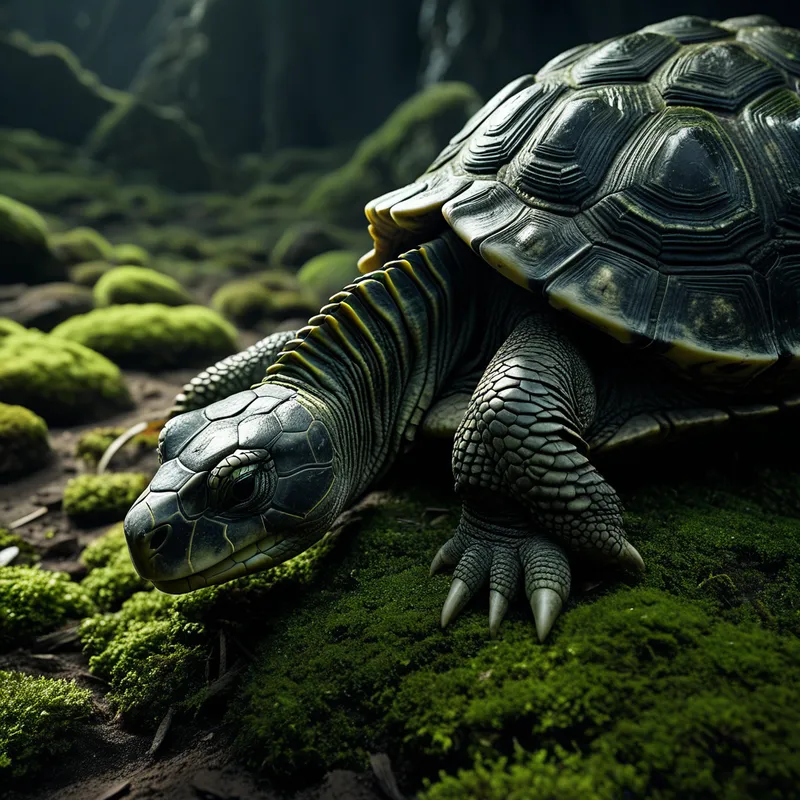
To the cold, silent north—a realm of long nights, deep waters, and patient earth—they sent a guardian. But not a warrior of fire and fury. The north required a different strength. From the abyssal waters of the Youming rose a creature of profound antiquity: a tortoise, vast as a mountain range, its shell the color of a moonless midnight, etched with the patterns of the stars yet unborn. Its eyes held the slow wisdom of tectonic plates shifting.
Yet, it was not alone. Wrapped around its mighty form, in a dance of eternal embrace, was a serpent—a being of flowing water and hidden currents, its scales shimmering like oil on dark water. They were two, yet moved as one. The tortoise, Xuanwu, provided unshakable foundation; the serpent, its spirit and coiling vitality.
Their task was not conquest, but containment. The north was the seat of winter, of endings, of the mysterious Yin. Here, the chaotic waters of the underworld threatened to seep upward, and the winds of dissolution howled. The Black Tortoise planted its colossal feet upon the unstable borders. The serpent tightened its grip, binding the tortoise’s strength with fluid grace. Together, they became a living dam, a sacred knot. They did not fight the chaos; they absorbed it, transformed its frantic energy into the slow, sure pulse of endurance. The waters stilled. The winds were gentled to a whisper. The north was secured not by a wall, but by a presence—a testament to the power of stillness, of bearing weight, of holding the line through eons with silent, unwavering resolve.
Cultural Origins & Context
The myth of the Xuanwu is not the product of a single author, but a slow crystallization of ancient Chinese cosmological thought. Its earliest roots lie in the astrological systems of the Warring States period, where celestial phenomena were meticulously mapped onto earthly governance and natural philosophy. The Black Tortoise was one of the Si Xiang, the Four Symbols, each governing a quadrant of the sky and a season.
Its stories were passed down through a blend of state-sponsored cosmology, Taoist mystical texts, and local folk religion. Taoist practitioners, in their quest for physical immortality and spiritual alignment with the cosmos, revered Xuanwu as a powerful deity of the north, associated with water (the tortoise) and the art of longevity (the serpent’s regenerative shedding). Temples were built in its honor, often in locations associated with dark waters or northern mountains. For the common people, the Black Tortoise was a protective symbol, its image used in architecture—particularly on the northern walls of buildings and cities—to ward off evil spirits and cold, destructive forces. It functioned as a societal anchor, a divine reminder that stability, both of the empire and the individual soul, required the harmonious integration of steadfastness (the shell) and adaptive vitality (the coiling spirit).
Symbolic Architecture
The Black Tortoise is a master symbol of paradoxical unity. It is not a simple animal, but a sacred hybrid, a coincidentia oppositorum—a meeting of profound opposites.
The Tortoise symbolizes the earthly, the foundational, the container. Its heavy shell represents boundaries, protection, and the burden of existence borne with grace. It is the principle of form, weight, and enduring patience. The Serpent, in contrast, is the aquatic, the fluid, the unconscious. It represents the hidden currents of life, psychic energy, transformation (through shedding), and the mysterious, coiling power of the instinctual world. Their fusion into Xuanwu creates a complete psychic system.
The shell is not a prison, but the crucible in which the fluid soul is tempered into wisdom.
Psychologically, this represents the essential integration of the conscious ego (the defined, protective self) with the unconscious (the fluid, mysterious depths). The north, its domain, is the direction of winter, introspection, and the shadow. The Black Tortoise thus becomes the guardian of the inner sanctum, the one who presides over the difficult but necessary process of confronting what is dark, cold, and hidden within us. Its victory is not an aggressive slaying, but a profound holding—the ability to contain anxiety, chaos, and the unknown without being shattered by it. It is the archetype of the resilient container, the one who can wait out the storm by becoming an unshakeable part of the landscape.
The Dreamer’s Resonance
When the image of the Black Tortoise surfaces in a modern dream, it is rarely a literal, mythological tableau. Instead, it manifests as a feeling-pattern of immense, slow stability amidst turmoil. One might dream of being in a house during a ferocious storm, and noticing that one wall—the north wall—is made of dark, polished stone, immovable and cool to the touch. Or one might dream of carrying a tremendous, comfortable weight on their back, a weight that somehow makes them stronger and more grounded rather than crushing them.
Somatically, this myth resonates with processes of deep grounding and containment. It appears when the dreamer’s psyche is undergoing a period of intense pressure, uncertainty, or emotional flooding. The unconscious presents the Black Tortoise as an internal model for how to proceed: not through frantic action or escape, but through a deliberate, almost meditative, consolidation of the self. The coiling serpent in these dreams might feel like a tightening anxiety, but in the context of the myth, it is revealed as a necessary binding force—the tension that creates integrity. The dream is an invitation to stop fighting the weight of one’s circumstances or inner shadows, and to learn the alchemy of bearing it with conscious, patient awareness, allowing that pressure to forge a more resilient and integrated psyche.
Alchemical Translation
The individuation process, the journey toward psychic wholeness, is profoundly modeled by the myth of the Black Tortoise. Its alchemy is not of fire, but of water and earth—a slow, cold, patient transmutation.
The first stage is the recognition of the north within—the acknowledgment of one’s own cold, dark, shadowy aspects: the repressed emotions, the frozen traumas, the stagnant pools of unresolved history. This is the chaotic northern sea. The ego’s initial impulse is to flee this inner winter or to attack it with the “sunlight” of positive thinking. The Black Tortoise teaches a different way: to stand sentinel at this border. To become the container. This means developing the “shell” of conscious discipline, mindfulness, or therapeutic practice—a defined space where the shadowy, serpentine contents of the unconscious can be observed without being acted out or denied.
Individuation is the tortoise-shell slowly growing around the serpent-soul, not to imprison it, but to give its fluid power a lasting form.
The final transmutation is the sacred marriage of opposites within the self. The conscious mind (tortoise) and the unconscious (serpent) cease their conflict. They learn to move as one coordinated entity. The weight of responsibility becomes dignified endurance. The fluidity of emotion becomes guided wisdom. The individual no longer feels torn between being solid and being sensitive; they embody a grounded vitality. They achieve the Black Tortoise’s ultimate gift: an unshakeable inner foundation from which all true action and creativity can safely emerge. They hold their own north, becoming the calm, enduring center of their personal cosmos.
Associated Symbols
Explore related symbols from the CaleaDream lexicon: