The Birds of Rhiannon Myth Meaning & Symbolism
Enchanted birds whose song can lull the world to sleep, awaken the dead, and bend time, belonging to the otherworldly goddess Rhiannon.
The Tale of The Birds of Rhiannon
Listen. There is a song older than the oldest stone in Gwynedd. It is not carried on the wind, but is the wind itself—a melody woven from twilight and longing. It belongs to the Birds of Rhiannon.
To hear it is to forget your name.
The tale unfolds not in the sunlit world of men, but in the bruised purple hour between one day and the next. It begins with a king, Bran the Blessed, who is both protector and doomed. He leads his men across the Irish Sea, a voyage of vengeance and sorrow. Battle is joined, a terrible, grinding affair. Bran is struck by a poisoned spear. The wound is mortal. He knows his time in the Middle Kingdom is done.
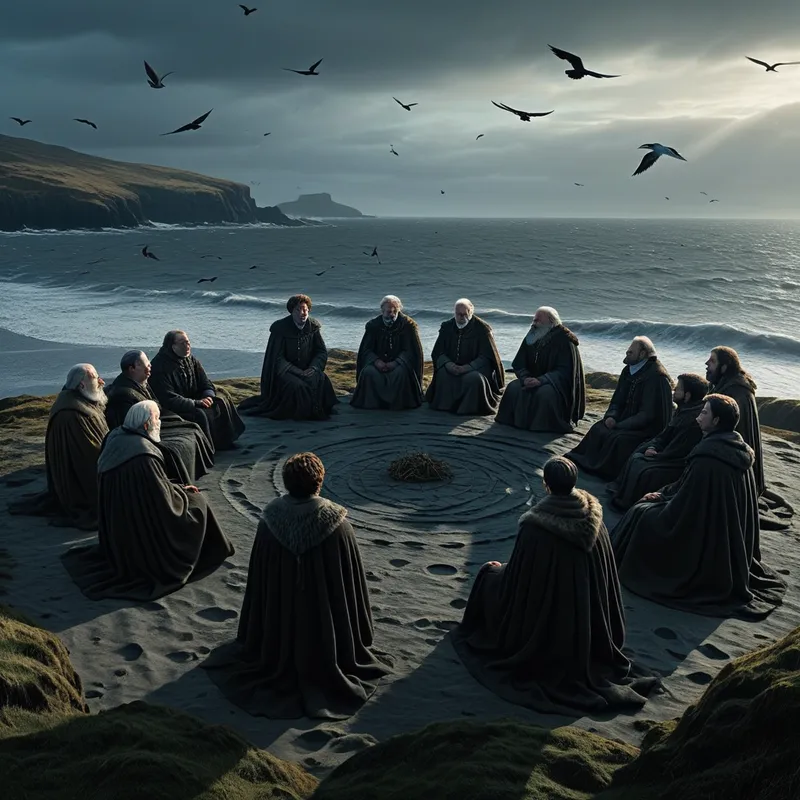
He gives a final, grievous order to his seven surviving companions. “Cut off my head,” he says, his voice like stones grinding in a deep tide. “Carry it with you back to the White Hill in Llundain. Bury it facing the continent, that it may forever guard this land from invasion.”
They obey, their hearts as heavy as the head they now bear. The journey home is a procession of ghosts. They sail, then walk, the head never decaying, speaking wise and comforting words. For seven years, they dwell in a state of suspended grace at Gwales, a feasting hall by the sea. The head is their companion, the doors to the hall facing a terrible sorrow are kept shut, and for eighty years they feel no weariness, only the bliss of companionship outside of time.
But a door is opened. The memory of all their loss, the weight of every funeral pyre, rushes in. The spell of Gwales is broken. They must complete their task.
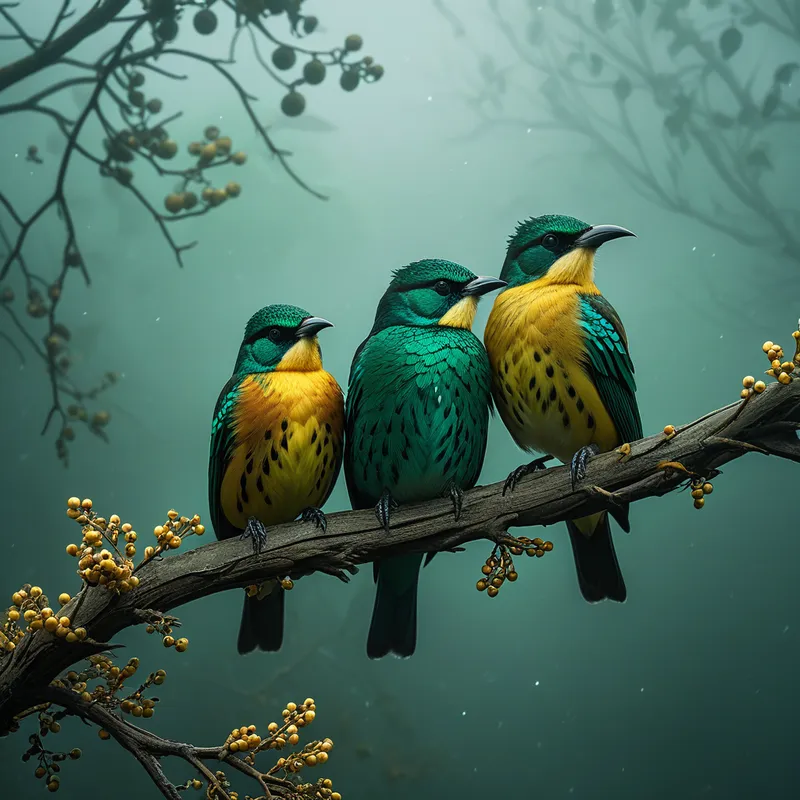
It is here, in this moment of reawakened, acute grief, as they tread the hard road toward London with their sacred burden, that the song finds them. It comes from a thicket, from a branch of hawthorn silvered with dew. Three birds are singing. Their feathers hold the sheen of a forgotten sunset, of deep ocean caves, of the first green of the world. They are the Birds of Rhiannon.
And they sing.
The song is a falling, a softening. It does not erase the grief of the men, but enfolds it. Time itself becomes unmoored. The long march slows, stretches, becomes a dream. The pain in their hearts is not gone, but it is held in a cradle of sound so profound that waking and sleeping, past and present, sorrow and peace, lose their edges. The birds sing the companions into a state of sacred suspension, a final mercy on their road to destiny. Their music can wake the dead from their slumber and lull the living into a trance. It is the sound of the threshold itself.
Cultural Origins & Context
This haunting fragment survives in the Mabinogion, specifically within the branch of Branwen ferch Llŷr. While recorded by Christian scribes in the medieval period, its roots dig deep into the pre-Christian, Celtic soil of Britain. The tale of Bran’s death and the journey of his head is a foundational bardic narrative, a “wondrous head” myth common to Indo-European tradition, where the severed head retains oracular and protective power.
The Birds are intrinsically linked to Rhiannon, a figure who herself straddles worlds—a goddess of sovereignty, horses, and the Otherworld. Her birds are not mere pets or symbols; they are an extension of her numinous power. In a culture where the natural world was utterly ensouled, birds were frequent messengers between realms. That Rhiannon’s birds govern sleep, awakening, and the distortion of time speaks to her authority over the ultimate transitions: life, death, and the dream state that mirrors them. The myth was not mere entertainment; it was a psychic map, teaching listeners how to navigate profound loss, how to carry grief, and how to recognize the moments of grace that suspend our suffering.
Symbolic Architecture
The myth constructs a powerful symbolic architecture around the central image of the enchanted song.
The Three Birds represent a trinity of otherworldly influence. They are not predators or scavengers, but singers. Their power is aesthetic, spiritual, and transformative. They embody the principle that true magic—and true healing—often arrives not as a force, but as a frequency.
Bran’s Head is the enduring consciousness severed from the body of action. It is wisdom persisting beyond the death of the ego’s worldly identity. The journey of the companions carrying the head is the psyche’s arduous task of integrating a traumatic, consciousness-altering insight.
The song of the birds does not cure grief; it sanctifies it by placing it outside of time’s relentless, linear march.
Gwales, the feasting hall of forgetfulness, and the hard road to London, represent the two poles of the human response to trauma: blissful dissociation and dutiful, painful confrontation. The Birds appear at the crisis point between these two states. Their song offers a third way—not denial, and not raw, unmediated pain, but a liminal holding. They transmute chronological time (chronos) into meaningful, sacred time (kairos).
The Dreamer’s Resonance
When this myth stirs in the modern unconscious, it often manifests in dreams of profound auditory enchantment. A dreamer may hear a music that stops them in their tracks within the dreamscape, a melody that induces overwhelming peace or sorrow so beautiful it becomes indistinguishable from joy. They may dream of carrying a heavy, precious, or talking object (the head) on a long journey, burdened by a duty born of a past “death” or severance.
Somatically, this can correlate with a feeling of temporal distortion—a sense that hours have passed in minutes, or that a moment has stretched into an eternity. Psychologically, the dreamer is likely at a point of exhaustion from carrying a long-held grief, a foundational loss, or a core identity-shattering insight. The psyche, in the imagery of the Birds, is offering a reprieve. It is not an escape, but an invitation to let the wound be bathed in a different quality of attention—one that exists outside the narrative of “before and after,” “cause and effect.” The dream is a signal that the conscious mind needs to cease its marching and allow a deeper, melodic layer of the self to hold the pain.

Alchemical Translation
In the alchemy of individuation, the myth models the critical stage of mortificatio followed by sublimatio. The mortificatio is the battle, the poisoning, the severing of Bran’s head—the necessary death of an old attitude or psychic structure. The long journey is the separatio, the laborious sorting and carrying of the valuable essence (the still-wise head) away from the corruptible body of former life.
The arrival of the Birds’ song represents the sublimatio. This is the process where the heavy, leaden weight of grief and duty is vaporized, spiritualized, and lifted into a different realm of experience. It is not bypassing. It is transmutation.
The modern individual’s “Birds of Rhiannon” moment arrives when grief, fully faced, suddenly reveals its hidden melody—the unexpected meaning, the bittersweet gift, the strange peace at the core of the wound.
For the individual, this translates to the practice of finding the “song” within the loss. This might be creative expression born from pain, a meditation that allows the feeling to simply be without a story, or an immersion in art or nature that temporarily dissolves the ego’s timeline. The goal is not to reach London and bury the past, but to become, periodically, like the companions on the road: one who can carry the sacred, speaking wound and be utterly stopped, healed, and transformed by the timeless song that makes the carrying possible. We are asked to become both the steadfast companion and the receptive listener, allowing the otherworldly frequency of our deepest sorrows to reveal its paradoxical, enchanting, and life-sustaining music.
Associated Symbols
Explore related symbols from the CaleaDream lexicon: