
The biblical Tabernacle - a po Myth Meaning & Symbolism
A portable temple built in the desert, housing the divine presence and mapping the human psyche's path from outer chaos to inner sanctum.
The Tale of The biblical Tabernacle - a po
In the furnace of [the desert](/myths/the-desert “Myth from Biblical culture.”/), where [the wind](/myths/the-wind “Myth from Various culture.”/) sculpts dunes into fleeting temples, a people walked, unmoored. They carried the memory of chains and the echo of a voice from a burning mountain. The voice had spoken law, but also a promise: I will dwell among you. But how can the Infinite dwell within the finite? How can the Uncontained be contained?
The answer came not as a city on a hill, but as a whisper of instruction, a divine blueprint whispered to [Moses](/myths/moses “Myth from Biblical culture.”/) on [the summit](/myths/the-summit “Myth from Taoist culture.”/). It was to be a tent—a mishkan—a dwelling place. But this was no ordinary shelter. It was to be a microcosm, a portable slice of heaven’s order planted in the chaos of [the wilderness](/myths/the-wilderness “Myth from Biblical culture.”/).
The call went out to the heart of every willing soul: bring gold, silver, bronze; bring blue, purple, and scarlet thread; bring acacia wood and oil for light; bring the sweet incense of your intention. And they brought, a torrent of generosity, until the artisans had to say, “Enough! Stay your hands from the offering.”
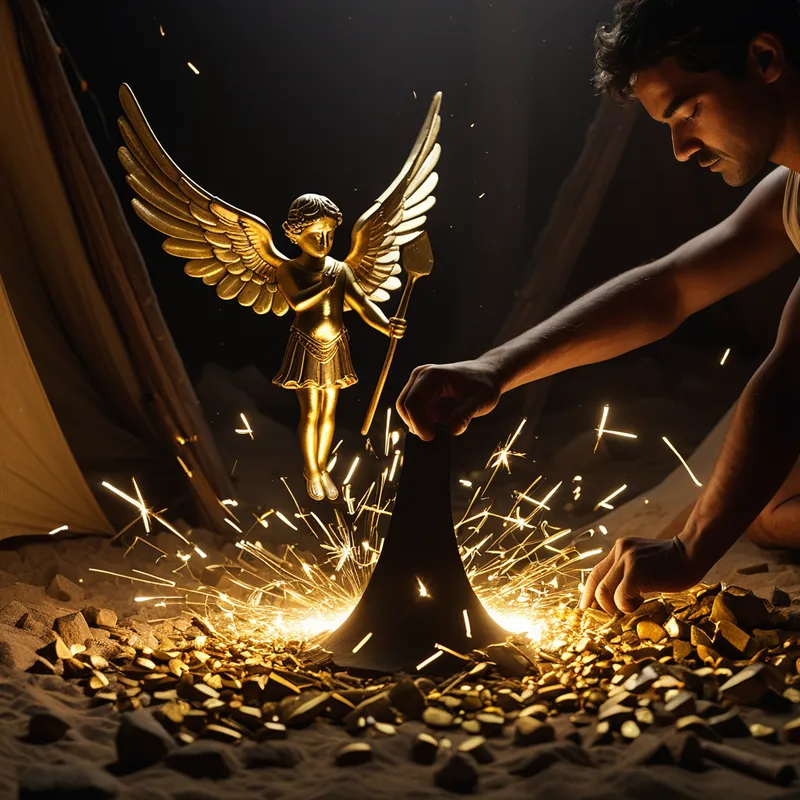
Then the work began, a symphony of sacred making. Bezalel and Oholiab oversaw it, their hands and minds animated by a wisdom beyond craft. From the heavy, grounded sockets of silver to the finely spun linen curtains embroidered with cherubim, every element was consecrated. The altar of burnt offering stood at [the threshold](/myths/the-threshold “Myth from Folklore culture.”/), a place of transformation where the earthly met the consuming fire. The laver of bronze held [water](/myths/water “Myth from Chinese culture.”/) for purification, a mirror and a cleanser.
Within the first chamber, the Holy Place, stood the table of [showbread](/myths/showbread “Myth from Biblical culture.”/)—the sustenance of presence—[the menorah](/myths/the-menorah “Myth from Biblical culture.”/) of pure gold—the illuminating spirit—and [the altar of incense](/myths/the-altar-of-incense “Myth from Christian culture.”/)—the prayers of the heart rising like perfume. And then, [the veil](/myths/the-veil “Myth from Various culture.”/). A tapestry of exquisite work, a final boundary woven with guardian cherubim. Behind it lay [the Holy of Holies](/myths/the-holy-of-holies “Myth from Biblical culture.”/), a perfect cube of darkness and potential.
There, shrouded in silence, rested the Ark of the Covenant, crowned by the Mercy Seat, flanked by two golden cherubim whose wings stretched over it, touching. And in the space between those wings, the voice had promised, the Presence would speak.
On the day of completion, the cloud that had led them—the visible sign of the Unseen—descended. It covered the Tent of Meeting, and the glory of YHWH filled [the Tabernacle](/myths/the-tabernacle “Myth from Biblical culture.”/). A fire was in the cloud by night, a pillar of light in the desert dark. Moses could not enter. The structure was complete, [the vessel](/myths/the-vessel “Myth from Alchemical culture.”/) was ready, and the Presence had taken residence. The journey through the wilderness could continue, not with a god ahead or above, but with a [sacred heart](/myths/sacred-heart “Myth from Christian culture.”/) at the center of the camp, beating in time with their marches and their rests.
Cultural Origins & Context
This is not a myth from a singular, lost culture, but the foundational narrative of sacred architecture from the Hebrew priestly tradition. It is meticulously recorded in the latter chapters of the Book of Exodus, a text that functions as both historical chronicle and cosmic manual. Its primary custodians were the priestly class, the Levites, for whom the [Tabernacle](/myths/tabernacle “Myth from Biblical culture.”/)’s precise measurements and rituals were not mere procedure, but the very mechanics of maintaining cosmic and communal order.
Its societal function was multifaceted. Politically, it provided a tangible, unifying center for a nascent tribal confederation in the anarchic space of the desert. Theologically, it solved the profound paradox of a transcendent God engaging with a material people. Psychologically, it mapped a path from profane space to the most sacred, creating a graduated system of approachability. It was told not around campfires for entertainment, but recited in ritual and law, its details memorized as a sacred technology. It established the prototype for the later Temple in [Jerusalem](/myths/jerusalem “Myth from Biblical culture.”/), embedding the idea that the divine meeting place is both a specific location and a portable pattern imprinted on the soul of the people.
Symbolic Architecture
The Tabernacle is the ultimate [symbol](/symbols/symbol “Symbol: A symbol can represent an idea, concept, or belief, serving as a powerful tool for communication and understanding.”/) of the [temenos](/myths/temenos “Myth from Greek culture.”/)—the sacred [enclosure](/symbols/enclosure “Symbol: A bounded space representing psychological containment, social boundaries, or existential limitations. It can symbolize both safety and restriction.”/)—drawn not on land, but within the [human](/symbols/human “Symbol: The symbol of a human represents individuality, complexity of emotions, and social relationships.”/) [psyche](/myths/psyche “Myth from Greek culture.”/). It is a three-tiered map of [consciousness](/symbols/consciousness “Symbol: Consciousness represents the state of awareness and perception, encompassing thoughts, feelings, and experiences.”/).
The outer court, with its altar and laver, represents the realm of the body and the conscious ego—the place of sacrifice (surrendering old identities) and purification (cleansing the persona).
The Holy Place symbolizes [the personal unconscious](/myths/the-personal-unconscious “Myth from Jungian Psychology culture.”/) and the [realm](/symbols/realm “Symbol: The symbol of ‘Realm’ often signifies the boundaries of one’s consciousness, experiences, or emotional states, suggesting aspects of reality that are either explored or ignored.”/) of [soul](/symbols/soul “Symbol: The soul represents the essence of a person, encompassing their spirit, identity, and connection to the universe.”/)-work. Here, the [bread](/symbols/bread “Symbol: Bread symbolizes nourishment, sustenance, and the daily essentials of life, often representing fundamental needs and comfort.”/) (sustenance of [the self](/myths/the-self “Myth from Jungian culture.”/)), the light ([illumination](/symbols/illumination “Symbol: A sudden clarity or revelation, often representing spiritual awakening, intellectual breakthrough, or the dispelling of ignorance.”/) of [insight](/symbols/insight “Symbol: A sudden, deep understanding of a complex situation or truth, often arriving unexpectedly and illuminating hidden connections.”/)), and the [incense](/symbols/incense “Symbol: Incense represents spiritual communication, purification, and the transformation of the material into the ethereal through smoke.”/) ([ascent](/symbols/ascent “Symbol: Symbolizes upward movement, progress, spiritual elevation, or striving toward higher goals, often representing personal growth or transcendence.”/) of desire and [prayer](/symbols/prayer “Symbol: Prayer represents communication with the divine or a higher power, often reflecting inner desires and spiritual needs.”/)) are the ongoing processes of introspection and nourishment of the inner [life](/symbols/life “Symbol: The symbol of ‘Life’ represents a journey of growth, interconnectedness, and existential meaning, encompassing both the joys and challenges that define human experience.”/).
The Holy of Holies is the irreducible core, the Self. It is the seat of ultimate [authority](/symbols/authority “Symbol: A symbol representing power structures, rules, and control, often reflecting one’s relationship with societal or personal governance.”/) and [mystery](/symbols/mystery “Symbol: An enigmatic, unresolved element that invites curiosity and exploration, often representing the unknown or hidden aspects of existence.”/), the “[throne](/symbols/throne “Symbol: A seat of authority, power, and sovereignty, representing leadership, divine right, or social hierarchy.”/) [room](/symbols/room “Symbol: A room in a dream often symbolizes the self, representing personal space, mental state, or aspects of one’s identity.”/)” of the psyche. The cherubim guarding the [veil](/symbols/veil “Symbol: A veil typically symbolizes concealment, protection, and transformation, representing both mystery and femininity across cultures.”/) are the psychic defenses and complexes that protect this profound center from casual intrusion. The Ark within holds [the covenant](/symbols/the-covenant “Symbol: A sacred, binding agreement between parties, often with divine or societal significance, representing commitment, obligation, and mutual responsibility.”/)—the foundational laws and promises that [structure](/symbols/structure “Symbol: Structure in dreams often symbolizes stability, organization, and the framework of one’s life, reflecting how one perceives their environment and personal life.”/) one’s inner [reality](/symbols/reality “Symbol: Reality signifies the state of existence and perception, often reflecting one’s understanding of truth and life experiences.”/). The entire structure, oriented to move with the people, signifies that this sacred order is not [static](/symbols/static “Symbol: Static represents interference, disruption, and the breakdown of clear communication or signal, often evoking feelings of frustration and disconnection.”/) but must be carried within through all of life’s [wilderness](/symbols/wilderness “Symbol: Wilderness often symbolizes the untamed aspects of the self and the unconscious mind, representing a space for personal exploration and discovery.”/) journeys.
The Dreamer’s Resonance
When this myth stirs in the modern unconscious, it rarely appears as a literal tent. One might dream of discovering a hidden room in their house, perfectly preserved and charged with awe. Or of constructing an elaborate, intricate model whose purpose feels vitally important. One may dream of a sequence of rooms or gates they must pass through, each requiring a specific action or surrender.
Somatically, this can feel like a tightening in the chest (the veil being approached) or a profound sense of calm centeredness (dwelling in the Holy Place). Psychologically, these dreams signal a process of inner sanctification. The dreamer is, often without conscious intent, organizing the chaos of their inner world. They are building a structure to contain powerful, potentially overwhelming energies (the “divine presence”), which in psychological terms could be a nascent talent, a traumatic memory, or a burgeoning spiritual awareness. The dream-work is the labor of Bezalel, using the raw materials of life experience to craft a vessel sturdy enough to hold one’s own deepest truth.
Alchemical Translation
The alchemy of the Tabernacle is [the opus](/myths/the-opus “Myth from Alchemical culture.”/) of individuation. It models the psychic transmutation from a state of scattered exile (the desert) to one of integrated, centered dwelling.
The wilderness is the prima materia—the raw, undifferentiated stuff of the psyche. The divine instructions are the archetypal blueprint of the Self, emerging from the mountain-top moments of insight.
The first alchemical stage, [nigredo](/myths/nigredo “Myth from Alchemical culture.”/), is seen in the outer court’s altar: the burning away of the dross of the old, rigid personality. The albedo, or whitening, is the purification at the laver. The work in the Holy Place represents citrinitas, the yellowing or illumination, where the soul’s faculties are engaged and refined. Finally, the entry into the Holy of Holies is the [rubedo](/myths/rubedo “Myth from Alchemical culture.”/), the reddening or culmination, where [the ego](/myths/the-ego “Myth from Jungian culture.”/) consciously relates to and is anchored by the Self. The enduring glory cloud signifies the successful coniunctio—the marriage of the conscious and unconscious, resulting in a personality that is both grounded and guided by a transcendent center.
For the modern individual, the myth does not command the building of a physical shrine. It invites the construction of an inner temenos. This is the disciplined creation of a psychic structure—through ritual, reflection, creative work, or therapy—that can safely house our most sacred and powerful contents. It is the journey from being a wanderer, buffeted by external chaos and internal compulsions, to becoming a living temple, a portable sanctuary that carries the sacred center within, no matter what wilderness one traverses.
Associated Symbols
Explore related symbols from the CaleaDream lexicon: