The Bee of Lower Egypt Myth Meaning & Symbolism
A myth where the tears of the sun god Ra, falling in chaos, birth a sacred bee whose hum brings structure to the primordial world.
The Tale of The Bee of Lower Egypt
In the time before time, when [the world](/myths/the-world “Myth from Tarot culture.”/) was a single, breathless [thing](/myths/thing “Myth from Norse culture.”/) called Nun, there was only the deep and the dark. No shore, no sky, no word to separate the waters from [the void](/myths/the-void “Myth from Buddhist culture.”/). From within this boundless potential, the first thought stirred. It was Ra, [the self](/myths/the-self “Myth from Jungian culture.”/)-created, who willed himself into being. A golden [scarab](/myths/scarab “Myth from Egyptian culture.”/) pushing against the inside of a cosmic egg. His light was a solitary island in the endless ocean of Nun, brilliant and terribly alone.
Ra looked upon the formless, silent waters, and a great weariness touched his spirit. This was not the weariness of fatigue, but of profound solitude—the loneliness of a creator with nothing yet to reflect his glory. From his divine eye, a single tear welled. It was not a tear of sorrow, but of concentrated, creative potency, hot and heavy with the unspoken desire for company, for order, for a world that could answer back.
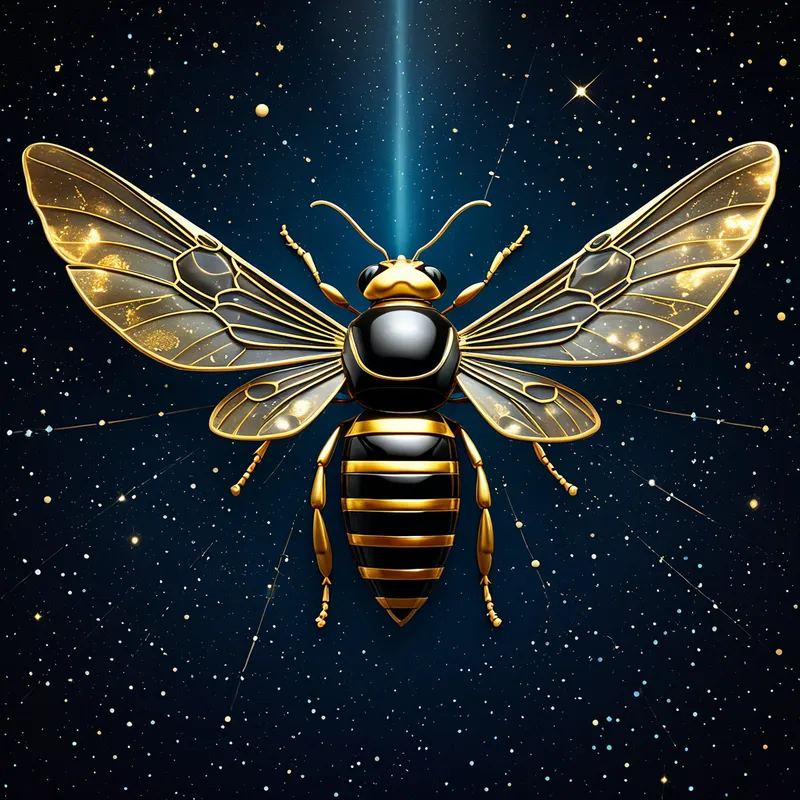
The tear fell. It fell through the golden aura of Ra and into the cool, black embrace of Nun. As it descended, it began to change. Its liquid light hardened, took form. It grew a body of polished obsidian, wings of thinnest lapis lazuli veined with gold. It spruted delicate antennae that tuned themselves to the frequencies of the deep. Before it touched the [water](/myths/water “Myth from Chinese culture.”/), it was alive. It was a Bee.
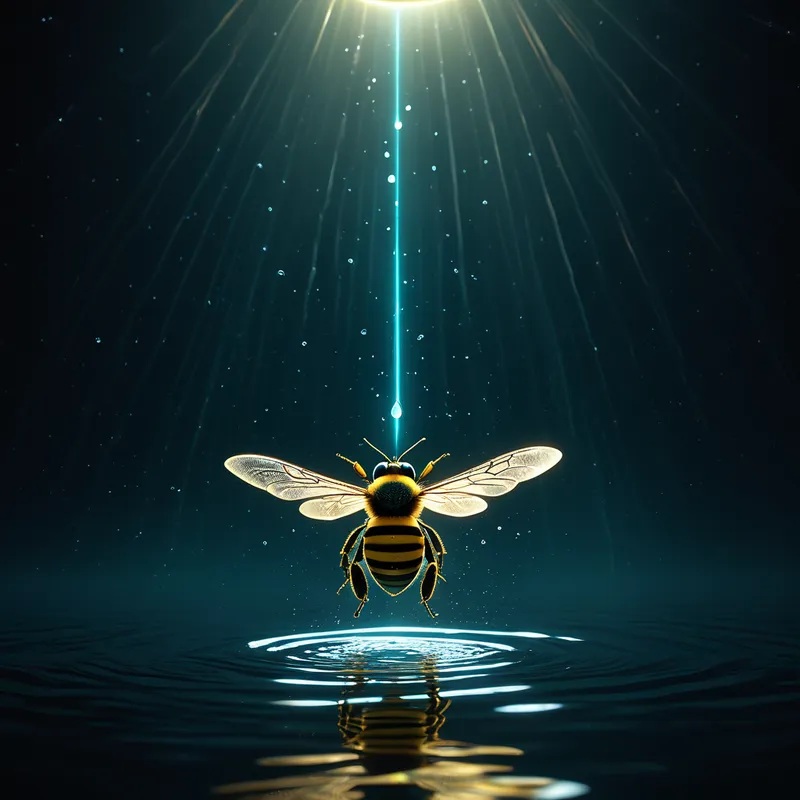
It hit the surface of Nun not with a splash, but with a sound. A low, resonant hum that vibrated through the primordial soup. Where there had been only silent potential, now there was vibration. Frequency. The Bee did not drown. It moved upon the face of the waters, and its hum was a command. The chaotic particles in the water began to listen, to arrange themselves around the steady pulse.
The Bee began to work. It did not gather pollen, for there were no flowers. It gathered the very substance of Nun itself—the dark, watery matter of possibility. With divine instinct, it began to build. Not a hive of wax, but a structure of solidified intention, a crystalline lattice of order that gleamed with a soft, internal light. The first pattern was drawn in the chaos: a perfect hexagon, a cell of sacred geometry. Then another, and another, linking together.
As the [honeycomb](/myths/honeycomb “Myth from Natural culture.”/) of order spread, Ra watched from above. His weariness lifted. His tear had not been lost; it had become an architect. The hum of the Bee was the first song of creation, a rhythmic incantation pulling form from the formless. The structured cells became the first foundations—not of land, but of the very laws that would allow land to be. The principle of structure, of repeated, harmonious pattern, was now embedded in the heart of creation. The Bee of Lower Egypt had translated the silent longing of the sun into the humming blueprint of the world.
Cultural Origins & Context
The motif of the Bee of Lower Egypt is woven into the earliest strata of Egyptian royal ideology and cosmology. It is not a narrative myth with a lengthy plot found in one [papyrus](/myths/papyrus “Myth from Egyptian culture.”/), but a profound etiological fragment, a foundational “why” story preserved in temple texts, royal titulary, and cosmological hymns. The bee was the emblem of the King of Lower Egypt (the [Nile Delta](/myths/nile-delta “Myth from Egyptian culture.”/)), and its origin story explains this sacred association.
This myth was likely the domain of priests and scribes in [the temple](/myths/the-temple “Myth from Jewish culture.”/) schools of Lower Egypt, particularly in centers like Buto, the ancient capital. It served a crucial societal function: it legitimized [the pharaoh](/myths/the-pharaoh “Myth from Egyptian culture.”/)‘s rule over the northern lands by linking his authority directly to the first creative act of Ra. The [pharaoh](/myths/pharaoh “Myth from Egyptian culture.”/) was not just a ruler; he was the living embodiment of that ordering principle, the human equivalent of the Bee, tasked with maintaining Maat against the ever-present threat of chaos (Isfet). The myth provided a divine blueprint for kingship—rule as a creative, structuring, and industrious force that transforms raw potential (the people, the land, the inundation) into a prosperous, ordered society ([the hive](/myths/the-hive “Myth from Various culture.”/)).
Symbolic Architecture
At its core, this myth is about the [emergence](/symbols/emergence “Symbol: A process of coming into being, rising from obscurity, or breaking through a barrier, often representing birth, transformation, or revelation.”/) of [consciousness](/symbols/consciousness “Symbol: Consciousness represents the state of awareness and perception, encompassing thoughts, feelings, and experiences.”/) and order from the unconscious and chaotic. Nun represents the undifferentiated [psyche](/myths/psyche “Myth from Greek culture.”/), the [womb](/symbols/womb “Symbol: A symbol of origin, potential, and profound transformation, representing the beginning of life’s journey and the unconscious source of creation.”/) of all potential where everything exists but nothing is distinct. Ra is the spark of ego-[consciousness](/symbols/consciousness “Symbol: Consciousness represents the state of awareness and perception, encompassing thoughts, feelings, and experiences.”/), the first point of self-aware light.
The divine tear is the moment when consciousness, facing its own isolation in the vastness of the psyche, experiences a profound emotional charge—a creative suffering.
This tear is not waste; it is sacred substance. It is the [investment](/symbols/investment “Symbol: Dreams of investment symbolize commitment of resources for future returns, reflecting personal growth, risk assessment, and life choices.”/) of psychic [energy](/symbols/energy “Symbol: Energy symbolizes vitality, motivation, and the drive that fuels actions and ambitions.”/) (libido) into the unknown. The Bee is the [symbol](/symbols/symbol “Symbol: A symbol can represent an idea, concept, or belief, serving as a powerful tool for communication and understanding.”/) of the transformative process itself. It is the instinctual, archetypal force that knows how to convert raw, emotional energy (the salty tear) and chaotic [material](/symbols/material “Symbol: Material signifies the tangible aspects of life, often representing physical resources, desires, and the physical world’s influence on our existence.”/) (Nun) into organized, sustainable [structure](/symbols/structure “Symbol: Structure in dreams often symbolizes stability, organization, and the framework of one’s life, reflecting how one perceives their environment and personal life.”/) (the [honeycomb](/symbols/honeycomb “Symbol: Honeycomb symbolizes productivity, community, and the sweetness of life.”/)).
The bee’s hum is critical. It is the first [vibration](/symbols/vibration “Symbol: A rhythmic oscillation or resonance, often representing energy, connection, or unseen forces. In dreams, it can signal awakening, disturbance, or spiritual communication.”/), [the logos](/myths/the-logos “Myth from Biblical culture.”/) or [word](/symbols/word “Symbol: Words in dreams often represent communication, expression, and the power of language in shaping our realities.”/) that begins to sort [chaos](/symbols/chaos “Symbol: In Arts & Music, chaos represents raw creative potential, uncontrolled expression, and the breakdown of order to forge new artistic forms.”/) into categories. The hexagonal honeycomb is a universal symbol of [efficiency](/symbols/efficiency “Symbol: A tool or object representing optimization, streamlined processes, and maximum output with minimal waste. It symbolizes the pursuit of perfection in function.”/), [community](/symbols/community “Symbol: Community in dreams symbolizes connection, support, and the need for belonging.”/), and natural order—the perfect [marriage](/symbols/marriage “Symbol: Marriage symbolizes commitment, partnership, and the merging of two identities, often reflecting one’s feelings about relationships and social obligations.”/) of [strength](/symbols/strength “Symbol: ‘Strength’ symbolizes resilience, courage, and the ability to overcome challenges.”/) and economy. It represents the innate patterns (archetypes) within the psyche that guide the organization of experience.
The Dreamer’s Resonance
When this myth stirs in the modern dreamer, it often signals a profound process of inner ordering following a period of chaos or emotional release. To dream of a bee emerging from water, or of building geometric structures in a dark, formless space, is to dream the work of the Bee of Lower Egypt.
Somnatically, one might feel a deep, resonant vibration in the chest or solar plexus—the hum making itself known. Psychologically, the dreamer is likely in a phase where a past period of confusion, grief, or “falling apart” (the tear into the waters) is now yielding to a new, instinctive understanding. The psyche is beginning to spontaneously organize itself around a core pattern or truth. There is a sense of industrious, almost impersonal purpose. The dreamer isn’t forcing the new structure; they are [the vessel](/myths/the-vessel “Myth from Alchemical culture.”/) through which the natural ordering principle, the Bee, is working. It is the dream of healing, where pain becomes the substrate for a more resilient and complex psychic architecture.

Alchemical Translation
The alchemical journey mirrored here is the opus contra naturam—the work against nature, which is really work with deeper nature. [The prima materia](/myths/the-prima-materia “Myth from Alchemical culture.”/) is the chaotic Nun of our unexamined lives and unresolved emotions. The sol or sun is our conscious intention (Ra). The process begins not with forceful will, but with a surrender to authentic feeling—the shedding of the sacred tear. This emotional honesty is the catalyst.
The Bee represents the transcendent function, the psychic process that arises autonomously to bridge the conscious and unconscious, forging a new, ordered attitude from the conflict.
The alchemical stage is coagulatio—the solidification of spirit into form. The humming work is the diligent, patient application of insight to daily life, building cell by cell a new way of being. The golden honey produced is not material wealth, but the achieved Maat of the individual—a life of meaning, purpose, and inner harmony distilled from the raw experiences of suffering and chaos. The individuated Self, in this frame, is not just the Ra-like sun, but the entire perfected system: the sun, the tear, the bee, and the golden, humming hive of a psyche that has transformed its own darkness into structured light.
Associated Symbols
Explore related symbols from the CaleaDream lexicon: