The Bear Ancestor Myth Meaning & Symbolism
A sacred story of a celestial being who descends to become the first bear, teaching humanity the rituals of kinship, death, and renewal.
The Tale of The Bear Ancestor
Listen. In the time before memory, when the world was young and the taiga breathed with a single, great spirit, the people lived in hunger and fear. The cold was a knife, and the forest, a vast, unknowable dark. They did not know how to live with the land, only upon it, taking without knowing how to give back.
High above, in the realm of the Sky Father, a being of great power watched. This was not a god of thunder, but of a deeper, quieter knowing. He saw the people’s suffering, their clumsy hunting, their waste. A profound sorrow moved within him, a compassion as vast as the sky itself. He could not remain aloof.
So he made a choice that would echo through all generations. He called his family to him beneath the great Tree of Life. “My children,” his voice was the wind in the high branches, “the people below are lost. They are our kin, though they have forgotten. I will go to them. I will wear the strongest cloak, become the mightiest of the forest’s children, so that my body may sustain them and my spirit may teach them.”
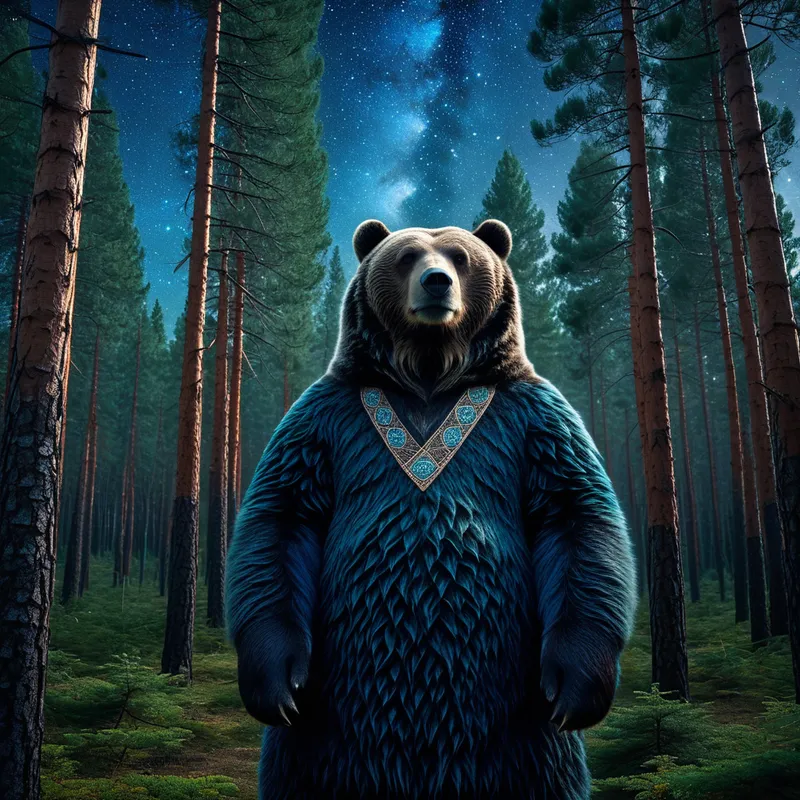
His family wept, for they knew the cost. He embraced them one last time, then stepped to the edge of the celestial realm. He did not fly, but let himself fall, a slow, deliberate descent like a leaf or a snowflake. As he fell, the starlight woven into his form began to change. His limbs grew heavy and powerful, his skin thickened into a pelt of dense, dark fur. His wise eyes remained, but now they were set in the noble head of the first great bear.
He landed softly in a clearing, the earth accepting his weight. The people, hunting nearby, saw him and trembled. This was no ordinary beast. It moved with a dreadful, deliberate grace. Yet, it did not charge. It looked at them, and in that look was not animal fury, but a profound, unsettling recognition.
For years, the bear lived among them, a silent patriarch. He taught them by example—where the sweetest berries grew, how to catch salmon from the rushing rivers, which roots held medicine. He showed them the sacred places. When the time was right, he allowed the bravest hunter to find him, sitting calmly before a ancient pine. The hunt was not a chase, but a solemn ritual. The bear guided the hunter’s hand, and the spear found its mark not in rage, but in a sacred agreement.
As his life left his great body, he spoke, not with a voice, but directly into the hunter’s soul. “You have taken my body, as I promised. Now, you must honor my spirit. Treat my bones with respect. Sing the songs I will teach you. Tell my story. In this way, I will return, and you will never be hungry in spirit again.” The people, awestruck, learned the first rituals. They carefully arranged his bones on a high platform, sang the songs of mourning and gratitude, and told the story of the sky-being who became their ancestor. And from that day, every bear that walked the taiga carried a spark of that first, sacred sacrifice, a relative in a shaggy cloak, forever teaching the laws of reciprocity between the human world and the wild.
Cultural Origins & Context
This myth, in its many regional variations, forms the bedrock of the bear ceremonialism found across Siberian and North Eurasian indigenous cultures. It was not a story told for mere entertainment around the fire, but a living, sacred narrative performed. It was recited by shamans and elders during the critical Bear Festival, a multi-day event of profound importance.
The societal function was multifaceted. Firstly, it provided a cosmological and ethical framework for hunting, transforming a act of killing into one of communion and religious obligation. The bear was not simply prey, but a visiting deity-relative whose gift of meat and hide required elaborate thanks and ritual care to ensure its return and the continued balance of the world. Secondly, it established a kinship model that extended beyond the human clan to encompass the most powerful non-human person in the environment. This created a relational, rather than dominative, approach to nature. The myth was the charter for a complete way of life, governing everything from hunting techniques to funeral rites, binding the community to the cycles of death and regeneration witnessed in the forest itself.
Symbolic Architecture
At its [heart](/symbols/heart “Symbol: The heart symbolizes love, emotion, and the core of one’s existence, representing deep connections with others and self.”/), the Bear [Ancestor](/symbols/ancestor “Symbol: Represents lineage, heritage, and the collective wisdom or unresolved issues passed down through generations.”/) myth is a master [symbol](/symbols/symbol “Symbol: A symbol can represent an idea, concept, or belief, serving as a powerful tool for communication and understanding.”/) of the coniunctio between the celestial and the earthly, the divine and the animal, the giving [spirit](/symbols/spirit “Symbol: Spirit symbolizes the essence of life, vitality, and the spiritual journey of the individual.”/) and the receiving [community](/symbols/community “Symbol: Community in dreams symbolizes connection, support, and the need for belonging.”/).
The ultimate sacrifice is not destruction, but a voluntary descent into form so that form may learn the language of spirit.
The Bear represents the Great [Mother](/symbols/mother “Symbol: The symbol of ‘Mother’ represents nurturing, protection, and the foundational aspect of one’s emotional being, often associated with comfort and unconditional love.”/) in her most formidable, non-[human](/symbols/human “Symbol: The symbol of a human represents individuality, complexity of emotions, and social relationships.”/) [aspect](/symbols/aspect “Symbol: A distinct feature, quality, or perspective of something, often representing a partial view of a larger whole.”/): the nourishing yet dangerous [wilderness](/symbols/wilderness “Symbol: Wilderness often symbolizes the untamed aspects of the self and the unconscious mind, representing a space for personal exploration and discovery.”/) itself. The Ancestor’s descent is the incarnation of [consciousness](/symbols/consciousness “Symbol: Consciousness represents the state of awareness and perception, encompassing thoughts, feelings, and experiences.”/) into the raw [material](/symbols/material “Symbol: Material signifies the tangible aspects of life, often representing physical resources, desires, and the physical world’s influence on our existence.”/) of instinct and [body](/symbols/body “Symbol: The body in dreams often symbolizes the dreamer’s self-identity, personal health, and the relationship they have with their physical existence.”/). The myth resolves the [tension](/symbols/tension “Symbol: A state of mental or emotional strain, often manifesting physically as tightness, pressure, or unease, signaling unresolved conflict or anticipation.”/) between humanity and [nature](/symbols/nature “Symbol: Nature symbolizes growth, connectivity, and the primal forces of existence.”/) not through conquest, but through the shocking [revelation](/symbols/revelation “Symbol: A sudden, profound disclosure of truth or insight, often through artistic or musical means, that transforms understanding.”/) of kinship. The terrifying “other” is revealed to be our own [family](/symbols/family “Symbol: The symbol of ‘family’ represents foundational relationships and emotional connections that shape an individual’s identity and personal development.”/), wearing a different [skin](/symbols/skin “Symbol: Skin symbolizes the boundary between the self and the world, representing identity, protection, and vulnerability.”/).
The [ritual](/symbols/ritual “Symbol: Rituals signify structured, meaningful actions carried out regularly, reflecting cultural beliefs and emotional needs.”/) [treatment](/symbols/treatment “Symbol: Treatment in a dream symbolizes healing, self-care, and the need for change or intervention in one’s life.”/) of the bones is key. The bones are the enduring [structure](/symbols/structure “Symbol: Structure in dreams often symbolizes stability, organization, and the framework of one’s life, reflecting how one perceives their environment and personal life.”/), the immortal part. By honoring them, the people participate in a cycle of eternal return. The bear does not truly die; it sheds its bodily form so its essential [pattern](/symbols/pattern “Symbol: A ‘Pattern’ in dreams often signifies the underlying structure of experiences and thoughts, representing both order and the repetitiveness of life’s situations.”/) can be renewed. This is a profound alchemical [image](/symbols/image “Symbol: An image represents perception, memories, and the visual narratives we create in our minds.”/) of unus mundus—the one world where spirit and matter are not opposites, but different expressions of the same sacred substance.
The Dreamer’s Resonance
When this myth stirs in the modern dreamer’s psyche, it often signals a profound confrontation with the instinctual foundation of the Self. To dream of a bear—especially one that is awe-inspiring, communicative, or sacrificial—is to encounter the Self in its most grounded, powerful, and non-personal form.
The somatic process is one of grounding. One may feel a heavy, powerful presence in the dream, a pulling down from anxious mental heights into the body’s wisdom. Psychologically, it is the process of acknowledging a deep, often neglected, part of one’s nature that is fiercely protective, cyclical, and aligned with natural law. The “hunt” in the dream is rarely violent; it is a destined meeting where a part of our untamed, instinctual energy (the bear) is ready to be “reclaimed” by the conscious ego (the hunter) through respect and ritual, not suppression. The dream may evoke feelings of immense grief mixed with gratitude—the hallmark of integrating a major archetypal content. It is the psyche’s way of initiating us into a more reciprocal relationship with our own inner wilderness.
Alchemical Translation
For the individual on the path of individuation, the Bear Ancestor myth models the stage of nigredo giving way to a sacred coniunctio. Our modern “sky” is the over-identification with intellect, spirit, or persona—disembodied and disconnected. The “descent” is the often painful, humbling process of incarnating: accepting our animal nature, our bodily needs, our shadowy instincts, and our embeddedness in the cycles of nature (life, death, decay, rebirth).
Individuation requires the celestial part of us to willingly wear the bear-skin of our embodied, instinctual life.
The “hunt” is the ego’s necessary engagement with this powerful inner content. We must “face the bear” of our deepest fears, rages, or primal needs. But the myth instructs us that this is not a battle to be won. It is a ritual to be performed with reverence. The killing is the dissolution of the old attitude of superiority or fear toward our instinctual self. The “ritual treatment of the bones” is the conscious, daily work of honoring that integrated power—giving it structure through discipline (the bones), celebrating it through creativity (the songs), and ensuring its return by living in cyclical harmony rather than linear consumption. The ultimate triumph is not a hero’s victory, but a community’s sustained relationship. Psychically, this means the conscious mind no longer fears or exploits the unconscious, but enters into a sacred, reciprocal partnership with it. The nourishing power of the deep psyche (the bear’s meat) becomes sustainably available, and the spirit of wholeness (the ancestor) returns again and again.
Associated Symbols
Explore related symbols from the CaleaDream lexicon:
- Bear — The primary symbol of immense instinctual power, wilderness, maternal protection, and cyclical hibernation/rebirth, revered as a divine ancestor and teacher.
- Sacrifice — The voluntary descent and offering of the celestial being, modeling the necessary giving up of a higher, detached state for embodied, relational life.
- Ancestor — Represents the foundational, spiritual lineage that connects humanity directly to the non-human world, providing identity and ethical law.
- Forest — The symbolic realm of the deep, unconscious psyche—dense, mysterious, nourishing, dangerous, and home to the instinctual self.
- Bone — The enduring structure, the immortal pattern or essence that remains after dissolution and must be honored for regeneration to occur.
- Ritual — The prescribed acts of respect, song, and story that transform a mundane act (hunting, eating) into a sacred communion that maintains cosmic order.
- Sky — The realm of spirit, consciousness, divinity, and distant order from which the transformative impulse to incarnate descends.
- Tree — The Axis Mundi connecting the celestial, earthly, and underworld realms, under which the Ancestor announces his decision and around which the rituals of life revolve.
- Hunter — The conscious ego or human community that must engage with the powerful instinctual self not as an enemy, but as a sacred partner in a ritual exchange.
- Grief — The essential, respectful emotion that accompanies the receiving of a sacred gift, acknowledging the cost of the sacrifice and the reality of cyclical loss.
- Rebirth — The core promise of the myth: that through proper ritual and remembrance, what is given up or dies returns in a new form, ensuring continuity and renewal.
- Kinship — The revolutionary revelation at the heart of the story: that the ultimate “other” is family, demanding an ethic of relationship over one of exploitation.