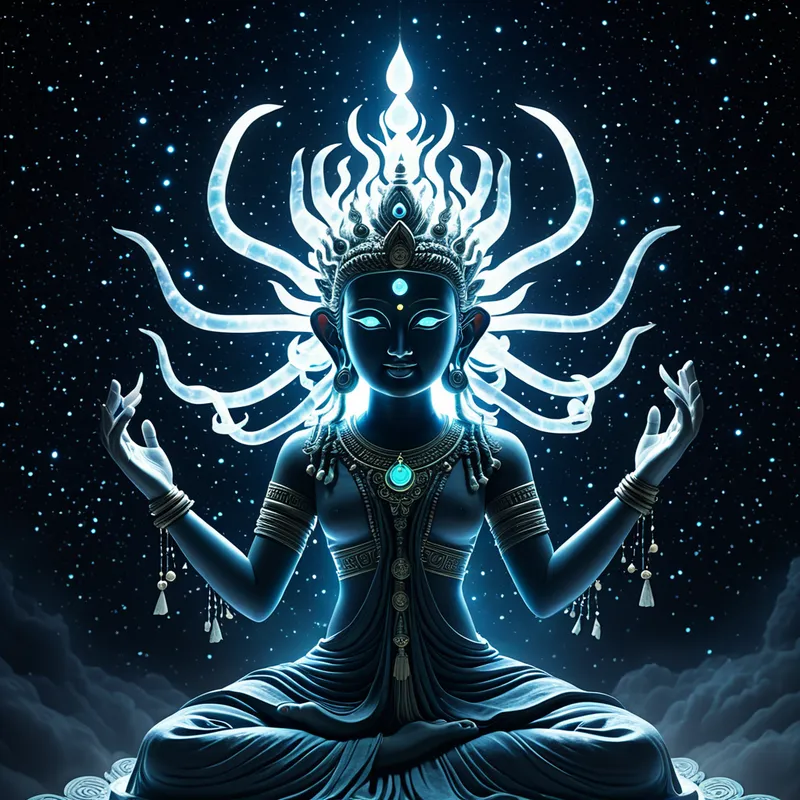
The Bardo Myth Meaning & Symbolism
A sacred map of the 49-day journey through luminous, terrifying, and liberating states of consciousness between death and a new birth.
The Tale of The Bardo
Listen. The great breath has ceased. The body, that familiar mountain, grows cold. The senses—sight, sound, taste—retreat like tides into a vast, interior ocean. This is not an end, but a crossing. The soul, now a flickering flame of awareness called the namshé, is cast adrift.
First, there is a profound peace, a luminous emptiness like clear sky after a storm. This is the Chikhai Bardo. A sound like a thousand thunders vibrates from the heart of reality itself, and a light, unbearably brilliant and peaceful, dawns. It is the radiance of your own true nature, the Dharmakaya. To recognize it is to be liberated, to dissolve into bliss. But for most, gripped by the habit of self, it is too vast, too naked. The soul flinches and turns away.
And so the dream deepens. The second phase, the Chönyid Bardo, unfolds like a flower of sound and light. From the central void, five colored lights emanate—dull blue, white, yellow, red, green—the elemental energies of mind. From them arise the shiwa. They are sublime, seated in celestial mandalas: [Vairocana](/myths/vairocana “Myth from Buddhist culture.”/), Akshobhya, and their consorts. They appear not as external gods, but as projections of your own latent perfections. A soft sound, like a distant bell, calls you to merge with them. Yet fear, the old ghost of separation, arises again. You mistake the luminous for a threat and flee.
Then the light transforms. The peaceful forms melt and reshape into the terrifying, glorious visages of the trowo. Their bodies are dark clouds and lightning, adorned with skulls and flames. They bear choppers and skull-cups, their roars shake the foundations of illusion. They are not evil, but fierce compassion, the violent urgency of truth trying to shatter your last chains. They are your own passions—anger, desire, ignorance—purified and unleashed as liberators. You are chased by raging bulls, confronted by judges who hold [the mirror](/myths/the-mirror “Myth from Various culture.”/) of your [karma](/myths/karma “Myth from Hindu culture.”/). The ground seems to give way, and you fall through realms of phantom sensation.
Exhausted by the spectacle, the soul seeks refuge. This longing for form births the final stage, the Sidpa Bardo. [The world](/myths/the-world “Myth from Tarot culture.”/) of apparitions solidifies. You possess a subtle “mental body,” experiencing phantom hungers and drives. You see visions of future parents in union, drawn by karmic affinity—attraction, jealousy, or indifference determining your entry. A wind of karma begins to blow, irresistible. You are pulled toward the warm glow of a womb, the light of a destined realm. The choice, in this final moment, is made by the weight of a lifetime’s habits. The great wheel turns. The journey ends where it must begin again.
Cultural Origins & Context
This intricate cartography of the afterlife is not mere folklore, but the core of Vajrayana</abryana Buddhist practice. Its primary source is the Bardo Thödol, a terma attributed to the 8th-century master [Padmasambhava](/myths/padmasambhava “Myth from Buddhist culture.”/). It was hidden for future discovery, unearthed in the 14th century. The text was traditionally read aloud to the dying and recently deceased, a spoken guide through the bewildering post-mortem landscape.
Its function was profoundly pragmatic and pedagogical. In a culture where death was not a taboo but a central life-event, the myth provided a framework to demystify the ultimate transition. It was a spiritual technology, rehearsed in life through meditation on the deities and the clear light, so that at the critical moment, recognition—not fear—would prevail. The lama serving as the guide for the deceased embodied the myth in action, turning death from a terrifying unknown into a structured path with signposts and opportunities for liberation.
Symbolic Architecture
The Bardo is not merely a post-mortem itinerary; it is a master [symbol](/symbols/symbol “Symbol: A symbol can represent an idea, concept, or belief, serving as a powerful tool for communication and understanding.”/) for the liminal, in-between states that permeate existence.
The Bardo is the eternal present tense of the psyche, the gap between one thought and the next, the suspended moment between inhale and exhale, where all possibilities—and all terrors—are born.
The three Bardos map the [architecture](/symbols/architecture “Symbol: Architecture in dreams often signifies structure, stability, and the framing of personal identity or life’s journey.”/) of [consciousness](/symbols/consciousness “Symbol: Consciousness represents the state of awareness and perception, encompassing thoughts, feelings, and experiences.”/) itself. The Chikhai Bardo represents the ground of being, the pure potentiality that underlies all experience, which we [glimpse](/symbols/glimpse “Symbol: A fleeting, partial view or moment of insight that suggests more lies beyond immediate perception, often hinting at hidden truths or future possibilities.”/) in moments of shock, awe, or deep [meditation](/symbols/meditation “Symbol: Meditation represents introspection, mental clarity, and the pursuit of inner peace, often providing a pathway for deeper self-awareness and spiritual growth.”/). The Chönyid Bardo symbolizes the phenomenal world as it arises from mind—the peaceful deities are our innate wisdom, the wrathful ones our raw psychic [energy](/symbols/energy “Symbol: Energy symbolizes vitality, motivation, and the drive that fuels actions and ambitions.”/), which we often perceive as external threats or personal demons. The Sidpa Bardo is the compulsive drive toward re-embodiment, the crystallization of potential into the solid, suffering “I” of habitual existence.
The deities are not external saviors but archetypal facets of the unconscious. To “merge” with a peaceful deity is to integrate a quality of wisdom; to face a wrathful one is to confront and transmute a [shadow](/symbols/shadow “Symbol: The ‘shadow’ embodies the unconscious, repressed aspects of the self and often represents fears or hidden emotions.”/) [aspect](/symbols/aspect “Symbol: A distinct feature, quality, or perspective of something, often representing a partial view of a larger whole.”/). The entire [journey](/symbols/journey “Symbol: A journey in dreams typically signifies adventure, growth, or a significant life transition.”/) is a profound [metaphor](/symbols/metaphor “Symbol: A figure of speech where one thing represents another, often revealing hidden connections and deeper truths through symbolic comparison.”/) for [projection](/symbols/projection “Symbol: The unconscious act of attributing one’s own internal qualities, emotions, or shadow aspects onto external entities, people, or situations.”/): we flee from the luminous and terrifying contents of our own [psyche](/myths/psyche “Myth from Greek culture.”/), misperceiving them as external, thus binding ourselves to repeated cycles of suffering ([samsara](/myths/samsara “Myth from Buddhist culture.”/)).
The Dreamer’s Resonance
When this mythic pattern stirs in modern dreams, it rarely appears as literal Tibetan iconography. Instead, it manifests as the sensation of the Bardo.
You dream of being in an airport terminal at night, with no flight information, every gate leading to an unknown destination. You are in a house you know, yet the rooms keep rearranging, and doors open onto impossible landscapes. You are being judged by a faceless committee, or you are fleeing a formless pursuer through shifting terrain. These are dreams of the Sidpa Bardo—the anxiety of choice, the search for a safe harbor in transition.
Dreams of radiant, overwhelming light or of meeting sublime, awe-inspiring figures point to the Chikhai and peaceful Chönyid states. Dreams of being chased by monsters, of apocalyptic landscapes, or of confronting terrifying, yet strangely compelling, beings mirror the wrathful deities. The somatic experience is key: the paralysis of awe, the visceral thrill of fear, the weightless drift. These dreams surface during life’s major transitions—the end of a relationship, a career change, a spiritual crisis—when the old “self” has died, but the new one is not yet born. The psyche is literally navigating its own intermediate state.
Alchemical Translation
For the modern individual, the Bardo myth models the alchemy of psychic transformation, or individuation. It reframes every crisis as a Chikhai moment—a shocking rupture with the familiar that offers a fleeting glimpse of a larger, truer self beyond our small story.
The work of the soul is not to avoid the Bardo, but to learn to dwell within its luminous uncertainty, to become a citizen of the threshold.
The “peaceful and wrathful deities” represent the contents of the personal and collective unconscious that we must integrate. Our “wrathful deities” are our repressed anger, our unacknowledged passions, our shadow. The myth teaches that we must not simply defeat these forces, but recognize them as our own energy in distorted form, to be faced, known, and thereby transformed into wisdom. The fierce deity is our own vitality, which, when denied, turns destructive; when embraced, becomes catalytic power.
The entire 49-day journey symbolizes the necessary period of gestation and dissolution following any profound change. We are tempted to rush into a new “rebirth”—a new identity, relationship, or project—to escape the discomfort of the in-between (Sidpa Bardo). The alchemical instruction is to resist the karmic wind of habit, to prolong the intermediate state consciously. This is the practice of holding the tension of opposites, of dwelling in the question without demanding an answer. It is in this suspended space, this psychological Bardo, that genuine transformation occurs—where the soul, faced with the mirror of its own making, can finally choose not another temporary form, but the liberating recognition of its own luminous nature. The goal is not a better rebirth, but to become the navigator of the between itself, free in life as in death.
Associated Symbols
Explore related symbols from the CaleaDream lexicon: