The Baobab Tree Creation Myth Meaning & Symbolism
A tale of a proud tree, uprooted by the gods and replanted upside-down, becoming the enduring, life-giving Baobab of the savanna.
The Tale of The Baobab Tree Creation
In the time before time, when the world was soft and new, the gods walked among their creations. The air was thick with the scent of damp earth and blooming things, and every creature, every plant, knew its place. All, that is, save one.
In the heart of a lush and verdant grove, there grew a tree of such surpassing beauty it stole the breath. Its trunk was smooth and strong as polished bronze. Its leaves were a tapestry of emerald and jade, whispering secrets to the wind. Its flowers bloomed like captured sunsets, and its fruit was sweet, round, and perfect. This tree knew its own glory. It would preen before the still forest pools, admiring its reflection. “Look how my branches touch the clouds,” it would murmur to the birds. “See how my shadow offers the finest shade.” It grew taller, prouder, more boastful with each passing season, until its vanity echoed through the grove.
The other trees bowed their heads in quiet endurance. The animals passed quickly, unnerved by its haughty silence. Even the wind seemed to sigh as it passed through its perfect leaves. The tree’s pride became a cold, still thing in the center of the vibrant world.
Then came the day the Nyame himself walked the earth. He heard the tree’s silent boast. He felt the discord in the grove. A deep rumble, not of anger but of profound correction, stirred in the belly of the sky. The other trees trembled. The birds fell silent.
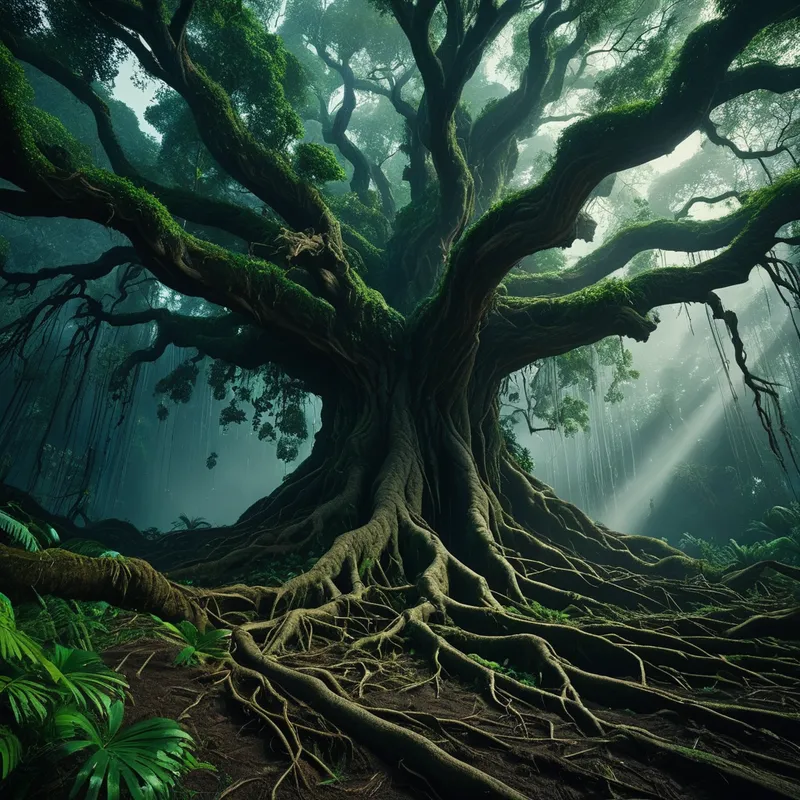
Without a word, a force greater than any storm took hold. The earth groaned and cracked. Roots that had drunk deep for centuries were torn from their dark bed. Soil rained down like brown tears. There was a moment of terrible, weightless suspension—the beautiful tree, upended, its crown pointing to the torn earth, its roots clawing uselessly at the open sky.
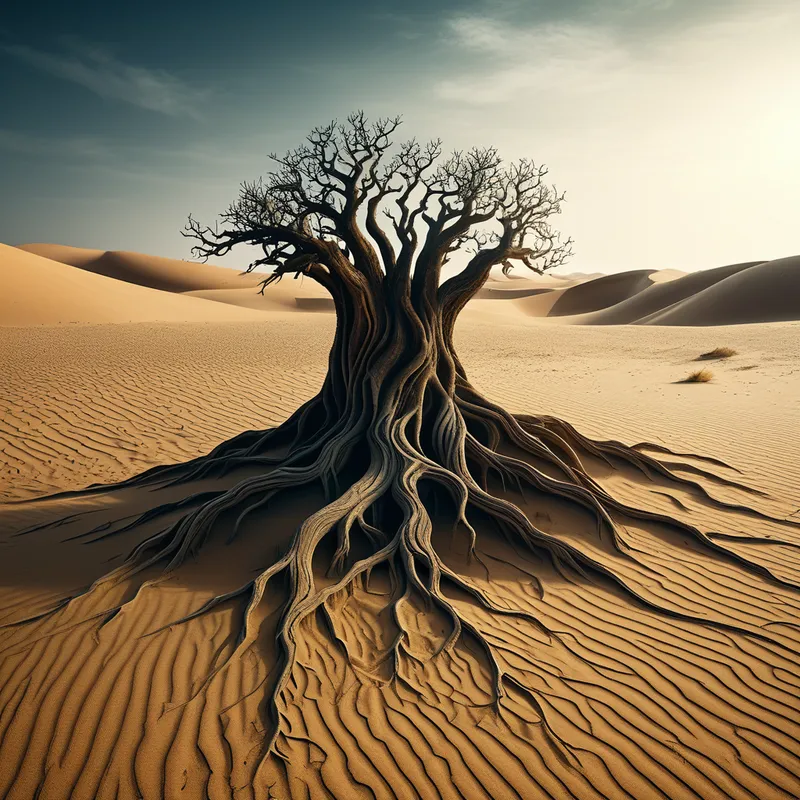
Then, a mighty hand—whether of Nyame or the earth itself—took the uprooted marvel and thrust it back into the ground. But not as it was. It was planted upside-down. Its once-proud crown, its beautiful branches, were buried in the dark, silent womb of the earth. And its roots, those hidden, grasping fingers, were left to splay out against the burning sky.
The grove was still. The deed was done. The gods departed.
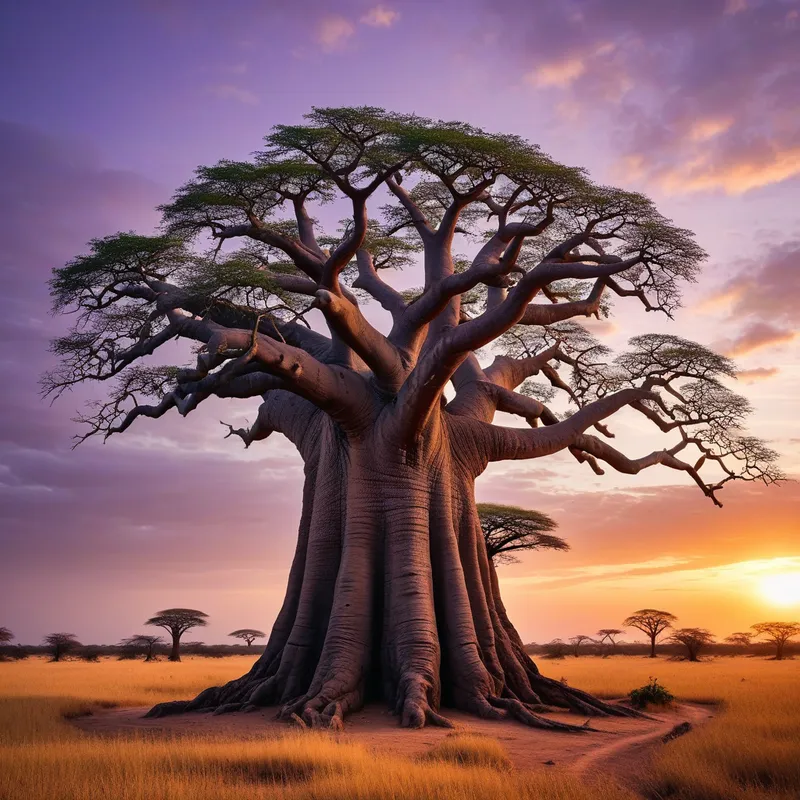
Seasons turned. Where the proud tree once stood, a new form emerged from the savanna’s red soil. It was a tree like no other: a massive, swollen trunk that seemed to hold the memory of a thousand droughts; branches that were not branches at all, but stark, root-like limbs reaching for a horizon it would never grasp. Its leaves were sparse, its flowers brief and ghostly white. It bore a strange, gourd-like fruit that hung like dry, dusty pods. It was the Baobab. Humbled. Strange. Enduring. And in its strange, inverted form, it finally learned its purpose: not to boast of its beauty to the sky, but to offer its hollow heart, its water, its fruit, and its vast, grounding presence to all who sought shelter in its shadow.
Cultural Origins & Context
This myth finds its roots among the many ethnic groups scattered across the savannas and Sahel of West Africa, from Senegal to Sudan, where the Baobab (Adansonia digitata) is a keystone of the physical and cultural landscape. It is an oral tradition, passed down through generations by griots, elders, and storytellers around evening fires. The tale was never mere entertainment; it was a foundational narrative encoding ecological wisdom, social values, and cosmological order.
Functionally, it served multiple purposes. It explained the Baobab’s unique, “upside-down” appearance, anchoring the strange in the familiar realm of divine action. More importantly, it functioned as a powerful moral and social parable. In cultures where community survival depended on humility, cooperation, and respect for the natural order, the myth warned against the dangers of excessive pride (hubris) and individualism. The Baobab’s transformation from a selfish beauty to a communal lifeline—a source of water, food, fiber, and shelter—illustrated the supreme value of utility and generosity over mere aesthetics. It taught that true greatness is measured by what one gives, not by what one possesses or displays.
Symbolic Architecture
At its core, the myth is a profound [allegory](/symbols/allegory “Symbol: A narrative device where characters, events, or settings represent abstract ideas or moral qualities, conveying deeper meanings through symbolic storytelling.”/) of [transmutation](/symbols/transmutation “Symbol: A profound, alchemical process of fundamental change where one substance or state transforms into another, often representing spiritual evolution or personal metamorphosis.”/). The beautiful [tree](/symbols/tree “Symbol: In dreams, the tree often symbolizes growth, stability, and the interconnectedness of life.”/) represents the untamed, narcissistic ego in its pristine, self-contained state. It is pure potential, but potential turned [inward](/symbols/inward “Symbol: A journey toward self-awareness, introspection, and the exploration of one’s inner world, thoughts, and unconscious mind.”/), admiring its own [reflection](/symbols/reflection “Symbol: Reflection signifies self-examination, awareness, and the search for truth within oneself.”/). Its uprooting is the necessary, often traumatic, intervention of a greater psychic or cosmic law—the Self, or the objective psyche, acting to correct a dangerous one-sidedness.
The most profound healing often begins with a sacred violence—an uprooting of the ego from the soil of its own making.
The act of replanting upside-down is the masterstroke of symbolic genius. It represents a complete inversion of values and orientation. What was once hidden (the roots, the unconscious, the foundational support) is now exposed to the world. What was once displayed (the [crown](/symbols/crown “Symbol: A crown symbolizes authority, power, and achievement, often representing an individual’s aspirations, leadership, or societal role.”/), the conscious [identity](/symbols/identity “Symbol: Identity represents the sense of self, encompassing personal beliefs, cultural background, and social roles.”/), the [persona](/symbols/persona “Symbol: The social mask or outward identity one presents to the world, often concealing the true self.”/)) is now buried, forced to draw nourishment from the dark, rich humus of the unconscious. The Baobab becomes a living [symbol](/symbols/symbol “Symbol: A symbol can represent an idea, concept, or belief, serving as a powerful tool for communication and understanding.”/) of the individuated [personality](/symbols/personality “Symbol: Personality in dreams often symbolizes the traits and characteristics of the dreamer, reflecting how they perceive themselves and how they believe they are perceived by others.”/): its [strength](/symbols/strength “Symbol: ‘Strength’ symbolizes resilience, courage, and the ability to overcome challenges.”/) is in its hollow, [vessel](/symbols/vessel “Symbol: A container or structure that holds, transports, or protects something essential, representing the self, emotions, or life journey.”/)-like [trunk](/symbols/trunk “Symbol: The trunk in dreams typically denotes the core structure or foundation of one’s identity, values, or beliefs.”/) (receptivity), its [resilience](/symbols/resilience “Symbol: The capacity to recover quickly from difficulties, adapt to change, and maintain strength through adversity.”/) in its grotesque, swollen form (containment), and its [purpose](/symbols/purpose “Symbol: Purpose signifies direction, meaning, and intention in life, often reflecting personal ambitions and core values.”/) in its [life](/symbols/life “Symbol: The symbol of ‘Life’ represents a journey of growth, interconnectedness, and existential meaning, encompassing both the joys and challenges that define human experience.”/)-giving offerings (generativity).
The Dreamer’s Resonance
When this mythic pattern stirs in the modern dreamer, it often manifests as dreams of profound disorientation or inversion. One may dream of being turned upside-down, of houses with roofs underground, or of trees growing from their heads. Somaticly, this can feel like a deep, gravitational pull in the gut—a sense of being fundamentally rearranged.
Psychologically, this signals a critical phase where a long-held identity, a source of pride or self-definition, is being challenged by the unconscious. The “beautiful tree” of one’s achievements, intellect, or self-image is being uprooted. This process is rarely gentle. It feels like a loss, a humiliation, a cosmic injustice. The dreamer may experience a period of depression, emptiness, or feeling “useless” and grotesque—like the Baobab in its new, strange form. This is the psyche’s incubation period, where the old conscious attitude is buried to make contact with the nourishing, but previously ignored, roots of being.
Alchemical Translation
The myth models the complete alchemical cycle of psychic transformation: from the prima materia of raw, prideful potential (the beautiful tree), through the nigredo of mortification and uprooting (the divine punishment), into the albedo of inversion and washing (replanting in a new orientation), culminating in the rubedo of embodied service (the Baobab as community pillar).
For the modern individual, the journey is from ego-centricity to eco-centricity. The initial state is one of identification with a specific, admired facet of oneself. The crisis—the uprooting—is any life event that shatters this identification: failure, loss, critique, or the simple, wearying burden of maintaining a facade. The alchemical work is to consciously endure the inversion—to allow what was hidden (vulnerability, need, instinct, shadow) to become part of one’s visible architecture, and to let one’s former “crowning glory” (the persona) descend to become a root, drawing wisdom from the dark.
The goal is not to become perfect, but to become useful—a vessel that stores the waters of experience to nourish the wider world of the soul and the community.
The triumphant Baobab does not regain its original beauty. It becomes something more vital: a sanctuary. Its hollowness is its capacity. Its grotesqueness is its resilience. Its fruit is its gift. The individuated self, forged through such a trial, is no longer a monument to itself, but a living, giving, deeply rooted presence in the landscape of life.
Associated Symbols
Explore related symbols from the CaleaDream lexicon:
- Tree — The central archetype of life, connection, and growth, here specifically inverted to symbolize a radical transformation of identity and purpose.
- Root — Symbolizes the hidden foundations, the unconscious, and ancestral connection, which are exposed and made central to the Baobab’s new existence.
- Sky — Represents the realm of the divine (Nyame), consciousness, and the lofty ambitions that led to the tree’s initial downfall.
- Earth — The grounding, nourishing, and ultimately transformative feminine principle that receives and reshapes the uprooted tree, giving it new life.
- Pride — The core flaw or challenge that initiates the mythic drama, representing the ego’s isolation from the collective and the natural order.
- Fruit-bearing Tree — The ultimate state of the Baobab, symbolizing generativity, offering, and the tangible gifts that come from a life of service after transformation.
- Hollowed Tree Stump — Reflects the Baobab’s vessel-like quality, representing containment, potential space, and the wisdom that comes from being emptied of selfish pride.
- Gnarled Tree — Embodies the beauty of resilience, age, and character forged through hardship, directly mirroring the Baobab’s post-transformation appearance.
- Lightning-Struck Tree — Parallels the sudden, divine intervention of uprooting, a symbol of catastrophic but sacred change that leaves a permanent, awe-inspiring mark.
- Tree of Life — The Baobab in its final form becomes a local incarnation of this universal archetype, a nexus of sustenance, shelter, and spiritual connection for its entire ecosystem.
- Sacrifice — The beautiful tree’s form and pride are sacrificed, not through its own will, but through divine necessity, to create a greater good for the community.
- Rebirth — The entire myth is a story of death and rebirth into a new, more essential form, where life continues but in a radically different and more meaningful configuration.