The Bantu Migration Myth Myth Meaning & Symbolism
An ancestral myth of a great journey, guided by divine signs, where a people move toward their destiny, carrying the seed of culture and identity.
The Tale of The Bantu Migration Myth
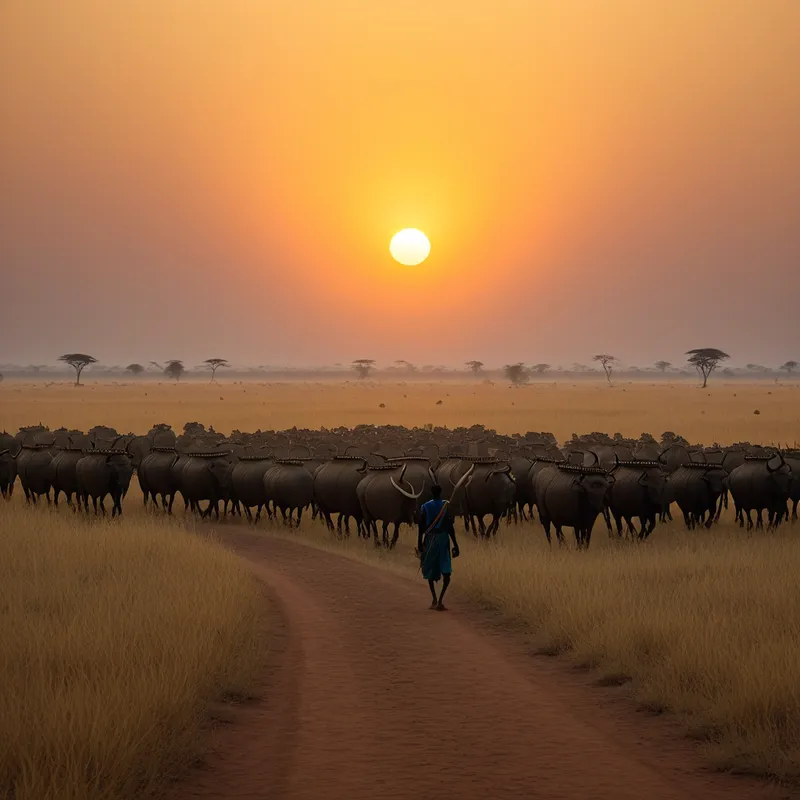
Listen, and let the breath of the ancestors carry you back. It was in the time when the world was still speaking clearly, when the soil remembered every footfall and the rivers sang the names of those who drank from them. The people lived in a land of first beginnings, a place of deep forests and whispering grasses. But a restlessness, not of fear, but of a deep, humming promise, began to stir in the marrow of the community. It was a calling felt in the quiet moments, a pull as sure and steady as the river’s current.
The wise ones, the Abaphansi, gathered. They listened to the wind, read the patterns in the thrown bones, and watched the behavior of the sacred cattle. The signs were undeniable. A great movement was ordained. It was not an exile, but a pilgrimage toward a destiny written in the very patterns of the land. The divine instruction was clear: they must journey. They must carry the essence of who they were—the seed of their language, the rhythm of their songs, the knowledge of iron and clay—and plant it in new soil.
So began the great walking. They did not flee; they flowed. Families became a river of humanity, a slow, deliberate tide across the face of the continent. They were guided by omens: a certain bird’s flight at dawn, the path of a migrating herd of antelope, the way a particular tree leaned toward the sun. At times, the way was hard. Rivers swelled to block their path, and unfamiliar forests held watchful silences. Disagreements would sometimes fracture the river into separate streams, each following its own interpretation of the signs, giving birth to new clans, new dialects, all from the same ancestral source.
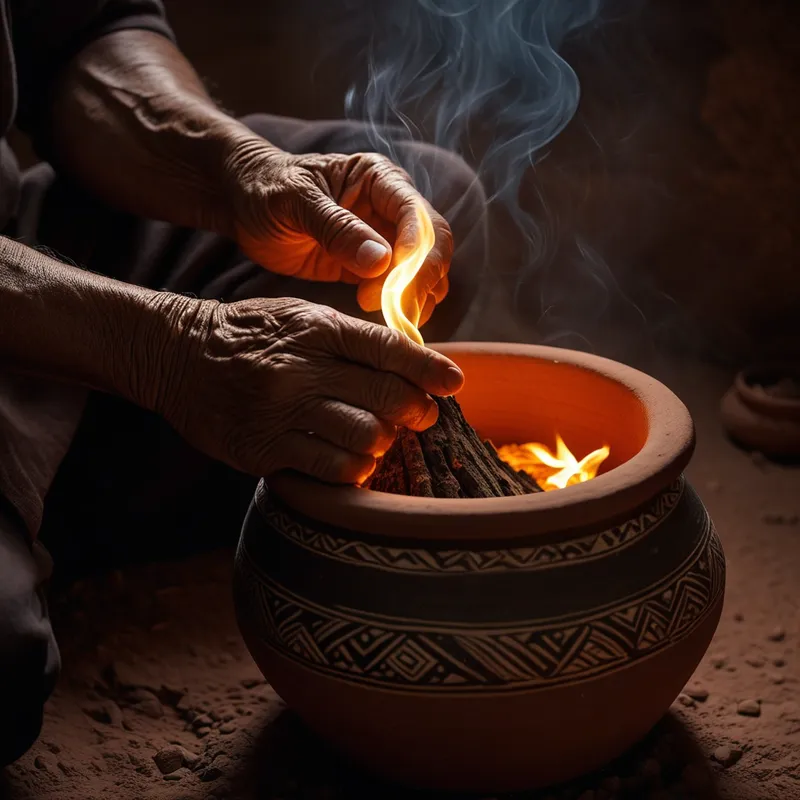
The most sacred duty was the carrying of the fire. Not just any flame, but the living ember from the hearth of the homeland. This fire was the ntu of the people itself—their warmth, their light, their continuity. It was tended day and night, sheltered from rain and wind. To let it die was to let the soul of the journey perish. And so they walked, generation upon generation, not toward a known city, but toward a feeling of rightness, a resonance between their inner spirit and the outer world. They walked until the land said, “Rest. Build. Become.” And there, they would kindle the carried ember into a new hearth, and the journey in the body would pause, even as the journey in the spirit continued forever.
Cultural Origins & Context
The narrative often termed the “Bantu Migration” is less a single, codified myth from one text and more a profound meta-narrative woven into the historical consciousness and oral traditions of numerous Bantu-speaking peoples across sub-Saharan Africa. It is the deep story behind the vast linguistic and cultural kinship that stretches from Cameroon to Kenya to South Africa. This story was not told by a single bard, but by countless grandmothers, grandfathers, and griots over millennia, around evening fires, during initiation rites, and at gatherings of clans.
Its primary societal function was etiological and identity-forming. It answered the profound questions: “Why are we here, in this specific place? Where do we come from? Why do our cousins speak a language that sounds like a echo of our own?” It transformed historical processes of expansion, adaptation, and interaction into a sacred epic of becoming. The myth provided a divine sanction and a profound purpose for the immense challenges of displacement and settlement. It taught that movement could be sacred, that identity is portable but must be tended like a fire, and that destiny is a dialogue between the people and the living landscape.
Symbolic Architecture
At its [heart](/symbols/heart “Symbol: The heart symbolizes love, emotion, and the core of one’s existence, representing deep connections with others and self.”/), this is not a myth of conquest, but a myth of [quest](/symbols/quest “Symbol: A quest symbolizes a journey or search for purpose, fulfillment, or knowledge, often representing life’s challenges and adventures.”/). The [migration](/symbols/migration “Symbol: A journey of movement from one place to another, often representing transition, adaptation, or seeking new opportunities.”/) is the ultimate [symbol](/symbols/symbol “Symbol: A symbol can represent an idea, concept, or belief, serving as a powerful tool for communication and understanding.”/) of the [soul](/symbols/soul “Symbol: The soul represents the essence of a person, encompassing their spirit, identity, and connection to the universe.”/)‘s [journey](/symbols/journey “Symbol: A journey in dreams typically signifies adventure, growth, or a significant life transition.”/) toward its own fulfillment. The homeland is not left behind in disgrace, but as a necessary [womb](/symbols/womb “Symbol: A symbol of origin, potential, and profound transformation, representing the beginning of life’s journey and the unconscious source of creation.”/); the [destination](/symbols/destination “Symbol: Signifies goals, aspirations, and the journey one is on in life.”/) is not a conquered prize, but a destined [resonance](/symbols/resonance “Symbol: A deep, sympathetic vibration or connection, often in sound or feeling, that amplifies and harmonizes across systems.”/).
The journey is the destination made visible, step by step, a slow unfolding of a promise whispered at the origin.
The Bantu themselves are the collective [hero](/symbols/hero “Symbol: A hero embodies strength, courage, and the ability to overcome significant challenges.”/). The guiding signs—birds, animals, celestial events—represent the intuitive, synchronicitous [language](/symbols/language “Symbol: Language symbolizes communication, understanding, and the complexities of expressing thoughts and emotions.”/) of the unconscious, or the world of the spirits, directing [consciousness](/symbols/consciousness “Symbol: Consciousness represents the state of awareness and perception, encompassing thoughts, feelings, and experiences.”/) toward its next stage of development. The fracturing of the group symbolizes necessary [differentiation](/symbols/differentiation “Symbol: The process of distinguishing or separating parts of the self, emotions, or identity from a whole, often marking a developmental or psychological milestone.”/), the psychic principle that wholeness requires the courage to become distinct, to follow one’s own unique thread within the larger [pattern](/symbols/pattern “Symbol: A ‘Pattern’ in dreams often signifies the underlying structure of experiences and thoughts, representing both order and the repetitiveness of life’s situations.”/).
The sacred fire is the central symbol of cultural and psychic continuity. It is the transformative spark of consciousness itself that must be protected through [life](/symbols/life “Symbol: The symbol of ‘Life’ represents a journey of growth, interconnectedness, and existential meaning, encompassing both the joys and challenges that define human experience.”/)‘s transitions. The new hearth where it is finally laid represents the achieved [integration](/symbols/integration “Symbol: The process of unifying disparate parts of the self or experience into a cohesive whole, often representing psychological wholeness or resolution of internal conflict.”/), the point where the wandering soul finds its authentic place in the world and builds its conscious [life](/symbols/life “Symbol: The symbol of ‘Life’ represents a journey of growth, interconnectedness, and existential meaning, encompassing both the joys and challenges that define human experience.”/) there.
The Dreamer’s Resonance
When this myth stirs in the modern dreamer, it often manifests not as a literal dream of walking, but as a profound somatic and emotional pattern. It is the dream of restless seeking—of packing bags for a journey with no clear destination, of following a compelling but mysterious path through unknown psychic terrain, or of carefully guarding a small, precious light in a vast darkness.
Psychologically, this signals a major process of psychic migration. The old “homeland”—a worn-out identity, a stagnant life pattern, a outgrown belief system—is no longer viable. The Self is issuing a call to move. The anxiety and restlessness are the “signs” being felt but not yet fully read. The dreamer is in the liminal space between what was and what will be, carrying the essential ember of their core self (their values, talents, true passions) through a period of disorientation. The journey feels arduous because it is the work of shedding old skins and navigating by inner compass alone.
Alchemical Translation
The alchemy modeled here is the transmutation of potential into manifested being. The initial restlessness is the prima materia, the raw, undifferentiated longing of the soul. The decision to heed the call is the first coagulation, the commitment to the opus.
The path is the alembic. Each step is a distillation, separating the essential fire of the true self from the ash of conditioned identity.
The guided wandering represents the long stage of solutio and coagulatio—dissolving into the unknown and re-forming again and again, learning adaptability and resilience. The fracturing of the group is a necessary separatio, where one must distinguish one’s own unique destiny from collective or familial expectations. Protecting the fire is the work of sublimatio—lifting and preserving the highest value through all trials.
Finally, reaching the place of resonance and building the new hearth is the coniunctio, the sacred marriage between the inner self and the outer world. The carried ember ignites the new life. The wanderer becomes a settler, not by stopping the journey, but by internalizing it. The migration becomes eternal, an inward movement of continual growth and integration. The Self is no longer seeking a home; it has become the home, the sacred hearth where the fire of consciousness burns perpetually.
Associated Symbols
Explore related symbols from the CaleaDream lexicon:
- Journey — The central axis of the myth, representing the soul’s necessary progression from potential to actualization, a sacred process of becoming.
- Fire — The sacred ember carried from the homeland, symbolizing the immortal spark of cultural identity, consciousness, and the essential self that must be preserved through all transitions.
- Earth — The living, responsive landscape that offers signs and finally provides the “place of resonance,” representing the material world in dialogue with the spiritual journey.
- River — The flow of the people across the continent, embodying the themes of destiny, adaptation, branching into new possibilities, and the life-sustaining power of movement.
- Seed — The cultural and linguistic knowledge carried within the people, representing potential, the promise of future growth, and the transmission of life from one state to another.
- Mountain — The distant, often-seen goal or challenge on the horizon, representing obstacles that define the journey and the elevated perspective gained through striving.
- Root — The connection to the original homeland and ancestors, representing the deep, nourishing source from which the journeying self draws its strength and identity.
- Bridge — The liminal space of the migration itself, a crossing from a known past into an unknown future, symbolizing transition, courage, and the link between worlds.
- Destiny — The invisible pull guiding the migration, representing the teleological force of the Self, the unfolding pattern that the conscious ego must discover and follow.
- Ancestral Spirit — The collective wisdom and guidance felt through omens and divination, representing the influence of the deep unconscious and historical psyche on the present journey.
- Forest — The unknown, dense challenges encountered along the path, representing the unconscious terrain that must be navigated with faith and intuition.
- Circle — The cyclical nature of the journey, where leaving one home leads to establishing another, completing a cycle of death and rebirth on both cultural and personal levels.